Normal view

Received before yesterday

Published at Solar Energy – Damage modeling of power tower receiver tubes using the SRLIFE tool
16 January 2026 at 00:51


Abstract:
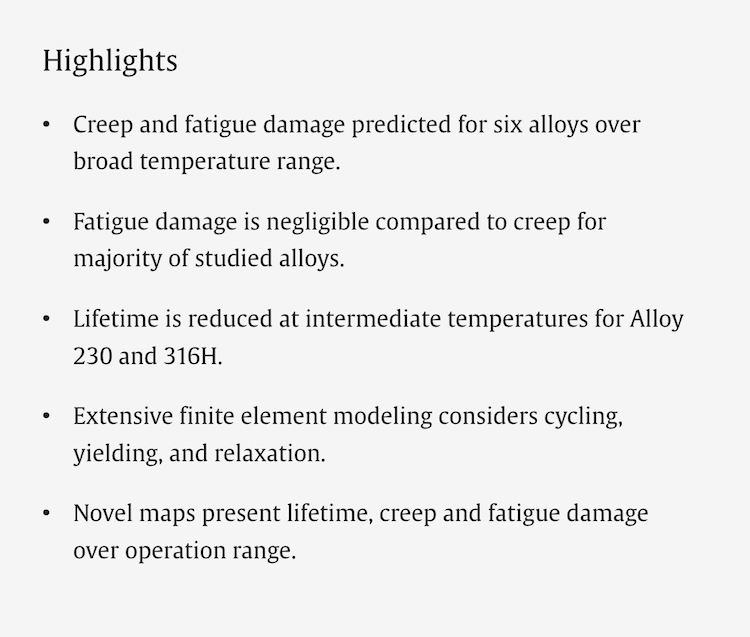
Concentrating Solar Power (CSP) molten-salt central receivers are subject to high, transient incident flux during daily operation. The resulting creep-fatigue damage impacts the receiver’s reliability and restricts the permissible incident flux distribution for a given receiver. This paper aims to reduce CSP plants’ levelized cost of electricity by developing a methodology to predict lifetime and identifies the primary damage mechanism (creep vs fatigue) for any given fluid temperature and temperature gradient. Results are presented in the form of a damage map that serves as a valuable operation guide and design tool. Damage maps can be used to reduce maintenance costs by improving reliability and reduce receiver capital costs by better utilizing the receiver area. FEA simulation and damage modeling of tubes subject to asymmetrical flux conditions is performed in the open-source receiver design tool srlife. Parametric studies are performed over a range of inner tube temperatures and thermal gradients for A230, 316H, 740H, A282, A617, and 800H high temperature alloys. Damage maps are presented for each alloy. A parametric, FEA-based methodology is presented for comparison of fatigue-creep ratios and prediction of tube lifetime based on the critical thermal operating conditions. Fatigue is found to be negligible compared to creep for almost every case. This finding suggests that fatigue effects associated with cloud events are insignificant compared to creep at these high temperature operating conditions. Additionally, lifetime predictions identify thermal conditions where small changes in operating conditions can result in large changes in predicted lifetime.

Jacob Wenner, Mark C. Messner, Michael J. Wagner, Damage modeling of power tower receiver tubes using the SRLIFE tool, Solar Energy, Volume 299, 2025, 113627, ISSN 0038-092X, https://doi.org/10.1016/j.solener.2025.113627

The post Published at Solar Energy – Damage modeling of power tower receiver tubes using the SRLIFE tool appeared first on SolarPACES.
Published at Applied Thermal Engineering – Modelling of flow regimes in tubular concentrating direct absorption solar collectors

16 January 2026 at 00:38

Abstract:
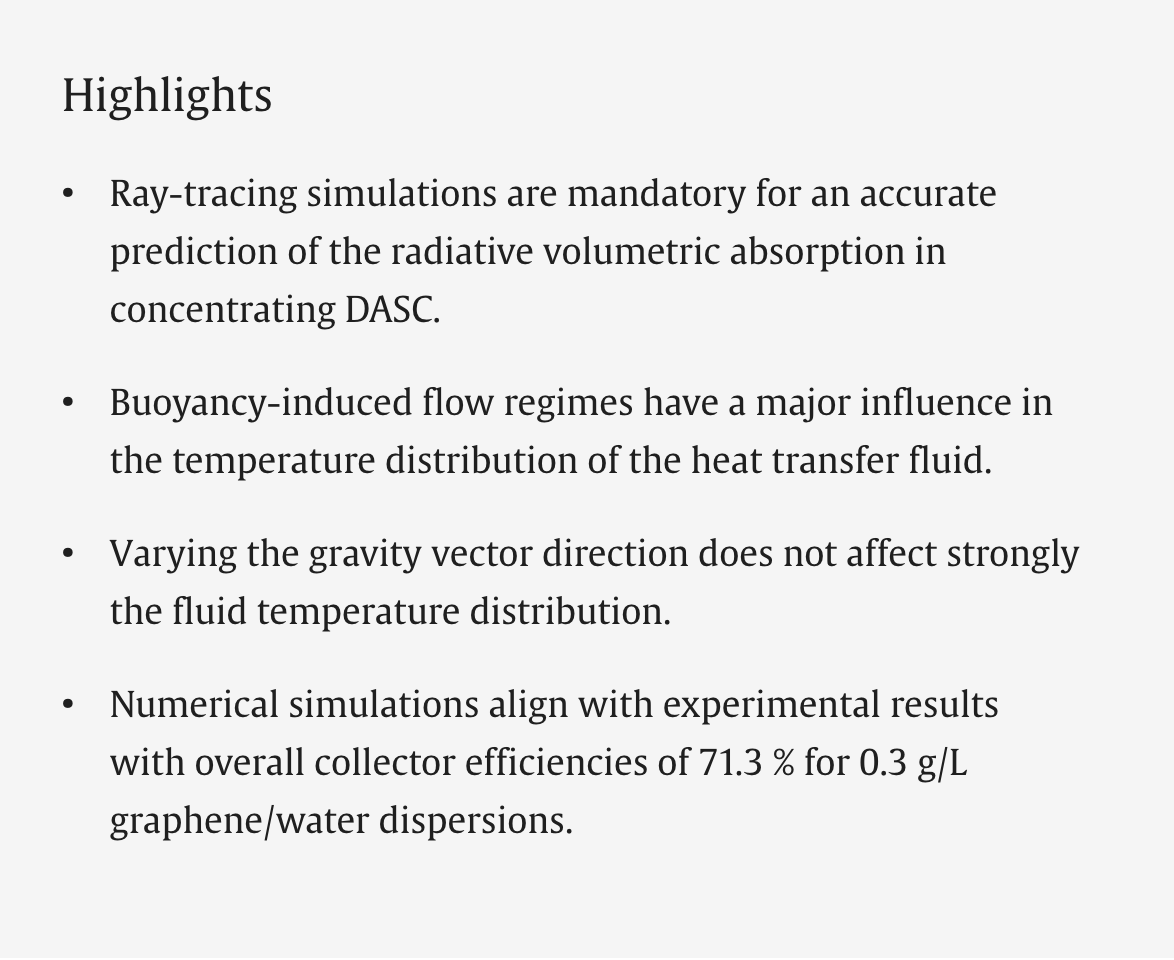
Direct absorption solar collectors have gained attention in the last decades as a promising solution to enhance the performance of conventional thermal collectors. In this concept, the heat transfer fluid absorbs the concentrated radiation volumetrically, which optical properties can be enhanced by dispersing nanoparticles. While several works have reported the benefits of volumetrically absorbing the incident radiation, few studies have explored its effect on the fluid temperature distribution. The presents paper offers a comprehensive numerical analysis of the optical and thermal behavior of a parabolic-trough direct absorption solar collector using a graphene nanoparticle dispersion as absorbing medium. A Monte Carlo based ray-tracing approach is coupled to a computational fluid dynamics analysis to offer a complete evaluation of the performance of such systems. The results reveal a trade-off between complete absorption inside the tube and strong absorption in the wall vicinity, which takes place at higher optical depths. Furthermore, the fluid dynamics simulations underscore the role of buoyancy forces in achieving homogeneous temperature distributions, especially at lower flow rates. Neglecting gravitational effects may lead to inaccurate predictions of the system thermal performance. The numerical predictions align closely with experimental campaigns conducted for a similar collector, with total collector efficiencies of 66.3 % and 71.3 % for 0.2 g/L and 0.3 g/L nanofluids respectively. While these results represent a first-order comparison, they suggest that the model is reliable for designing and optimizing PT-DASC systems for real-world applications.

Miguel Sainz-Mañas, Françoise Bataille, Cyril Caliot, Gilles Flamant,
Modelling of flow regimes in tubular concentrating direct absorption solar collectors, Applied Thermal Engineering, Volume 279, Part C, 2025,127716, ISSN 1359-4311, https://doi.org/10.1016/j.applthermaleng.2025.127716

The post Published at Applied Thermal Engineering – Modelling of flow regimes in tubular concentrating direct absorption solar collectors appeared first on SolarPACES.

Published at Solar Energy Engineering – A Solar Air Receiver With Porous Ceramic Structures for Process Heat at Above 1000 °C—Heat Transfer Analysis

27 December 2025 at 02:02


Abstract:
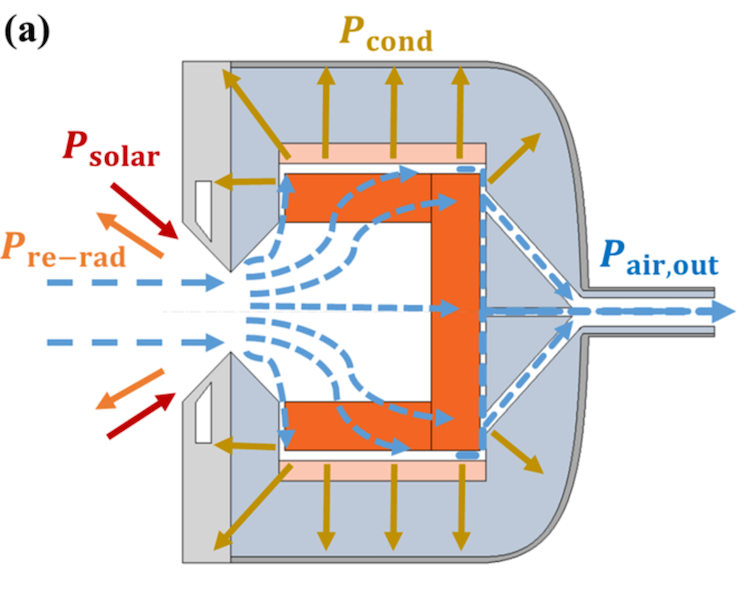
Concentrated solar energy can be used as the source of heat at above 1000 °C for driving key energy-intensive industrial processes, such as cement manufacturing and metallurgical extraction, contributing to their decarbonization. The cornerstone technology is the solar receiver mounted on top of the solar tower, which absorbs the incident high-flux radiation and heats a heat transfer fluid. The proposed high-temperature solar receiver concept consists of a cavity containing a reticulated porous ceramic (RPC) structure for volumetric absorption of concentrated solar radiation entering through an open (windowless) aperture, which also serves for the access of ambient air used as the heat transfer fluid flowing across the RPC structure. A heat transfer analysis of the solar receiver is performed by means of two coupled models: a Monte Carlo (MC) ray-tracing model to solve the 3D radiative exchange and a computational fluid dynamics (CFD) model to solve the 2D convective and conductive heat transfer. Temperature distributions computed by the iteratively coupled models were compared with experimental data obtained by testing a lab-scale 5 kW receiver prototype with a silicon carbide RPC structure exposed to 3230 suns flux irradiation. The receiver model is applied to optimize its dimensions for maximum efficiency and to scale-up for a 5 MW solar tower.

Vikas R. Patil, Aldo Steinfeld, J. Sol. Energy Eng. Apr 2025, 147(2): 021007 (13 pages) Paper No: SOL-24-1108 https://doi.org/10.1115/1.4066499

The post Published at Solar Energy Engineering – A Solar Air Receiver With Porous Ceramic Structures for Process Heat at Above 1000 °C—Heat Transfer Analysis appeared first on SolarPACES.

International Journal of Hydrogen Energy – A techno-economic and environmental evaluation of the integration of direct air capture with hydrogen derivatives production

27 December 2025 at 01:50


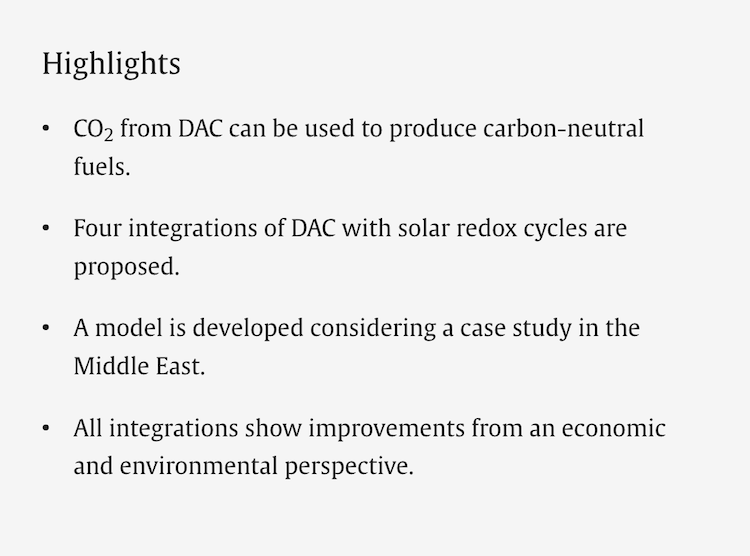
Abstract:
Carbon-neutral fuels are key to decarbonizing hard-to-abate sectors. Solar redox cycles can produce them by creating oxygen vacancies in a metal oxide capable of splitting water and CO2. The resulting synthesis gas can be processed into a liquid fuel like methanol. To close the carbon cycle, feedstock CO2 can be captured from the atmosphere with direct air capture (DAC), but the synergies between synthetic fuel production and DAC are largely unexplored. In this work, four integration strategies between DAC and solar redox cycles are proposed. Each of them is modeled with Aspen Plus and HFLCAL and compared with a techno-economic and a cradle-to-gate life cycle assessment. The optimal configuration, with a levelized cost of 7.9 ± 0.4 USD2022/kgMethanol and a climate change impact of −450 ± 30 g CO2e/kgMethanol, uses solid DAC powered by waste heat. Therefore, the study recommends the integration of DAC in the production of synthetic fuels.

Enric Prats-Salvado, Nathalie Monnerie, Christian Sattler, A techno-economic and environmental evaluation of the integration of direct air capture with hydrogen derivatives production, International Journal of Hydrogen Energy, Volume 140, 2025, Pages 1153-1162, ISSN 0360-3199, https://doi.org/10.1016/j.ijhydene.2024.10.026

The post International Journal of Hydrogen Energy – A techno-economic and environmental evaluation of the integration of direct air capture with hydrogen derivatives production appeared first on SolarPACES.

Published at Solar Energy – Solar concentrator layout and performance analysis for multi-aperture receiver-reactors in high-temperature applications

26 December 2025 at 23:57


Abstract:
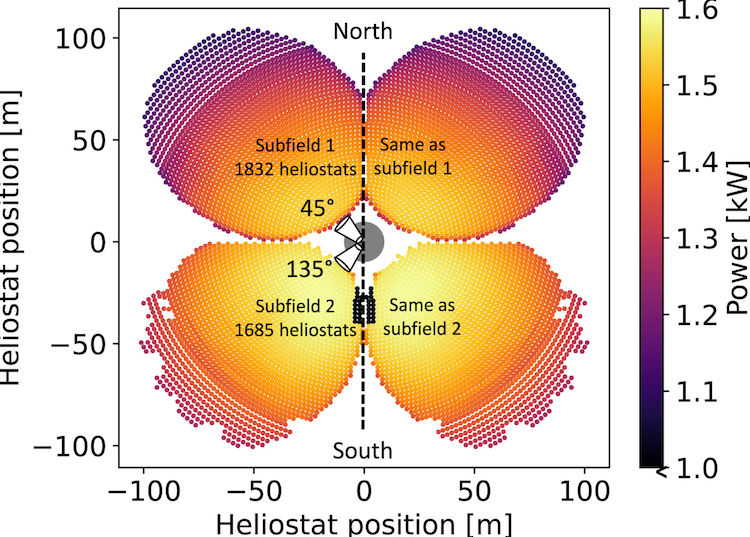
Promising new receiver-reactor concepts with multiple apertures have been proposed for high temperature solar thermochemical hydrogen production. However, limited information about suitable solar concentrator designs consisting of heliostat fields and secondary concentrators is available so far.
The goal of this study is a detailed investigation of the effect of selected solar concentrator design parameters on its performance. For a 10 MW receiver-reactor the number of subfields and corresponding apertures is varied in combination with the receiver height above the ground, the acceptance angle of the secondary concentrator, and the design point flux density. In addition, the performance is analyzed at different power levels. The average annual performance is evaluated as well as the hourly behavior. The latter of which is important to quantify the performance of a plant with an integrated receiver-reactor.
For the heliostat field layout the program HFLCAL1 is used. Solar concentrator designs with annual average efficiencies of over 60% are identified delivering flux densities of up to 5000 suns at design point for 10 MW receivers. Instead of a joint evaluation of the solar concentrator together with a specific receiver-reactor a generic receiver-reactor surrogate model is introduced. With this surrogate model an hourly analysis of the plant performance is conducted and a parametrized correction factor is presented to derive more accurate yearly plant performance estimates.
The study provides detailed information on solar concentrators using multiple heliostat subfields and central tower systems with secondary optics, and indicates further optimization potential of solar concentrators for high-temperature receivers.

Hanna Lina Pleteit, Stefan Brendelberger, Peter Schwarzbözl, Malou Großmann, Martin Roeb, Christian Sattler,Solar concentrator layout and performance analysis for multi-aperture receiver-reactors in high-temperature applications,Solar Energy,Volume 303, 2026,114115,ISSN 0038-092X, https://doi.org/10.1016/j.solener.2025.114115

The post Published at Solar Energy – Solar concentrator layout and performance analysis for multi-aperture receiver-reactors in high-temperature applications appeared first on SolarPACES.

Published at Solar Energy – Effects of concentrated solar–integrated packed-bed thermal energy storage operation on solid oxide electrolysis cell performance

11 December 2025 at 23:58

Abstract:

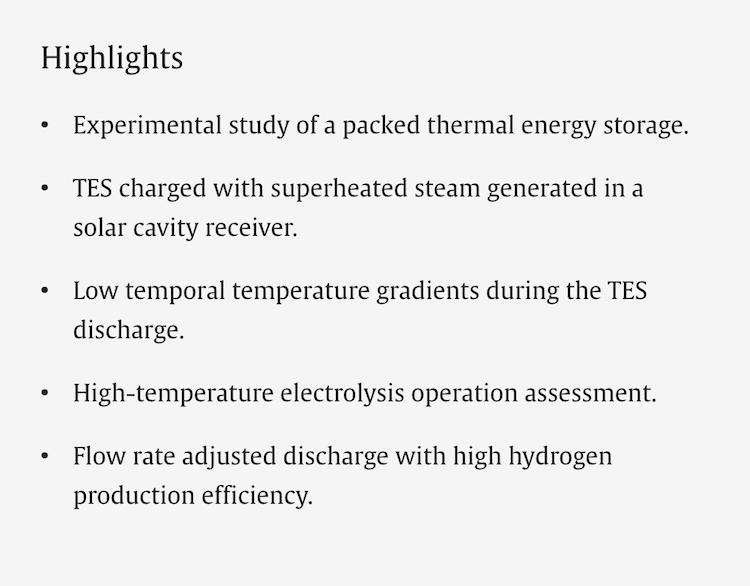
The use of renewable energy in the context of green hydrogen production requires suitable energy storage technologies to compensate for intermittent wind and solar resources. High-temperature electrolysis is a promising way to produce hydrogen as it has the highest electrical efficiency by using steam instead of liquid water compared to low temperature electrolysis. Here, a part of the total energy demand is substituted by thermal energy. For a sustainable and continuous process operation with concentrated solar energy, a high-temperature thermal energy storage heating air and steam is required to operate the high-temperature electrolysis above 800 °C. In this study, the charging and discharging behavior of a packed bed thermal energy storage with a capacity of 17.46 kWh is experimentally tested and a utility scale storage numerically analyzed. The storage is charged with superheated steam from a solar cavity receiver and discharged with ambient air or steam flow. The storage discharge temperature profile results in a change in the electrolysis operating state and therefore, a change in the reagent flow rate. This changes the hydrogen production capacity during the discharge period. Adjusting the thermal energy storage discharge flow rate maintains an electrical conversion efficiency of 97 %. Furthermore, additional electric heating or exothermal operation of the electrolysis is avoided. Additionally, an electrolysis cooling rate of greater than −0.3 K/min can be maintained.

Timo Roeder, Yasuki Kadohiro, Kai Risthaus, Anika Weber, Enric Prats-Salvado, Nathalie Monnerie, Christian Sattler,Effects of concentrated solar–integrated packed-bed thermal energy storage operation on solid oxide electrolysis cell performance,Solar Energy,Volume 302,2025,114032,ISSN 0038-092X, https://doi.org/10.1016/j.solener.2025.114032

The post Published at Solar Energy – Effects of concentrated solar–integrated packed-bed thermal energy storage operation on solid oxide electrolysis cell performance appeared first on SolarPACES.

Published at Applied Thermal Engineering – Dynamic heat transfer model for thermal energy storage using metal wool–phase change material composites

11 December 2025 at 23:52


Abstract:
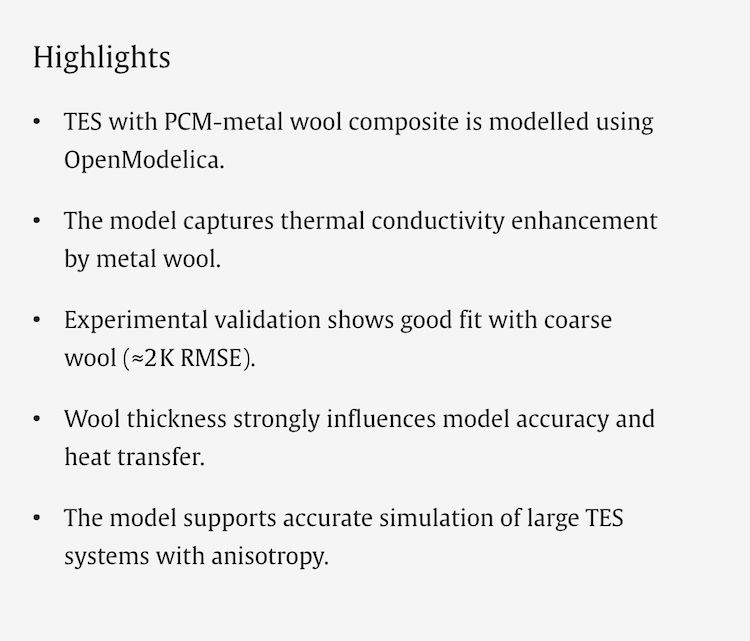
Decarbonisation of the energy sector is critical for climate change mitigation, with the power sector remaining a major contributor to global emissions. Concentrating solar power (CSP) technology combined with thermal energy storage (TES) presents a promising solution to overcome this challenge. TES systems, particularly those utilising phase change materials (PCMs), offer efficient energy storage by harnessing latent heat, enabling reliable power generation, and providing high-temperature heat for industrial processes. This research introduces a heat transfer model designed to simulate the thermal behaviour of TES systems utilising wool–PCM composites as storage medium. The mathematical model was implemented on the OpenModelica platform and it is intended to be incorporated into a simulation tool currently being developed by the authors to assess the performance of CSP plants under dynamic conditions. The model was validated by comparing the simulation results with the experimental measurements of the temperature within the composite domain during both the charging and discharging cycles. The simulations replicated key experimental parameters, including geometry, material properties, and boundary conditions, and evaluated two configurations with coarse and fine wool fibres. The results demonstrated good agreement with the experimental data for coarse wool, with a root mean square error (RMSE) of up to 2.29 K. For fine fibres, the RMSE increased to 5.31 K, indicating a larger deviation. Despite these challenges, the model successfully captured the overall thermal response trend and phase transition behaviour observed experimentally. The findings highlight the efficacy and limitations of the proposed thermal model and emphasise the necessity for advanced macroscopic-scale effective thermal conductivity modelling approaches for such composites that integrate the influence of pore-scale characteristics (i.e., volume change). This research will advance the current state-of-the-art in this field and will mitigate the discrepancies identified in this study when these models are applied in practice. This integration is crucial for enhancing the accuracy and improving the time simulation of large-scale TES systems in CSP applications.

Pablo D. Tagle-Salazar, Luisa F. Cabeza, Anton López-Román, Cristina Prieto,
Dynamic heat transfer model for thermal energy storage using metal wool–phase change material composites,Applied Thermal Engineering,Volume 281, Part 1,2025,128548,ISSN 1359-4311,
https://doi.org/10.1016/j.applthermaleng.2025.128548

The post Published at Applied Thermal Engineering – Dynamic heat transfer model for thermal energy storage using metal wool–phase change material composites appeared first on SolarPACES.

❌