
Reading view

As emissions soar, operators look to carbon capture

During 2024 and 2025, a new trend emerged: many large data center builders and operators reported increases in their Scope 2, location- and market-based greenhouse gas (GHG) emissions inventories, reversing their efforts toward net-zero commitments. While this shift does not indicate a loss of commitment to those goals, it is an inevitable result of the rapid growth in energy demand driven by data center expansion.

The International Energy Agency (IEA) and other analysts project that a menu of wind, solar, nuclear, geothermal and natural gas generation assets will be required to meet the projected 75-125 GW of new electricity demand.

  • Wind and solar generation are expected to supply up to 50% of the necessary new capacity globally, with complementary battery systems to time-shift solar and wind generation from high to low output periods.
  • Natural gas generation will provide a significant portion of the remaining generation capacity, as it is currently the only reliable generation type available that can be deployed on the timeline needed to meet projected demand.
  • Large-scale and small modular nuclear reactors, along with geothermal generation, offer reliable, dispatchable, carbon-free generation; however, development and implementation timelines are expected to limit volume availability until the early 2030s or later.

On-site and grid-connected natural gas generation will play a significant role as the primary generation source for many planned data center campuses, as well as acting as “fill-in” generation assets to stabilize the grid during periods of low wind and solar output. As a result, data center operators will face a choice: access or deploy these generation assets with carbon capture and storage (CCS) systems or delay their facility-specific net-zero carbon goals to 2040 and beyond.

Carbon capture technologies are still immature; however, turbine manufacturers are offering natural gas combined cycle (NGCC) and simple cycle turbines integrated with commercially available amine-based solvent CCS systems. Several projects are underway to construct and operate natural gas electricity generation systems with CCS. But the use of this technology will depend on the ability to colocate with carbon storage facilities — and on economics.

It is widely expected that carbon capture will become more competitive as the cost of offsets increases. While CCS is expected to add 10-30% to the cost of electricity, Uptime Intelligence estimates that this premium will soon be comparable to the cost of energy attribute certificates (EACs) and carbon offsets currently applied by operators to achieve market-based net-zero emissions goals.

Carbon capture technologies

Carbon capture is no longer a new technology, but its use has been very limited due to the difficulty of securing carbon storage capacity and by the additional capital and operating costs involved. However, the key role of natural gas-fired electricity generation in powering the planned data center build-out, combined with the need to decarbonize the data center energy supply to meet GHG reduction commitments, may necessitate greater deployment.

There are six distinct carbon capture technologies available (see Table 1). Of these, only the amine solvent systems are currently commercially available. Of the remaining five, solid sorbent and chilled ammonia technologies appear the most promising, as they most easily integrate with an NGCC system, have lower energy debt, lower costs per metric ton of removal and per MWh generated, and are further along in the development process. Nevertheless, all five non-commercial technologies will require at least five years of pilot and demonstration projects to validate their technical and economic credentials.

Table 1 Carbon capture technologies
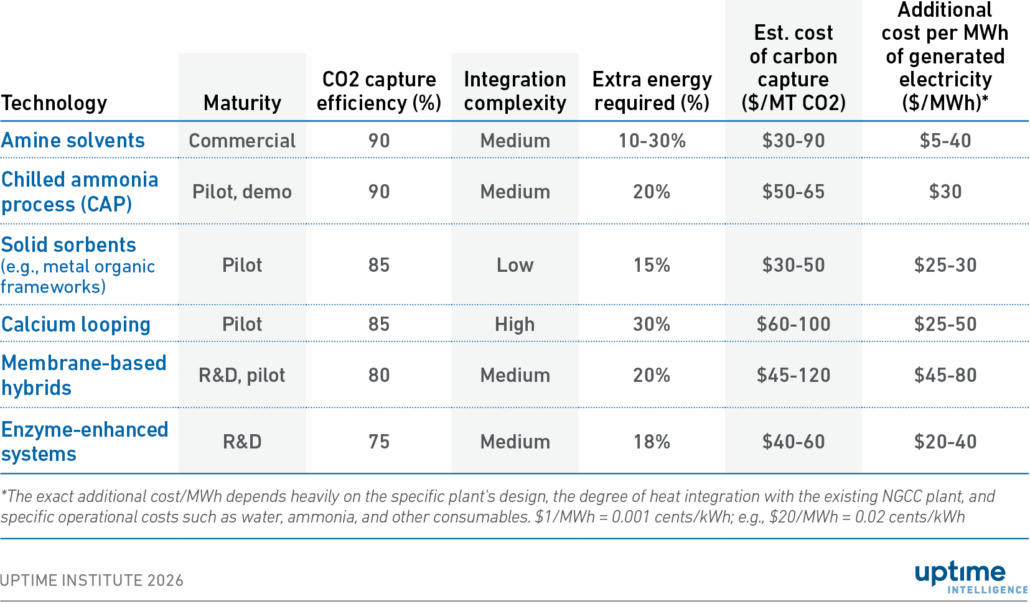
Table: Carbon capture technologies

Amine-based CCS systems

Amine-based CCS systems are installed and operating at facilities with CO2 flue gas concentrations of 15% or more, such as coal-fired electricity generation assets and fertilizer and chemical manufacturing plants. While they have not yet been deployed at a commercial scale on natural gas-powered electricity generation assets, their application is technically feasible. Pilot and demonstration projects using natural gas turbines, which have CO2 flue gas concentrations of 4-7%, have indicated that CO2 can be captured at up to 90% efficiency.

There are six types of amine-based carbon capture systems currently available (see Table 2). These systems differ in both the cost per metric ton of CO2 removal and the cost per generated MWh. Still, the premium for carbon capture systems will likely be 10-40% of the electricity costs, depending on fuel prices, CO2 concentration in the flue gas, and the type and source of the energy consumed for CCS operation and capture media regeneration.  

Table 2 Amine-based carbon capture systems
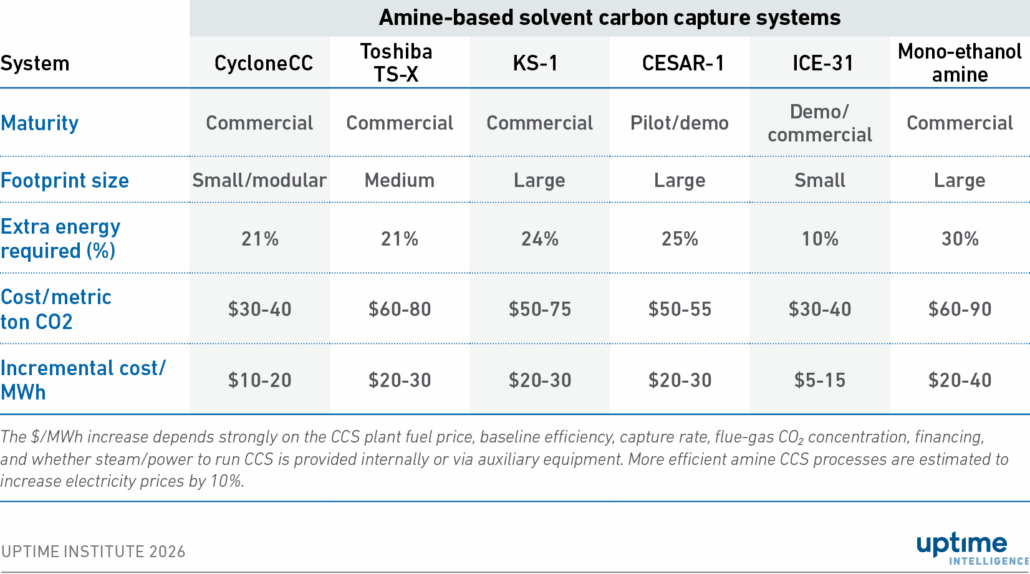
Table: Amine-based carbon capture systems

An 860 MW natural gas combined cycle (NGCC) power plant with an integrated amine-based CCS system (supplied by GE Vernova), currently under construction in Teesside, UK, will be the first full-scale CCS deployment on an electricity-generating asset. The facility is colocated with a North Sea carbon storage facility. It is expected to enter operation in 2026 and remove 2 million metric tons of CO2 per year.

CCS opportunities and challenges

Recent announcements by hyperscalers indicate growing activity in NGCC/CCS systems. Google has entered into a power purchase agreement (PPA) with a 400 MW integrated natural gas-fired cogeneration and CCS plant in Illinois. Microsoft has publicly expressed openness to procuring electricity from natural gas-fired power plants with CCS when it is economically viable.

Energy developers and turbine generator manufacturers are also entering the market with a specific focus on data center operators. ExxonMobil/NextEra and Chevron are involved in the development and marketing of data center campuses with behind-the-meter NGCC/CCS generation. GE Vernova and Engine No. 1 have co-developed and are marketing an integrated natural gas turbine/CCS offering for behind-the-meter use in data centers.

CCS systems perform best on natural gas generation assets that operate continuously; therefore, they will not be suitable for standby generation. They are appropriate for behind-the-meter or on-grid power generation assets.

Constructing an integrated NGCC/CCS system can take up to two years longer than constructing a standalone NGCC system. Given the urgency of installing new generation capacity to support planned data center builds, carbon capture systems will likely go into operation two or three years after the NGCC system, improving the overall energy delivery timeline.

Carbon transport and storage

The viability of a carbon capture project depends on the availability of an accessible, permitted geological formation capable of storing carbon. As a result, operators will need to locate data centers in electricity grid regions with carbon storage facilities — such as Texas, the North Sea, the Santos pre-salt basin in Brazil, Gorgon in Australia, Qilu-Shengli in China — or colocate with a carbon storage facility or pipeline to access low-carbon, natural gas-generated electricity. This limitation will rule out retrofitting CCS systems to existing generation capacity and require operators to partner with energy developers with CCS expertise for new generation.

CO2 can be stored in four different types of geological formations:

  • Oil and gas reservoirs. Depleted oil and gas reservoirs can store CO2. In some cases, CO2 injection has the added benefit of improving oil extraction from the rock formation. Oil fields have been injecting and storing CO2 for more than 30 years.
  • Deep saline formations. These porous rock formations are found in many areas worldwide and are projected to be capable of sequestering thousands of gigatonnes of CO2. Suitable formations must be at least 800 meters below the surface and overlain by impermeable cap rock such as shale.
  • Coal beds. Coal beds that are too deep or too thin to be economically mined may have potential for CO2 storage.
  • Basalt formations and shale basins. CO2 can be captured in both basalt and shale formations. In basalt formations, CO2 has been shown to mineralize over time. A small demonstration project is underway at a basalt formation in Iceland; however, neither type of formation has been tapped for commercial, high-volume carbon storage.

The CO2 transport and injection/monitoring processes add $10-30 per metric ton of CO2 stored and $5-15 per MWh. These factors are included in the cost per metric ton of captured CO2 values in Tables 1 and 2.

The amount that data center operators pay for power varies widely, however, Uptime Intelligence estimates that CCS systems — including generation/carbon capture with storage — will increase electricity costs by 15-40% at $70 per MWh and 10-25% at $140 per MWh. One source estimates that CCS systems will have a premium of $25-50 per MWh. As most systems are still in the research and development, pilot and demonstration phases, the final costs of carbon capture remain highly uncertain. They are expected to decline as experience is gained from early, full-scale systems.

The cost of electricity from NGCC/CCS systems is competitive with the other baseload technologies. Although wind and solar generation can have much lower costs, additional investments in batteries and/or baseload or peaking power are required to provide reliable power to the grid, increasing the cost per MWh into a range comparable with NGCC/CCS generation (see Table 3). Electricity costs will vary by region and over time based on fuel prices, financing and capital costs, and the complexity and duration of the permitting process.

Table 3 Levelized cost of electricity by generation technology
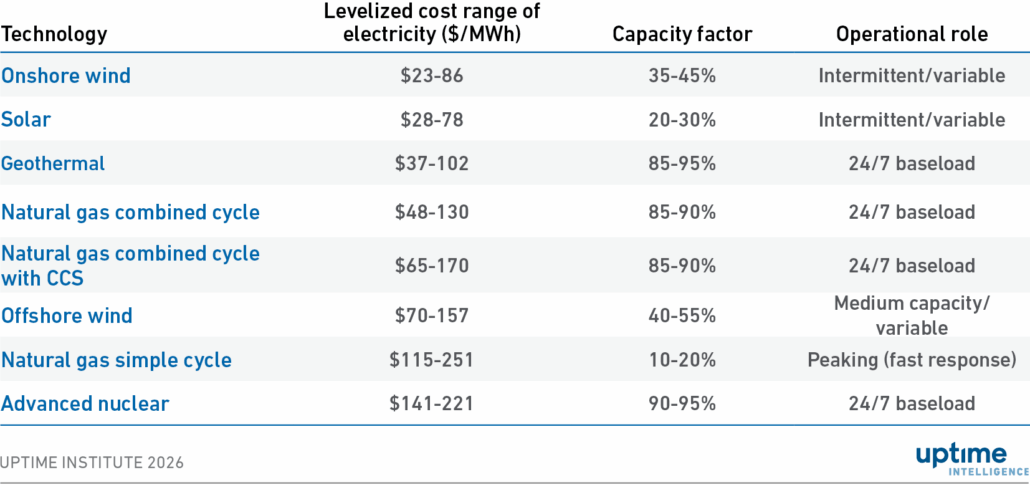
Table: Levelized cost of electricity by generation technology

Net-zero goals need carbon capture

Many data center operators have set net-zero CO2e emissions goals for their businesses. Given the planned power demand of the data center build-out, natural gas electricity generation assets will be a critical component of the industry’s electricity supply strategy. Operators will need to procure electricity from NGCC/CCS generation facilities to meet net-zero goals at the facility level.

With an estimated energy price premium of 10-20%, NGCC/CCS systems offer a viable alternative to virtual power purchase agreements (VPPA) and their associated energy attribute certificates (EACs), as well as to forestry, soil and direct air capture projects. The cost of a VPPA-based EAC is often opaque, as it depends on the VPPA electricity cost and the average spot market price for the generation region. As such, the cost of an EAC can reflect either the loss or profit of the energy purchase contract. By comparison, soil and forestry carbon offsets currently cost $10-50 per metric ton of carbon, and direct air capture offsets cost $600-1,000 per metric ton. Capturing carbon at its source of generation offers a viable strategy from both a cost-management and public-relations perspective.  

Note: EACs represent the zero-emissions characteristics of carbon-free electricity generation.

To demonstrate their commitment to their net-zero plans, operators will need to work with energy developers and turbine manufacturers to deploy natural gas generation with CCS as part of their data center build-out plans. Given the economic realities of the EAC and carbon offset markets, these systems can be financially attractive while directly reducing CO2 emissions associated with the operation of their data center facilities.


The Uptime Intelligence View

The rapid expansion of the global data center footprint, and the associated growth in power demand, will necessitate the deployment of gigawatts of natural gas generation. Without carbon capture, the deployment and use of these generation systems will significantly increase facility-level Scope 1 and Scope 2 emissions, pushing operators’ net-zero commitments to 2040 or beyond.

Where operators can purchase electricity from NGCC/CCS assets, they should be able to source low-carbon power at prices that are competitive with other carbon-free energy alternatives. This option will not be viable in many markets due to the unavailability of storage capacity, and operators will therefore need to develop partnerships with energy developers that specialize in NGCC/CCS systems in markets where storage is available. Nevertheless, operators that are serious about their net-zero commitments will need to support development of CCS technologies, include access to these systems in their site selection process, and procure low-carbon energy generated from these systems where it fits with business and sustainability objectives.

The post As emissions soar, operators look to carbon capture appeared first on Uptime Institute Blog.
  •  

AI in data: sorting reality from hallucination

Many people do not use the term artificial intelligence correctly: vendors, investors, and even some operators label everything from basic automation scripts to deep learning controllers as AI. This inflation of the term has commercial and strategic motives. AI branding helps attract funding, creates differentiation in the market, and positions traditional analytics as cutting-edge solutions.

However, this broad usage also breeds confusion and skepticism. Data center operators, uncertain about the level of autonomy or risk they face, often hesitate to implement even safe, deterministic systems.

Many operators remain hesitant to implement AI in their data centers, often citing fears of hallucination — the risk that an AI system might generate false or invented information. Yet not all AI behaves this way, and the term is frequently misapplied. By clarifying the different types of AI, how they vary in capability and reliability, and which pose genuine hallucination risks, operators can better distinguish dependable automation from the marketing-driven “AI-washing” that fuels confusion and obscures real risk.

The spectrum of AI in data centers

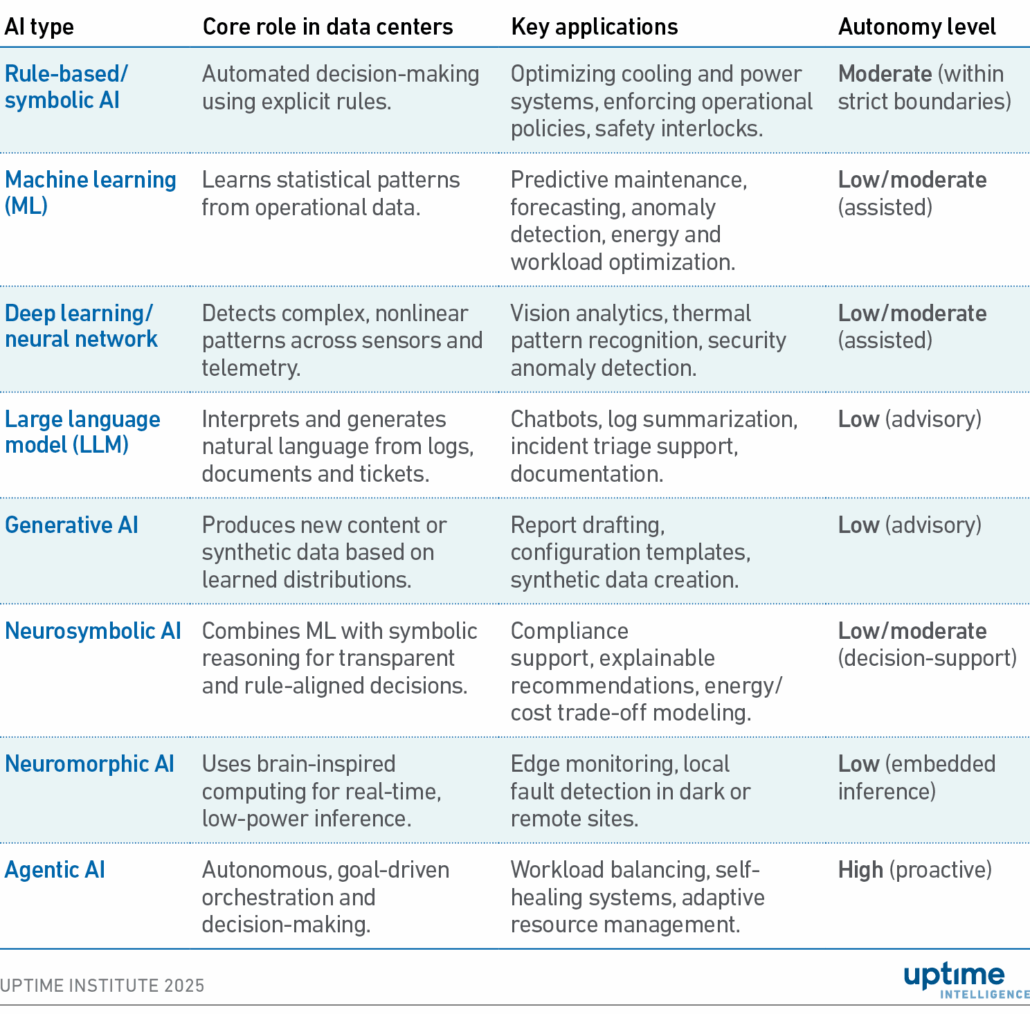
AI in data centers spans a broad continuum, from deterministic, data-driven algorithms to advanced systems capable of adaptive or autonomous decision-making. Treating these technologies as a single category obscures important differences in capability, reliability and operational risk. Understanding this spectrum is critical for evaluating what each system can — and cannot — safely automate.

Table 1 compares the different types of AI used in modern data centers.

Table 1 AI types used in data centers

Table: AI types used in data centers

Mislabeling AI: the root of hallucination fears

Across the tech sector, and within data center operations in particular, everything from basic regression models to large transformer networks is labeled as AI. This conflation blurs the operational reality:

  • Predictive and optimization models (ML, neural networks) rely on measurable data and statistical learning. They rarely improvise.
  • Generative and language models (LLMs, GenAI) produce content probabilistically, often without grounding in external data, which creates a risk of fabrication.
  • Agentic AI orchestrates systems and can call on other models (including LLMs) to plan or communicate, but its reliability depends on which components it uses.

This terminological blur feeds operator anxiety. A predictive control loop that tunes chillers based on real-time feedback is not at risk of hallucination, yet many operators equate it with the behavior of chatbots and generative systems. In practice, hallucination is a property of generative AI, not of deterministic automation or data-driven control.

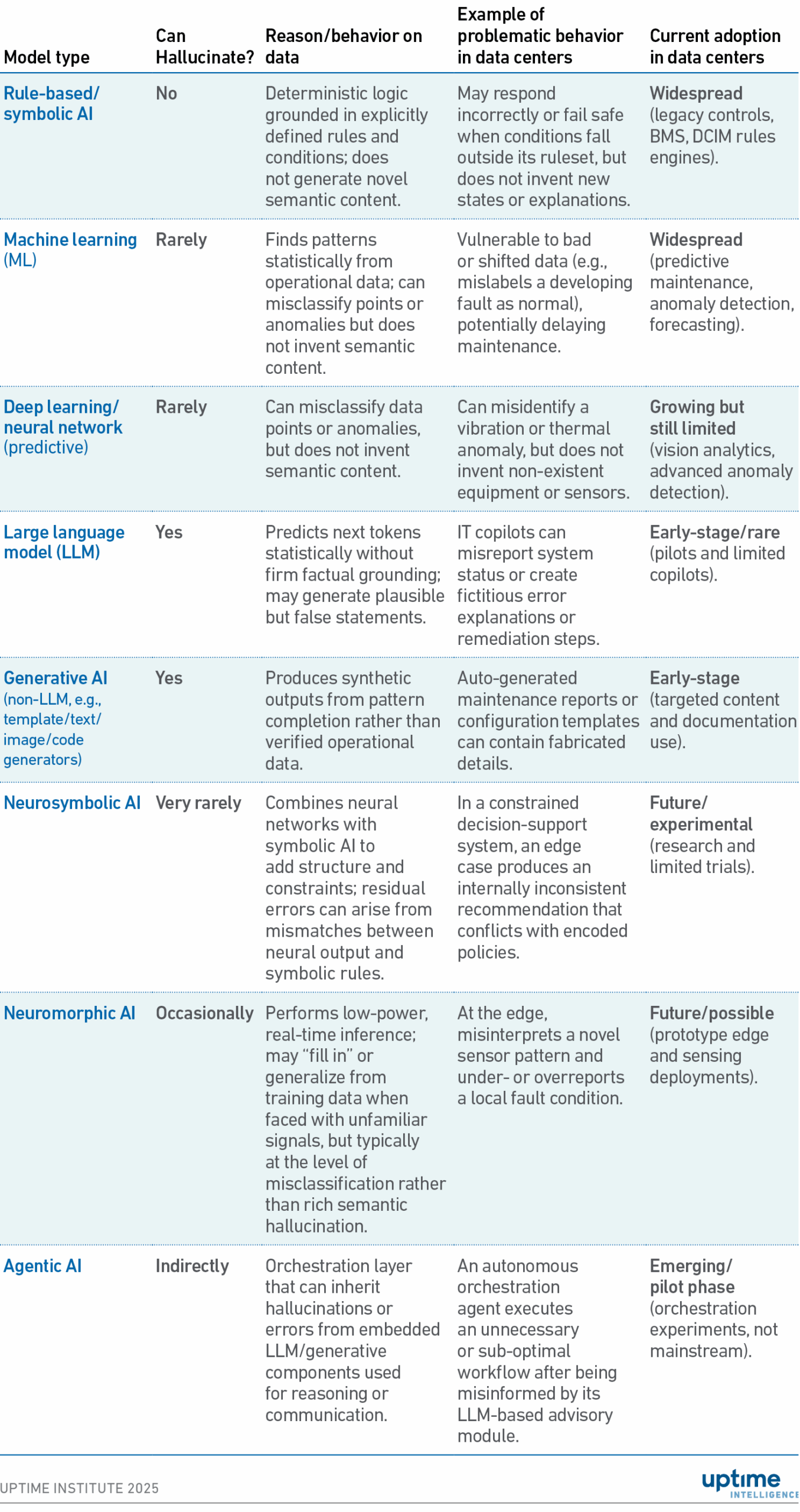
Understanding which AI types can hallucinate, and why, is essential for evaluating their operational reliability. Table 2 below clarifies the differences across major AI categories used in data centers.

Table 2 Hallucination behavior and risks across AI types

Table: Hallucination behavior and risks across AI types

Managing and mitigating hallucination risks

Operators can apply a focused set of safeguards that keep AI useful while limiting unsafe or fabricated outputs:

  • Constrain generative models to verified, domain‑specific sources such as maintenance manuals, runbooks, building management system (BMS)/data center infrastructure management (DCIM) logs, incident records and approved knowledge articles.
  • Use retrieval‑augmented generation (RAG) so that models base responses on current operational data rather than general training alone.
  • Adopt hybrid architectures that pair LLM copilots with deterministic rule engines or physics‑based digital twins, which can verify or veto proposed actions before they affect live systems.
  • Require human‑in‑the‑loop validation before AI can change configurations, control physical systems, or execute high‑impact runbook steps.
  • Establish clear governance that makes a distinction between “assistive AI” (documentation, recommendations, analysis) and “operational AI” (any system that can directly change configurations or physical infrastructure).
  • Apply strict scoping and access control so more powerful generative or agentic components start in read‑only or advisory modes and follow least‑privilege principles for credentials and APIs.

The Uptime Intelligence View

Much of the data center industry’s caution around AI appears to come from treating it as a single, generative technology rather than a stack of distinct capabilities. In real deployments, predictive models are typically aligned with control and optimization tasks; emerging agentic approaches support orchestrated, multi-step decision flows; and LLMs or other generative systems are best suited for documentation, reasoning support, and advisory use under governance constraints. When these distinctions are made explicit, AI can be a potential enabler of resilient, self‑optimizing facilities and poses less risk of becoming a direct threat to uptime.

The post AI in data: sorting reality from hallucination appeared first on Uptime Institute Blog.

  •  

3PL turns a pain point into a selling point


The asset-based third-party logistics service specialist (3PL) and freight broker RJ Logistics offers a wide range of services, including cross-border shipping, truckload, expedited, flatbed/specialized, and drayage offerings. But the woman-owned, Southfield, Michigan-based company says its true strength is providing a positive freight experience for both shippers and carriers through open communication and collaboration.

But as RJ expanded its North American services into Mexico a few years back, it realized there was one aspect of its own operations that was falling short of its standards for communication: its ability to track and provide timely updates on cross-border shipments to customers. The 3PL was finding that traditional shipment-tracking tools that rely on driver opt-in or ELD (electronic logging device) integrations were not effective in Mexico. To compensate for the visibility gap, it was forced to rely heavily on manual check calls to determine the whereabouts of shipments, which slowed response times and created friction for operators and customers.

There were personnel repercussions as well. The lack of timely updates pulled RJ’s employees away from higher-value tasks, adding stress to the team and limiting their ability to scale up in the wake of a post-Covid market shift.

MAKING DATA COLLECTION AUTOMATIC

In search of a solution, the company turned to Rectangle, a Chicago-based provider of a universal application programming interface (API) and data sync platform built specifically for logistics. According to Rectangle, its technology streamlines complex workflows by turning them into automated data streams that connect seamlessly across systems, giving logistics teams real-time visibility without additional manual work.

RJ says it implemented Rectangle’s universal API and data sync platform in less than a day. The new system now pulls global positioning system (GPS) data from carriers and pushes live location updates directly into RJ Logistics’ McLeod transportation management system (TMS), creating an accurate, up-to-date view of every cross-border shipment inside the TMS.

The change gives RJ Logistics consistent visibility across borders and keeps reliable data flowing into existing systems. The new setup also eliminates those previously experienced gaps, speeds up response times, and strengthens customer trust, according to the two companies.

FROM PAIN POINT TO COMPETITIVE ADVANTAGE

Since the go-live, manual check calls have dropped by more than 70%, freeing up the equivalent of two full-time team members, according to the companies. RJ’s operators now focus on managing exceptions and customer service, while its customers receive faster, more consistent updates.

“With Rectangle, we went from spending hours chasing updates to having live tracking data flow directly into McLeod. It’s changed how we operate and how our customers see us,” said Ben Murchison, director of technology at RJ Logistics, in a case study describing the project. “Without bothering drivers, we’re seeing unprecedented tracking coverage for our cross-border shipments.”

Today, the integration delivers more than 95% tracking coverage with a 95th percentile tracking interval of about 15 minutes and has increased the number of tracking data points by a factor of 20. On top of that, the automation has laid the foundation for RJ Logistics’ next phase of growth, according to the two companies.

And importantly, offering that real-time cross-border visibility has allowed the 3PL to turn a former pain point into a competitive advantage, the company says. It now highlights live tracking as a core selling point in customer conversations, helping it stand out and win new business in a crowded market.

  •  

Truckstop.com acquires heavy haul rating specialist Wize Load


The freight matching and transportation tech firm Truckstop.com today said it has acquired Wize Load, a provider of heavy haul rate intelligence tools, saying the move was part of its continued investment in heavy haul, oversized, and specialized freight.

According to Idaho-based Truckload.com, freight that involves open deck, heavy haul, or overdimensional equipment often requires more planning than standard truckload. For example, equipment requirements, permits, escorts, routing limits, and specialized equipment all affect how loads are priced and moved, and quoting these shipments can take more time without the right data.

To address that issue, the company has renamed Wize Load as “Truckstop Heavy Haul Rates,” and says the platform will give brokers a faster way to estimate pricing by bringing lane data, permit rules, and equipment requirements together in one place.

“This acquisition reflects our long-term focus on freight that requires more planning than standard truckload,” said Scott Moscrip, founder and CEO of Truckstop.com. “We are doubling down on technology built for heavy haul, oversized, and overdimensional freight, including the Heavy Haul Load Board and now Heavy Haul Rates. When a load involves permits, escorts, or specialized equipment, pricing has to be right before the truck moves.”

Terms of the deal were not disclosed.

  •  

Gartner: AI-assistant software soon to enter fast growth phase


As the adoption of artificial intelligence (AI) chatbots levels off, supply chain management (SCM) software with agentic AI capabilities will grow from less than $2 billion in 2025 to $53 billion in spend by 2030, according to a report from Gartner Inc.

The initial wave of AI-assistant SCM software has already had a substantial impact on the SCM market, the report says. And it is now entering a new phase in which providers are seeking competitive advantage through investments in AI agents to execute simple tasks either individually or in collaboration with other agents.

“Simple AI agents are capable of executing discrete supply chain tasks, increasingly enabling organizations to automate routine workflows and freeing up bandwidth of humans to complete more complex tasks,” said Balaji Abbabatulla, VP Analyst in Gartner’s Supply Chain practice. “As supply chain organizations begin to realize, measure and demonstrate business value from such simple AI agents over the next 12 to 18 months, leaders in these organizations will start prioritizing investments in clusters of simple AI agents to enable orchestration of multi-step workflows with or without humans in the loop.”

Gartner predicts that by 2030, 60% of enterprises using SCM software will have adopted agentic AI features, up from just 5% in 2025, as businesses move from planning to deploying agentic AI within supply chain workflows.

However, enterprise deployments of AI-driven SCM will lag behind general availability of such capabilities from SCM software providers due to the increasing gap between the technology and other layers of the supply chain operating model. Therefore, as chief supply chain officers and supply chain technology leaders evaluate and plan for the adoption of agentic AI capabilities, it is essential for them to determine and deploy appropriate levels of human-in-the-loop for supply chain management decisions, particularly during the early stages of AI-driven SCM software deployment.

“Leaders should focus their change management investments in adjacent layers of the supply chain operating model—such as data management, operations management, workforce AI-readiness, and network-centricity,” Abbabatulla said. “Additionally, developing strategic partnerships with AI-driven SCM platform providers is crucial to ensure robust support for multi-agent, multi-vendor AI agent orchestration.”

  •  

Tariffs on steel and aluminum hit European machine producers


As new Trump Administration tariffs on steel and aluminum began to bite this week, European machine producers said the policy change came so quickly they have not had time to adjust, according to a statement from trade group VDMA.

“Starting April 6, a flat tariff rate of 25 percent will apply to many machines from Europe. In many cases, this will place a heavier burden on the European machinery industry than before -- which is disappointing. What is particularly challenging for our companies is that they are not being given time to prepare for the change,” Oliver Richtberg, Head of the Foreign Trade Division at the VDMA, said in a release.

One of the challenges is a requirement that companies provide proof of where the steel and aluminum used in the machinery was cast or smelted, even for small components like screws, the group said.

“For certain machinery products, such as injection molding machines and conveyor technology, a tariff cap of 15 percent applies for a limited period until December 31, 2027. This provides limited relief for some companies. Products consisting predominantly of steel and aluminum, on the other hand, are significantly worse off. For these, a 50 percent tariff will apply to the entire product in the future.”

The VDMA represents 3,500 German and European mechanical and plant engineering companies, which employ around 3 million people in the EU-27.

The new policy comes after President Donald Trump signed a series of executive actions on April 2 to set Section 232 tariffs on pharmaceutical products and charge a flat 25% rate for steel, aluminum and copper derivative products, according to New York-based shipping and logistics provider Sobel Network Shipping.

  •  

Building a stronger warehouse culture


Third-party logistics service provider (3PL) States Logistics prides itself on being a people-first company. But a challenging warehouse labor market was making it difficult for company leaders to find, retain, and develop front-line workers at some of its locations across Arizona and California just a few years ago. That all changed when the 3PL partnered with TrailPath Workplace Solutions, a workplace and people development company whose technology platform “transforms workplace dynamics, increases visibility, and helps both people and organizations thrive,” according to TrailPath.

States Logistics has reduced turnover at key locations and reports improved employee morale since implementing the platform, which provides visibility, training, and worker engagement tools that help companies improve decision-making and foster a better team environment.

ASSESSING PROBLEMS

States Logistics was experiencing higher than desired turnover at some of its locations and sought a “differentiated approach that could really help it stand out as an employer of choice,” according to TrailPath’s chief operating officer, Ben Green, and his colleague, Chief Knowledge Officer Clint McCrystal. They said the first step to addressing the problem was to assess the 3PL’s employment environment as a way to find opportunities to improve.

“[States Logistics’] biggest issue was turnover,” explains Green, noting that the 3PL was fighting a tough labor market in Southern California, in particular. Although the employee-owned 3PL was doing everything it could to address those challenges—including offering flexible scheduling and competitive pay to attract and keep front-line personnel—nothing seemed to work. And the high turnover was making it difficult for the company to continuously improve operations.

TrailPath began with an overall assessment of States Logistics’ workplace culture and operations in 2023 and implemented a pilot program the following year at one of the 3PL’s warehouses. The pilot combined the company’s NxtPath technology platform with leadership and coaching development to improve the facility’s workplace culture.

Creating a meaningful work environment is at the heart of those efforts.

“For us, [it’s all about] creating dignity, trust, and respect in the workplace,” McCrystal says.

TrailPath uses a “declining to thriving” model to measure worker engagement, satisfaction, and performance. Employees can express how they feel about their job within the NxtPath system by reporting whether they are “declining, surviving, growing, or thriving.” The real-time data-driven system alerts leaders to any changes in the metrics, allowing them to check in with workers and address problems and concerns if scores decline. The system also calculates and tracks an overall score for the workplace.

Progressing along the index requires building “meaningful employment environments,” where “trust and dignity [are] established and the work is meaningful,” according to TrailPath. When team members are “thriving,” productivity increases, turnover declines, commitment increases, safety improves, and people grow, according to Green and McCrystal.

ACHIEVING RESULTS

Today, States Logistics is growing and thriving: Within six months of implementing the technology and training, the pilot site saw a turnover reduction of 12%, according to Green. The 3PL has since added sites to the program and has reduced turnover between 5% and 15% per site.

What’s more, the 3PL has improved along the “declining to thriving” index at those facilities where the system is being used: The pilot site’s overall “growing or thriving” score rose from 60% to 83% from 2023 to 2025, exceeding the company average by a significant margin, according to Andrew Hillier, TrailPath’s business development manager.

In a statement to DC Velocity, Hillier said that accomplishment is “massively impactful in practice because each converted employee adds trust, reliability, and predictability to the operation.”

States Logistics continues to add sites to the NxtPath platform. As of late February, Green said the partners were about two-thirds of the way through the rollout and expected to be up and running in all eight of the 3PL’s locations this spring. The partners plan to integrate the company’s fleet of drivers into the program as well.

And it’s all in the name of becoming a place where people want to work.

“For a small, privately held company like States, hanging on to your employees is everything from a livelihood perspective,” McCrystal says. **please pull terminator to the right. Thanks!

  •  

Iran War: global airfreight pricing continues to rise


With petroleum markets under pressure from disruption by the Iran War, global airfreight pricing continued to rise during the last week of March, indicating that the price of jet fuel is replacing capacity constraints as the driver of upward rate momentum, according to a report from WorldACD.

Oil prices have soared in recent weeks as Iran has closed the Strait of Hormuz to most maritime traffic by both oil tankers and containerships. That has led to spikes at pump prices for gasoline, diesel, and jet fuel.

Since the outbreak of the Iran war in late February, the price of jet fuel has more than doubled, reaching an all-time high in March, WorldACD said. Inevitably, the higher jet fuel price led to upward pricing momentum.

Against that backdrop, worldwide air cargo tonnage in week 13 (23-29 March) was unchanged from the previous week, data from WorldACD show, as volumes out of four regions slipped, while the other two recorded low single-digit increases, an indication that the return of capacity – albeit still down from levels before the Middle East conflict – has absorbed current demand. On the other hand, average global full-market air cargo rates continued to rise to a new high this year at $2.98, but the momentum slowed for the second week in a row, from +10% in week 11 to +5% last week, on a week-on-week basis.

Air cargo capacity remains depressed, as airlines based in the Gulf region continued to rebuild their capacity but still face constraints from the conflict, especially on their passenger schedules. Compared with the previous two weeks (2Wo2W), capacity from the Middle East and South Asia (MESA) region was up +31% for the fortnight from 16 to 29 March, but still -33% below the level in the corresponding fortnight a year ago.

Airlines in the northern hemisphere switch to their summer schedule by the start of April, which should begin to impact capacity and pricing in a number of markets in week 14. However, the ongoing conflict in the Middle East will likely have a much larger impact on demand and pricing, the report said.

  •  

U.S. flatbed truck freight rate jumps to largest weekly increase in over a decade


As fuel costs continue to climb under oil supply disruptions caused by the Iran War, U.S. trucking freight rates are rising accordingly as carriers price in the cost of more expensive diesel, according to a report from DAT One and DAT iQ.

The national average flatbed rate for the week ending April 4 rose by 11 cents to $2.55 a mile, marking the largest weekly increase in over a decade. The rate is now at its highest in four years and 40 cents higher than in the same period last year.

Meanwhile, the national dry van load-to-truck ratio dropped to 9.0 last week, influenced by a 14% decline in load posts and a 2% decrease in equipment posts. Specifically, total load posts on DAT One dropped to 3.58 million last week, a 12% decrease from the previous week, as the market seemed to pull back after the quarter ended and before Easter.

  •  

Report: global freight markets rocked by Iran War effects


Global freight planning is being reshaped by three outcomes of the Iran War—fuel shock, tighter air capacity, and Strait of Hormuz disruption—according to a report from Dimerco Express Group, the Taipei-based global shipping and logistics service provider.

Under that pressure, the freight market is increasingly driven by fuel costs, rerouting, and geopolitical disruption rather than a broad demand surge, the firm said in its “April 2026 Asia-Pacific Freight Report.” Overall, the report points to continued expansion in global manufacturing, but with softer momentum, higher operating costs, and tighter booking conditions across key air, ocean, and rail lanes.

The report listed four data points to support that conclusion:

  • Jet fuel rose from about $95 per barrel in late February to $197 per barrel by March 20.
  • Taiwan air freight rates increased by roughly 20% to 30% on disrupted lanes.
  • North America air freight rates rose 20% to 50% as fuel surcharges and rerouting intensified.
  • China-Europe rail hubs imposed $300 to $500 per container increases in March, with broader market increases now moving above $500 per container.

“April is shaping up to be a cost-driven freight market, not a broad demand-driven one,” Catherine Chien, Chairwoman of Dimerco, said in a release. “We are seeing fuel shock and Middle East rerouting tighten air capacity from Taiwan, Korea, and across Southeast Asia, while ocean carriers layer in bunker-related surcharges and rail into Europe moves higher as shippers look for alternatives. If disruption around the Strait of Hormuz continues, shippers should expect elevated freight costs, shorter rate validity, and more route-specific volatility across Asia-Europe and Asia-North America in the weeks ahead.”

  •  

Survey: Manufacturing workers are skeptical of adopting AI


Amid skepticism by shop floor workers, artificial intelligence (AI) adoption in manufacturing can hinge on the attitudes and readiness of frontline manufacturing leaders, according to a study from PwC and the Manufacturing Institute—the workforce development and education affiliate of the National Association of Manufacturers (NAM).

According to the new survey data, nearly half (48%) of respondents rated their frontline leaders as very or extremely effective in shaping the experience of frontline workers. Yet that effectiveness has not translated to AI readiness. When asked about frontline leaders’ readiness to lead AI-driven change, 54% of respondents reported low or very low confidence.

Another hurdle revealed by the survey was that 45% of frontline leaders report being skeptical of AI—even as 50% express excitement. And frontline workers have even more reservations, with 62% viewed as skeptical and just 24% described as excited.

That divergence can have long-term implications for AI adoption. But researchers offered strategies to overcome the issue, saying that offering meaningful training and treating AI as a primary capability with demonstrable benefits can reduce skepticism and resistance to AI implementation. The survey supports that with the statistics that 45% of leaders attribute unsuccessful AI initiatives to excluding frontline leaders from the design or rollout process.

The findings come from “Frontline Leadership in Manufacturing AI Adoption,” a study which surveyed over 100 manufacturing leaders across operations, human resources, and executive roles in the third quarter of 2025 about AI adoption.

“As AI becomes more important to manufacturing, leaders need to offer additional training so that workers are equipped to utilize AI on the shop floor,” Manufacturing Institute Chief Program Officer Gardner Carrick said in a release. “The survey shows manufacturing leaders the opportunities they have to get this right. Real training, upskilling and hands-on experience will demonstrate to employees the benefits that will come with proper AI integration.”

  •  

In Person interview: Sai Shivareddy of Nyobolt


Sai Shivareddy is the co-founder and CEO of Nyobolt, a provider of high-power fast-charging energy solutions. His experience includes over a decade working in research and development in both industry and academia, where he invented several products relating to super-capacitors, advanced materials, and battery technologies. He has also led product development and commercial teams globally in the battery industry at startups and corporate firms.

Shivareddy holds a Ph.D. in engineering from St John’s College at Cambridge University in England, where he worked with household appliance maker Dyson on developing new concepts for high-power energy storage technologies.

Q: How would you describe the current market for batteries and integrated energy systems?

A: We’re in the middle of an energy crisis due to both a global energy shortage and an increase in demand. As supply chains and autonomous mobile robots operate 24/7, AI [artificial intelligence] data centers guzzle more power, manufacturing and construction accelerates, and electric vehicle adoption continues, the need for batteries and integrated energy systems has never been more important, especially because they can help find solutions for mitigating the energy gap of these insatiable data centers.

The size of the global battery market was estimated at $154.12 billion in 2025 and is projected to reach $554.83 billion by 2033, according to [market research and consulting firm] Grand View Research. The race is on to provide sustainable solutions to meet the needs of an increasingly electrified world where instant power is a necessity.

Q: As an engineer, what drew you to the battery industry?

A: For as long as I can remember, I’ve been curious about how things were powered. While studying for my doctorate in engineering at Cambridge, I became fascinated with battery materials. There I worked closely with Dyson on concepts for high-power energy storage technologies, and I knew developing energy solutions would be my mission.

While my career has spanned mining, materials, and manufacturing, it was science that led me to entrepreneurship. Once my co-founder, Clare Grey, and our team made breakthroughs in the lab, I couldn’t wait to translate those discoveries into real-world solutions for industries where instant power is mission-critical, including autonomous robotics, AI data centers, and transportation.

Q: What are the most important advances you’ve seen recently in power technologies?

A: While energy density (the ability to deliver longer run-times) continues to improve slowly, power density has been slow to catch up until recently. Previously, a super-capacitor, or ultra-cap, was the only available technology to get the high peak currents needed for today’s demanding products. Nyobolt’s battery technology now has the power advantages of a super-cap with the energy of a Li-ion [lithium-ion] battery—bringing the best of both [technologies] to enable new capabilities from mobile robotics to AI data centers.

Q: What are the biggest advantages that modern fast-charging systems bring to operations?

A: The world now operates at one speed: always-on. Ultra-fast charging increases uptime and eliminates downtime because the battery charges simultaneously. Nyobolt’s batteries’ life cycle is at least 10 times that of traditional lithium-ion technology, allowing robots to operate longer, more reliably, and with reduced operating expense.

Our collaboration with Symbotic Inc., the leader in AI-enabled robotics technology for the supply chain, where we’re supplying the battery technology for its SymBot autonomous mobile robots, illustrates how the bots can do substantially more work, be teleoperated for longer, and travel farther between charges—providing greater flexibility, speed, and efficiency in moving goods through the supply chain.

Q: What types of material handling equipment are best suited for your power systems?

A: We help companies in industries where speed, uptime, and reliability matter most. Our ultra-fast charging technology and compact advanced power solutions unlock unmatched performance across fleets of material handling robots, forklifts, pallet jacks, and humanoid robots as well as other demanding industrial equipment.

Our mission at Nyobolt is to accelerate progress of the AI-driven, electrified world by providing instant power to mission-critical industries.

Q: Can you briefly explain what is meant by power density and why this is important for material handling equipment?

A: Power density in batteries measures how quickly energy can be delivered or absorbed per unit of mass. It is typically measured in watts per kilogram (W/kg) or in volume—watts per liter (W/L).

Traditionally, a battery’s capacity (energy) is measured in amp-hours or watt-hours, always with a time component: this many watts for this much time. Power is the instant watts or amps that a battery can deliver while still maintaining its output voltage.

High power density means a battery can release a large amount of energy in a short amount of time, which is critical for applications requiring rapid bursts of energy or high power output. Nyobolt’s batteries deliver more energy density than super-capacitors while matching lithium-ion energy levels. They are also smaller and lighter, and provide an ultra-fast charge (enabled by our proprietary materials) without accelerating degradation. This is important for material handling equipment and warehouse robotics because Nyobolt’s solution maximizes uptime, extends cycle life, and enables in-process charging. This eliminates the need for mid-shift charging or battery swaps that can cause operational bottlenecks.

Q: We hear of explosions and fires occurring with some battery technologies. What do you do to ensure your products are safe?

A: We’ve developed unique materials that enable high thermal stability for our batteries. We maintain temperature control under rapid cycles, which translates to improved safety and thermal performance.

Our battery cells are tested to all the latest industry standards for thermal runaway, propagation, and physical abuse. Nyobolt’s customized power systems are similarly tested to standards required for each application, such as mobile robotics, material handling equipment, etc.

Nothing is more effective and satisfying than watching a test engineer drive a nail through our cells/packs and observing them safely maintain reasonable thermal operating ranges with mitigated risk of thermal runaway. It’s all of the performance with none of the fear factor.

Q: Are there other applications for your technology?

A: Yes, Nyobolt’s technology can also be utilized to reduce peak power demands in devices from stationary robotics to AI data centers. The same concept that allows fast charging also permits the battery to handle peak loads without increasing the size of the power system. In this way, the Nyobolt battery functions more like a super-capacitor but with a much larger energy reservoir.

What this means is that the stationary robot or AI data center can utilize a smaller power supply to handle larger needs. In robotics, this translates to smaller, lower-cost power supplies, and in data centers, it reduces the need for additional grid power.

  •  

Smaller “shallow-bay” warehouse space sees rising demand


Demand is rising for “shallow-bay properties” in industrial real estate, reflecting the growing need for smaller-format space tied to service-oriented users and last-mile distribution, according to a report from CBRE.

Unlike big-box warehouse properties that have expanded rapidly in recent years, the supply of shallow-bay space has grown only modestly, leaving many markets with aging inventory and limited new construction. CBRE defines shallow-bay space as buildings under 50,000 square feet with clear heights between 14 and 28 feet.

Starting in 2017, shallow-bay vacancy began falling below the overall industrial vacancy rate, reflecting growing demand for smaller-format space tied to service-oriented users and last-mile distribution. This gap widened significantly during the recent development cycle, as new supply was largely concentrated in big-box warehouse development while shallow-bay construction remained limited. By early 2024, shallow-bay vacancy was 2.5 percentage points below the overall industrial vacancy rate, underscoring the limited availability amid sustained demand for these smaller facilities.

By 2025, shallow-bay asking rents were more than 50% higher than 2010 levels, highlighting the durable demand and supply constraints of this segment. The steady increase in rents over this period reflects continued leasing activity and limited available space for smaller occupiers across most markets.

With little new development over the past two decades, shallow-bay industrial inventory in major U.S. markets is heavily concentrated in older facilities. Nearly half of shallow-bay inventory was built prior to 1980 and more than 80% was built before 2000. Properties built since 2010 account for only 5% of total inventory. This aging supply reflects the economic challenges of developing new shallow-bay facilities in major markets, where land costs and zoning constraints often favor larger warehouse developments.

Looking into the future, demand for shallow-bay space remains closely tied to small and mid-sized businesses that serve local economies. While a slowing economy could temper demand in the near term, the limited development pipeline and aging inventory base suggest shallow-bay properties will remain an important and supply-constrained segment of the industrial market.

  •  

Truck freight rates tick up slightly to start 2026


Truck freight rates have moved up modestly to start 2026, while the gap between spot and contract pricing has narrowed, according to the latest quarterly U.S. Bank Freight Payment Index – Rates Edition, which is produced in collaboration with DAT Freight & Analytics.

The trend comes as welcome news following more than three years of freight recession conditions that have seen trucking load rates linger near historic lows.

By the numbers, the report found that spot rates averaged $2.01 per mile in February, up from $1.65 in November. Meanwhile, contract rates ticked up to $2.12 in February, up from $2.02 in November.

The report also revealed compression between contract and spot rates. A year ago, contract rates carried an average premium of roughly $0.39 per mile over spot rates. By March 2026, that gap had narrowed to about $0.11 per mile, representing approximately $0.28 per mile of compression. The narrowing reflects spot rates catching up to contract pricing, leaving shippers with less margin to absorb volatility.

“What we’re seeing in early 2026 is a freight market beginning to rebalance, with spot rates improving modestly while contract pricing has remained relatively steady,” said Ken Adamo, Chief of Analytics at DAT Freight & Analytics.

  •  

Arvato expands Texas DC to meet hot demand for AI data center construction


Amid soaring investment in building the data centers that power artificial intelligence (AI), the third party logistics provider (3PL) Arvato this week said it is further expanding its Data Center Services footprint in the United States with a new logistics hub in Denton, Texas.

Located in the Dallas–Fort Worth metroplex, the facility “significantly increases” its operational capacity to support hyperscalers, cloud providers, and AI infrastructure companies across North America, the firm said.

The facility comprises approximately 270,000 square feet, with an initial 150,000 square feet allocated for operations and substantial room for future expansion. Specialized logistics offerings at the site allow Arvato to manage inbound and outbound flows of sensitive hardware, coordinate complex white-glove deliveries into active and under-construction data centers, and provide high-security warehousing and specialized handling services.

“The U.S. data center market is scaling at unprecedented speed,” Mitat Aydindag, President Tech at Arvato, said in a release. “In AI-driven environments, deployment speed and uptime depend directly on logistics performance. With our new hub in Dallas-Fort Worth, we are expanding a fully integrated U.S. Data Center platform that combines secure warehousing, specialized handling and coordinated last-mile execution. We are building the logistics layer behind next-generation AI infrastructure and enable our clients to scale with precision, security and confidence.”

The expansion comes the same week that DHL announced a similar initiative to address the hyperscaler market, launching a “significant expansion” of its North America data center logistics (DCL) infrastructure with 10 dedicated warehouse sites totaling more than seven million square feet of capacity set to go live in 2026.

  •  

Iran War: Container spot rates in Middle East region jump 30%


Spot rates for ocean container shipping are up by more than 30% since the end of February on routes with direct exposure to the Middle East disruption caused by the U.S. and Israel’s war against Iran, according to a report from Xeneta, anocean and air freight rate analytics provider.

And since global container flows move in a tightly orchestrated balance, those rate spikes are also affecting goods as far away as U.S. West Coast ports, the firm said.

“Five weeks into the Strait of Hormuz closure and spot rates on every major East-West trade lane have risen sharply, showing this is a conflict with global repercussions for ocean supply chains,” Peter Sand, Xeneta Chief Analyst, said in a release.

“No shipper is insulated from financial or operational risk. Far East to US West Coast – a trade which transits the Pacific thousands of miles from the epicenter of conflict – has seen spot rates climb 29% since the end of February. The complex interconnectivity of global supply chains means port congestion in the Middle East has rippled across to key Asian transshipment hubs — including Singapore, Port Klang and Tanjung Pelepas — which are also vital for feeding goods toward the US.”

Despite the jump in rates, wary shippers are still scrambling to secure capacity, as they hope to avoid potentially higher costs in the future, since peak season for importing inventory for winter holiday shoppers is only three months away.

“The position of carriers is unambiguous - the cost of uncertainty sits with the shipper, even on trades with no direct exposure to the Middle East. Market memory is a powerful force and shippers who experienced the second wave of the Red Sea crisis in 2024, when port congestion in Singapore saw already elevated rates double, are not waiting around and are securing capacity at today’s rates,” Sand said.

“Shippers booking capacity today are paying a premium for certainty, but it is a calculated risk against being caught short in peak season three months from now and paying even higher rates. Shippers who wait for conditions [to] stabilize are placing a bet with no clear evidence behind it.”

  •  

S & H Systems files for bankruptcy


The material handling and warehouse automation solution provider S & H Systems Inc. has declared bankruptcy, according to a report from the financial data provider Bondoro.

Jonesboro, Arkansas-based S & H Systems filed for Chapter 11 protection on February 2 in the U.S. Bankruptcy Court for the Eastern District of Arkansas, the report said.

According to New York-based Bondoro, S & H Systems reported $41.7 million in assets and $62.5 million in liabilities. Filed under case number 26-10365, the case indicates that there will be funds available for distribution to unsecured creditors.

The bankruptcy follows just a month after a January legal win by logistics automation equipment provider Beumer Group against S & H. In that case, Beumer said that S & H failed to pay it in full for a $1.3 million “logistic sorter for the Amazon SAX.7 Project," an Amazon facility located in Bloomington, California.

A company spokesperson for S & H did not reply to a request for comment.

  •  

A new twist on returns: an interview with Disney Petit


As much as you may hate the hassle of returning unwanted items, it’s a sure bet retailers hate it more. After all, dealing with a return is rarely as simple as placing the item back on a store shelf. In the majority of cases, a return kicks off a long and complex journey that may include inspection, sorting, tracking, reshipping, and determining the final disposition of the item, to name just a few of the steps. All this, of course, creates extra work and additional costs.

Adding to retailers’ pain, returns are only growing as e-commerce sales continue to surge. According to U.S. Census Bureau data published by the Federal Reserve Bank of St. Louis, e-commerce retail sales as a percentage of total retail sales nearly doubled in the last decade, rising from 7.2% in the third quarter of 2015 to 16.4% in the third quarter of 2025. And items ordered online tend to come back more often than those bought in stores: In an October 2024 study, the National Retail Federation reported that retailers’ online return rates were, on average, 21% higher than their overall return rates.

Then there’s the environmental cost. Sadly, a large number of returned items wind up in landfills. They are simply too complicated or expensive to process or repair to make it worth restoring them to inventory.

That’s where Disney Petit and LiquiDonate come in. Petit is the founder and CEO of this sustainability-focused software company that matches excess inventory from retailers, brands, and businesses with nonprofits and schools that can use those products.

Prior to founding LiquiDonate, Petit was the head of social impact at Postmates, an online delivery platform for food and other local goods, where she focused on last-mile delivery logistics. During her time at Postmates, Petit headed a team that partnered with the technology incubator Not Impossible Labs to create a text-messaging service called Bento that connected food-insecure people with prepaid meals at local restaurants. Bento was later recognized as one of Time magazine’s Best Inventions of 2021. Last year, LiquiDonate was named to Time’s Best Inventions list as well.

Petit received her bachelor’s degree in organizational communication from Rollins College in Winter Park, Florida, and her MBA in sustainable social impact from Saybrook University in Pasadena, California. Ahead of Earth Day, she discussed how her company helps retailers reduce waste with DC Velocity Group Editorial Director David Maloney.


Disney Petit, LiquiDonate

Q: How extensive is the problem retailers currently face with customer returns?

A: For anyone who works in warehousing, distribution, or reverse logistics, this is a problem that shows up every day. Returns have quickly, but quietly, become one of retail’s largest operational and cost challenges. According to the National Retail Federation’s annual retail returns research, about 20% to 30% of products purchased through e-commerce are returned, and in categories like apparel, the percentages are even higher.

The issue isn’t just the volume, though. It’s also that reverse logistics wasn’t built for this scale. Most distribution centers are designed for forward velocity, not for grading, sorting, and repackaging or redistributing millions of potentially low-value items. These operations teams are constantly forced to choose between clogging their DCs with this flow or disposing of the products to keep the [process moving]. And it’s just been really difficult for retailers to keep up with the volume, especially as e-commerce continues to grow.

Q: We know that returns come back to DCs in a variety of conditions. Some are still in the original packaging and haven’t been opened, while others are damaged, defective, or, at the very least, require repackaging. How much of what is returned can really be put back into inventory for resale?

A: It really depends on the product. An item is considered resellable if [it could potentially be resold] in the same condition it came back in. But you also have to consider that once you factor in things like freight, labor, space, and handling, it costs between $15 and $35 to process a single return. So it just doesn’t make a lot of sense for some of these products to be resold. In those cases, the only appropriate path right now is really disposal—sending them to a landfill or incineration site, and sometimes they call that “recycling.” But what’s really happening is that we’re just filling landfills with these goods.

If you think about what it takes to repackage or re-tag a shirt, and it was a low-price, low-volume item to begin with, then it doesn’t make sense to resell it. I think it surprises most people that up to 70% or 80% of these unsellable returns actually end up in landfills.

Q: That is a very big number. And that’s where your organization comes in. Can you explain what prompted you to start LiquiDonate, and what you do as an organization?

A: Well, LiquiDonate is really personal for me. Before founding LiquiDonate, I spent 10 years as the 15th employee at Postmates. We were dealing with “last-mile delivery logistics” as we know it today. While I was there, I built a number of different products. One of them, called Food Fight!, was created to match surplus food from our restaurant clients with shelters in 700 cities across the U.S.

And from matching food, which is one of the most difficult items to match and move in a timely manner, I realized that there was an even bigger need in the retail space. Retail returns, excess inventory, overstock, misprints … all of these items were ending up in a landfill. I knew that there were a lot of nonprofits and other organizations out there that would be able to repurpose and reuse these goods. And it could be done without cannibalizing sales to potential full-price customers the way a lot of resale platforms do. After Postmates was acquired by Uber, I decided to start LiquiDonate, because at that point, we’d done a lot of work in the food-recovery space and I thought, why not take the technology into the retail space and help solve this returns crisis?

Q: Traditionally, returned products are handled in a number of ways. Sometimes they’re sold off to odd-lot resellers or discounters. Other times they’re shipped to distant processing centers, where in all likelihood they’ll simply be disposed of. Can you talk about the problems associated with these return practices?

A: The ways that returns are handled now are completely inefficient. Whether you go online to make a return or go into a store, there are a number of problems that come up for the retailer once you really start digging into the system. Let’s take a customer who’s making an in-store return, for example. Chances are, that customer will come in to make the return on a weekend or another busy period when speedy processing is a priority. In those cases, the store associate isn’t going to take the time to find out why the item is being returned or whether there’s something else they could recommend to that customer. Instead, it’s about completing the transaction as quickly as possible.

There’s even less information for an online return, and they usually come with additional cost. A lot of retailers are leaning into just exchanging the product for the customer. But once again, that’s additional cost, as you’re paying for a shipping label for that product to go back to a warehouse that’s hundreds or maybe thousands of miles away from the original consumer. You’re also now paying for another product to be shipped from a warehouse to that consumer. The behemoths of the retail world have [trained consumers to expect free returns and free shipping], which means that retailers are seeing their costs just balloon on a return. But in reality, there are a lot of opportunities there to make the return a more seamless, streamlined, and efficient process by using a service like LiquiDonate.

Q: Would you describe your solution as an alternative to sending these returned goods to landfills?

A: Absolutely. We’ve built a software platform that enables retailers to donate all of their excess and unsellable inventory, including returns, to local nonprofits and schools, instead of having that return travel hundreds or thousands of miles back to a warehouse.

There are several reasons that a retailer won’t want an item back. The product might not be worth that $15 to $35 on average that it would cost the retailer to take it back. The item may already be on clearance, or maybe the retailer doesn’t want anything that costs less than $15 sent back to the warehouse, or maybe it’s simply that the tag was removed. All of those reasons can be implemented into our software. So instead of producing a shipping label to a distant warehouse where the item is just going to be disposed of, our software is able to instantly produce a shipping label for a nonprofit within about 30 miles of that customer’s home, anywhere in the U.S. or Canada. The item would then go to a nonprofit that actually wants the item.

We are exclusively a non-resale platform, so these nonprofits that are receiving [returned items] are using the products for direct service. And then on the back end, our software completely automates the tax receipt process so that the retailers’ accounting teams do not have to chase down paper receipts. On average, we’re bringing down the cost of the shipping labels by 60%, and we’re reducing the transit distance by up to 90%. So there are some real environmental benefits and cost savings for the retailers that are using our service.

Q: So instead of sending the product back to the vendor, a consumer looking to make a return would be instructed to send it directly to the nonprofit using the label you supply? Is that correct?

A: Exactly, and the customer doesn’t have any idea that there was a different process happening [behind the scenes]. That is something that we know is really important for retailers. It has to be just as easy or easier for the consumer to make the return, and so we made sure that was part of the process.

Q: Is the consumer aware that they’re sending it to a nonprofit instead of the original seller?

A: No, not necessarily. The retailer can choose to “white label” the software, or they can choose to have unicorns and confetti fly across the screen with a message thanking you for your donation. It’s really up to the retailer to decide if they’re going to use this as a marketing tactic or not.


boxes willed with return items

Q: I imagine some companies would consider it good public relations to show they are helping others with the donation. What are some of the other benefits for retailers and consumers?

A: Well, just thinking about the marketing aspect, we all know that Gen Z and some younger consumers really care a lot about this. And maybe because they know their product is being donated to a nonprofit, the consumer packs it with a little extra care or sends it a bit more expeditiously than they might have done otherwise. So there are a few benefits of the feel-good aspect.

But then outside of that, we’re doing some significant landfill diversion. In the last four years, we’ve diverted over 12 million items that otherwise would have ended up in the trash.

And then, of course, there are cost savings. The retailers are saving money on the shipping label and saving on the transit distance. That may even allow retailers to change the amount of carbon offsets they buy on an annual basis because they’re reducing the transit distance so much.

Q: And the retailer is also credited with making a donation for tax purposes?

A: Yes, absolutely. The tax receipt piece of what we do makes accounting teams our best friends.

Q: Disney, LiquiDonate was recognized by Time magazine as one of the “Best Inventions of 2025.” Can you tell us about that honor?

A: Being named one of Time’s “Best Inventions” was incredibly validating, not just personally, but for the operators that we work with. It confirmed that LiquiDonate isn’t just a feel-good idea, but rather a logistics infrastructure that the industry had been missing. It has helped move the conversation from being something that’s nice to have to something that is necessary to have.

Q: It is a great idea for both retailers and consumers, and of course, for the nonprofits that benefit from it. So how can retailers and nonprofits find out more about your ReturnsDirect solution?

A: Retailers that are on Shopify can install our app and begin rerouting their eligible returns the same day they install it. For enterprise retailers, we typically run 30-day pilots that integrate our existing returns solution into their OMS [order management system], their ERP [enterprise resource planning system], or their warehouse workflow without disrupting their operations.

And nonprofits are vetted so that they only receive what they can actually use, which keeps the system efficient on an end-to-end basis. To sign up, they can simply go to our website, www.liquidonate.com, and go to the Nonprofit Hub section.

  •  

Iran War: Diesel price surge forces change in U.S. freight markets


The cost shock of spiraling diesel prices is tightening freight capacity in American trucking markets as the Iran War enters its second month and maritime traffic through the Strait of Hormuz remains tightly restricted, reports say.

Diesel prices surged to $5.375 per gallon during the week of March 22-28—the highest weekly national average since late 2022—according to load board operator DAT One. In response, the available number of trucks posted fell across all three equipment types, with dry van, reefer, and flatbed each reaching their lowest Week 13 truck-post counts in at least 10 years of DAT data.

At the same time, total load posts rose slightly to 3.99 million last week, suggesting that demand remained steady as available capacity contracted. So following the law of supply and demand, fewer available trucks helped push rates higher across the board, the firm said. By the averages, dry van rates were $2.34 per mile, (up 6 cents week over week), refrigerated were $2.75 per mile (also up 6 cents), and flatbed were $2.80 per mile (up 10 cents).

But high costs at the pump are trumping those inflated rates, since the cost of fuel is up $1.31 per gallon over the past three weeks alone, said Dean Croke, Industry Analyst, DAT Freight & Analytics.

“Truckers are responding to fuel prices by cutting deadhead miles, looking for lighter loads, and slowing down. At current diesel prices, slowing from 75 to 65 mph saves roughly 8 to 9 cents per mile in fuel—the equivalent of a significant per-mile pay raise without hauling a single extra load,” Croke said.

“Carriers are also sitting on the sidelines or declining unprofitable loads, which for brokers increases the urgency of having deep carrier relationships rather than relying on transactional capacity,” he said.

The huge jump in the cost of gas will also hit the bottom line for fleet operators at a corporate level, according to market analysts with TD Cowen.

“Diesel prices have increased 55% [year to date] and will play a significant role in 1H results for [transport companies], at a minimum. The velocity of change in diesel prices is so significant that even carriers who have a fuel surcharge that re-prices weekly, will see a near-term squeeze (intraweek prices at pump outpacing [fuel surcharge] passed onto shippers),” TD Cowen analyst Jason Seidl said in an email.

“[Truckload] carriers will feel the largest negative effect in Q1, with one-way having the most exposure given more deadhead miles vs Dedicated. The diesel pressure is likely pressuring small fleets who cannot absorb diesel price increases as well as large carriers,” he said.

  •  

Walmart expands digital shelf technology into Mexico


Walmart de México y Centroamérica, the largest retailer in Mexico, is expanding its use of digital store modernization technology through a collaboration with Vusion, a provider of AI-powered digitalization solutions for physical commerce.

Under the deal, Walmart will deploy Vusion’s “EdgeSense” connected store platform across its Walmart Express stores and begin the transformation of its Supercenter fleet. This initiative following the deployment of Vusion's connected store technologies across Walmart U.S. stores.

Through the plan, Walmart Express stores will be fully deployed with EdgeSense technology by the end of 2026, marking the first large-scale rollout of the platform in Latin America. Following this phase, Walmart Mexico also plans to expand the deployment to Walmart Supercenters.

Specifically, Walmart Express stores will be equipped with more than 1.7 million electronic shelf labels and over 180,000 EdgeSense smart rails.

The EdgeSense system combines intelligent shelf infrastructure, computer vision, artificial intelligence (AI), electronic shelf labels, and real-time retail data to create a unified operating system for physical stores. The platform enables retailers to automate store operations, improve inventory accuracy, and unlock new data-driven capabilities across merchandising, and shopper engagement.

  •