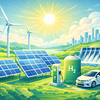
Key demands include incentives for green hydrogen, energy storage, transmission modernisation, and domestic manufacturing to enhance energy security and project viability.
Industry expects the Budget to align clean energy expansion with manufacturing scale-up and investment certainty; eyes PLI push for polysilicon, wafers, and nil GST on battery storage
Recent growth in solar and wind capacity provides a strong foundation, but the budget must enhance fiscal incentives and support energy storage and green hydrogen to meet ambitious climate goals.
Proposals on the table include the introduction of a 'National Transmission Corridor Act' to streamline right-of-way processes, extending the ISTS waiver through 2030, and maintaining contract integrity.
India’s energy transition continues to hinge on a cohesive approach that integrates robust policies, financial incentives, and close industry collaboration.
Despite a robust pipeline of green industrial projects, execution is stalled by barriers like demand, financing, and infrastructure. Addressing these challenges is crucial for India to maintain competitiveness and capitalize on global green markets.
The upcoming Union Budget can foster growth and clean air by investing in infrastructure, particularly robust pollution monitoring and market-based regulations like emissions trading, as demonstrated by Surat's success.
Bridging the policy and implementation gap needs to be prioritised to build confidence among private capital and development finance institutions so that India can march towards its sustainability goals
Union Budget 2026 Live Updates: Finance Minister Nirmala Sitharaman all set to present the Union Budget 2026 in Parliament on February 1. Experts say the Budget could play an important role in advancing India’s Viksit Bharat vision by accelerating the country’s renewable energy push. Policy support is expected to focus on incentives for grid modernisation, energy storage and strengthening domestic clean energy manufacturing.Stronger fiscal backing for green hydrogen, solar power and battery storage could help speed up the energy transition while improving long-term energy security. With India targeting 500 GW of renewable capacity by 2030, the clean energy sector is increasingly seen as central to driving inclusive growth, boosting industrial competitiveness and meeting climate commitments.
However, potential dialogue and other factors are causing a pause in recent gains. Analysts expect prices to hover around $60 a barrel this year. Increased US oil output and production resumption in Kazakhstan also influence sentiment.
Designed to fortify grid stability and promote the swift integration of renewable resources, this plan encompasses both pumped storage projects and advanced battery systems.
Ranjit Rath says geological parallels with prolific Southeast Asian basins and improved subsurface data underpin Oil India’s confidence in Andaman exploration.
Highlighting limits of variable renewables, the Economic Survey recasts nuclear as a reliable clean energy source for hydrogen and energy-intensive industrial decarbonisation.
 Login
Login