 Login
Login
The Rising Risk Profile of CDUs in High-Density AI Data Centers
AI has pushed data center thermal loads to levels the industry has never encountered. Racks that once operated comfortably at 8-15 kW are now climbing past 50-100 kW, driving an accelerated shift toward liquid cooling. This transition is happening so quickly that many organizations are deploying new technologies faster than they can fully understand the operational risks.
In my recent five-part LinkedIn series:
- 2025 U.S. Data Center Incident Trends & Lessons Learned (9-15-2025)
- Building Safer Data Centers: How Technology is Changing Construction Safety (10-1-2025)
- The Future of Zero-Incident Data Centers (1ind0-15-2025)
- Measuring What Matters: The New Safety Metrics in Data Centers (11-1-2025)
- Beyond Safety: Building Resilient Data Centers Through Integrated Risk Management (11-15-2025)
— a central theme emerged: as systems become more interconnected, risks become more systemic.
That same dynamic influenced the Direct-to-Chip Cooling: A Technical Primer article that Steve Barberi and I published in Data Center POST (10-29-2025). Today, we are observing this systemic-risk framework emerging specifically in the growing role of Cooling Distribution Units (CDUs).
CDUs have evolved from peripheral equipment to a true point of convergence for engineering design, controls logic, chemistry, operational discipline, and human performance. As AI rack densities accelerate, understanding these risks is becoming essential.
CDUs: From Peripheral Equipment to Critical Infrastructure
Historically, CDUs were treated as supplemental mechanical devices. Today, they sit at the center of the liquid-cooling ecosystem governing flow, pressure, temperature stability, fluid quality, isolation, and redundancy. In practice, the CDU now operates as the boundary between stable thermal control and cascading instability.
Yet, unlike well-established electrical systems such as UPSs, switchgear, and feeders, CDUs lack decades of operational history. Operators, technicians, commissioning agents, and even design teams have limited real-world reference points. That blind spot is where a new class of risk is emerging, and three patterns are showing up most frequently.
A New Risk Landscape for CDUs
- Controls-Layer Fragility
- Controls-related instability remains one of the most underestimated issues in liquid cooling. Many CDUs still rely on single-path PLC architectures, limited sensor redundancy, and firmware not designed for the thermal volatility of AI workloads. A single inaccurate pressure, flow, or temperature reading can trigger inappropriate or incorrect system responses affecting multiple racks before anyone realizes something is wrong.
- Pressure and Flow Instability
- AI workloads surge and cycle, producing heat patterns that stress pumps, valves, gaskets, seals, and manifolds in ways traditional IT never did. These fluctuations are accelerating wear modes that many operators are just beginning to recognize. Illustrative Open Compute Project (OCP) design examples (e.g., 7–10 psi operating ranges at relevant flow rates) are helpful reference points, but they are not universal design criteria.
- Human-Performance Gaps
-
- CDU-related high-potential near misses (HiPo NMs) frequently arise during commissioning and maintenance, when technicians are still learning new workflows. For teams accustomed to legacy air-cooled systems, tasks such as valve sequencing, alarm interpretation, isolation procedures, fluid handling, and leak response are unfamiliar. Unfortunately, as noted in my Building Safer Data Centers post, when technology advances faster than training, people become the first point of vulnerability.
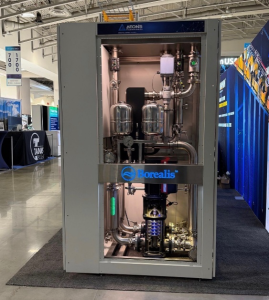
Photo Image: Borealis CDU
Photo by AGT
Additional Risks Emerging in 2025 Liquid-Cooled Environments
Beyond the three most frequent patterns noted above, several quieter but equally impactful vulnerabilities are also surfacing across 2025 deployments:
- System Architecture Gaps
- Some first-generation CDUs and loops lack robust isolation, bypass capability, or multi-path routing. Single points of failure, such as a valve, pump, or PLC drive full-loop shutdowns, mirroring the cascading-risk behaviors highlighted in my earlier work on resilience.
- Maintenance & Operational Variability
-
- SOPs for liquid-cooling vary widely across sites and vendors. Fluid handling, startup/shutdown sequences, and leak-response steps remain inconsistent and/or create conditions for preventable HiPo NMs.
- Chemistry & Fluid Integrity Risks
-
- As highlighted in the DTC article Steve Barberi and I co-authored, corrosion, additive depletion, cross-contamination, and stagnant zones can quietly degrade system health. ICP-MS analysis and other advanced techniques are recommended in OCP-aligned coolant programs for PG-25-class fluids, though not universally required.
- Leak Detection & Nuisance Alarms
-
- False positives and false negatives, especially across BMS/DCIM integrations, remain common. Predictive analytics are becoming essential despite not yet being formalized in standards.
- Facility-Side Dynamics
-
- Upstream conditions such as temperature swings, ΔP fluctuations, water hammer, cooling tower chemistry, and biofouling often drive CDU instability. CDUs are frequently blamed for behavior originating in facility water systems.
- Interoperability & Telemetry Semantics
-
- Inconsistent Modbus, BACnet, and Redfish mappings, naming conventions, and telemetry schemas create confusion and delay troubleshooting.
Best Practices: Designing CDUs for Resilience, Not Just Cooling Capacity
If CDUs are going to serve as the cornerstone of liquid cooling in AI environments, they must be engineered around resilience, not simply performance. Several emerging best practices are gaining traction:
- Controls Redundancy
- Dual PLCs, dual sensors, and cross-validated telemetry signals reduce single-point failure exposure. These features do not have prescriptive standards today but are rapidly emerging as best practices for high-density AI environments.
- Real-Time Telemetry & Predictive Insight
- Detecting drift, seal degradation, valve lag, and chemistry shift early is becoming essential. Predictive analytics and deeper telemetry integration are increasingly expected.
- Meaningful Isolation
- Operators should be able to isolate racks, lines, or nodes without shutting down entire loops. In high-density AI environments, isolation becomes uptime.
- Failure-Mode Commissioning
- CDUs should be tested not only for performance but also for failure behavior such as PLC loss, sensor failures, false alarms, and pressure transients. These simulations reveal early-life risk patterns that standard commissioning often misses.
- Reliability Expectations
- CDU design should align with OCP’s system-level reliability expectations, such as MTBF targets on the order of >300,000 hours for OAI Level 10 assemblies, while recognizing that CDU-specific requirements vary by vendor and application.
Standards Alignment
The risks and mitigation strategies outlined above align with emerging guidance from ASHRAE TC 9.9 and the OCP’s liquid-cooling workstreams, including:
- OAI System Liquid Cooling Guidelines
- Liquid-to-Liquid CDU Test Methodology
- ASTM D8040 & D1384 for coolant chemistry durability
- IEC/UL 62368-1 for hazard-based safety
- ASHRAE 90.4, PUE/WUE/CUE metrics, and
- ANSI/BICSI 002, ISO/IEC 22237, and Uptime’s Tier Standards emphasizing concurrently maintainable infrastructure.
These collectively reinforce a shift: CDUs must be treated as availability-critical systems, not auxiliary mechanical devices.
Looking Ahead
The rise of CDUs represents a moment the data center industry has seen before. As soon as a new technology becomes mission-critical, its risk profile expands until safety, engineering, and operations converge around it. Twenty years ago, that moment belonged to UPS systems. Ten years ago, it was batteries. Now, in AI-driven environments, it is the CDU.
Organizations that embrace resilient CDU design, deep visibility, and operator readiness will be the ones that scale AI safely and sustainably.
# # #
About the Author
Walter Leclerc is an independent consultant and recognized industry thought leader in Environmental Health & Safety, Risk Management, and Sustainability, with deep experience across data center construction and operations, technology, and industrial sectors. He has written extensively on emerging risk, liquid cooling, safety leadership, predictive analytics, incident trends, and the integration of culture, technology, and resilience in next-generation mission-critical environments. Walter led the initiatives that earned Digital Realty the Environment+Energy Leader’s Top Project of the Year Award for its Global Water Strategy and recognition on EHS Today’s America’s Safest Companies List. A frequent global speaker on the future of safety, sustainability, and resilience in data centers, Walter holds a B.S. in Chemistry from UC Berkeley and an M.S. in Environmental Management from the University of San Francisco.
The post The Rising Risk Profile of CDUs in High-Density AI Data Centers appeared first on Data Center POST.