Reading view

The Data Center Boom Is Concentrated in the U.S.


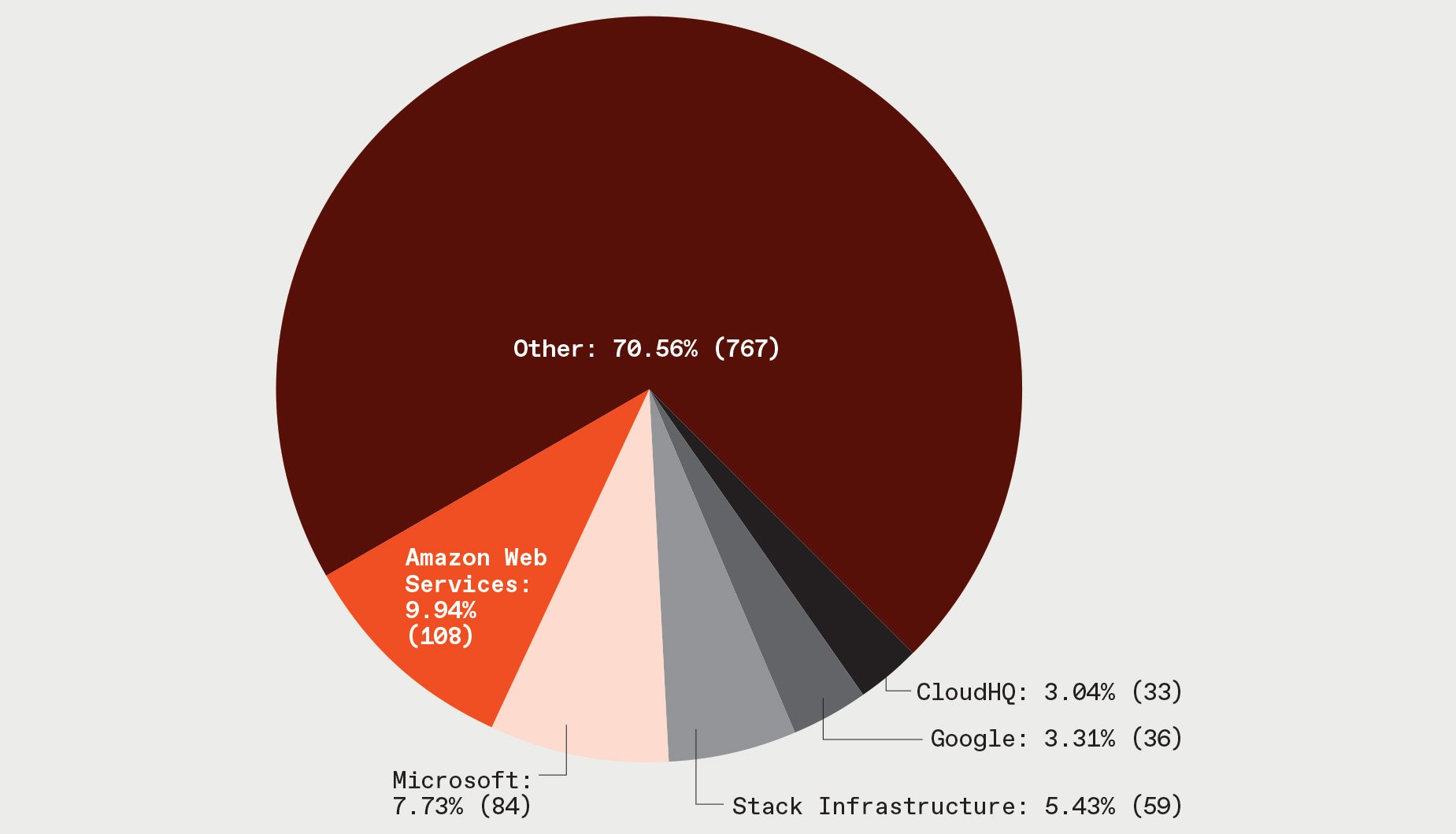
If a data center is moving in next door, you probably live in the United States. More than half of all upcoming global data centers—as indicated by land purchased for data centers not yet announced, those under construction, and those whose plans are public—will be developed in the United States.

chart visualization

And these figures are likely underselling the near-term data-center dominance of the United States. Power usage varies widely among data centers, depending on land availability and whether the facility will provide xhttps://spectrum.ieee.org/data-center-liquid-cooling or mixed-use services, says Tom Wilson, who studies energy systems at the Electric Power Research Institute. Because of these factors, “data centers in the U.S. are much larger on average than data centers in other countries,” he says.


Wilson adds that the dataset you see here—which comes from the analysis firm Data Center Map—may undercount new Chinese data centers because they are often not announced publicly. Chinese data-center plans are “just not in the repository of information used to collect data on other parts of the world,” he says. If information about China were up-to-date, he would still expect to see “the U.S. ahead, China somewhat behind, and then the rest of the world trailing.”

chart visualization

One thing that worries Wilson is whether the U.S. power grid can meet the rising energy demands of these data centers. “We’ve had flat demand for basically two decades, and now we want to grow. It’s a big system to grow,” he notes.

chart visualization

He thinks the best solution is asking data centers to be more flexible in their power use, maybe by scheduling complex computation for off-peak times or maintaining on-site batteries, removing part of the burden from the power grid. Whether such measures will be enough to keep up with demand remains an open question.

  •  

ZincFive Earns Four Wins at the 2025 Power Technology Excellence Awards

ZincFive® has closed out 2025 with major industry recognition, earning top honors in the 2025 Power Technology Excellence Awards across four categories: Innovation, Product Launch, Safety, and Environmental Excellence. Powered by GlobalData’s business intelligence, the awards celebrate companies pushing the global power sector forward, and this year’s results underscore ZincFive’s accelerating leadership.

The wins reflect the company’s momentum as demand for high-power, low-impact energy storage solutions continues to intensify. With nearly 2 gigawatts of nickel-zinc (NiZn) systems deployed or contracted worldwide, ZincFive is helping operators meet the explosive requirements of AI-driven data centers while strengthening resilience and reducing environmental impact.

At the center of this progress is ZincFive’s Immediate Power Solutions portfolio, which blends patented NiZn chemistry with intelligent system-level engineering. These systems deliver millisecond-level responsiveness to dynamic loads and operate reliably at higher temperatures, reducing cooling requirements and improving overall efficiency. The award-winning BC 2 AI UPS Battery Cabinet extends this approach even further, providing fast-load support for GPU-intensive AI applications and traditional outage protection in a single compact system. By consolidating functions that once required multiple layers of equipment, it frees valuable white space and simplifies power architecture.

ZincFive’s wins also reinforce the company’s long-standing commitment to safety and sustainability. NiZn technology is inherently safe, built from abundant, recyclable materials and provides lifetime greenhouse gas emissions that are 25 to 50 percent lower than traditional lead-acid and lithium-ion options. This aligns with growing industry expectations for cleaner, more responsible power infrastructure.

These latest honors join a growing list of accolades, including recent recognition on TIME’s 2025 World’s and America’s Top GreenTech Companies lists, the 2024 Edison Award™, CleanTech Breakthrough’s 2024 Overall Innovation of the Year, and more, signaling a defining moment for ZincFive as it continues to set new benchmarks in mission-critical power.

To learn more, reach the full release here.

The post ZincFive Earns Four Wins at the 2025 Power Technology Excellence Awards appeared first on Data Center POST.

  •  

CloudKleyer Begins DigitalH2-Ops Development – Supported by EU Funding and the State of Hesse

Originally posted on TelecomNewsroom.

CloudKleyer GmbH has partnered with Archigas GmbH to commence DigitalH2-Ops, a two-year initiative dedicated to building a federated and regulation-compliant data infrastructure tailored for the hydrogen market.

DigitalH2-Ops focuses on gathering and refining data throughout the entire hydrogen supply chain, covering production, storage systems, transportation routes, and consumption. The initiative creates a unified digital interface for data accessibility, enhances cooperation between businesses, and ensures secure data transmission that meets European compliance standards.

Leveraging automated processing and instant analytics, the system contributes to improved efficiency, greater transparency, and stronger innovative capability across the hydrogen ecosystem.

To continue reading, please click here.

The post CloudKleyer Begins DigitalH2-Ops Development – Supported by EU Funding and the State of Hesse appeared first on Data Center POST.

  •  

The Speed of Burn

It takes the Earth hundreds of millions of years to create usable energy.

It takes us milliseconds to burn it.

That imbalance between nature’s patience and our speed has quietly become one of the defining forces of our time.

All the power that moves our civilization began as light. Every joule traces back to the Big Bang, carried forward by the sun, stored in plants, pressed into fuels, and now released again as electricity. The current that runs through a data center today began its journey billions of years ago…ancient energy returning to motion through modern machines.

And what do we do with it? We turn it into data.

Data has become the fastest-growing form of energy use in human history. We are creating it faster than we can process, understand, or store it. The speed of data now rivals the speed of light itself, and it far exceeds our ability to assign meaning to it.

The result is a civilization burning geological time to produce digital noise.

The Asymmetry of Time

A hyperscale data center can take three to five years to design, permit, and build. The GPUs inside it process information measured in trillionths of a second. That mismatch; years to construct, microseconds to consume, defines the modern paradox of progress. We are building slower than we burn.

Energy creation is slow. Data consumption is instantaneous. And between those two speeds lies a widening moral and physical gap.

When we run a model, render an image, or stream a video, we aren’t just using electricity. We’re releasing sunlight that’s been waiting since the dawn of life to be freed. The electrons are real, finite, and irreplaceable in any human timeframe — yet we treat data as limitless because its cost is invisible.

Less than two percent of all new data is retained after a year. Ninety-eight percent disappears — deleted, overwritten, or simply forgotten. Still, we build ever-larger servers to hold it. We cool them, power them, and replicate them endlessly. It’s as if we’ve confused movement with meaning.

The Age of the Cat-Video Factory

We’ve built cat-video factories on the same grid that could power breakthroughs in medicine, energy, and climate.

There’s nothing wrong with joy or humor. Those things are a beautiful part of being human. But we’ve industrialized the trivial. We’re spending ancient energy to create data that doesn’t last the length of a memory. The cost isn’t measured in dollars; it’s measured in sunlight.

Every byte carries a birth certificate of energy. It may have traveled billions of years to arrive in your device, only to vanish in seconds. We are burning time itself — and we’re getting faster at it every year.

When Compute Outruns Creation

AI’s rise has made this imbalance impossible to ignore. A one-gigawatt data campus, power consumption that once was allocated to the size of a national power plant, can now belong to a single company. Each facility may cost tens of billions of dollars and consume electricity on par with small nations. We’ve reached a world where the scarcity of electrons defines the frontier of innovation.

It’s no longer the code that limits us; it’s the current.

The technology sector celebrates speed: faster training, faster inference, faster deployment. But nature doesn’t share that sense of urgency. Energy obeys the laws of thermodynamics, not the ambitions of quarterly growth. What took the universe 18 billion years to refine (the conversion of matter into usable light) we now exhaust at a pace that makes geological patience seem quaint.

This isn’t an argument against technology. It’s a reminder that progress without proportion becomes entropy. Efficiency without stewardship turns intelligence into heat.

The Stewardship of Light

There’s a better lens for understanding this moment. One that blends physics with purpose.

If all usable power began in the Big Bang and continues as sunlight, then every act of computation is a continuation of that ancient light’s journey. To waste data is to interrupt that journey; to use it well is to extend it. Stewardship, then, isn’t just environmental — it’s existential.

In finance, CFOs use Return on Invested Power, ROIP to judge whether the energy they buy translates into profitable compute and operational output. But there’s a deeper layer worth considering: a moral ROIP. Beyond the dollars, what kind of intelligence are we generating from the power we consume? Are we creating breakthroughs in medicine, energy, and climate, or simply building larger cat-video factories?

Both forms of ROIP matter. One measures financial return on electrons; the other measures human return on enlightenment. Together, they remind us that every watt carries two ledgers: one economic, one ethical.

We can’t slow AI’s acceleration. But we can bring its metabolism back into proportion. That begins with awareness… the humility to see that our data has ancestry, that our machines are burning the oldest relics of the cosmos. Once you see that, every click, every model, every watt takes on new weight.

The Pause Before Progress

Perhaps our next revolution isn’t speed at all. Perhaps it’s stillness, the mere ability to pause and ask whether the next byte we create honors the journey of the photons that power it.

The call isn’t to stop. It’s to think proportionally.

To remember that while energy cannot be created or destroyed, meaning can.

And that the true measure of progress may not be how much faster we can turn power into data, but how much more wisely we can turn data into light again.

Sunlight is the power. Data is the shadow.

The question is whether our shadows are getting longer… or wiser.

# # #

About the Author

Paul Quigley is President of Airsys Cooling Technologies. He writes about the intersection of power, data, and stewardship. Airsys focuses on groundbreaking technology with a conscience

The post The Speed of Burn appeared first on Data Center POST.

  •  

How shippers and 3PLs are responding to tariff turmoil


Fluctuating tariffs and shifting trade policies are having a disruptive effect on global supply chains—forcing many retailers, manufacturers, and others to reconsider strategies around sourcing, production, and distribution. Yet despite the challenges, shippers and their third-party logistics service providers (3PLs) appear confident in their ability to adapt to tariffs, according to the “2026 Third-Party Logistics Study.” That optimism may be fueled by lessons learned during the pandemic, which exposed vulnerabilities in global supply chains and accelerated shippers’ and 3PLs’ efforts to build resilience into their own supply chains, the study authors wrote.

So how are shippers and 3PLs applying those Covid-era lessons to today’s world? What are they doing to mitigate the impact of tariff volatility? How are they handling the added costs? What follows is a snapshot of the study’s findings:


  •