 Login
Login
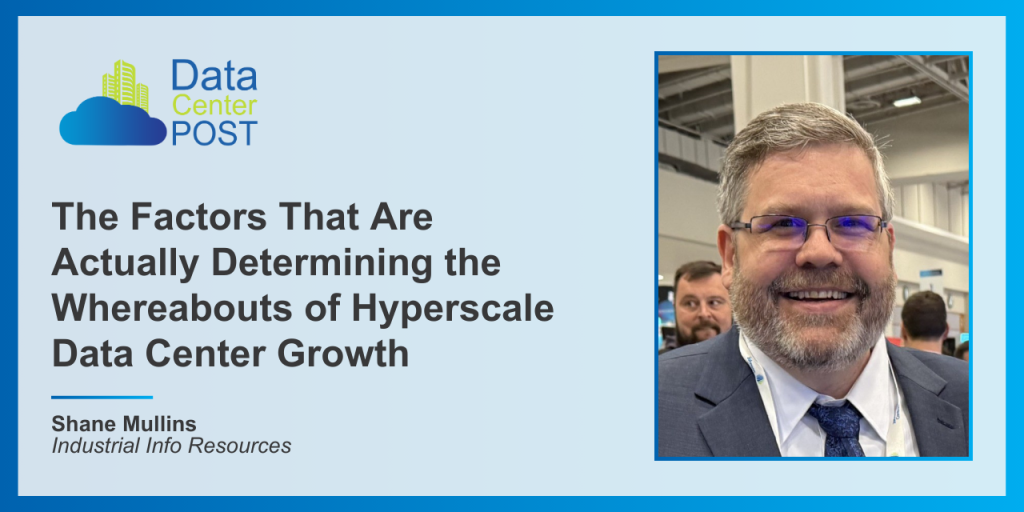
The Factors That Are Actually Determining the Whereabouts of Hyperscale Data Center Growth
Individual data centers are now being planned with power loads that exceed those of America’s largest nuclear plants. This is happening for the first time in U.S. history, and it’s reshaping how and where AI infrastructure can realistically be built.
The scale of demand is like nothing we’ve seen before, and developers who once focused on site access, tax incentives, and interconnection speed are now having to evaluate something far more fundamental. They’re assessing whether the grid can deliver the gigawatts of reliable capacity that AI truly requires. This shift is redrawing the map of U.S. data center development, simply because traditional markets are straining under this new, unprecedented load. As a result, new regions are emerging as contenders.
There’s no shortage of opinions on which states are best positioned to capitalize on this moment. Environmentally, states like Texas, Montana, South Dakota, and Nebraska offer low-carbon power, minimal water stress, and long-term sustainability advantages that could help hyperscalers move toward net-zero goals. But development doesn’t always follow ideals. It follows infrastructure. And today, project velocity is rapidly accelerating in states with existing fiber, redundant grid access, fast permitting, and an experienced labor pool, not just green credentials.
The Power Constraint Reality
Transmission and generation limitations have become the number-one barrier to new development. Utilities that once welcomed projects are now warning developers about decade-long delays. In San Antonio, for example, utility officials are telling data center companies that additional capacity may not be available until 2032.
Five years ago, a typical large data center might have drawn 20 to 50 megawatts. Today, AI-focused facilities are routinely planned at 300 megawatts or more; in theory, that’s enough power to sustain a small city. The U.S. currently has 40 gigawatts of operational data center capacity, up from just 26 gigawatts at the end of 2023, and another 24 gigawatts is under construction. In other words, total capacity is set to double in roughly two years.
At Industrial Info Resources, we’re tracking $3.3 trillion in global data center infrastructure investments, including $1 trillion announced in the U.S. in just the past nine months. Yet much of the transmission system these projects rely on is more than 40 years old, strained, and unable to accommodate this surge without major upgrades.
Every data center project is now, ultimately, a power project.
Why Traditional Hotspots Are Reaching Capacity
States like Texas, Ohio, Georgia, and Illinois rose to prominence because of low-cost electricity, abundant natural gas, deep labor pools, and cooperative regulatory environments. But even these markets are showing signs of saturation. Interconnection queues are backed up, delivery timelines are slipping, and developers who once viewed these areas as infinitely scalable are reassessing their options.
The PJM Interconnection, a regional transmission organization covering 13 states, recorded an 800% spike in wholesale capacity prices in its latest auction. The surge was driven by tightening reserve margins and insufficient baseload additions.
Still, not all leading markets are losing momentum; the reality is much more nuanced. Let me explain:
1) Virginia Still Dominates, Here’s Why
Roughly 70% of the world’s internet traffic flows through Loudoun County. That alone keeps Northern Virginia at the top of the list. Add unmatched fiber density, low latency access to East Coast population centers, $50 billion in Dominion Energy grid upgrades, and powerful tax incentives, and one could argue that Virginia remains the most competitive and strategically essential data center market in the world.
2) Despite the Circumstances, Texas Remains a Growth Engine
Texas offers massive wind, solar, and battery energy storage growth, abundant natural gas, and a regulatory environment that supports rapid load growth. ERCOT’s structure allows for faster interconnections, and the state is fast-tracking permits for behind-the-meter natural gas plants to bridge developers until zero-carbon grid supply scales. Again, one could argue that this combination keeps Texas squarely in the number-one or number-two position for AI capacity additions.
3) And the Next Tier of High-Velocity Markets
Georgia continues to attract hyperscale interest with low power prices, tax credits, and significant fiber expansion across the Southeast. This draws development into Alabama and Florida as well. Other hot markets remain in Pennsylvania, Utah, Arizona, Illinois, and Ohio due to their mix of low-cost power, fiber proximity, and access to skilled labor.
The Behind-the-Meter Power Trend
With grid availability tightening, more operators are turning to behind-the-meter solutions such as natural gas fuel cells, turbines, and reciprocating engines. These systems provide bridge power while utilities work through multi-year transmission expansions, and states that permit these assets quickly have a clear advantage.
Even operators committed to 100% renewable energy now recognize the need for reliable natural gas backup to maintain uptime and support local grid stability. A Duke University study found that 40 demand-curtailment events could enable 75 gigawatts of additional data center capacity without requiring new transmission.
The study illustrates a clear reality: flexible load management and temporary curtailment will become essential tools for enabling the next wave of AI-driven growth.
What Emerging States Need to Win
For states seeking to break into the market, the fundamentals matter most. This looks like lower-cost electricity, abundant natural gas, rural land with favorable tax structures, and large parcels suitable for multi-hundred-megawatt campuses.
Arizona is a great example. The state is developing a new natural gas pipeline from the Permian Basin, specifically to support its expanding data center ecosystem. But not all announced projects move forward. Constraints in interconnection studies, available power, or realistic timelines cause many proposals to stall. Tracking approved projects versus announced projects is essential to understanding true market momentum, especially in an industry where nondisclosure agreements tend to limit visibility.
The Reliability Crisis and the Path Forward
From roughly 2014 to 2024, U.S. electricity demand was essentially flat. Today, it is growing about 2% annually, driven largely by AI. The challenge is that renewable energy has expanded far faster than the dispatchable baseload required to support it, widening the reliability gap.
Meeting future AI needs will require a multi-pronged strategy that entails new natural gas plants, delayed coal retirements over the next five to six years, expanded battery storage, and eventually next-generation nuclear. Several major technology companies are already investing in small modular reactors as part of their long-term portfolios.
Data centers themselves can help stabilize the grid through battery storage deployments, demand-response participation, and flexible load practices. But long-term success ultimately depends on whether states can modernize transmission infrastructure, streamline interconnection processes, and commit to realistic baseload planning.
The states that move decisively to address these constraints, and align their infrastructure with the power-first reality of AI, will capture an outsized share of the coming investment. AI-driven demand is not slowing, and the next chapter of America’s energy and technology landscape will be written by those preparing for this moment now.
# # #
About the Author
Shane Mullins brings over 30 years of experience in energy market intelligence and database management to his role at Industrial Info Resources. He specializes in product development for energy equipment and service providers, leveraging decades of industry insight to help clients make informed, data-driven decisions in a rapidly evolving energy landscape.
The post The Factors That Are Actually Determining the Whereabouts of Hyperscale Data Center Growth appeared first on Data Center POST.