
Reading view

Data Center Liquid Cooling Market to Surpass USD 27.1 Billion by 2035
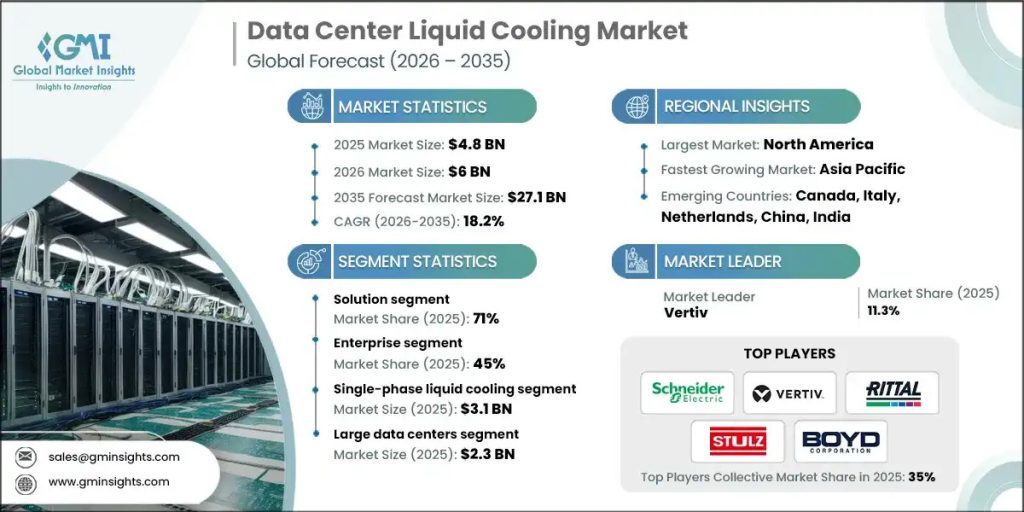
The global data center liquid cooling market was valued at USD 4.8 billion in 2025 and is estimated to grow at a CAGR of 18.2% to reach USD 27.1 billion by 2035, according to a recent report by Global Market Insights Inc.

Rising energy costs, coupled with stringent sustainability requirements, are accelerating the adoption of liquid cooling technologies across data centers. Liquid cooling systems offer significantly lower Power Usage Effectiveness (PUE) ratios ranging from 1.05 to 1.15 compared to 1.4-1.8 for traditional air-cooled facilities, which directly lowers electricity consumption and reduces carbon emissions. Regulatory mandates, including the EU Energy Efficiency Directive, Germany’s Energy Efficiency Act targeting PUE 1.3 by 2027, and California’s energy efficiency standards, are pushing operators toward advanced cooling solutions.

Furthermore, the ability of liquid cooling systems to recover waste heat for district heating or industrial processes transforms data centers into contributors to circular energy economies, supporting corporate net-zero initiatives and enhancing operational sustainability. North America continues to lead the data center liquid cooling market, driven by a dense concentration of hyperscale cloud operators, semiconductor manufacturers, and systems integrators deploying high-density AI and HPC infrastructure.

The solution segment held a 71% share in 2025 and is forecast to grow at a CAGR of 15% from 2026 to 2035. Direct-to-chip cooling is the fastest-growing technology, employing cold plates and micro-channel coolers attached directly to processors, GPUs, and memory to remove 60-80% of heat before it enters the air. These systems circulate coolants such as water with inhibitors or glycol mixtures across chip surfaces, achieving thermal resistances as low as 0.01-0.05°C/W.

The single-phase liquid cooling systems segment reached USD 3.1 billion in 2025. These systems maintain coolant in liquid form throughout the cycle, transferring heat via conduction and convection without phase change. Coolants circulate through cold plates, immersion tanks, or heat exchangers at 18-50°C, depending on design, while facility chillers, dry coolers, or towers remove heat from the loop.

U.S. data center liquid cooling market captured USD 1.29 billion in 2025. Federal initiatives, including AI and HPC programs, semiconductor funding under the CHIPS Act, and defense modernization projects incorporating AI, are key drivers of liquid cooling adoption in public sector data centers.

Leading companies in the data center liquid cooling market include Alfa Laval, Asetek, Boyd, CoolIT Systems, Green Revolution Cooling, LiquidStack, Rittal, Schneider Electric (Motivair), Stulz, and Vertiv. Key strategies adopted by companies in the market focus on technological innovation, such as developing high-efficiency immersion and direct-to-chip cooling solutions for next-generation processors and GPUs. Firms are forming strategic partnerships with hyperscale cloud providers, semiconductor manufacturers, and HPC integrators to expand deployment. Investments in R&D for energy-efficient, modular, and scalable systems strengthen product differentiation. Companies are also emphasizing geographic expansion into emerging markets, supporting sustainability initiatives, and integrating IoT-enabled monitoring tools to optimize performance, enhance reliability, and maintain long-term client relationships.

The post Data Center Liquid Cooling Market to Surpass USD 27.1 Billion by 2035 appeared first on Data Center POST.

  •  

Union Budget 2026–27: Higher Clean Energy Allocation To Boost Manufacturing, Storage, And Infrastructure

The Union Budget 2026–27 presents a clear and steady roadmap for India’s economic growth with a strong focus on self-reliance, infrastructure expansion, and clean energy transition. The overall tone of […]

The post Union Budget 2026–27: Higher Clean Energy Allocation To Boost Manufacturing, Storage, And Infrastructure appeared first on SolarQuarter.

  •  

Union Budget 2026: Solar Power Anchors India’s Clean Energy Transition with Focus on Manufacturing, Storage, and Grid Resilience

The Union Budget 2026 prioritizes clean energy, particularly solar power, as central to India's growth strategy. Key allocations support both decentralised and utility-scale solar projects, alongside carbon management and manufacturing initiatives. The budget aims to enhance grid resilience, improve financing, and promote skills development, ensuring a robust and sustainable energy transition.

The post Union Budget 2026: Solar Power Anchors India’s Clean Energy Transition with Focus on Manufacturing, Storage, and Grid Resilience appeared first on SolarQuarter.

  •  

Africa’s Solar Surge: Balancing Growth, Access, And Environmental Challenges

rows of solar modules in photovoltaic power station

Africa is witnessing a significant rise in solar energy adoption, offering hope for a continent long challenged by limited access to electricity. Recent data from the Kigali-based Africa Solar Industry […]

The post Africa’s Solar Surge: Balancing Growth, Access, And Environmental Challenges appeared first on SolarQuarter.

  •  

Measured Optimism: Balancing Growth and Realism in the Global Data Center Market

Understanding What’s Next for Digital Infrastructure

At this year’s infra/STRUCTURE Summit 2025, held at the Wynn Las Vegas, industry leaders came together to unpack the state of digital infrastructure in an era defined by AI-driven demand and hyperscale expansion.

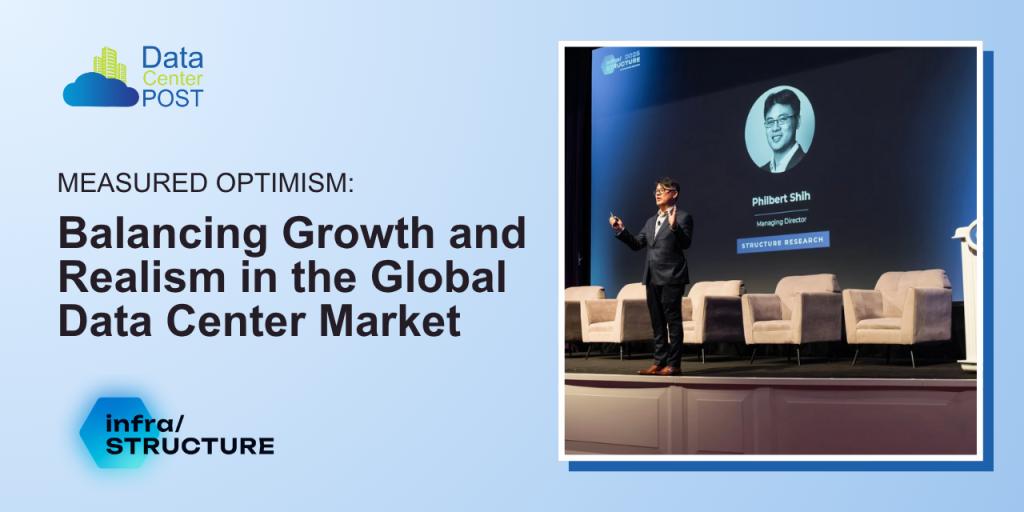
One of the standout sessions of the event was “Measured Optimism,” led by Philbert Shih, Managing Director of Structure Research. Known for his data-first insights and global perspective, Shih provided an in-depth look at where the data center market stands today, and where it’s heading next.

His central question set the tone: Are we in a period of sustainable growth, or are we overbuilding?

A Balanced View: Bullish but Realistic

Shih began by acknowledging the debate between the “bulls” and “bears” in digital infrastructure, those who see unbounded opportunity and those who warn of a potential correction.

While recognizing some speculative trends, such as “fake data centers” and build pauses in certain regions, Shih urged attendees to take a longer view.

“There’s a lot of interest in the space, a lot of people with assets to develop,” Shih said. “But the fundamentals remain strong. We’ve seen time and again that this sector has the ability to absorb and grow through cycles.”

Shih drew comparisons to previous market phases. From the dot-com era to the rise of cloud computing, he suggested that what we’re seeing today is a natural evolution, not a bubble.

What the Data Shows

Shih supported his analysis with Structure Research’s latest findings:

  • Demand Continues to Outpace Supply. Hyperscalers and AI workloads are driving record demand. “We consistently see management teams reporting more demand than they can support,” Shih shared.
  • AI is an Accelerant, Not a Disruption. Shih explained that Meta’s recent build pause was less about demand softening and more about re-architecting for AI infrastructure. “AI is reshaping how capacity is planned and deployed,” he said.
  • Global Growth Momentum. While North America remains the largest market, growth across Europe and Asia is accelerating. Chinese and regional cloud providers are increasingly driving new development around the world.
  • Healthy Cycles, Not Cracks. Shih described the current slowdown in some areas as part of the natural “build–pause–absorb” cycle that defines infrastructure development. “Infrastructure doesn’t grow in a straight line,” he noted.

Collaboration Over Competition

A recurring theme throughout Shih’s presentation was partnership. The idea that hyperscalers might replace colocation providers with self-built facilities has largely given way to collaboration.

“There’s more cooperation between hyperscalers and colocation providers than ever before,” Shih said. “These partnerships are becoming essential to meeting global demand efficiently and sustainably.”

Shih also highlighted opportunities in pre-development and edge-scale projects, where new entrants and established providers alike are finding innovative ways to meet demand closer to users.

A Measured but Positive Outlook

Despite capital market challenges, supply chain constraints, and growing power demands, Shih’s conclusion was optimistic, grounded in data and real-world momentum.

“I’m more confident today than I was two years ago,” Shih said. “We’re not overbuilding, we’re building smarter, globally, and with a clearer sense of what’s next.”

The session ended with a strong message: while the sector must navigate its cycles carefully, the long-term trajectory remains firmly upward.

Infra/STRUCTURE 2026: Save the Date

Want to tune in live, receive all presentations, gain access to C-level executives, investors and industry leading research? Then save the date for infra/STRUCTURE 2026 set for October 7-8, 2026 at The Wynn Las Vegas. Pre-Registration for the 2026 event is now open, and you can visit www.infrastructuresummit.io to learn more.

The post Measured Optimism: Balancing Growth and Realism in the Global Data Center Market appeared first on Data Center POST.
  •