Normal view

Received yesterday — 31 January 2026 SolarPACES

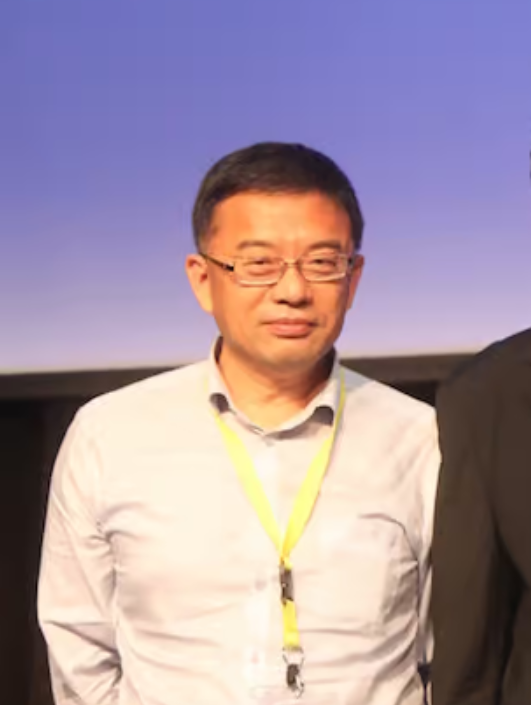
Wang Zhifeng wins China’s Science and Technology Award 2025

26 January 2026 at 23:41

Source: China Solar thermal Alliance

On November 28, 2025, the China Renewable Energy Society (CRES) announced the list of winners of 2025 CRES Science and Technology Awards, including 10 first prize winners, 12 second prize winners, 13 third prize winners, 1 Science and Technology Achievement Award winner, five Science and Technology Innovation Award winners, and 10 Young Scientist Award winners.

Dr. Wang Zhifeng, researcher at the Institute of Electrical Engineering, Chinese Academy of Sciences (IEECAS) and Chairman of CRES Concentrating Solar Power Committee, won the Science and Technology Achievement Award.

Wang Zhifeng, born in October 1963, holding a PhD in Engineering Thermophysics from Tsinghua University, Researcher and PhD Supervisor at IEECAS, Chairman of China Solar Thermal Alliance (CSTA), Vice President of the IEA-SolarPACES, Chairman of CRES Concentrating Solar Power Committee, Vice Chairman of the Solar Thermal Power Generation Professional Committee of China Electrotechnical Society (CES), Vice Chairman of the National Solar Thermal Power Generation Standardization Committee, one of the first specially appointed core backbone researchers of the CAS (2015), one of the first recipients of the National “Ten Thousand Talents Program” (2014), expert receiving special allowance of the State Council, winner of the Outstanding Contribution Award for Solar Thermal Energy Utilization in China (2016). He has twice been awarded the title of CAS Excellent Doctoral Supervisor. He has published a monograph on concentrating solar power (in Chinese, English, and Arabic), titled Design of Solar Thermal Power Plants, and more than 70 papers.

He has long been committed to the modeling and optimization of concentrating solar power (CSP) systems, as well as the research on photothermal conversion equipment and thermal energy storage. He proposed that the core scientific problem of solar thermal power generation is the coupling of unsteady light-heat-work processes, presented a roadmap for the development CSP technology, and proposed the concept of the 4th-generation CSP technology. He has presided over numerous major projects financed by the 863 Program and 973 Program (both are National High-Technology R&D Programs of China), the National Key R&D Program of China, and the National Natural Science Foundation of China, achieving multiple breakthroughs. As the project leader, he has led the construction of:

Asia’s first solar tower plant (2012);

China’s first cross-seasonal solar thermal energy storage project, achieving 210-day continuous thermal energy storage across different seasons (2021);

the world’s first CSP kiln for cement and ceramics firing (2022); and

the world’s first supercritical CO2 CSP system (2024).

The post Wang Zhifeng wins China’s Science and Technology Award 2025 appeared first on SolarPACES.

China connects 9 more CSP projects in 2025 for 27 total

26 January 2026 at 18:28


Source: China Solar Thermal Alliance: Blue Book 2025

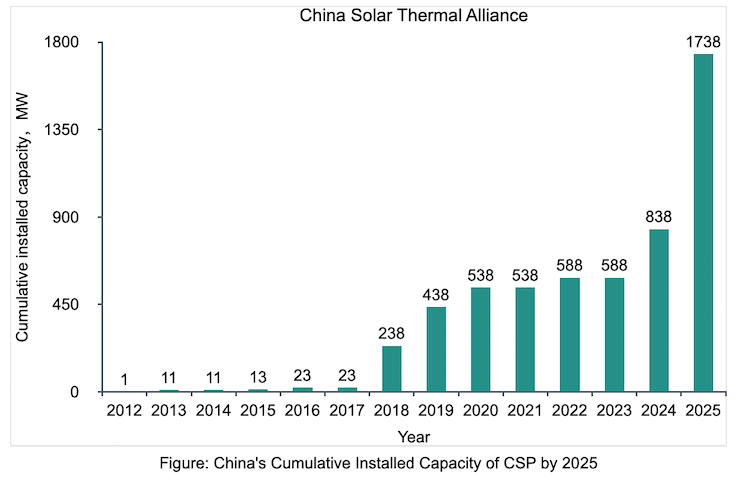
In 2025, China connected 9 new CSP plants to the grid, with a total installed capacity of 900 MW. By the end of 2025, China had built 27 CSP plants/systems, with a cumulative installed capacity of 1738.2 MW (including the country’s first 200 kW supercritical carbon dioxide solar thermal power experimental system), representing a 107% increase compared to 2024 and ranking third globally. Among this total, the installed capacity of grid-connected CSP plants reached 1720 MW.

On January 21, 2026, the Blue Book of China’s Concentrating Solar Power Industry (2025) (hereinafter referred to as the Blue Book) was officially released. Compiled jointly by the China Solar Thermal Thermal Alliance (CSTA) and the CSP Committee of the China Renewable Energy Society, the Blue Book was approved for publication by the Expert Committee of the CSTA.

Article 25 of the Energy Law of the People’s Republic of China, which came into effect on January 1, 2025, stipulates that “Actively develop Concentrating Solar Power (CSP) “, laying a solid legal foundation for the sustainable development of the sector.

In 2025, relevant national authorities issued more than ten policy documents related to CSP. Among them, the Some Opinions on Promoting the Large-scale Development of CSP, jointly issued by the National Development and Reform Commission and the National Energy Administration on December 23, 2025, is a specialized policy document.

The policy document explicitly states that CSP is an effective means to achieve the safe and reliable replacement of traditional energy with new energy, and a robust pillar for accelerating the construction of a new power system. The document emphasizes giving full play to the supporting and regulating role of solar thermal power generation in the new power system, tapping its potential as a green, low-carbon baseload power source, promoting the transformation of its system-level power supply value, and increasing the proportion of green and reliable supporting capacity in the new power system. It also supports solar thermal power plants equipped with electric heating systems to function as long-duration energy storage stations through the electricity market.

The Blue Book elaborates that solar thermal power generation is a system that converts solar radiation into thermal energy and then generates electricity through a heat-to-work conversion process. The main concentrating technologies for CSP include eight types: tower concentrating, trough concentrating, linear Fresnel concentrating, dish concentrating, wheel concentrating, rotating tower concentrating, secondary and multi-reflection concentrating, and transmissive concentrating.

Figure: China’s Cumulative Installed Capacity of CSP by 2025: CSTA

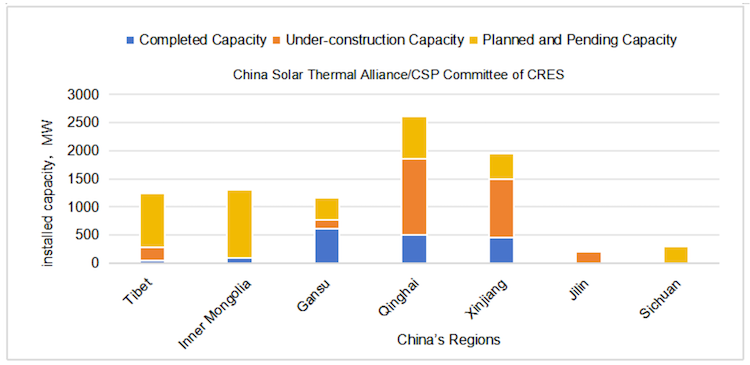
According to statistics from the CSTA and the CSP Committee of the China Renewable Energy Society, approximately 25 solar thermal power projects were in the substantive construction phase, with a total installed capacity of 3000 MW. Notably, two 350 MW standalone solar thermal power plants commenced construction at the end of 2025. The number of planned and pending solar thermal power projects in China stood at around 31, with a total installed capacity of approximately 4050 MW (excluding projects with unspecified installed capacity).

According to the target set forth in the Several Opinions on Promoting the Large-scale Development of Solar Thermal Power Generation, by 2030, China’s total installed capacity of solar thermal power generation is expected to reach around 15,000 MW. Assuming all planned and pending projects are implemented, an additional approximately 6000 MW of installed capacity will need to be developed and constructed in the next five years based on existing projects.

Figure: Expected Total Installed Capacity Based on all CSP projects in 2025 (Including Planned and Pending Projects) : CSTA

Regarding the construction of CSP plants across provinces and regions, Blue Book shows that by the end of 2025, Gansu Province had the largest cumulative installed capacity (621 MW, including the 1 MW rooftop linear Fresnel CSP system of Lanzhou Dacheng), followed by Qinghai Province (510 MW) and Xinjiang Uygur Autonomous Region (450 MW). Among under-construction projects, Qinghai Province led with the largest installed capacity under construction (1350 MW), followed by Xinjiang (1050 MW) and Tibet Autonomous Region (250 MW).

Based on public information and preliminary verification by the CSTA, Inner Mongolia Autonomous Region, Tibet Autonomous Region, and Qinghai Province ranked among the top in terms of planned and pending solar thermal power generation installed capacity, with a combined total of approximately 3000 MW.

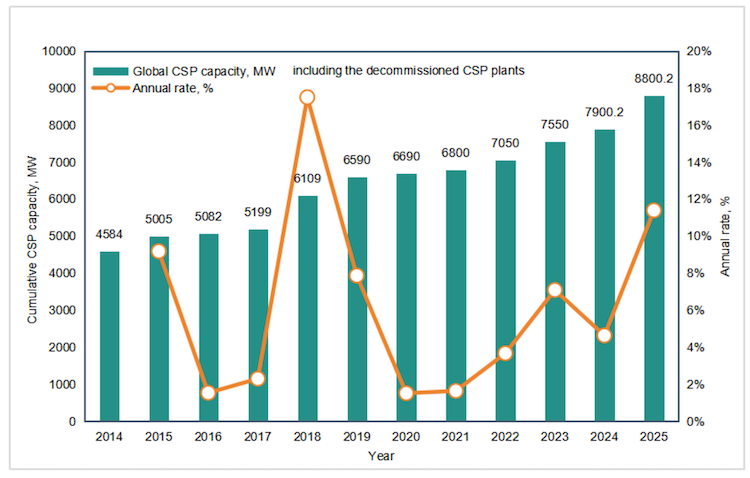
Figure: the cumulative installed capacity of CSP in major countries and regions worldwide reached 8800.2 MW (including 8 decommissioned trough power plants built in the United States in the 1980s), a year-on-year increase of 11.4%.

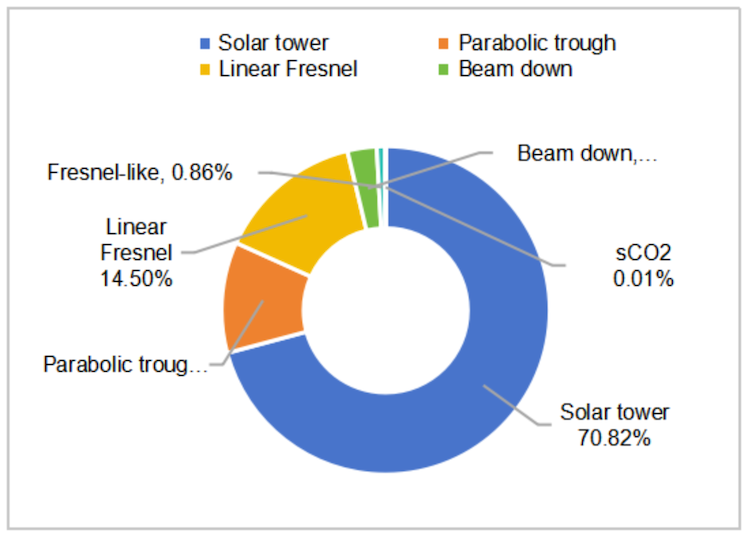
In terms of the market share of concentrating technologies, Blue Book shows that by the end of 2025, tower concentrating accounted for approximately 70.82% of China’s cumulative installed solar thermal power capacity, followed by trough concentrating (10.93%), linear Fresnel concentrating (14.50%), secondary reflection concentrating (2.88%), Fresnel-like concentrating (0.86%), and supercritical carbon dioxide concentrating (0.01%).

Figure: Market share of different concentrating technologies in China‘s cumulative installed capacity: CSTA

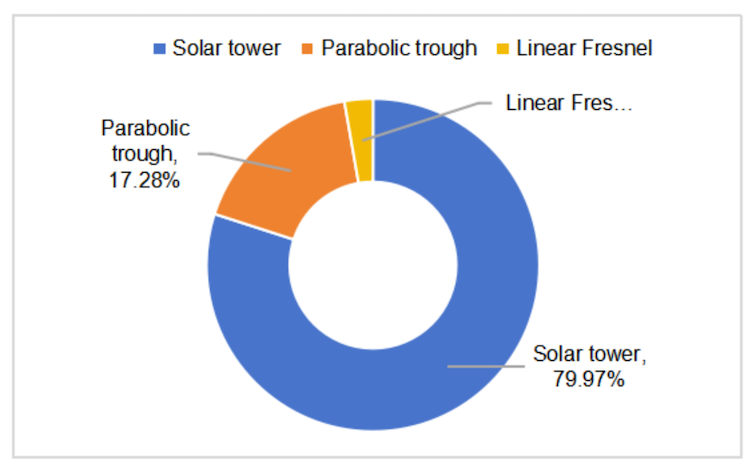
In contrast, in major overseas countries and regions, trough concentrating dominated with a share of about 79.97%, followed by tower concentrating (17.28%) and linear Fresnel concentrating (2.75%).

Figure: Market share of different concentrating technologies in overseas cumulative installed capacity: CSTA

Regarding the operation of CSP demonstration projects, the Blue Book separately presents the technical parameters and annual operation data of the first batch of solar thermal power demonstration projects. Seven early-built solar thermal power plants achieved a total power generation of over 1.1789 billion kWh in 2025. The Luneng Golmud Multi-energy Complementary Project’s 50 MW tower solar thermal power plant generated 148.2327 million kWh in 2025, a year-on-year increase of 55.92%. The CSSC New Energy Urad Middle Banner 100 MW trough solar thermal power plant achieved an annual power generation of 301 million kWh in 2025, representing an 8.27% increase compared to 2024. Both the CGN Delingha 50 MW trough solar thermal demonstration power plant and the Shouhang High-tech Dunhuang 100 MW tower solar thermal power plant hit record-high annual power generation in 2025, with a year-on-year increase of approximately 3.7%. The Qinghai Zhongkong Delingha 50 MW tower solar thermal power plant completed its annual power generation target for the fourth consecutive year. The Lanzhou Dacheng Dunhuang 50 MW linear Fresnel solar thermal power plant mainly focused on further upgrading its operation and maintenance strategies in 2025, resulting in a 13.6% increase in annual power generation. The PowerChina Gonghe 50 MW tower solar thermal power plant saw a 6.4% year-on-year growth in annual power generation in 2025. Due to unit overhauls conducted from September to October 2025, the PowerChina Hami 50 MW tower solar thermal power plant experienced an impact on power generation, with an annual output of approximately 102.99 million kWh in 2025.

In terms of the industrial chain and production capacity, based on inquiries using professional software that considered five key factors—enterprise name, business scope, company profile, brand products, and enterprise status—the Blue Book reveals that there are approximately 6,610,686 large, medium, small, and micro-sized enterprises involved in solar thermal power generation in China, including 10,722 state-owned enterprises, 533,771 private enterprises, 3,469 foreign-invested enterprises, and 458,861 micro-enterprises. Within the industrial chain, there are 36,884 manufacturing enterprises, among which 4,011 are general equipment manufacturers and 1,460 are special equipment manufacturers. In terms of manufacturing capacity, taking the production capacity of flat mirrors as an example, based on the requirement that “the mirror field area of a 100 MW power plant should not be less than 800,000 square meters in principle”, the annual production capacity of major mirror manufacturers in China can support the construction of approximately 5,300 MW of solar thermal power plants.

In terms of technological R&D and achievement recognition, China launched 4 national key R&D program projects related to solar thermal power generation in 2025, with approximately 13 such projects under implementation during the year. Regarding standards, by the end of 2025, the International Electrotechnical Commission Technical Committee 117 (IEC/TC 117) had issued 11 international standards for solar thermal power generation. China currently has approximately 33 national standards in effect for solar thermal power generation, with 5 more in the drafting stage. In 2025, the National Energy Administration issued a total of 24 industry standard plans related to solar thermal power generation. By the end of 2025, the National Solar Thermal Industry Technology Innovation Strategic Alliance had released 22 alliance standards, including 14 standards specifically for solar thermal power generation. In 2025, several technological achievements related to solar thermal power generation participated in relevant award evaluations or were recognized by national authorities, with the number of awarded or recognized achievements increasing by approximately 71% compared to 2024.

Chapter 6 of the Blue Book elaborates on the techno-economic performance of solar thermal power generation. It shows that under the full power generation mode, the calculated levelized cost of electricity (LCOE) for parabolic trough, solar tower, and linear Fresnel CSP projects ranges from 0.426 CNY/kWh to 0.5323 CNY/kWh.

In terms of carbon emission reduction, the carbon footprint factor of solar thermal power generation was 0.0312 kgCO₂e/kWh in 2024, second only to nuclear power and hydropower. In 2025, the trading volume of Chinese Certified Emission Reductions (CCER) from grid-connected solar thermal power projects reached 1.0692 million tons, with a transaction value of 87 million CNY and an average transaction price of 81.58 CNY/ton (compared to an average transaction price of 69.27 CNY/ton for grid-connected offshore wind power projects).

The Blue Book indicates that through long-term operational verification, solar thermal power plants can achieve a maximum peak regulation rate of 10% per minute; existing projects have realized continuous operation for 230 days, with an annual equivalent full-load operation hour count reaching 3,300 hours. The Blue Book puts forward the following recommendations: expedite the research and formulation of a compensation mechanism for solar thermal power generation as a supporting power source; strengthen top-level design and planning guidance; fully summarize and evaluate the construction and operational experience of integrated solar thermal and photovoltaic projects; promote the large-scale and diversified development of solar thermal power generation in a classified manner; and accelerate technological and industrial innovation in solar thermal power generation.

The Blue Book consists of 9 chapters, including: Overview of Solar Thermal Power Generation Technologies, Market Development of Solar Thermal Power Generation, Operation of Solar Thermal Power Generation Demonstration Projects, Industrial Chain of Solar Thermal Power Generation, Technological R&D of Solar Thermal Power Generation, Techno-economic Performance of Solar Thermal Power Generation, Carbon Emission Reduction of Solar Thermal Power Generation, Development Recommendations for Solar Thermal Power Generation, and Appendices.

You can download the Chinese version of the Blue Book from the official website of the China Solar Thermal Alliance.


The post China connects 9 more CSP projects in 2025 for 27 total appeared first on SolarPACES.

Glasspoint closes $20 million solar fund for global industrial heat

26 January 2026 at 18:05


DUBAI, January 26, 2026 — GlassPoint, the leader in solar industrial process heat, today announced it has closed a $20M funding round led by N.I.S. New Investment Solutions, a Liechtenstein-based asset management firm, with participation from returning investor MIG Capital. The investment will advance existing megaprojects with Searles Valley Minerals in California and Ma’aden in Saudi Arabia, as well as power expansion across the globe with a focus on projects in the U.S. Southwest, Southern Europe, the Middle East and South America.


More energy is used globally in the form of industrial process heat (26%) than all forms of electricity combined (20%), according to the International Energy Agency. Unlike electricity, industrial process heat is notoriously difficult to decarbonize, primarily due to the low cost of burning fossil fuels to generate heat.


More than 50% of industry is located in regions sunny enough to benefit from GlassPoint technology. In those locations, GlassPoint’s technology delivers superior economics for industrial process heat compared to burning fossil fuels or electrification.


“In many parts of the world, solar energy is now the lowest cost source of industrial power, creating an opportunity to simultaneously reduce operating costs and emissions,“ said Takashi Sato, Founder of N.I.S. “GlassPoint is a proven solution for this moment and has already won the confidence of some of the most discerning industrial organizations in the world, from oil and gas leaders to mining titans.”


“GlassPoint provides industry leaders with a proven solution to deliver industrial process heat at the lowest cost,” said Rod MacGregor, Chief Executive Officer at GlassPoint. “With this latest round of financing, we will expand into several new global markets where GlassPoint’s technology delivers compelling value. We look forward to helping leaders across mining, oil & gas, and building materials achieve a significant cost advantage against their competitors.”


The funding comes on the heels of GlassPoint’s partnership with Searles Valley Minerals to deploy 750 MWth of GlassPoint’s advanced solar technology to reduce costs while beginning to decommission the last two coal-fired plants in California. The company continues to advance its flagship 1.5 GWth project with Ma’aden to decarbonize a bauxite refinery in Saudi Arabia and help the Kingdom meet aggressive sustainability goals. Additionally, GlassPoint’s 330 MWth deployment in Oman has been providing steam on a daily basis since 2017.


GlassPoint’s unmatched ability to deploy at scale is based on multiple industry-first technologies.


  • GlassPoint’s Enclosed Trough is the lowest-cost way to convert sunlight into industrial heat, delivering nearly 70% of the energy available in sunlight directly to the customer.

  • GlassPoint’s Unify Storage System stores solar heat during the day and releases it at night, enabling an uninterrupted supply of clean thermal energy whenever it is needed.


With the new funding, GlassPoint is expanding its Technology Center in Stuttgart, Germany, with leading technologists and engineers. The company is also hiring business development, engineering, and finance talent in Dubai and the United States.


About GlassPoint

GlassPoint is the leader in solar industrial process heat, with its technology powering 60% of the world’s solar industrial steam capacity. With the only solar industrial process heat solution proven at scale, GlassPoint delivers superior unit economics compared to fossil fuels and electrification. GlassPoint is helping industrial organizations significantly lower costs while delivering a reliable source of carbon-free steam. The company builds, owns and operates large-scale solar steam facilities to reduce carbon emissions in hard-to-abate industries such as mining and metals, chemicals, construction materials, oil and gas, desalination and more. Learn more at glasspoint.com.


About MIG Capital

MIG Capital is one of the leading German VC investors. Through its MIG funds, MIG invests in young deep tech and life sciences companies in German-speaking Europe and beyond. To date, the company has invested over €770 million in approx. 60 start-ups. MIG portfolio companies develop innovations in areas including biopharmaceuticals, energy and environmental technologies, advanced computing, digitalization / IoT, medical technology, and digital health. The MIG investment portfolio currently consists of more than 30 companies.


MIG’s investment team is made up of a dedicated group of engineers, scientists, physicians and entrepreneurs who use analytical and creative processes to assess the risks and opportunities of business models and technologies. Their reputation, experience and network provide excellent access to companies, institutions and decision-makers to support the growth of their portfolio companies.


In recent years, MIG Capital has realized more than ten successful portfolio company sales, including Siltectra (to Infineon) and Hemovent (to MicroPort). It has placed several companies on the stock exchange including BRAIN, NFON, BioNTech, and Immatics.


For further information, please visit www.mig.agwww.mig-fonds.de or LinkedIn.


Joshua Toledo

M: 347.478.1768

The post Glasspoint closes $20 million solar fund for global industrial heat appeared first on SolarPACES.

Received before yesterday SolarPACES

12 concentrated solar and thermal energy storage tenders in China last month

16 January 2026 at 01:24


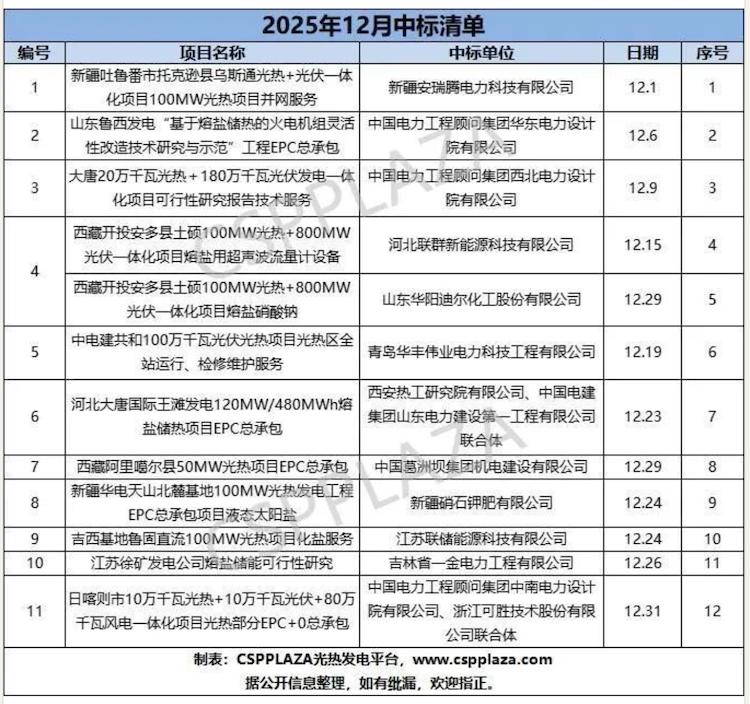
According to incomplete statistics from CSPPLAZA, a total of 12 important tenders across 11 CSP/molten salt thermal storage-related projects were completed in December 2025.

December 2025 saw significant progress in both concentrated solar power (CSP) and molten salt thermal storage, with key milestones reached in multiple major projects:

In the CSP sector, EPC contractors were finalized for the 50MW solar thermal project in Ga’er County, Ngari, Tibet, and the 100MW solar thermal project in Xigazê City. Both projects are scheduled to commence construction in March 2026. Additionally, the feasibility study was awarded for China Datang Corporation’s 200MW CSP + 1,800MW photovoltaic integrated power generation project.

In the molten salt thermal storage sector, EPC contractors were successfully selected for two projects: Shandong Luxi Power Generation’s “Research and Demonstration of Flexibility Transformation Technology for Thermal Power Units Based on Molten Salt Thermal Storage” and Hebei Datang International Wangtan Power Generation’s 120MW/480MWh molten salt thermal storage project. Meanwhile, Jiangsu Xukuang Power Generation Company’s molten salt energy storage project is actively advancing its preliminary work.

Source: Jennifer Zhang at LinkedIn for CSPPlaza

The post 12 concentrated solar and thermal energy storage tenders in China last month appeared first on SolarPACES.

Published at Solar Energy – Damage modeling of power tower receiver tubes using the SRLIFE tool

16 January 2026 at 00:51


Abstract:
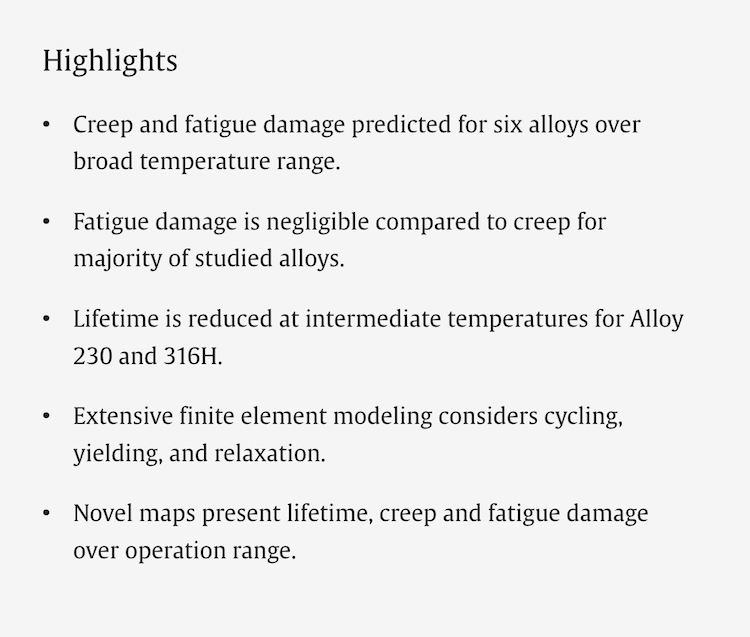
Concentrating Solar Power (CSP) molten-salt central receivers are subject to high, transient incident flux during daily operation. The resulting creep-fatigue damage impacts the receiver’s reliability and restricts the permissible incident flux distribution for a given receiver. This paper aims to reduce CSP plants’ levelized cost of electricity by developing a methodology to predict lifetime and identifies the primary damage mechanism (creep vs fatigue) for any given fluid temperature and temperature gradient. Results are presented in the form of a damage map that serves as a valuable operation guide and design tool. Damage maps can be used to reduce maintenance costs by improving reliability and reduce receiver capital costs by better utilizing the receiver area. FEA simulation and damage modeling of tubes subject to asymmetrical flux conditions is performed in the open-source receiver design tool srlife. Parametric studies are performed over a range of inner tube temperatures and thermal gradients for A230, 316H, 740H, A282, A617, and 800H high temperature alloys. Damage maps are presented for each alloy. A parametric, FEA-based methodology is presented for comparison of fatigue-creep ratios and prediction of tube lifetime based on the critical thermal operating conditions. Fatigue is found to be negligible compared to creep for almost every case. This finding suggests that fatigue effects associated with cloud events are insignificant compared to creep at these high temperature operating conditions. Additionally, lifetime predictions identify thermal conditions where small changes in operating conditions can result in large changes in predicted lifetime.

Jacob Wenner, Mark C. Messner, Michael J. Wagner, Damage modeling of power tower receiver tubes using the SRLIFE tool, Solar Energy, Volume 299, 2025, 113627, ISSN 0038-092X, https://doi.org/10.1016/j.solener.2025.113627

The post Published at Solar Energy – Damage modeling of power tower receiver tubes using the SRLIFE tool appeared first on SolarPACES.

Published at Applied Thermal Engineering – Modelling of flow regimes in tubular concentrating direct absorption solar collectors

16 January 2026 at 00:38

Abstract:
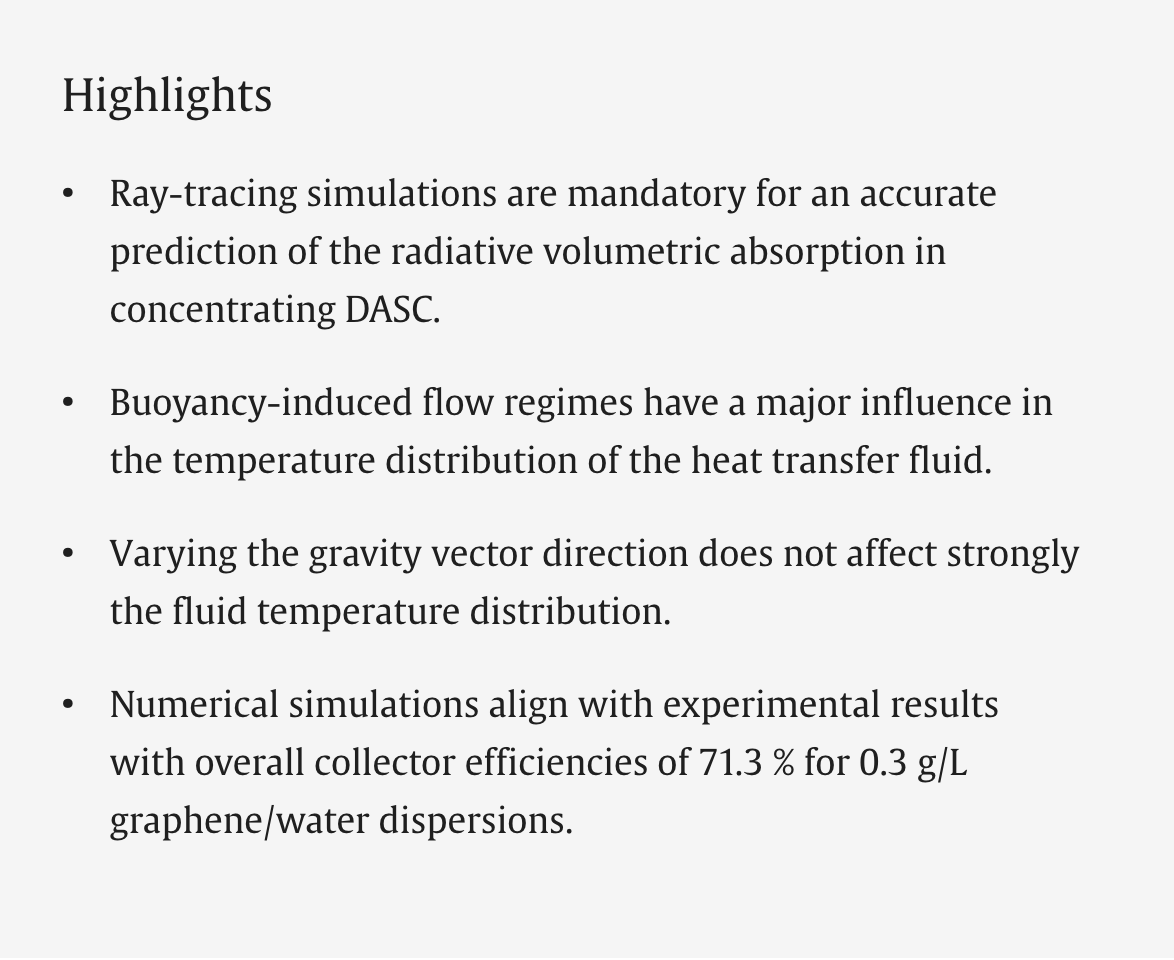
Direct absorption solar collectors have gained attention in the last decades as a promising solution to enhance the performance of conventional thermal collectors. In this concept, the heat transfer fluid absorbs the concentrated radiation volumetrically, which optical properties can be enhanced by dispersing nanoparticles. While several works have reported the benefits of volumetrically absorbing the incident radiation, few studies have explored its effect on the fluid temperature distribution. The presents paper offers a comprehensive numerical analysis of the optical and thermal behavior of a parabolic-trough direct absorption solar collector using a graphene nanoparticle dispersion as absorbing medium. A Monte Carlo based ray-tracing approach is coupled to a computational fluid dynamics analysis to offer a complete evaluation of the performance of such systems. The results reveal a trade-off between complete absorption inside the tube and strong absorption in the wall vicinity, which takes place at higher optical depths. Furthermore, the fluid dynamics simulations underscore the role of buoyancy forces in achieving homogeneous temperature distributions, especially at lower flow rates. Neglecting gravitational effects may lead to inaccurate predictions of the system thermal performance. The numerical predictions align closely with experimental campaigns conducted for a similar collector, with total collector efficiencies of 66.3 % and 71.3 % for 0.2 g/L and 0.3 g/L nanofluids respectively. While these results represent a first-order comparison, they suggest that the model is reliable for designing and optimizing PT-DASC systems for real-world applications.

Miguel Sainz-Mañas, Françoise Bataille, Cyril Caliot, Gilles Flamant,
Modelling of flow regimes in tubular concentrating direct absorption solar collectors, Applied Thermal Engineering, Volume 279, Part C, 2025,127716, ISSN 1359-4311, https://doi.org/10.1016/j.applthermaleng.2025.127716

The post Published at Applied Thermal Engineering – Modelling of flow regimes in tubular concentrating direct absorption solar collectors appeared first on SolarPACES.

Ranga Pitchumani – we’ve just started scratching the surface of Gen3 CSP

15 January 2026 at 23:31


In a video call from the US, SolarPACES caught up with Ranga Pitchumani, Editor-in-Chief of Solar Energy, a leading journal in the field.

Dr. Pitchumani was the Chief Scientist at the U.S. Department of Energy (DOE), SunShot Initiative, Founding Director of its Concentrating Solar Power (CSP) program, and Director of the Initiative’s Systems (Grid) Integration program. A former Ex-Co member of the IEA SolarPACES, he has also served as an advisor to several solar energy programs in different countries including the Australian Solar Thermal Research Initiative of ARENA. In his academic role, he is the George R. Goodson Endowed Chair Professor of Mechanical Engineering at Virginia Tech where he directs the Advanced Materials and Technologies Laboratory and has authored numerous scientific papers in the field of solar energy.

SK: How has CSP changed since you led the DOE SunShot program for the Obama administration?

RP: The pursuit of making CSP cost-competitive with grid parity, that began with the SunShot Initiative, has advanced quite well. There has been a systematic exploration of the various options or pathways for Generation 3 CSP namely the liquid pathway (using molten salt as the heat transfer fluid and storage medium), the gas pathway (directly capturing concentrated solar energy using supercritical CO2), and the solid pathway (using particles for direct capture, transport and storage of concentrated solar energy). Of these, the particle pathway has emerged as a viable approach to realizing high-temperature next-generation CSP. Sandia is leading the development of the next-generation particle receiver and CSP system. There’s tremendous momentum in particle-based CSP now.

Apart from the engineering marvel and challenges in this technology, there’s a lot of interesting fundamental physics that we need to understand and incorporate into our traditional analysis. Particles are a new domain for CSP and likewise high-temperature Gen3 CSP brings unique challenges to particle flow, heat transfer, and interactions with confinement surfaces. So, it is an important learning and discovery exercise as we develop the technology driven by the science.

And we are just starting to “scratch the surface” of the problem.

SK: Literally, in some of your work..

RP: I have always argued that CSP is an amalgam of multiple disciplines, including physics, optics, chemistry, chemical engineering, mechanical engineering, materials science – and with particles also high temperature tribology. Now, more than ever, is a fertile opportunity for the broader community to engage in advancing this fantastic technology.

SK: Yes, it really is astonishing to me how many other disciplines are involved in particle CSP. How best to hoist sand up to the top of a tower is not what somebody imagines they’ll figure out when they get into concentrated solar research, right?

RP: Absolutely, absolutely. And to me, that makes it interesting and fun, because it keeps me young, because I am always needing to learn new things.

SK: Do your Virginia Tech students come from many kinds of engineering backgrounds?

RP: In my lab we have quite a mix. I have physicists, chemical engineers, mechanical engineers, electrical engineers, and materials scientists. It’s just getting the brightest minds to work on problems. It’s wonderful. My research group is passionate, whether I’m there or not. I mean, they’re not doing it because their supervisor gave them this problem. They’re doing it because they love it. And so they go above and beyond. And most of the time I’m learning from them.

It’s really a fantastic way to do work, because you excite them, you give them the broad picture, and say, here’s a big problem to solve. And they’re off. They’re not asking me what to do next. They are in the driver’s seat, and my role is to fuel their curiosity by asking the critical questions. It’s an extremely fun exchange. Quite unlike a classroom setting where the professor knows the answer to the problem and is testing to see if the student can arrive at the answer. Research is more of a two-way exchange. Very often, I am the student learning from them and discovering with them. These are the thought leaders, entrepreneurs and change makers of the future. I simply have the privilege of having them in my group now.

SK: That is great. It sounds really gratifying. So last time I covered your work, it was on coatings, if I recall. Has your focus always been on these physical surfaces?

RP: The nexus of materials and energy systems has certainly been one of the focus areas of the research in my lab. In our last conversation, we spoke about our work on surface innovations to tame corrosion attack of substrate alloys by molten chloride and carbonate salts at the Gen3 CSP relevant high temperatures. Following up on that, we showed through a rigorous technoeconomic analysis the impressive levelized cost reductions of over 60% compared to Haynes 230, enabled by the corrosion mitigation coatings on low-cost ferrous materials such as stainless steel, while offering corrosion protection on par with or better than the expensive Haynes alloy. So, with these coatings we developed, we can now use common materials like stainless steel, and they can withstand the worst of corrosive elements, such as molten chloride salts, at Gen3 CSP conditions.

We also spoke about our innovation on high temperature solar absorber coatings that feature very high solar absorptance with a low emittance that reduces re-radiation losses from the receiver, overall resulting in an exceptional efficiency for Gen3 systems. We have since subjected the coatings to several rounds of independent testing on sun at Sandia National Laboratories and the National Laboratory of the Rockies (previously, NREL). The coatings continue to amaze us by retaining their excellent optical properties with flying colors—or in spectral parlance, “flying wavelengths”—under on-sun conditions.

Aside from the surface sciences and engineering, the research projects in my laboratory include grid integration of solar energy, solar forecasting under uncertainty, and thermal and thermochemical energy storage.

SK: I’ll add the links to these when I post this. And your papers (below) advance particle-based heat exchangers for CSP. What are the unique challenges in designing heat exchangers for a falling particle system?

RP: One of the things that’s unique about particles, as opposed to the other fluids, is that when they interact with the surfaces on which they move, they introduce a different type of degradation than, say, molten salts and others. And this is really pertaining to the wear on the materials as particles interact with the surfaces. There are two ways that particles interact with a surface. One is when particles impinge on the surface and cause what’s called erosion, or erosive wear. The other is when a bed of particles slide on the surface, and they create what’s called abrasive wear. At high temperatures there’s also oxidation happening on the surfaces at the same time, that gets vigorous as temperature increases. All of these mechanisms occurring simultaneously need to be understood to predict how materials that interact with the particles may degrade or lose mass over time.

SK: Can you adapt abrasion lessons from other industries or are they too different to CSP?

RP: There’s a whole field – tribology – focused on wear mechanisms, but they were focused on particles interactions at low temperatures, room temperature or slightly higher, not at the temperatures that we see and expect to see in next generation CSP. So, there are unique challenges to abrasion in high temperature CSP, and there was a science gap that existed when we started looking at this problem. The question is how the interactions of particles, maybe carbo beads or silica sand, with the various components of the falling particle, CSP system influence material degradation at high temperatures.

A lot of work has been done on the solar receiver component. But there is a whole slew of other components. How the particles interact with the transfer chutes, with the valves and storage bins, and with the surfaces in the heat exchanger? So that’s kind of how we got interested in this problem; finding the wear mechanisms and the wear behavior of the surfaces, as particles are interacting with the various sub-components of the CSP system.

SK: How do you simultaneously maximize heat transfer and minimize abrasion?

RP: We studied the particle s-CO2 shell and tube heat exchanger configuration, and quantified both the heat transfer performance and the surface wear simultaneously. This is the first study of its kind looking at the two aspects together. The study brings forth the tradeoffs: designs and conditions that provide for good heat transfer are not necessarily the ones that are benign to erosion or abrasion wear. For example, you may want close packing of the heat transfer surfaces between which particles flow, as that would be good for heat transfer, but that’s also terrible for abrasion, because the particles are trying to squeeze in through the narrow gaps between surfaces, and rub against the surface and abrade more. The question then is, how do we develop designs that trade off between these physical mechanisms through fundamentally understanding the mechanisms.

To answer the question, we studied the heat transfer and abrasion characteristics quite comprehensively and developed trade-off maps so that designers can select tube layouts that achieve the desired heat transfer while keeping abrasion within whatever their desired limit is. What makes this a first is the coupled thermal and abrasion study for heat exchangers. Heat exchanger analysis is well established and can be found in textbooks, but they are based on fluids, liquids and gases flowing through the passages of the heat exchanger. Abrasion and erosion are at the heart of the field of tribology, but its confluence with fundamental heat transfer analysis, heat exchanger analysis, and in the context of a particle medium, is where the gaps, challenges and opportunities are. Our studies are filling this gap for the engineering community.

SK: So as Gen-3 CSP develops you want to clear any issues in advance?

RP: Right. We are trying to engineer this system without a full understanding of the science behind it. That’s really where our work comes in. We want to put out the science so that anybody can use it, and we make it in a way so that it’s not solving just one problem, but we give a design map that anybody can use for their material, for their system, and so forth.

SK: Which metal is it?

RP: We are studying different alloys, stainless steel, Inconel alloys, Haynes, and ceramics such as silicon carbide, to name a few. And usually the wear rate is a function of material properties such as hardness. So, we try to present results in a general form so that the results can be translated across materials.

SK: Could you make a harder metal?

RP: Yes that’s a whole field in metallurgy, how do you harden surfaces and materials? The other way to harden materials, and make them immune to abrasive or erosive wear, is with coatings. With a carbide coating, for example, you can bump up the surface hardness by a factor of five, ten, or more. Correspondingly, the wear rate can be diminished by about that factor. But then the question is, what is the cost trade-off? Is the cost of coatings worth the reduction they provide, or can we alter the heat exchanger design or its configuration, so that we may not need this coating, but can still reduce the wear? Another factor that comes into play are the oxides that grow on the surface at high temperatures, which may be beneficial in reducing wear, depending on the competing rates of oxidation and abrasion or erosion. Understanding all of these considerations is the crux of cost-effective and viable engineering for particle-based Gen3 CSP.

SK: Might this happy medium negate the potential advantage of using high temperature particles and s-CO2 cycle?

RP: The idea is not to degrade performance. Heat transfer is often the most important part of the thermal system. But within a desired heat transfer range, what is the abrasion or erosion wear for those designs? Then if I tweak the heat exchanger performance a little bit, am I saving a lot on material wear? So you can do the tradeoffs of heat exchanger efficiency – giving up a little bit on the efficiency – if that amounts to considerable increase in component life. Or you may say, material wear is paramount. If you want the material wear to be less than say 10 microns a year, you can determine the upper bound on the heat exchanger performance for this constraint. Either way it’s information for the designer to say, which way should I go? Our experiments and modeling are aimed toward developing happens when the particles interact with the surfaces at high temperatures in a heat exchanger and in other components.

SK: Right. Gen-3 particle CSP has such high temperatures, even up to 1500°C.

RP: As I mentioned before, one of the consequences of the high temperatures is oxidation. The surface grows an oxide layer, and so the particles are now interacting not with the nascent surface, but with the oxide layer on top. Now, there are many fundamental questions. What does the oxide layer do? Does it help to kind of shield the underlying surface from the particles? Does it make it worse? Does it crack and go away, all kinds of things can happen. So we are deliberately uncovering the physics of what happens at high temperatures to the layers. And it is fun part to be working on the problem, both from an experimental side and the computational modeling side. We have very detailed experimental data and very insightful simulations of the oxide layer growth with simultaneous abrasion that explain the data, which we’ll publish soon.

It’s a really fantastic domain of problems. We’re marching along trying to understand as we go and at the end we’ll have really nice portfolio of science that we have discovered, but also solutions enabled by the science. The more we approach the problem with a systematic focus, rather than a hurried “let’s put it together and see” approach, the more we can make advances towards the final goal of achieving cost competitive CSP. CSP is an awesome technology, perhaps less appreciated, whether it generates firm power or heat. And heat – generated cleanly – is very, very important for many applications.

SK: So if you were to predict the future, would you say that particle CSP with the s-CO2 Brayton loop is the future? That tiny little turbine is really a big, major change. I remember seeing the turbine at Crescent Dunes, it was like a 747. How could you make cheap power with something that gigantic?

RP: The large power block that you saw is similar to that in fossil powered plants that use steam for power generation. Steam cycles are at their limit of efficiency and pushing the efficiency higher quickly becomes cost prohibitive. s-CO2 based Brayton cycle offers the efficiencies needed for cost-competitive CSP. The genesis of a concerted development of s-CO2 cycle components, the tiny turbines, the compressors, and other subsystems dates back to SunShot. Since then a lot of progress has been made in addressing challenges in terms of materials, being able to handle the high pressures and so forth, and we are advancing closer to viable commercial system. And since a power block is something that is shared with conventional power generation, it really benefits multiple technologies: fossil and nuclear in addition to solar thermal. In reality, the first adopters could be fossil because there’s so many of them.

SK: But why should the fossil industry get to benefit from all the work done by concentrated solar researchers?

RP: That’s one way to see it. I actually see it a different way. If you can reduce the cost of the power block through the larger deployment opportunities in fossil or nuclear, that ultimately benefits CSP. So the more the deployment opportunities in other thermal plants, the more CSP benefits from that lower price. What SunShot brought was a sense of purpose, direction and urgency, in terms of what we need to reach the efficiency target for CSP, and what does the s-CO2 cycle have to look like? Without a purpose, if you just say, oh, this cycle looks like a good idea, let’s just explore, and see what we can develop – then you don’t know where you’re going, or how far you need to go. And all that changed with the DOE Gen-3 solar program that pushed for the s-CO2 Brayton cycle with particles for heat transfer.

Papers:

Analysis and design of a particle heat exchanger for falling particle concentrating solar power

Analysis of abrasion wear in particle storage and valve subsystem for falling particle concentrating solar power

Analysis and mitigation of erosion wear of transfer ducts in a falling particle CSP system

Erosion wear analysis of heat exchange surfaces in a falling particle-based concentrating solar power system

Analysis of erosion of surfaces in falling particle concentrating solar power

Effects of Thermally Grown Oxides on Erosion Wear of Surfaces at High Temperature for Falling Particle Concentrating Solar Power

The post Ranga Pitchumani – we’ve just started scratching the surface of Gen3 CSP appeared first on SolarPACES.

Stored solar heat gets an algorithm to ensure a steady supply

6 January 2026 at 22:44

A new paper from researchers at PROMES-CNRS in France presents a control strategy to reliably deliver a precise thermal power from concentrated solar to meet industrial heat requirements.

The objective was to design a proof-of-concept algorithm for operating a concentrated solar plant, but one intended primarily to deliver heat, and deliver it from thermal energy storage tanks rather than from each moment’s sunlight, as in a typical CSP power plant.

“There are lots of studies on the control of solar plants, but most of them are on CSP plants, with only power production objectives. So you can find lots of references trying to, for example, use an optimization algorithm to maximize the profit you can make with such a plant. But this is not our objective. Our objective was to satisfy a heat demand from industry.” said lead author Eliott Girard in a call from France.

To do this, the algorithm would control the flow rate of the hot storage liquid to deliver a required thermal power throughout the day.

“We are focusing on operational constraints, such as what happens when you have a larger DNI drop, on a smaller time scale, to determine the best mass flow rate in the plant over a short time horizon,” Girard explained. “This is what’s new about our study.”

The setup would comprise a solar field of parabolic trough collectors, delivering oil heated by focused sunlight to a single thermocline thermal energy storage tank, so that heat would primarily be drawn from the storage tank.

A thermocline storage with particles in oil

In thermocline storage, both the heated and cooled heat-transfer fluid is stored in a single tank. This creates a region of a mixed temperature (a ‘thermocline’) in the middle.

When this thermocline region can be minimized, it reduces costs to store both temperatures in a single tank. The solar-heated oil enters at the top, and once the heat is extracted by a heat exchanger in the middle, the now-cooler liquid sinks to the bottom. This cooler liquid is then routed back to the parabolic trough collector field for reheating by focused sunlight.

The study assumed that the liquid would be the thermal oil, the standard in commercial trough-type CSP plants. Small pebble-like particles inside a basket in the oil would store additional heat.

“We created this algorithm on the assumption that we would have particles in the oil,” Girard explained.

“The advantage of this is that the solid particles increase their storage capacity. And also, solid particles enhance stratification at the thermocline. So you can have a clear thermocline zone, a clear separation between hot and cold. That’s also why this tank has that high capacity, because there are lots of particles which also store some energy.”

A practical solution for many industrial heat uses

The plant would use the control system to ensure the correct amount of heat is delivered by adjusting the flow rate of the heat-transfer fluid through the system. It is possible to increase or slow the flow rate by adjusting the pumps.

The team tested the setup under three scenarios: steady heat needs, on-and-off heat needs, and slowly changing heat needs (similar to what’s needed in paper processing, for example).

The effectiveness of the control algorithm was judged based on two factors:
How much the delivered heat deviated from the target and how much the system overshoots the target when responding to changes.

The team tested three heat-demand scenarios, all simulated under clear-sky, overcast and mixed conditions.

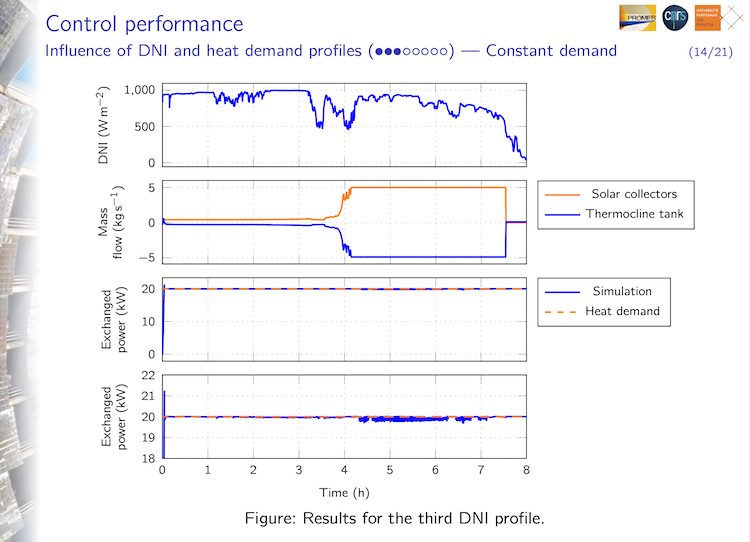
Constant demand: Steady 30 kW thermal power throughout.
Batch demand: Alternates between one hour at 60 kW and one hour with no heat required.
Realistic demand: Gradual changes typical of a paper treatment process during the day.

In all cases, the control system did a good job keeping to the target, with only minor differences from what was required and not much “overshoot” (where the system briefly gives too much heat). The system handled both slow and rapid changes in heat demand and incident solar energy reliably, suggesting it would perform well in other real-world situations.

High ratio of storage to solar field

When concentrated solar power is used primarily to supply a storage system, it should have relatively more storage capacity than the solar field, but determining how much is a work in progress.

Because it would primarily draw on stored solar thermal energy rather than on the sunlight incident on the solar collectors themselves, the prototype plant simulated in the study would have a higher solar ratio than conventional CSP plants. A small 150 kW solar field of parabolic trough collectors would be paired with 1,100 kW of thermal storage, a much higher ratio than in a CSP plant generating power.

“But this might be too extreme a ratio,” Girard considered. “I think the storage tank is actually too oversized in relation to the collectors.”

Next, Girard will be revisiting the effect of the storage tank size relative to the solar field.

The case study is based on a real plant at the PROMES laboratory.
But he emphasized that what is really needed at this point is physical validation:

“There are very few studies concerning the control of CST plants that are based on a physical plant; it’s mostly simulation. Physical validation of the control strategies is lacking. They almost always remain as only validated by simulations, but they need to really implement control strategies,” he said.

Read the Paper; Control of a concentrated solar plant for heat production under various thermal demand and the SolarPACES 2025 Conference Presentation: Model-Based Predictive Control of a Concentrated Solar Plant for Heat Production 

The post Stored solar heat gets an algorithm to ensure a steady supply appeared first on SolarPACES.

China targets 15 GW of CSP in next Five-Year Plan – Official Document

31 December 2025 at 06:48

Three Gorges Renewables 100 MW Tower CSP in Golmud, Qinghai

Three Gorges Renewables 100 MW Tower CSP in Golmud, Qinghai [Tower CSP predominates in China, and is typically 100 MW, so 15 GW would mean 150 CSP projects]

BEIJING, Dec. 23 (Xinhua) — China unveiled a policy roadmap on Tuesday to accelerate solar thermal power development, targeting around 15 gigawatts (GW) of installed capacity by 2030, with costs broadly comparable to coal-fired power.

The guideline, jointly issued by the National Development and Reform Commission and the National Energy Administration, emphasizes project construction and the expansion of application scenarios to facilitate large-scale deployment of solar thermal power.

By 2030, China aims to build the sector into an internationally competitive new energy industry, characterized by globally leading technologies that are fully domestically controllable, alongside market-oriented and industrialized growth, according to the document.

After years of development, China has achieved significant advancements in major solar thermal technologies and built a leading industrial chain, with construction costs per kilowatt falling from about 30,000 yuan ($4,254 USD) a decade ago to half that today. Generation costs have also experienced a substantial reduction.

However, the sector still faces challenges, including high upfront investment and relatively weak market competitiveness, an official with the National Energy Administration said.

To tackle these obstacles, the document outlines strategies such as developing large-capacity solar thermal plants tailored to regional conditions, and implementing integrated projects combining solar thermal, wind and photovoltaic power under coordinated operation. These initiatives aim to fill local power gaps, support grid operations and enhance power supply security and stability.

It also encourages fair market participation by solar thermal power, with provincial-level regions urged to adopt region-specific pricing mechanisms that balance competition and operational stability.

The document stresses accelerating research and development in key technologies, materials and equipment, supporting leading solar thermal firms and research institutions in establishing joint R&D platforms to enhance technological self-reliance and domestic production of core equipment.


15GW by 2030 – China Policy Roadmap

Promoting the Large-Scale Development of Concentrated Solar Power (CSP)

On December 23, 2025, the National Development and Reform Commission and the National Energy Administration jointly issued the Opinions on Promoting the Large-Scale Development of Concentrated Solar Power (CSP) (hereinafter referred to as the Opinions).

The Opinions put forward the overall objectives, development planning and layout, application market expansion, technological and industrial innovation, policy guarantee mechanisms, etc., for CSP in the next five years, and set the direction for the leapfrog development of CSP. The full text translation is as follows. For the sake of accuracy, the Chinese version shall prevail.

Opinions of the National Development and Reform Commission and the National Energy Administration on Promoting the Large-Scale Development of Concentrated Solar Power (CSP): Jilin Province, Sichuan Province, Tibet Autonomous Region, Gansu Province, Qinghai Province, Ningxia Hui Autonomous Region, Xinjiang Uygur Autonomous Region; relevant dispatched offices of the National Energy Administration; relevant power enterprises:

Concentrated Solar Power (CSP) has the dual functions of peak-regulating power supply and long-duration energy storage. It can realize the regulation and support of new energy by new energy, provide long-cycle peak-regulating capacity and moment of inertia for the power system, and has the potential to serve as peak-regulating and basic power supply in some regions. It is an effective means to achieve the safe and reliable replacement of traditional energy by new energy, and an effective support for accelerating the construction of a new type of power system.

At the same time, the CSP industry chain is long, and its large-scale development and utilization will become a new growth point of China’s new energy industry. To better adapt to the demand for high-quality development of new energy and help accelerate the construction of a new type of power system, the following opinions are put forward on promoting the large-scale development of CSP.

I. Overall Objectives

Actively promote the construction of CSP projects, continuously expand new scenarios for the development and utilization of CSP, and ensure the large-scale development of CSP. By 2030, the total installed capacity of CSP will strive to reach about 15 million kilowatts, and the levelized cost of electricity (LCOE) will be basically equivalent to that of coal-fired power; technologies will achieve international leadership and complete independent controllability, the industry will realize independent marketization and industrialization development, and become a new industry with international competitive advantages in the new energy field.

II. Strengthen Planning Guidance

(1) Conduct in-depth CSP resource surveys
Establish a scientific and systematic system of content and methods for resource surveys, integrate basic data such as solar energy observation, land and resources, topography and geomorphology, and water resources, evaluate the level of CSP resources, identify restrictive factors for site construction, connect with territorial spatial planning, and form a comprehensive and systematic CSP resource database. Establish a dynamic management mechanism for the survey results database, update basic information in a timely manner, and ensure the timeliness and practicality of survey results. For key provinces and regions, clarify advantageous resource areas and development potential, make early preparations for factor guarantee and site protection, and lay a solid foundation for project construction. Strengthen the sharing and application of survey results to provide a scientific basis for regional CSP development.

(2) Improve the planning and layout of CSP
Adapt to the situation and needs of the large-scale development of CSP, clarify the positioning and role of CSP in the new type of power system, improve the technical system for CSP development planning research, and conduct scientific research on the planning and layout of CSP on the basis of resource survey work. Encourage all provinces and regions to, in light of the national energy development strategy, ecological and environmental protection requirements, regional resource endowments, regional energy development needs, power system characteristics, and electric-thermal coupling needs, fully consider the role of CSP in regional power balance and regulating support power supply, formulate CSP development plans in accordance with local conditions, propose the layout of key CSP projects by stage and region around development models and implementation paths, and do a good job in connecting with other development plans. Support provinces and regions where technology and economy are feasible and demand is urgent to plan and construct a certain scale of CSP projects every year, and provide corresponding policy guarantees.

(3) Coordinate the layout of CSP and industrial development
Give full play to the supporting and regulating capacity of CSP, conduct research on the coordinated layout of CSP and industries by sector, and propose plans for the coordinated layout of CSP and related industries. Encourage new energy integrated projects with CSP as the supporting and regulating power supply to be closely combined with new high-energy-consuming industries such as mineral resource development and smelting, computing power centers, power battery manufacturing, and salt lake lithium extraction. Explore new formats for local consumption of new energy such as computing power-power coordination, direct green power connection, and source-grid-load-storage integration, so as to realize the efficient utilization of renewable energy and promote the construction and layout of industrial parks supplied with a high proportion of renewable energy.

III. Actively Cultivate the CSP Application Market

(4) Reasonably configure the scale of CSP as needed in combination with the construction of large energy bases
Support new energy bases with technical and economic conditions, such as large “desert, Gobi, and barren land” external transmission new energy bases, hydro-wind-solar external transmission bases, and various self-use bases, to carry out the construction of CSP plant projects. Scientifically determine the installed capacity of CSP in the bases, optimize and improve the regulating capacity of the bases, increase the proportion of green power in the bases, reduce the average carbon emission per kilowatt-hour of the bases, strengthen the stable transmission of new energy, and actively explore the role of CSP plants with feasible technology and economy as supporting and regulating power supply in large bases.

(5) Construct a number of supporting and regulating new energy power stations dominated by CSP
In light of internal and external conditions such as regional resource endowments, construction factors, energy demand, and consumption capacity, and according to the needs of building a new type of power system, with the goals of effectively filling regional power gaps, alleviating the pressure of power guarantee, and providing green supporting and regulating capacity, implement the concept of electric-thermal coupling and source-grid coordination, construct a number of large-capacity CSP plants for local consumption or integrated dispatch and operation projects of CSP, wind power, and photovoltaic power generation, improve the peak-regulating capacity and stability of regional power grids, and enhance the safety and flexibility of power supply.

(6) Explore the construction of a source-grid-load-storage integrated system with CSP as the basic power supply
Actively promote industries with green traceability needs, and in combination with the needs of industrial adjustment and transfer, construct a source-grid-load-storage integrated system based on CSP plants, combined with other new energy power sources and new energy storage facilities in CSP resource-rich areas. In areas with conditions, further explore covering the electricity, steam, and heat needs of nearby areas. Strengthen the management and operation of the source-grid-load-storage integrated system, and establish and improve the operation mechanism and safety guarantee system. Encourage the exploration of constructing weakly connected or independent source-grid-load-storage integrated systems supported by CSP at the end of power grids with conditions, so as to improve the level of power supply guarantee.

IV. Give Full Play to the Supporting and Regulating Role of CSP in the New Type of Power System

(7) Give play to the supporting role of CSP in the new type of power system
Combined with the green supporting capacity of CSP that integrates “thermal-electric” conversion and conventional AC synchronous generators, give full play to the role of CSP in frequency modulation, voltage regulation, black start, and inertia response, further optimize the operation mode of power stations, tap the potential of CSP as a green and low-carbon basic power supply, promote the transformation of the system power supply guarantee value of CSP, and increase the proportion of green and reliable supporting capacity of the new type of power system.

(8) Enhance the regulating role of CSP in the new type of power system
Give play to the functions of large-scale, low-cost, and high-safety heat storage systems of CSP, utilize the wide load regulation range and fast load change capacity of CSP, exert deep peak-regulating capacity, and improve the regulating capacity of the power system. Encourage the configuration or reservation of electric heating systems, and support CSP plants equipped with electric heating systems to play the role of system long-duration energy storage power stations through the power market and obtain corresponding market returns.

(9) Accelerate the construction of ongoing projects and improve the dispatch response capacity of operational projects
Fully absorb the experience of commissioned projects in design, construction, and operation links, actively apply new technologies, new equipment, and new processes to reduce costs and increase efficiency, and accelerate the construction of ongoing projects on the basis of ensuring safety and quality. Provincial energy competent departments should strengthen the supervision of registered but not started projects and accelerate their commencement and construction. Actively promote operational projects to explore profit models in the power market, continuously improve dispatch response and the ability to participate in the auxiliary service market, and take multiple measures to improve the economic benefits of power stations.

V. Accelerate Technological and Industrial Innovation of CSP

(10) Gradually promote the popularization of high-parameter and large-capacity technologies
Actively support the technological innovation and engineering application of high-parameter and large-capacity CSP plants, steadily promote the construction of 300,000-kilowatt level CSP plants in areas with suitable resource conditions and high demand for power and heat loads, strengthen project monitoring and evaluation, accumulate basic data for the subsequent promotion of 600,000-kilowatt level CSP plants, gradually improve the technological advancement of CSP plants and the system supporting and regulating role, and effectively improve the safe and reliable replacement capacity of new energy.

(11) Accelerate breakthroughs in key technologies and promote cost reduction and efficiency increase in the CSP industry
Accelerate the R&D of key technologies, materials, and equipment, support leading CSP enterprises and scientific research institutions to form R&D consortia, focus on fields such as efficient concentrating, heat absorption and heat exchange, large-scale long-duration high-temperature heat storage, efficient energy conversion, highly flexible CSP units, and intelligent control, develop localized key equipment such as new large-aperture trough collectors, high-precision heliostats, low-cost and long-life heat storage materials, and new turbines, and comprehensively improve the independentization of China’s core CSP technologies and the localization of key equipment. Strengthen basic research on applications in the CSP field, break through scientific theories such as high-parameter “light-thermal-electric” conversion and efficient thermal energy storage, and encourage disruptive technological innovation.

(12) Establish and improve a coordinated development mechanism to promote the high-quality development of the CSP industry
Explore the research and application of CSP and coal-fired power coupling carbon reduction technologies, and encourage the construction of CSP and coal-fired power coupling technology projects in areas with suitable resource and construction conditions. Scientifically plan the coordinated development layout of the CSP industry chain, actively build a complete industrial chain, give full play to the leading role of modern industrial chain chain leaders, promote in-depth cooperation upstream and downstream of the CSP industry chain, and form an industrial pattern of complementary advantages and coordinated development. Accelerate the strengthening and supplementation of the CSP industry chain, promote the deep integration of capital and the industrial chain, build CSP industrial parks or industrial clusters in key areas, and promote cost reduction and efficiency increase in the CSP industry through industrial agglomeration and coordinated development. Accelerate the construction of the CSP industry standardization system, improve the standardization level of the whole process of CSP industry design, manufacturing, construction, and operation and maintenance, and actively participate in the formulation of international standards.

(13) Actively promote the “going global” of the industry and improve the level of international cooperation in CSP
Make full use of bilateral and multilateral energy cooperation mechanisms, give play to the advantages of China’s CSP industry in technological innovation and equipment, strengthen mutual recognition with relevant national standards, and develop diversified CSP products and technical services that meet local resource endowments and market demands. Increase external publicity, encourage domestic enterprises to carry out various forms of cooperation such as technology and joint venture operations with local enterprises in accordance with their own development strategies, explore the creation of flagship CSP projects under the “Belt and Road” Initiative, and at the same time pay attention to preventing various risks to promote the long-term sustainability of cooperation projects.

VI. Improve the Policy Guarantee Mechanism

(14) Increase policy support
Support eligible CSP projects to revitalize stock assets and promote a virtuous circle of investment and financing by issuing Real Estate Investment Trusts (REITs) in the infrastructure field, asset-backed securities, etc.

(15) Promote the fair participation of CSP in the power market
Implement the requirements of the market-oriented reform of on-grid electricity prices for new energy, encourage relevant provinces to formulate implementation rules for new energy participation in the power market that support the development of CSP, and introduce sustainable development price settlement mechanisms that can adapt to market competition and ensure stable operation in accordance with local conditions. Eligible CSP capacity may be compensated according to reliable capacity. Encourage relevant provinces to explore the construction of a reliable capacity assessment method for CSP plants, and connect with national relevant requirements after the state establishes a reliable capacity compensation mechanism. Encourage CSP projects to participate in intra-provincial and inter-provincial and cross-regional annual medium and long-term power transactions, and support CSP to actively participate in various auxiliary service markets and obtain benefits.

(16) Establish and improve the CSP incentive mechanism
Systematically evaluate the construction and operation experience of the first batch of CSP demonstration projects, establish an industry-wide information sharing mechanism, and promote the coordinated development of the CSP industry. Systematically evaluate the operation status, peak-regulating effect, and system supporting capacity of CSP supporting new energy bases and source-grid-load-storage projects, and establish a project incentive mechanism based on evaluation results.

(17) Improve the green benefits of CSP plants
Coordinately utilize the national voluntary greenhouse gas emission reduction trading market, green certificate market, and new energy sustainable development price settlement mechanism, and do a good job in connecting supporting policies. CSP projects may independently choose the source of green benefits. Those intending to participate in the green certificate trading shall not apply for National Certified Emission Reductions (CCER) for the corresponding electricity, and shall not be included in the new energy sustainable development price settlement mechanism; those intending to apply for CCER shall cancel the untraded green certificates corresponding to the emission reductions after completing the verification and registration of emission reductions; projects included in the sustainable development price settlement mechanism in accordance with national regulations shall not obtain green certificate benefits repeatedly.

(18) Strengthen the guarantee of factors such as land and the implementation of policies
Coordinately plan the development layout of new energy, reasonably layout and reserve CSP sites in large wind-solar bases, source-grid-load-storage integration projects, industrial parks supplied with a high proportion of renewable energy, as well as various projects such as independent energy supply systems including CSP, CSP and coal-fired power coupling pilots, and combined heat and power generation. The land for CSP collector fields may be obtained through leasing.
Relevant provincial energy competent departments should actively promote the development of CSP, promptly organize and carry out provincial-level CSP resource surveys and layout planning, promote the implementation of various guarantee measures such as electricity price mechanisms and auxiliary service rules related to CSP, strengthen the overall coordination of project construction, and ensure the smooth implementation of projects. The dispatched offices of the National Energy Administration shall conduct regular supervision on the implementation of policies and measures for the large-scale development of CSP, and report major matters in a timely manner.

National Development and Reform CommissionNational Energy Administration -December 15, 2025:

The post China targets 15 GW of CSP in next Five-Year Plan – Official Document appeared first on SolarPACES.

Postdoc in Optimized thermal technologies for industrial decarbonization at KTH

28 December 2025 at 21:46
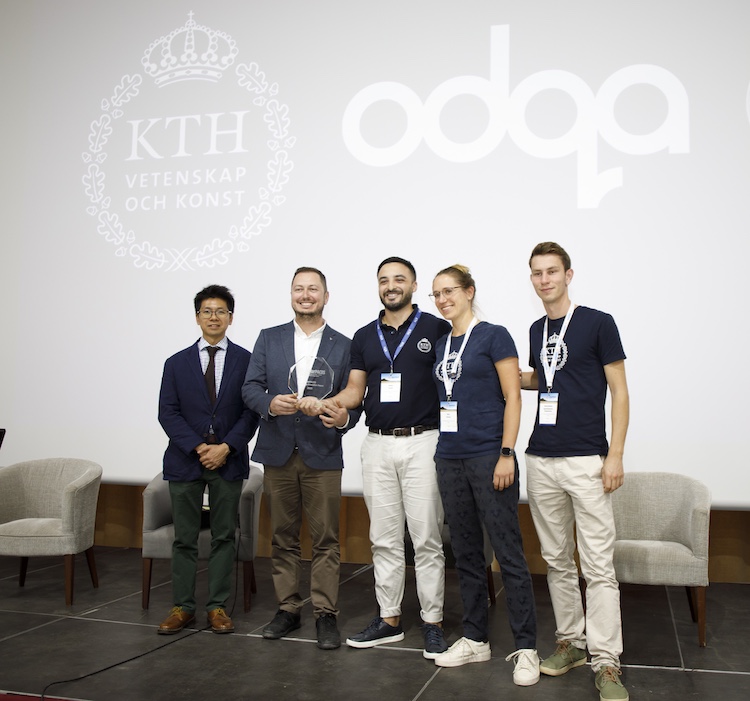
Accepting the SolarPACES Technology Innovation Award 2025 for the Innovative High-Temperature Air-Based Integrated CST for Flexible Renewable Heat are Pok Wan Kwang and Gediz Karaca from ODQA, with Rafael Guedez, Silvia Trevisan and Konstantinos Apostolopoulos-Kalkavouras from KTH

Accepting the SolarPACES Technology Innovation Award 2025 for the Innovative High-Temperature Air-Based Integrated CST for Flexible Renewable Heat are Pok Wan Kwang and Gediz Karaca from ODQA, with Rafael Guedez, Silvia Trevisan and Konstantinos Apostolopoulos-Kalkavouras from KTH

School of Industrial Engineering and Management at KTH

Job description

To achieve decarbonization of the industrial sector, technically efficient and cost-effective solutions integrating renewable energy sources, electrification of heat, and energy storage are deemed. We aim to design and prototype different thermal technologies and evaluate as well their integration and control within given hybrid systems, and under different market scenarios and industrial applications. Among these technologies we consider thermal energy storage (TES), heat pumps, electric heaters, and solar thermal collectors. The postdoc will lead activities within the scope of TES technology development (e.g. via numerical analyses and material characterization), laboratory testing and data analysis towards validation and upscaling, as well as system-level investigations towards commercialization. The latter potentially involving techno-economic analysis and AI-driven models for optimizing design and operation. Activities within project management and co-supervision of graduate students are also foreseen. Cooperation with industrial and academic partners is planned, both nationally and internationally. Candidates must have documented background and interest in thermodynamics, heat transfer, and experimental methods and activities.

Qualifications

  • A doctoral degree or an equivalent foreign degree in the field of thermal and/or fluid energy engineering. This eligibility requirement must be met no later than the time the employment decision is made.
  • Proven experience from doctoral thesis, authoring scientific publications or authoring industry reports (or equivalent industry), in the field of applied industrial thermal energy engineering. For example in relation to thermal energy storage, thermal machinery, heat pumps or solar thermal energy.

Preferred qualifications

  • A doctoral degree or an equivalent foreign degree, obtained within the last three years prior to the application deadline
  • It is advantageous to have previous experimental work with the technologies listed in the description i.e. thermal energy storage, thermal machines, heat pumps and/or solar thermal systems.
  • It is meritorious to have previous work (numerical & experimental) with boundary layer flows, heat transfer, surface effects and additive manufacturing.
  • It is meritorious to have previous experience in data analysis and processing with Python (or similar), preferably including documented experience with machine learning tools.
  • It is meritorious to be aware of diversity and equal opportunity issues, with specific focus on gender equality.
  • The candidate should have collaborative abilities and be able to work independently.

Great emphasis will be placed on personal skills.

Join us at KTH

KTH shapes the future through education, research and innovation. As a leading international technical university, we play an active role in advancing the transition towards a sustainable society. At KTH, you have the opportunity to grow and develop in a creative and dynamic environment, with good working conditions and attractive benefits. Equality, diversity and equal opportunities are essential to quality and form an integral part of KTH’s core values as a university and public authority.

Learn more about our benefits and what it’s like to work and grow at KTH.

Trade union representatives

Contact information to trade union representatives.

To apply for the position

Log into KTH’s recruitment system to apply for this position. You are responsible for ensuring that your application is complete according to the instructions in the ad.

Apply Here

The application must include:

  • CV including relevant professional experience and knowledge.
  • Copy of diplomas and grades from your previous university studies. Translations into English or Swedish if the original documents have not been issued in any of these languages.
  • Brief account of why you want to conduct research, your academic interests and how they relate to your previous studies and future goals. Max two pages long.
  • Copy of selected authored reports, scientific articles (or industrial equivalent) demonstrating previous relevant experience (Maximum 3 reports, all in PDF format).

Your complete application must be received at KTH no later than the last day of application, midnight CET/CEST (Central European Time/Central European Summer Time).

About the employment

The position offered is for, at the most, three years.

A position as a postdoctoral fellow is a time-limited qualified appointment focusing mainly on research, intended as a first career step after a dissertation.

Others

For information about processing of personal data in the recruitment process.

It may be the case that a position at KTH is classified as a security-sensitive role in accordance with the Protective Security Act (2018:585). If this applies to the specific position, a security clearance will be conducted for the applicant in accordance with the same law with the applicant’s consent. In such cases, a prerequisite for employment is that the applicant is approved following the security clearance.

We firmly decline all contact with staffing and recruitment agencies and job ad salespersons.

Disclaimer: In case of discrepancy between the Swedish original and the English translation of the job announcement, the Swedish version takes precedence.

Type of employmentTemporary position

Contract typeFull time

Full-time equivalent100%

First day of employmentFeb 16, 2026 or by agreement

SalaryMonthly salary

Number of positions1

LocationStockholm

CountyStockholms län

CountrySweden

Reference numberPA-2025-4357

Published18.Dec.2025

Last application date09.Jan.2026

Contact

Rafael Guedez, regm@kth.se


Related:

Over 90% efficient energy storage improved by flowing heat round two pebble layers

Another standalone thermal energy storage tech – the Heatcube

The post Postdoc in Optimized thermal technologies for industrial decarbonization at KTH appeared first on SolarPACES.

Published at Solar Energy Engineering – A Solar Air Receiver With Porous Ceramic Structures for Process Heat at Above 1000 °C—Heat Transfer Analysis

27 December 2025 at 02:02


Abstract:
Concentrated solar energy can be used as the source of heat at above 1000 °C for driving key energy-intensive industrial processes, such as cement manufacturing and metallurgical extraction, contributing to their decarbonization. The cornerstone technology is the solar receiver mounted on top of the solar tower, which absorbs the incident high-flux radiation and heats a heat transfer fluid. The proposed high-temperature solar receiver concept consists of a cavity containing a reticulated porous ceramic (RPC) structure for volumetric absorption of concentrated solar radiation entering through an open (windowless) aperture, which also serves for the access of ambient air used as the heat transfer fluid flowing across the RPC structure. A heat transfer analysis of the solar receiver is performed by means of two coupled models: a Monte Carlo (MC) ray-tracing model to solve the 3D radiative exchange and a computational fluid dynamics (CFD) model to solve the 2D convective and conductive heat transfer. Temperature distributions computed by the iteratively coupled models were compared with experimental data obtained by testing a lab-scale 5 kW receiver prototype with a silicon carbide RPC structure exposed to 3230 suns flux irradiation. The receiver model is applied to optimize its dimensions for maximum efficiency and to scale-up for a 5 MW solar tower.

Vikas R. Patil, Aldo Steinfeld, J. Sol. Energy Eng. Apr 2025, 147(2): 021007 (13 pages) Paper No: SOL-24-1108 https://doi.org/10.1115/1.4066499

The post Published at Solar Energy Engineering – A Solar Air Receiver With Porous Ceramic Structures for Process Heat at Above 1000 °C—Heat Transfer Analysis appeared first on SolarPACES.

International Journal of Hydrogen Energy – A techno-economic and environmental evaluation of the integration of direct air capture with hydrogen derivatives production

27 December 2025 at 01:50


Abstract:
Carbon-neutral fuels are key to decarbonizing hard-to-abate sectors. Solar redox cycles can produce them by creating oxygen vacancies in a metal oxide capable of splitting water and CO2. The resulting synthesis gas can be processed into a liquid fuel like methanol. To close the carbon cycle, feedstock CO2 can be captured from the atmosphere with direct air capture (DAC), but the synergies between synthetic fuel production and DAC are largely unexplored. In this work, four integration strategies between DAC and solar redox cycles are proposed. Each of them is modeled with Aspen Plus and HFLCAL and compared with a techno-economic and a cradle-to-gate life cycle assessment. The optimal configuration, with a levelized cost of 7.9 ± 0.4 USD2022/kgMethanol and a climate change impact of −450 ± 30 g CO2e/kgMethanol, uses solid DAC powered by waste heat. Therefore, the study recommends the integration of DAC in the production of synthetic fuels.

Enric Prats-Salvado, Nathalie Monnerie, Christian Sattler, A techno-economic and environmental evaluation of the integration of direct air capture with hydrogen derivatives production, International Journal of Hydrogen Energy, Volume 140, 2025, Pages 1153-1162, ISSN 0360-3199, https://doi.org/10.1016/j.ijhydene.2024.10.026

The post International Journal of Hydrogen Energy – A techno-economic and environmental evaluation of the integration of direct air capture with hydrogen derivatives production appeared first on SolarPACES.

Published at Solar Energy – Solar concentrator layout and performance analysis for multi-aperture receiver-reactors in high-temperature applications

26 December 2025 at 23:57


Abstract:
Promising new receiver-reactor concepts with multiple apertures have been proposed for high temperature solar thermochemical hydrogen production. However, limited information about suitable solar concentrator designs consisting of heliostat fields and secondary concentrators is available so far.
The goal of this study is a detailed investigation of the effect of selected solar concentrator design parameters on its performance. For a 10 MW receiver-reactor the number of subfields and corresponding apertures is varied in combination with the receiver height above the ground, the acceptance angle of the secondary concentrator, and the design point flux density. In addition, the performance is analyzed at different power levels. The average annual performance is evaluated as well as the hourly behavior. The latter of which is important to quantify the performance of a plant with an integrated receiver-reactor.
For the heliostat field layout the program HFLCAL1 is used. Solar concentrator designs with annual average efficiencies of over 60% are identified delivering flux densities of up to 5000 suns at design point for 10 MW receivers. Instead of a joint evaluation of the solar concentrator together with a specific receiver-reactor a generic receiver-reactor surrogate model is introduced. With this surrogate model an hourly analysis of the plant performance is conducted and a parametrized correction factor is presented to derive more accurate yearly plant performance estimates.
The study provides detailed information on solar concentrators using multiple heliostat subfields and central tower systems with secondary optics, and indicates further optimization potential of solar concentrators for high-temperature receivers.

Hanna Lina Pleteit, Stefan Brendelberger, Peter Schwarzbözl, Malou Großmann, Martin Roeb, Christian Sattler,Solar concentrator layout and performance analysis for multi-aperture receiver-reactors in high-temperature applications,Solar Energy,Volume 303, 2026,114115,ISSN 0038-092X, https://doi.org/10.1016/j.solener.2025.114115

The post Published at Solar Energy – Solar concentrator layout and performance analysis for multi-aperture receiver-reactors in high-temperature applications appeared first on SolarPACES.

SWISS signs long-term offtake agreement for solar jet fuel from Synhelion

19 December 2025 at 03:22


Press Release Zurich, December 16, 2025

Swiss International Air Lines (SWISS) and Swiss cleantech company Synhelion have signed a long-term offtake agreement for sustainable aviation fuel (SAF). From 2027, SWISS will purchase at least 200 tons of solar jet fuel from Synhelion annually, pioneering the use of this innovative fuel in civil aviation. The agreement marks an important milestone on the road to more sustainable aviation.

SWISS is the first airline to sign a binding five-year SAF offtake agreement with Synhelion. This marks a pioneering step toward defossilizing aviation. From 2027, Synhelion will produce renewable synthetic crude oil, known as “syncrude”, at its first commercial plant. The syncrude will be processed in an existing refinery together with fossil crude oil and refined into certified Jet-A-1 fuel. Thus, Synhelion directly replaces fossil crude oil with sustainable syncrude, without the need for any adjustments to the existing infrastructure. The fuel will be delivered to the airport via the regular logistics chain and fed into the fuel supply system. Synhelion’s synthetic jet fuel is based on renewable energy and sustainable feedstocks.

A strong signal for sustainable aviation

“The partnership with Synhelion is a significant step for SWISS on the path to decarbonizing our flight operations,” says Jens Fehlinger, CEO of SWISS. “Sustainable aviation fuels (SAF) are a core element of our sustainability strategy. The offtake agreement with Synhelion sends a strong signal for innovation and responsibility in aviation.”

With this offtake agreement, SWISS is actively supporting the scaling of Synhelion’s technology for the production of renewable synthetic fuels as a customer, investor, and strategic partner. This long-term planning certainty enables targeted expansion of production capacity and helps reduce costs over time.

Pioneering partnership

Synhelion also emphasizes the significance of the agreement: “The fact that SWISS, a leading airline, has committed early on to adopt our fuels demonstrates confidence in the market readiness of our technology,” says Philipp Furler, Co-CEO and Co-Founder of Synhelion. “This partnership is a milestone for the commercial market launch of our fuels – and sets a powerful example to other airlines worldwide.”

Expanding the partnership with Kuehne+Nagel

Part of the renewable jet fuel produced by Synhelion will be resold by SWISS to the logistics service provider Kuehne+Nagel. The company will use the sustainable fuel for air freight transportation with Swiss WorldCargo, offering its customers a tangible solution to reduce their carbon footprint in global logistics.

First delivery already completed

In July 2025, SWISS became the first airline in the world to use solar fuel from Synhelion in regular flight operations. Synhelion delivered its first barrel of syncrude from its DAWN plant to a refinery in northern Germany, where the syncrude was processed into certified jet fuel (Jet-A-1) and subsequently fed into the fuel supply system via Hamburg Airport.

How can Synhelion’s solar receiver achieve such high temperatures?

Synhelion produces first solar syngas in Wood’s industrial-scale reforming reactor

CEMEX and Synhelion ace the First “Hot Solar” Cement Trial

At Synhelion, Solar Jet Fuels Get Ready for Take-off

How Synhelion’s solar jet fuel started – an interview in 2017

The post SWISS signs long-term offtake agreement for solar jet fuel from Synhelion appeared first on SolarPACES.

Aluminum melted with Annular Fresnel solar at over 700°C

12 December 2025 at 03:33
pour of molten alumimum melted with Annular Fresnel

Pour of molten alumimum melted with Annular Fresnel solar collectors

Solar researchers at Fraunhofer Chile have designed, built, and tested a complete solar collector and crucible system for melting and recycling aluminum, heated by Annular Fresnel solar collectors. In Annular Fresnel, each mirror is flat, like a Fresnel mirror, but arranged in a circle, enabling the very high concentration possible with Dish solar concentrators.

The Annular Fresnel concentrators they had manufactured locally are sliced from silver-coated acrylic sheets. The team built a full system, including a complete crucible furnace and a handling system, which has been operated through multiple aluminum melt/pour cycles under real DNI conditions in Chile for this application‑specific innovation and engineering demonstrator.

Annular Fresnel mirrors are cut from silvered acrylic

The Annular Fresnel mirrors are cut from silvered acrylic

They showed that their setup, designed explicitly for aluminum recycling, will operate at the required high temperature at low cost and on a practical scale. As they revealed in a well-received presentation, Fresnel Solar Furnace for Aluminum Melting, and paper at the 2025 SolarPACES Conference in Spain, the team has successfully cast branded ingots during tests.

“We bypassed the standard laboratory phase and moved directly to testing in a relevant environment,” said lead author Pablo Castillo, in a call from Chile.

“It involved significant trial and error—specifically, determining exactly when the aluminum was molten by relying solely on the furnace’s temperature sensors, without visual confirmation.”

Local manufacturing limitations led to their choice of Annular Fresnel concentrators

Annular Fresnel concentrators are a cross between linear Fresnel reflectors – long lines of flat mirrors – and the highly concentrating solar Dish, in which each little mirror is curved. Annular Fresnel concentrators have the high-concentration advantage of Dish collectors but are simpler to manufacture because they consist of flat mirrors arranged in concentric reflecting rings. In this case, the mirror surface was achieved with silver-plated acrylic plastic.

“Our challenge was achieving this level of concentration using Chile’s local manufacturing capabilities,” Castillo explained.

“We hit a wall realizing we couldn’t manufacture a three-meter parabolic dish locally. Instead, we adopted a simpler design based on the linear Fresnel concept: 13 concentric rings on a single plane with varying slopes. We were pleasantly surprised to find that, even with local limitations, we could successfully achieve these complex geometries.”

Because Fresnel systems are typically linear, they need only single-axis tracking. However, by combining the low-cost Fresnel flat mirrors into a circular Dish-like configuration, the tracking system requirement also changes. The team innovated a slewing drive system for dual-axis tracking for their concentrator to accommodate the change.

Why Chilean aluminum recycling

With its world-leading DNI, Chile has vast regions where this simple solar technology for aluminum melting can recycle aluminum and other metals with similar melting points. And increasingly, Chilean policy requires metal recycling.

Currently, aluminum is exported to Brazil for recycling. The Fraunhofer team believes that, by building a deployable system for large cities in Northern Chile, where there is abundant solar resource, they can recycle aluminum using solar energy domestically and then sell it to companies looking for aluminum with a zero-carbon footprint.

“We have seen significant interest from major multinationals in the food and beverage sector who are pursuing circular economy goals for their packaging,” said Castillo.

“Our industrial partner, who currently exports scrap aluminum, noted a shifting international demand toward ‘green aluminum’ produced with near-zero carbon emissions. We are working together to develop this technology for coastal cities with major ports, as well as more populated areas in the Central Valley of Chile.”

What the experiment proved

The team proved that this simple-to-manufacture annular mirror geometry, combined with their practical, field‑tested aluminum recycling furnace and control system, is a feasible, low-cost route to industrial aluminum recycling.

Designed to maintain the crucible strictly within the optimal processing range of 520–640°C for repeated aluminum pours, their system utilizes a unique ring‑mirror field on a compact slewing drive. With full two‑axis tracking and custom controls, the setup successfully managed the melt-pour cycles using relatively modest, locally manufactured equipment compared to the giant solar furnaces typically used for research, such as those at Odeillo.

In 21 outdoor trials conducted between November 2024 and May 2025, the team established a reliable industrial workflow. On a representative high-performance day (April 8, 2025), the system achieved a maximum daily melt of 1.71 kg under a median DNI of 902 W/m², successfully executing multiple pour-and-recharge cycles. The results have been validated via a six-node thermodynamic model, confirming the system’s potential for scaling.

The system integrates custom electronics, software, and a sun-tracking mechanism for azimuth and elevation, installed at Parque Caren in Santiago, Chile (33.4351°S, 70.8457°W). Iterative prototyping optimized optical and thermodynamic performance, with the furnace heating a crucible to melt aluminum and pour it into ingot molds.

Next steps

To initially test the concept, it was most straightforward to position the furnace at a focal point above the dish. But in production, for practical reasons, the melting pour would need to be on the ground.

Annular Fresnel mirror aimed up to the crucible in initial testing

Annular Fresnel mirror aimed up to the crucible in initial testing

“Manipulating a furnace at 800°C and pouring molten liquid three meters above the ground poses significant safety risks,” he said.

To avoid this high-temperature operation at the natural sky-high focal point, they would add a secondary beam-down reflector, so that the furnace and the molten pour can be stable at ground level.

“While a beam-down reflector might incur slight optical energy loss, we gain stability and reduce exposure to wind and dust. So we believe we can achieve a higher output,” Castillo pointed out.

“We have already developed a ‘2.0’ design where the furnace remains stationary at ground level. Having proven the technology is feasible, our next steps are to refine the design, lower costs, and increase output.”

“Solar energy that can be poured in the fuel tank”: the Aldo Steinfeld Weltwoche interview

Solar furnace to melt steel at 2000°C for Swiss recycler Panatère

Startup concentrates solar to melt NASA’s lunar landing pads

Why Lunar Engineering is an Exciting R&D Field for the “Hot Solar”

The post Aluminum melted with Annular Fresnel solar at over 700°C appeared first on SolarPACES.

Published at Solar Energy – Effects of concentrated solar–integrated packed-bed thermal energy storage operation on solid oxide electrolysis cell performance

11 December 2025 at 23:58

Abstract:

The use of renewable energy in the context of green hydrogen production requires suitable energy storage technologies to compensate for intermittent wind and solar resources. High-temperature electrolysis is a promising way to produce hydrogen as it has the highest electrical efficiency by using steam instead of liquid water compared to low temperature electrolysis. Here, a part of the total energy demand is substituted by thermal energy. For a sustainable and continuous process operation with concentrated solar energy, a high-temperature thermal energy storage heating air and steam is required to operate the high-temperature electrolysis above 800 °C. In this study, the charging and discharging behavior of a packed bed thermal energy storage with a capacity of 17.46 kWh is experimentally tested and a utility scale storage numerically analyzed. The storage is charged with superheated steam from a solar cavity receiver and discharged with ambient air or steam flow. The storage discharge temperature profile results in a change in the electrolysis operating state and therefore, a change in the reagent flow rate. This changes the hydrogen production capacity during the discharge period. Adjusting the thermal energy storage discharge flow rate maintains an electrical conversion efficiency of 97 %. Furthermore, additional electric heating or exothermal operation of the electrolysis is avoided. Additionally, an electrolysis cooling rate of greater than −0.3 K/min can be maintained.

Timo Roeder, Yasuki Kadohiro, Kai Risthaus, Anika Weber, Enric Prats-Salvado, Nathalie Monnerie, Christian Sattler,Effects of concentrated solar–integrated packed-bed thermal energy storage operation on solid oxide electrolysis cell performance,Solar Energy,Volume 302,2025,114032,ISSN 0038-092X, https://doi.org/10.1016/j.solener.2025.114032

The post Published at Solar Energy – Effects of concentrated solar–integrated packed-bed thermal energy storage operation on solid oxide electrolysis cell performance appeared first on SolarPACES.

Published at Applied Thermal Engineering – Dynamic heat transfer model for thermal energy storage using metal wool–phase change material composites

11 December 2025 at 23:52


Abstract:
Decarbonisation of the energy sector is critical for climate change mitigation, with the power sector remaining a major contributor to global emissions. Concentrating solar power (CSP) technology combined with thermal energy storage (TES) presents a promising solution to overcome this challenge. TES systems, particularly those utilising phase change materials (PCMs), offer efficient energy storage by harnessing latent heat, enabling reliable power generation, and providing high-temperature heat for industrial processes. This research introduces a heat transfer model designed to simulate the thermal behaviour of TES systems utilising wool–PCM composites as storage medium. The mathematical model was implemented on the OpenModelica platform and it is intended to be incorporated into a simulation tool currently being developed by the authors to assess the performance of CSP plants under dynamic conditions. The model was validated by comparing the simulation results with the experimental measurements of the temperature within the composite domain during both the charging and discharging cycles. The simulations replicated key experimental parameters, including geometry, material properties, and boundary conditions, and evaluated two configurations with coarse and fine wool fibres. The results demonstrated good agreement with the experimental data for coarse wool, with a root mean square error (RMSE) of up to 2.29 K. For fine fibres, the RMSE increased to 5.31 K, indicating a larger deviation. Despite these challenges, the model successfully captured the overall thermal response trend and phase transition behaviour observed experimentally. The findings highlight the efficacy and limitations of the proposed thermal model and emphasise the necessity for advanced macroscopic-scale effective thermal conductivity modelling approaches for such composites that integrate the influence of pore-scale characteristics (i.e., volume change). This research will advance the current state-of-the-art in this field and will mitigate the discrepancies identified in this study when these models are applied in practice. This integration is crucial for enhancing the accuracy and improving the time simulation of large-scale TES systems in CSP applications.

Pablo D. Tagle-Salazar, Luisa F. Cabeza, Anton López-Román, Cristina Prieto,
Dynamic heat transfer model for thermal energy storage using metal wool–phase change material composites,Applied Thermal Engineering,Volume 281, Part 1,2025,128548,ISSN 1359-4311,
https://doi.org/10.1016/j.applthermaleng.2025.128548

The post Published at Applied Thermal Engineering – Dynamic heat transfer model for thermal energy storage using metal wool–phase change material composites appeared first on SolarPACES.

❌