Normal view

Received yesterday — 31 January 2026

Wang Zhifeng wins China’s Science and Technology Award 2025

26 January 2026 at 23:41

Source: China Solar thermal Alliance

On November 28, 2025, the China Renewable Energy Society (CRES) announced the list of winners of 2025 CRES Science and Technology Awards, including 10 first prize winners, 12 second prize winners, 13 third prize winners, 1 Science and Technology Achievement Award winner, five Science and Technology Innovation Award winners, and 10 Young Scientist Award winners.

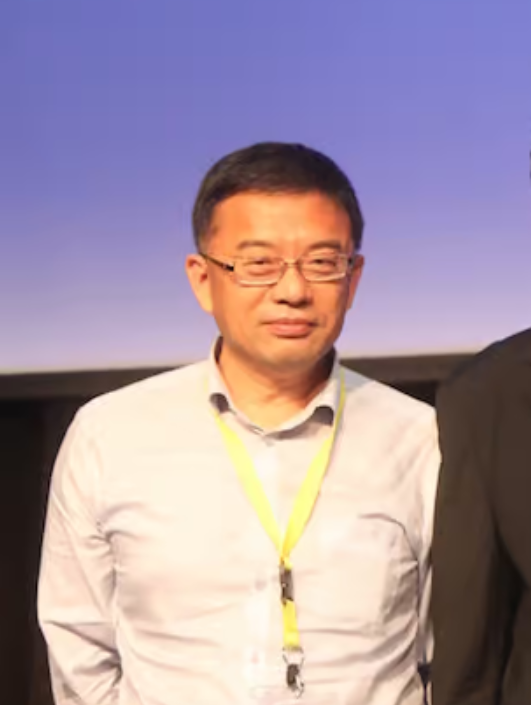
Dr. Wang Zhifeng, researcher at the Institute of Electrical Engineering, Chinese Academy of Sciences (IEECAS) and Chairman of CRES Concentrating Solar Power Committee, won the Science and Technology Achievement Award.

Wang Zhifeng, born in October 1963, holding a PhD in Engineering Thermophysics from Tsinghua University, Researcher and PhD Supervisor at IEECAS, Chairman of China Solar Thermal Alliance (CSTA), Vice President of the IEA-SolarPACES, Chairman of CRES Concentrating Solar Power Committee, Vice Chairman of the Solar Thermal Power Generation Professional Committee of China Electrotechnical Society (CES), Vice Chairman of the National Solar Thermal Power Generation Standardization Committee, one of the first specially appointed core backbone researchers of the CAS (2015), one of the first recipients of the National “Ten Thousand Talents Program” (2014), expert receiving special allowance of the State Council, winner of the Outstanding Contribution Award for Solar Thermal Energy Utilization in China (2016). He has twice been awarded the title of CAS Excellent Doctoral Supervisor. He has published a monograph on concentrating solar power (in Chinese, English, and Arabic), titled Design of Solar Thermal Power Plants, and more than 70 papers.

He has long been committed to the modeling and optimization of concentrating solar power (CSP) systems, as well as the research on photothermal conversion equipment and thermal energy storage. He proposed that the core scientific problem of solar thermal power generation is the coupling of unsteady light-heat-work processes, presented a roadmap for the development CSP technology, and proposed the concept of the 4th-generation CSP technology. He has presided over numerous major projects financed by the 863 Program and 973 Program (both are National High-Technology R&D Programs of China), the National Key R&D Program of China, and the National Natural Science Foundation of China, achieving multiple breakthroughs. As the project leader, he has led the construction of:

Asia’s first solar tower plant (2012);

China’s first cross-seasonal solar thermal energy storage project, achieving 210-day continuous thermal energy storage across different seasons (2021);

the world’s first CSP kiln for cement and ceramics firing (2022); and

the world’s first supercritical CO2 CSP system (2024).

The post Wang Zhifeng wins China’s Science and Technology Award 2025 appeared first on SolarPACES.

China connects 9 more CSP projects in 2025 for 27 total

26 January 2026 at 18:28


Source: China Solar Thermal Alliance: Blue Book 2025

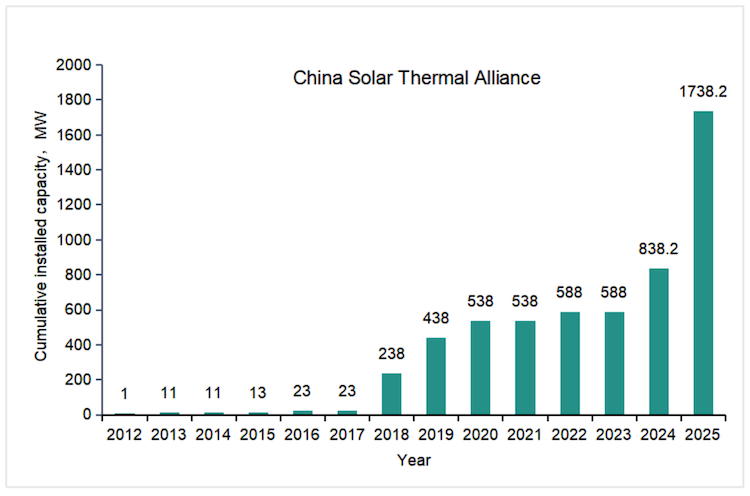
In 2025, China connected 9 new CSP plants to the grid, with a total installed capacity of 900 MW. By the end of 2025, China had built 27 CSP plants/systems, with a cumulative installed capacity of 1738.2 MW (including the country’s first 200 kW supercritical carbon dioxide solar thermal power experimental system), representing a 107% increase compared to 2024 and ranking third globally. Among this total, the installed capacity of grid-connected CSP plants reached 1720 MW.

On January 21, 2026, the Blue Book of China’s Concentrating Solar Power Industry (2025) (hereinafter referred to as the Blue Book) was officially released. Compiled jointly by the China Solar Thermal Thermal Alliance (CSTA) and the CSP Committee of the China Renewable Energy Society, the Blue Book was approved for publication by the Expert Committee of the CSTA.

Article 25 of the Energy Law of the People’s Republic of China, which came into effect on January 1, 2025, stipulates that “Actively develop Concentrating Solar Power (CSP) “, laying a solid legal foundation for the sustainable development of the sector.

In 2025, relevant national authorities issued more than ten policy documents related to CSP. Among them, the Some Opinions on Promoting the Large-scale Development of CSP, jointly issued by the National Development and Reform Commission and the National Energy Administration on December 23, 2025, is a specialized policy document.

The policy document explicitly states that CSP is an effective means to achieve the safe and reliable replacement of traditional energy with new energy, and a robust pillar for accelerating the construction of a new power system. The document emphasizes giving full play to the supporting and regulating role of solar thermal power generation in the new power system, tapping its potential as a green, low-carbon baseload power source, promoting the transformation of its system-level power supply value, and increasing the proportion of green and reliable supporting capacity in the new power system. It also supports solar thermal power plants equipped with electric heating systems to function as long-duration energy storage stations through the electricity market.

The Blue Book elaborates that solar thermal power generation is a system that converts solar radiation into thermal energy and then generates electricity through a heat-to-work conversion process. The main concentrating technologies for CSP include eight types: tower concentrating, trough concentrating, linear Fresnel concentrating, dish concentrating, wheel concentrating, rotating tower concentrating, secondary and multi-reflection concentrating, and transmissive concentrating.

Figure: China’s Cumulative Installed Capacity of CSP by 2025: CSTA

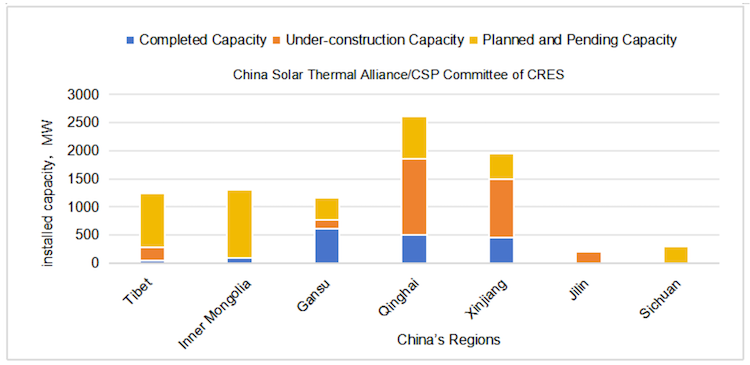
According to statistics from the CSTA and the CSP Committee of the China Renewable Energy Society, approximately 25 solar thermal power projects were in the substantive construction phase, with a total installed capacity of 3000 MW. Notably, two 350 MW standalone solar thermal power plants commenced construction at the end of 2025. The number of planned and pending solar thermal power projects in China stood at around 31, with a total installed capacity of approximately 4050 MW (excluding projects with unspecified installed capacity).

According to the target set forth in the Several Opinions on Promoting the Large-scale Development of Solar Thermal Power Generation, by 2030, China’s total installed capacity of solar thermal power generation is expected to reach around 15,000 MW. Assuming all planned and pending projects are implemented, an additional approximately 6000 MW of installed capacity will need to be developed and constructed in the next five years based on existing projects.

Figure: Expected Total Installed Capacity Based on all CSP projects in 2025 (Including Planned and Pending Projects) : CSTA

Regarding the construction of CSP plants across provinces and regions, Blue Book shows that by the end of 2025, Gansu Province had the largest cumulative installed capacity (621 MW, including the 1 MW rooftop linear Fresnel CSP system of Lanzhou Dacheng), followed by Qinghai Province (510 MW) and Xinjiang Uygur Autonomous Region (450 MW). Among under-construction projects, Qinghai Province led with the largest installed capacity under construction (1350 MW), followed by Xinjiang (1050 MW) and Tibet Autonomous Region (250 MW).

Based on public information and preliminary verification by the CSTA, Inner Mongolia Autonomous Region, Tibet Autonomous Region, and Qinghai Province ranked among the top in terms of planned and pending solar thermal power generation installed capacity, with a combined total of approximately 3000 MW.

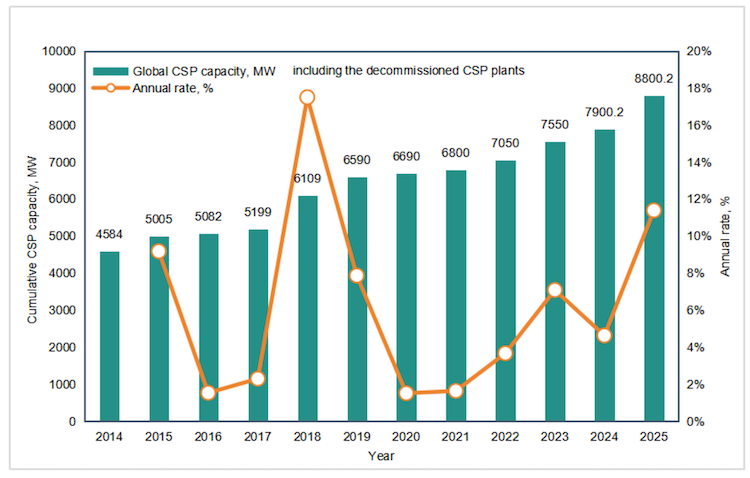
Figure: the cumulative installed capacity of CSP in major countries and regions worldwide reached 8800.2 MW (including 8 decommissioned trough power plants built in the United States in the 1980s), a year-on-year increase of 11.4%.

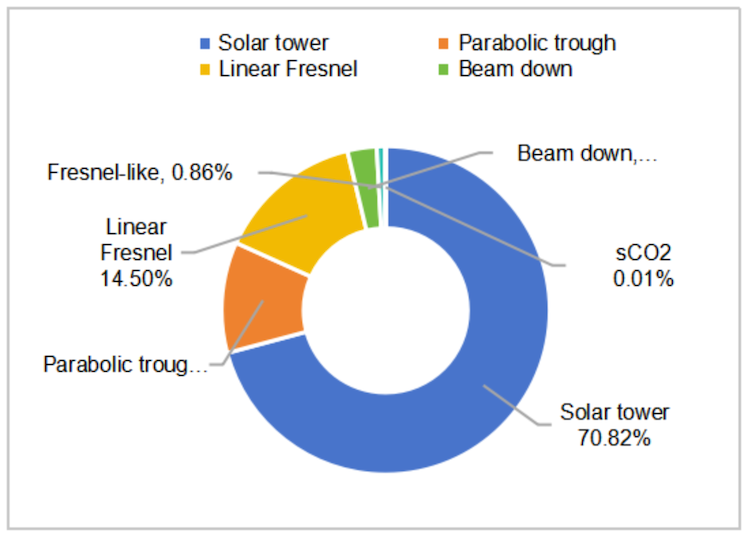
In terms of the market share of concentrating technologies, Blue Book shows that by the end of 2025, tower concentrating accounted for approximately 70.82% of China’s cumulative installed solar thermal power capacity, followed by trough concentrating (10.93%), linear Fresnel concentrating (14.50%), secondary reflection concentrating (2.88%), Fresnel-like concentrating (0.86%), and supercritical carbon dioxide concentrating (0.01%).

Figure: Market share of different concentrating technologies in China‘s cumulative installed capacity: CSTA

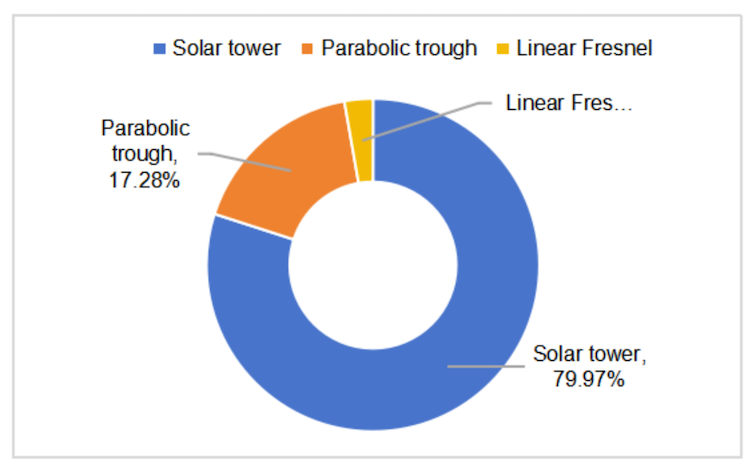
In contrast, in major overseas countries and regions, trough concentrating dominated with a share of about 79.97%, followed by tower concentrating (17.28%) and linear Fresnel concentrating (2.75%).

Figure: Market share of different concentrating technologies in overseas cumulative installed capacity: CSTA

Regarding the operation of CSP demonstration projects, the Blue Book separately presents the technical parameters and annual operation data of the first batch of solar thermal power demonstration projects. Seven early-built solar thermal power plants achieved a total power generation of over 1.1789 billion kWh in 2025. The Luneng Golmud Multi-energy Complementary Project’s 50 MW tower solar thermal power plant generated 148.2327 million kWh in 2025, a year-on-year increase of 55.92%. The CSSC New Energy Urad Middle Banner 100 MW trough solar thermal power plant achieved an annual power generation of 301 million kWh in 2025, representing an 8.27% increase compared to 2024. Both the CGN Delingha 50 MW trough solar thermal demonstration power plant and the Shouhang High-tech Dunhuang 100 MW tower solar thermal power plant hit record-high annual power generation in 2025, with a year-on-year increase of approximately 3.7%. The Qinghai Zhongkong Delingha 50 MW tower solar thermal power plant completed its annual power generation target for the fourth consecutive year. The Lanzhou Dacheng Dunhuang 50 MW linear Fresnel solar thermal power plant mainly focused on further upgrading its operation and maintenance strategies in 2025, resulting in a 13.6% increase in annual power generation. The PowerChina Gonghe 50 MW tower solar thermal power plant saw a 6.4% year-on-year growth in annual power generation in 2025. Due to unit overhauls conducted from September to October 2025, the PowerChina Hami 50 MW tower solar thermal power plant experienced an impact on power generation, with an annual output of approximately 102.99 million kWh in 2025.

In terms of the industrial chain and production capacity, based on inquiries using professional software that considered five key factors—enterprise name, business scope, company profile, brand products, and enterprise status—the Blue Book reveals that there are approximately 6,610,686 large, medium, small, and micro-sized enterprises involved in solar thermal power generation in China, including 10,722 state-owned enterprises, 533,771 private enterprises, 3,469 foreign-invested enterprises, and 458,861 micro-enterprises. Within the industrial chain, there are 36,884 manufacturing enterprises, among which 4,011 are general equipment manufacturers and 1,460 are special equipment manufacturers. In terms of manufacturing capacity, taking the production capacity of flat mirrors as an example, based on the requirement that “the mirror field area of a 100 MW power plant should not be less than 800,000 square meters in principle”, the annual production capacity of major mirror manufacturers in China can support the construction of approximately 5,300 MW of solar thermal power plants.

In terms of technological R&D and achievement recognition, China launched 4 national key R&D program projects related to solar thermal power generation in 2025, with approximately 13 such projects under implementation during the year. Regarding standards, by the end of 2025, the International Electrotechnical Commission Technical Committee 117 (IEC/TC 117) had issued 11 international standards for solar thermal power generation. China currently has approximately 33 national standards in effect for solar thermal power generation, with 5 more in the drafting stage. In 2025, the National Energy Administration issued a total of 24 industry standard plans related to solar thermal power generation. By the end of 2025, the National Solar Thermal Industry Technology Innovation Strategic Alliance had released 22 alliance standards, including 14 standards specifically for solar thermal power generation. In 2025, several technological achievements related to solar thermal power generation participated in relevant award evaluations or were recognized by national authorities, with the number of awarded or recognized achievements increasing by approximately 71% compared to 2024.

Chapter 6 of the Blue Book elaborates on the techno-economic performance of solar thermal power generation. It shows that under the full power generation mode, the calculated levelized cost of electricity (LCOE) for parabolic trough, solar tower, and linear Fresnel CSP projects ranges from 0.426 CNY/kWh to 0.5323 CNY/kWh.

In terms of carbon emission reduction, the carbon footprint factor of solar thermal power generation was 0.0312 kgCO₂e/kWh in 2024, second only to nuclear power and hydropower. In 2025, the trading volume of Chinese Certified Emission Reductions (CCER) from grid-connected solar thermal power projects reached 1.0692 million tons, with a transaction value of 87 million CNY and an average transaction price of 81.58 CNY/ton (compared to an average transaction price of 69.27 CNY/ton for grid-connected offshore wind power projects).

The Blue Book indicates that through long-term operational verification, solar thermal power plants can achieve a maximum peak regulation rate of 10% per minute; existing projects have realized continuous operation for 230 days, with an annual equivalent full-load operation hour count reaching 3,300 hours. The Blue Book puts forward the following recommendations: expedite the research and formulation of a compensation mechanism for solar thermal power generation as a supporting power source; strengthen top-level design and planning guidance; fully summarize and evaluate the construction and operational experience of integrated solar thermal and photovoltaic projects; promote the large-scale and diversified development of solar thermal power generation in a classified manner; and accelerate technological and industrial innovation in solar thermal power generation.

The Blue Book consists of 9 chapters, including: Overview of Solar Thermal Power Generation Technologies, Market Development of Solar Thermal Power Generation, Operation of Solar Thermal Power Generation Demonstration Projects, Industrial Chain of Solar Thermal Power Generation, Technological R&D of Solar Thermal Power Generation, Techno-economic Performance of Solar Thermal Power Generation, Carbon Emission Reduction of Solar Thermal Power Generation, Development Recommendations for Solar Thermal Power Generation, and Appendices.

You can download the Chinese version of the Blue Book from the official website of the China Solar Thermal Alliance.


The post China connects 9 more CSP projects in 2025 for 27 total appeared first on SolarPACES.

Glasspoint closes $20 million solar fund for global industrial heat

26 January 2026 at 18:05


DUBAI, January 26, 2026 — GlassPoint, the leader in solar industrial process heat, today announced it has closed a $20M funding round led by N.I.S. New Investment Solutions, a Liechtenstein-based asset management firm, with participation from returning investor MIG Capital. The investment will advance existing megaprojects with Searles Valley Minerals in California and Ma’aden in Saudi Arabia, as well as power expansion across the globe with a focus on projects in the U.S. Southwest, Southern Europe, the Middle East and South America.


More energy is used globally in the form of industrial process heat (26%) than all forms of electricity combined (20%), according to the International Energy Agency. Unlike electricity, industrial process heat is notoriously difficult to decarbonize, primarily due to the low cost of burning fossil fuels to generate heat.


More than 50% of industry is located in regions sunny enough to benefit from GlassPoint technology. In those locations, GlassPoint’s technology delivers superior economics for industrial process heat compared to burning fossil fuels or electrification.


“In many parts of the world, solar energy is now the lowest cost source of industrial power, creating an opportunity to simultaneously reduce operating costs and emissions,“ said Takashi Sato, Founder of N.I.S. “GlassPoint is a proven solution for this moment and has already won the confidence of some of the most discerning industrial organizations in the world, from oil and gas leaders to mining titans.”


“GlassPoint provides industry leaders with a proven solution to deliver industrial process heat at the lowest cost,” said Rod MacGregor, Chief Executive Officer at GlassPoint. “With this latest round of financing, we will expand into several new global markets where GlassPoint’s technology delivers compelling value. We look forward to helping leaders across mining, oil & gas, and building materials achieve a significant cost advantage against their competitors.”


The funding comes on the heels of GlassPoint’s partnership with Searles Valley Minerals to deploy 750 MWth of GlassPoint’s advanced solar technology to reduce costs while beginning to decommission the last two coal-fired plants in California. The company continues to advance its flagship 1.5 GWth project with Ma’aden to decarbonize a bauxite refinery in Saudi Arabia and help the Kingdom meet aggressive sustainability goals. Additionally, GlassPoint’s 330 MWth deployment in Oman has been providing steam on a daily basis since 2017.


GlassPoint’s unmatched ability to deploy at scale is based on multiple industry-first technologies.


  • GlassPoint’s Enclosed Trough is the lowest-cost way to convert sunlight into industrial heat, delivering nearly 70% of the energy available in sunlight directly to the customer.

  • GlassPoint’s Unify Storage System stores solar heat during the day and releases it at night, enabling an uninterrupted supply of clean thermal energy whenever it is needed.


With the new funding, GlassPoint is expanding its Technology Center in Stuttgart, Germany, with leading technologists and engineers. The company is also hiring business development, engineering, and finance talent in Dubai and the United States.


About GlassPoint

GlassPoint is the leader in solar industrial process heat, with its technology powering 60% of the world’s solar industrial steam capacity. With the only solar industrial process heat solution proven at scale, GlassPoint delivers superior unit economics compared to fossil fuels and electrification. GlassPoint is helping industrial organizations significantly lower costs while delivering a reliable source of carbon-free steam. The company builds, owns and operates large-scale solar steam facilities to reduce carbon emissions in hard-to-abate industries such as mining and metals, chemicals, construction materials, oil and gas, desalination and more. Learn more at glasspoint.com.


About MIG Capital

MIG Capital is one of the leading German VC investors. Through its MIG funds, MIG invests in young deep tech and life sciences companies in German-speaking Europe and beyond. To date, the company has invested over €770 million in approx. 60 start-ups. MIG portfolio companies develop innovations in areas including biopharmaceuticals, energy and environmental technologies, advanced computing, digitalization / IoT, medical technology, and digital health. The MIG investment portfolio currently consists of more than 30 companies.


MIG’s investment team is made up of a dedicated group of engineers, scientists, physicians and entrepreneurs who use analytical and creative processes to assess the risks and opportunities of business models and technologies. Their reputation, experience and network provide excellent access to companies, institutions and decision-makers to support the growth of their portfolio companies.


In recent years, MIG Capital has realized more than ten successful portfolio company sales, including Siltectra (to Infineon) and Hemovent (to MicroPort). It has placed several companies on the stock exchange including BRAIN, NFON, BioNTech, and Immatics.


For further information, please visit www.mig.agwww.mig-fonds.de or LinkedIn.


Joshua Toledo

M: 347.478.1768

The post Glasspoint closes $20 million solar fund for global industrial heat appeared first on SolarPACES.

Received before yesterday

12 concentrated solar and thermal energy storage tenders in China last month

16 January 2026 at 01:24


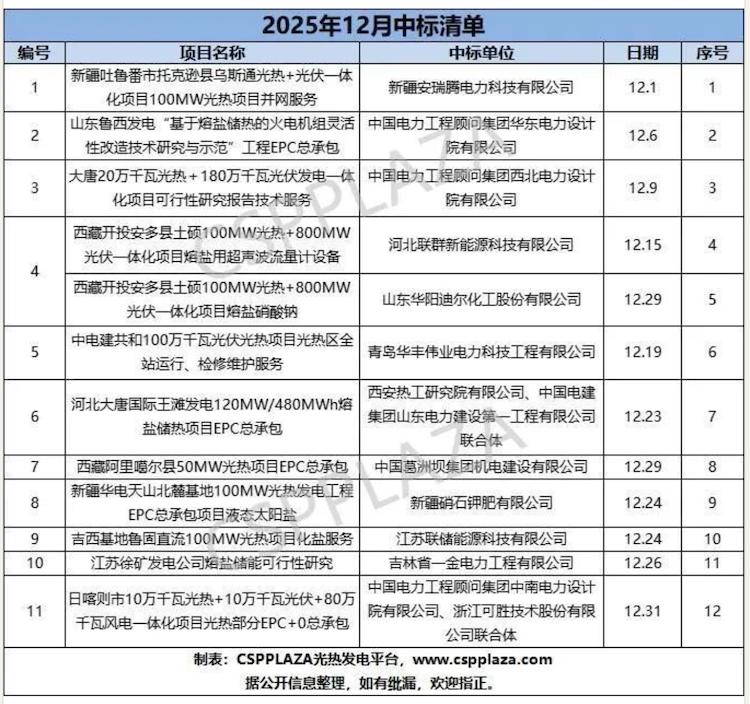
According to incomplete statistics from CSPPLAZA, a total of 12 important tenders across 11 CSP/molten salt thermal storage-related projects were completed in December 2025.

December 2025 saw significant progress in both concentrated solar power (CSP) and molten salt thermal storage, with key milestones reached in multiple major projects:

In the CSP sector, EPC contractors were finalized for the 50MW solar thermal project in Ga’er County, Ngari, Tibet, and the 100MW solar thermal project in Xigazê City. Both projects are scheduled to commence construction in March 2026. Additionally, the feasibility study was awarded for China Datang Corporation’s 200MW CSP + 1,800MW photovoltaic integrated power generation project.

In the molten salt thermal storage sector, EPC contractors were successfully selected for two projects: Shandong Luxi Power Generation’s “Research and Demonstration of Flexibility Transformation Technology for Thermal Power Units Based on Molten Salt Thermal Storage” and Hebei Datang International Wangtan Power Generation’s 120MW/480MWh molten salt thermal storage project. Meanwhile, Jiangsu Xukuang Power Generation Company’s molten salt energy storage project is actively advancing its preliminary work.

Source: Jennifer Zhang at LinkedIn for CSPPlaza

The post 12 concentrated solar and thermal energy storage tenders in China last month appeared first on SolarPACES.

China targets 15 GW of CSP in next Five-Year Plan – Official Document

31 December 2025 at 06:48

Three Gorges Renewables 100 MW Tower CSP in Golmud, Qinghai

Three Gorges Renewables 100 MW Tower CSP in Golmud, Qinghai [Tower CSP predominates in China, and is typically 100 MW, so 15 GW would mean 150 CSP projects]

BEIJING, Dec. 23 (Xinhua) — China unveiled a policy roadmap on Tuesday to accelerate solar thermal power development, targeting around 15 gigawatts (GW) of installed capacity by 2030, with costs broadly comparable to coal-fired power.

The guideline, jointly issued by the National Development and Reform Commission and the National Energy Administration, emphasizes project construction and the expansion of application scenarios to facilitate large-scale deployment of solar thermal power.

By 2030, China aims to build the sector into an internationally competitive new energy industry, characterized by globally leading technologies that are fully domestically controllable, alongside market-oriented and industrialized growth, according to the document.

After years of development, China has achieved significant advancements in major solar thermal technologies and built a leading industrial chain, with construction costs per kilowatt falling from about 30,000 yuan ($4,254 USD) a decade ago to half that today. Generation costs have also experienced a substantial reduction.

However, the sector still faces challenges, including high upfront investment and relatively weak market competitiveness, an official with the National Energy Administration said.

To tackle these obstacles, the document outlines strategies such as developing large-capacity solar thermal plants tailored to regional conditions, and implementing integrated projects combining solar thermal, wind and photovoltaic power under coordinated operation. These initiatives aim to fill local power gaps, support grid operations and enhance power supply security and stability.

It also encourages fair market participation by solar thermal power, with provincial-level regions urged to adopt region-specific pricing mechanisms that balance competition and operational stability.

The document stresses accelerating research and development in key technologies, materials and equipment, supporting leading solar thermal firms and research institutions in establishing joint R&D platforms to enhance technological self-reliance and domestic production of core equipment.


15GW by 2030 – China Policy Roadmap

Promoting the Large-Scale Development of Concentrated Solar Power (CSP)

On December 23, 2025, the National Development and Reform Commission and the National Energy Administration jointly issued the Opinions on Promoting the Large-Scale Development of Concentrated Solar Power (CSP) (hereinafter referred to as the Opinions).

The Opinions put forward the overall objectives, development planning and layout, application market expansion, technological and industrial innovation, policy guarantee mechanisms, etc., for CSP in the next five years, and set the direction for the leapfrog development of CSP. The full text translation is as follows. For the sake of accuracy, the Chinese version shall prevail.

Opinions of the National Development and Reform Commission and the National Energy Administration on Promoting the Large-Scale Development of Concentrated Solar Power (CSP): Jilin Province, Sichuan Province, Tibet Autonomous Region, Gansu Province, Qinghai Province, Ningxia Hui Autonomous Region, Xinjiang Uygur Autonomous Region; relevant dispatched offices of the National Energy Administration; relevant power enterprises:

Concentrated Solar Power (CSP) has the dual functions of peak-regulating power supply and long-duration energy storage. It can realize the regulation and support of new energy by new energy, provide long-cycle peak-regulating capacity and moment of inertia for the power system, and has the potential to serve as peak-regulating and basic power supply in some regions. It is an effective means to achieve the safe and reliable replacement of traditional energy by new energy, and an effective support for accelerating the construction of a new type of power system.

At the same time, the CSP industry chain is long, and its large-scale development and utilization will become a new growth point of China’s new energy industry. To better adapt to the demand for high-quality development of new energy and help accelerate the construction of a new type of power system, the following opinions are put forward on promoting the large-scale development of CSP.

I. Overall Objectives

Actively promote the construction of CSP projects, continuously expand new scenarios for the development and utilization of CSP, and ensure the large-scale development of CSP. By 2030, the total installed capacity of CSP will strive to reach about 15 million kilowatts, and the levelized cost of electricity (LCOE) will be basically equivalent to that of coal-fired power; technologies will achieve international leadership and complete independent controllability, the industry will realize independent marketization and industrialization development, and become a new industry with international competitive advantages in the new energy field.

II. Strengthen Planning Guidance

(1) Conduct in-depth CSP resource surveys
Establish a scientific and systematic system of content and methods for resource surveys, integrate basic data such as solar energy observation, land and resources, topography and geomorphology, and water resources, evaluate the level of CSP resources, identify restrictive factors for site construction, connect with territorial spatial planning, and form a comprehensive and systematic CSP resource database. Establish a dynamic management mechanism for the survey results database, update basic information in a timely manner, and ensure the timeliness and practicality of survey results. For key provinces and regions, clarify advantageous resource areas and development potential, make early preparations for factor guarantee and site protection, and lay a solid foundation for project construction. Strengthen the sharing and application of survey results to provide a scientific basis for regional CSP development.

(2) Improve the planning and layout of CSP
Adapt to the situation and needs of the large-scale development of CSP, clarify the positioning and role of CSP in the new type of power system, improve the technical system for CSP development planning research, and conduct scientific research on the planning and layout of CSP on the basis of resource survey work. Encourage all provinces and regions to, in light of the national energy development strategy, ecological and environmental protection requirements, regional resource endowments, regional energy development needs, power system characteristics, and electric-thermal coupling needs, fully consider the role of CSP in regional power balance and regulating support power supply, formulate CSP development plans in accordance with local conditions, propose the layout of key CSP projects by stage and region around development models and implementation paths, and do a good job in connecting with other development plans. Support provinces and regions where technology and economy are feasible and demand is urgent to plan and construct a certain scale of CSP projects every year, and provide corresponding policy guarantees.

(3) Coordinate the layout of CSP and industrial development
Give full play to the supporting and regulating capacity of CSP, conduct research on the coordinated layout of CSP and industries by sector, and propose plans for the coordinated layout of CSP and related industries. Encourage new energy integrated projects with CSP as the supporting and regulating power supply to be closely combined with new high-energy-consuming industries such as mineral resource development and smelting, computing power centers, power battery manufacturing, and salt lake lithium extraction. Explore new formats for local consumption of new energy such as computing power-power coordination, direct green power connection, and source-grid-load-storage integration, so as to realize the efficient utilization of renewable energy and promote the construction and layout of industrial parks supplied with a high proportion of renewable energy.

III. Actively Cultivate the CSP Application Market

(4) Reasonably configure the scale of CSP as needed in combination with the construction of large energy bases
Support new energy bases with technical and economic conditions, such as large “desert, Gobi, and barren land” external transmission new energy bases, hydro-wind-solar external transmission bases, and various self-use bases, to carry out the construction of CSP plant projects. Scientifically determine the installed capacity of CSP in the bases, optimize and improve the regulating capacity of the bases, increase the proportion of green power in the bases, reduce the average carbon emission per kilowatt-hour of the bases, strengthen the stable transmission of new energy, and actively explore the role of CSP plants with feasible technology and economy as supporting and regulating power supply in large bases.

(5) Construct a number of supporting and regulating new energy power stations dominated by CSP
In light of internal and external conditions such as regional resource endowments, construction factors, energy demand, and consumption capacity, and according to the needs of building a new type of power system, with the goals of effectively filling regional power gaps, alleviating the pressure of power guarantee, and providing green supporting and regulating capacity, implement the concept of electric-thermal coupling and source-grid coordination, construct a number of large-capacity CSP plants for local consumption or integrated dispatch and operation projects of CSP, wind power, and photovoltaic power generation, improve the peak-regulating capacity and stability of regional power grids, and enhance the safety and flexibility of power supply.

(6) Explore the construction of a source-grid-load-storage integrated system with CSP as the basic power supply
Actively promote industries with green traceability needs, and in combination with the needs of industrial adjustment and transfer, construct a source-grid-load-storage integrated system based on CSP plants, combined with other new energy power sources and new energy storage facilities in CSP resource-rich areas. In areas with conditions, further explore covering the electricity, steam, and heat needs of nearby areas. Strengthen the management and operation of the source-grid-load-storage integrated system, and establish and improve the operation mechanism and safety guarantee system. Encourage the exploration of constructing weakly connected or independent source-grid-load-storage integrated systems supported by CSP at the end of power grids with conditions, so as to improve the level of power supply guarantee.

IV. Give Full Play to the Supporting and Regulating Role of CSP in the New Type of Power System

(7) Give play to the supporting role of CSP in the new type of power system
Combined with the green supporting capacity of CSP that integrates “thermal-electric” conversion and conventional AC synchronous generators, give full play to the role of CSP in frequency modulation, voltage regulation, black start, and inertia response, further optimize the operation mode of power stations, tap the potential of CSP as a green and low-carbon basic power supply, promote the transformation of the system power supply guarantee value of CSP, and increase the proportion of green and reliable supporting capacity of the new type of power system.

(8) Enhance the regulating role of CSP in the new type of power system
Give play to the functions of large-scale, low-cost, and high-safety heat storage systems of CSP, utilize the wide load regulation range and fast load change capacity of CSP, exert deep peak-regulating capacity, and improve the regulating capacity of the power system. Encourage the configuration or reservation of electric heating systems, and support CSP plants equipped with electric heating systems to play the role of system long-duration energy storage power stations through the power market and obtain corresponding market returns.

(9) Accelerate the construction of ongoing projects and improve the dispatch response capacity of operational projects
Fully absorb the experience of commissioned projects in design, construction, and operation links, actively apply new technologies, new equipment, and new processes to reduce costs and increase efficiency, and accelerate the construction of ongoing projects on the basis of ensuring safety and quality. Provincial energy competent departments should strengthen the supervision of registered but not started projects and accelerate their commencement and construction. Actively promote operational projects to explore profit models in the power market, continuously improve dispatch response and the ability to participate in the auxiliary service market, and take multiple measures to improve the economic benefits of power stations.

V. Accelerate Technological and Industrial Innovation of CSP

(10) Gradually promote the popularization of high-parameter and large-capacity technologies
Actively support the technological innovation and engineering application of high-parameter and large-capacity CSP plants, steadily promote the construction of 300,000-kilowatt level CSP plants in areas with suitable resource conditions and high demand for power and heat loads, strengthen project monitoring and evaluation, accumulate basic data for the subsequent promotion of 600,000-kilowatt level CSP plants, gradually improve the technological advancement of CSP plants and the system supporting and regulating role, and effectively improve the safe and reliable replacement capacity of new energy.

(11) Accelerate breakthroughs in key technologies and promote cost reduction and efficiency increase in the CSP industry
Accelerate the R&D of key technologies, materials, and equipment, support leading CSP enterprises and scientific research institutions to form R&D consortia, focus on fields such as efficient concentrating, heat absorption and heat exchange, large-scale long-duration high-temperature heat storage, efficient energy conversion, highly flexible CSP units, and intelligent control, develop localized key equipment such as new large-aperture trough collectors, high-precision heliostats, low-cost and long-life heat storage materials, and new turbines, and comprehensively improve the independentization of China’s core CSP technologies and the localization of key equipment. Strengthen basic research on applications in the CSP field, break through scientific theories such as high-parameter “light-thermal-electric” conversion and efficient thermal energy storage, and encourage disruptive technological innovation.

(12) Establish and improve a coordinated development mechanism to promote the high-quality development of the CSP industry
Explore the research and application of CSP and coal-fired power coupling carbon reduction technologies, and encourage the construction of CSP and coal-fired power coupling technology projects in areas with suitable resource and construction conditions. Scientifically plan the coordinated development layout of the CSP industry chain, actively build a complete industrial chain, give full play to the leading role of modern industrial chain chain leaders, promote in-depth cooperation upstream and downstream of the CSP industry chain, and form an industrial pattern of complementary advantages and coordinated development. Accelerate the strengthening and supplementation of the CSP industry chain, promote the deep integration of capital and the industrial chain, build CSP industrial parks or industrial clusters in key areas, and promote cost reduction and efficiency increase in the CSP industry through industrial agglomeration and coordinated development. Accelerate the construction of the CSP industry standardization system, improve the standardization level of the whole process of CSP industry design, manufacturing, construction, and operation and maintenance, and actively participate in the formulation of international standards.

(13) Actively promote the “going global” of the industry and improve the level of international cooperation in CSP
Make full use of bilateral and multilateral energy cooperation mechanisms, give play to the advantages of China’s CSP industry in technological innovation and equipment, strengthen mutual recognition with relevant national standards, and develop diversified CSP products and technical services that meet local resource endowments and market demands. Increase external publicity, encourage domestic enterprises to carry out various forms of cooperation such as technology and joint venture operations with local enterprises in accordance with their own development strategies, explore the creation of flagship CSP projects under the “Belt and Road” Initiative, and at the same time pay attention to preventing various risks to promote the long-term sustainability of cooperation projects.

VI. Improve the Policy Guarantee Mechanism

(14) Increase policy support
Support eligible CSP projects to revitalize stock assets and promote a virtuous circle of investment and financing by issuing Real Estate Investment Trusts (REITs) in the infrastructure field, asset-backed securities, etc.

(15) Promote the fair participation of CSP in the power market
Implement the requirements of the market-oriented reform of on-grid electricity prices for new energy, encourage relevant provinces to formulate implementation rules for new energy participation in the power market that support the development of CSP, and introduce sustainable development price settlement mechanisms that can adapt to market competition and ensure stable operation in accordance with local conditions. Eligible CSP capacity may be compensated according to reliable capacity. Encourage relevant provinces to explore the construction of a reliable capacity assessment method for CSP plants, and connect with national relevant requirements after the state establishes a reliable capacity compensation mechanism. Encourage CSP projects to participate in intra-provincial and inter-provincial and cross-regional annual medium and long-term power transactions, and support CSP to actively participate in various auxiliary service markets and obtain benefits.

(16) Establish and improve the CSP incentive mechanism
Systematically evaluate the construction and operation experience of the first batch of CSP demonstration projects, establish an industry-wide information sharing mechanism, and promote the coordinated development of the CSP industry. Systematically evaluate the operation status, peak-regulating effect, and system supporting capacity of CSP supporting new energy bases and source-grid-load-storage projects, and establish a project incentive mechanism based on evaluation results.

(17) Improve the green benefits of CSP plants
Coordinately utilize the national voluntary greenhouse gas emission reduction trading market, green certificate market, and new energy sustainable development price settlement mechanism, and do a good job in connecting supporting policies. CSP projects may independently choose the source of green benefits. Those intending to participate in the green certificate trading shall not apply for National Certified Emission Reductions (CCER) for the corresponding electricity, and shall not be included in the new energy sustainable development price settlement mechanism; those intending to apply for CCER shall cancel the untraded green certificates corresponding to the emission reductions after completing the verification and registration of emission reductions; projects included in the sustainable development price settlement mechanism in accordance with national regulations shall not obtain green certificate benefits repeatedly.

(18) Strengthen the guarantee of factors such as land and the implementation of policies
Coordinately plan the development layout of new energy, reasonably layout and reserve CSP sites in large wind-solar bases, source-grid-load-storage integration projects, industrial parks supplied with a high proportion of renewable energy, as well as various projects such as independent energy supply systems including CSP, CSP and coal-fired power coupling pilots, and combined heat and power generation. The land for CSP collector fields may be obtained through leasing.
Relevant provincial energy competent departments should actively promote the development of CSP, promptly organize and carry out provincial-level CSP resource surveys and layout planning, promote the implementation of various guarantee measures such as electricity price mechanisms and auxiliary service rules related to CSP, strengthen the overall coordination of project construction, and ensure the smooth implementation of projects. The dispatched offices of the National Energy Administration shall conduct regular supervision on the implementation of policies and measures for the large-scale development of CSP, and report major matters in a timely manner.

National Development and Reform CommissionNational Energy Administration -December 15, 2025:

The post China targets 15 GW of CSP in next Five-Year Plan – Official Document appeared first on SolarPACES.

SWISS signs long-term offtake agreement for solar jet fuel from Synhelion

19 December 2025 at 03:22


Press Release Zurich, December 16, 2025

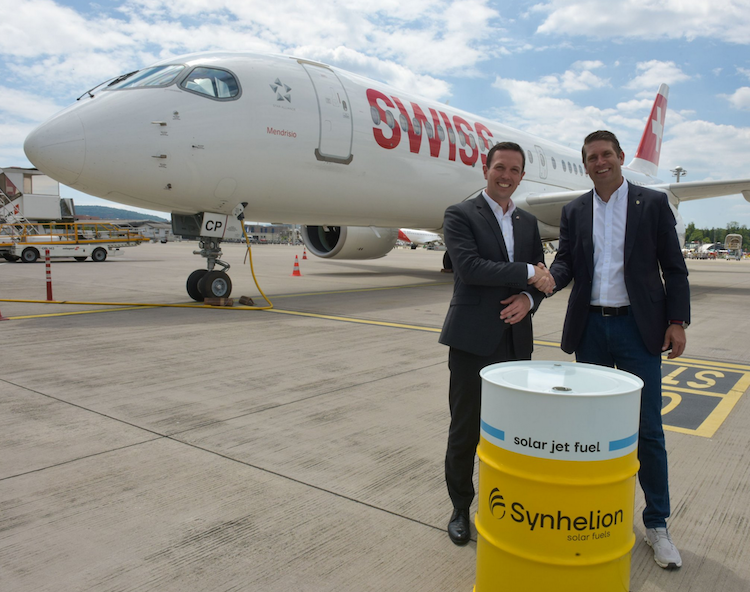
Swiss International Air Lines (SWISS) and Swiss cleantech company Synhelion have signed a long-term offtake agreement for sustainable aviation fuel (SAF). From 2027, SWISS will purchase at least 200 tons of solar jet fuel from Synhelion annually, pioneering the use of this innovative fuel in civil aviation. The agreement marks an important milestone on the road to more sustainable aviation.

SWISS is the first airline to sign a binding five-year SAF offtake agreement with Synhelion. This marks a pioneering step toward defossilizing aviation. From 2027, Synhelion will produce renewable synthetic crude oil, known as “syncrude”, at its first commercial plant. The syncrude will be processed in an existing refinery together with fossil crude oil and refined into certified Jet-A-1 fuel. Thus, Synhelion directly replaces fossil crude oil with sustainable syncrude, without the need for any adjustments to the existing infrastructure. The fuel will be delivered to the airport via the regular logistics chain and fed into the fuel supply system. Synhelion’s synthetic jet fuel is based on renewable energy and sustainable feedstocks.

A strong signal for sustainable aviation

“The partnership with Synhelion is a significant step for SWISS on the path to decarbonizing our flight operations,” says Jens Fehlinger, CEO of SWISS. “Sustainable aviation fuels (SAF) are a core element of our sustainability strategy. The offtake agreement with Synhelion sends a strong signal for innovation and responsibility in aviation.”

With this offtake agreement, SWISS is actively supporting the scaling of Synhelion’s technology for the production of renewable synthetic fuels as a customer, investor, and strategic partner. This long-term planning certainty enables targeted expansion of production capacity and helps reduce costs over time.

Pioneering partnership

Synhelion also emphasizes the significance of the agreement: “The fact that SWISS, a leading airline, has committed early on to adopt our fuels demonstrates confidence in the market readiness of our technology,” says Philipp Furler, Co-CEO and Co-Founder of Synhelion. “This partnership is a milestone for the commercial market launch of our fuels – and sets a powerful example to other airlines worldwide.”

Expanding the partnership with Kuehne+Nagel

Part of the renewable jet fuel produced by Synhelion will be resold by SWISS to the logistics service provider Kuehne+Nagel. The company will use the sustainable fuel for air freight transportation with Swiss WorldCargo, offering its customers a tangible solution to reduce their carbon footprint in global logistics.

First delivery already completed

In July 2025, SWISS became the first airline in the world to use solar fuel from Synhelion in regular flight operations. Synhelion delivered its first barrel of syncrude from its DAWN plant to a refinery in northern Germany, where the syncrude was processed into certified jet fuel (Jet-A-1) and subsequently fed into the fuel supply system via Hamburg Airport.

How can Synhelion’s solar receiver achieve such high temperatures?

Synhelion produces first solar syngas in Wood’s industrial-scale reforming reactor

CEMEX and Synhelion ace the First “Hot Solar” Cement Trial

At Synhelion, Solar Jet Fuels Get Ready for Take-off

How Synhelion’s solar jet fuel started – an interview in 2017

The post SWISS signs long-term offtake agreement for solar jet fuel from Synhelion appeared first on SolarPACES.

❌