
Reading view

Metro Connect USA 2026 Highlights the Future of U.S. Digital Infrastructure
Metro Connect USA 2026 brought the digital infrastructure community together in Fort Lauderdale, Florida, Feb. 23 to 25, as executives, investors and network operators gathered to discuss the evolving connectivity landscape. Over three days, conversations across keynote sessions, panels and private meetings focused on how the industry is adapting to the rapid growth of artificial intelligence, cloud services and bandwidth demand.

The 2026 event drew more than 3,700 decision-makers representing over 1,200 companies, reflecting the scale of collaboration and investment shaping the next phase of digital infrastructure development in the United States.

Artificial intelligence was a central theme throughout the conference. Industry leaders discussed how AI workloads are driving new requirements for data center capacity, fiber connectivity and power infrastructure. As AI adoption expands beyond hyperscale environments into enterprise applications and edge deployments, operators are facing increasing pressure to scale networks capable of supporting high-volume data movement and compute-intensive workloads.

Fiber infrastructure also remained a key topic. Discussions throughout the event highlighted continued investment in metro fiber expansion, long-haul backbone routes and fiber-to-the-home networks. As cloud platforms, streaming services and AI applications generate greater data traffic, fiber continues to serve as the underlying foundation supporting the digital economy.

Several speakers addressed how infrastructure and investment strategies are evolving alongside these shifts. Marc Ganzi, Chief Executive Offer at DigitalBridge discussed the continued influx of capital into digital infrastructure and the importance of disciplined investment as the sector scales. Steve Smith, Chief Executive Officer at Zayo Group highlighted the role of fiber expansion in supporting enterprise connectivity and hyperscale demand. Alex Hernandez, CEO of PowerBridge, participated in discussions focused on the growing power demands associated with AI infrastructure, including how utilities, data center developers and investors are working to expand power capacity and modernize energy delivery to support large-scale computing environments.

From the investment perspective, Santhosh Rao, Managing Director, Head of Digital Infrastructure at MUFG explored the evolving capital structures supporting infrastructure development, including structured financing and private credit solutions. Anton Moldan, Senior Managing Director at Macquarie Group shared insights into how institutional investors continue to evaluate digital infrastructure assets as a long-term growth opportunity within global infrastructure portfolios.

Beyond the formal sessions, Metro Connect remains known for its highly productive networking environment. Thousands of meetings took place across the event’s exhibit floor, private meeting rooms and curated networking gatherings, reinforcing the conference’s reputation as a place where partnerships are formed and transactions begin.

Outside the formal sessions, attendees spent much of the week engaged in meetings and informal discussions across the venue’s networking areas. Many participants noted that the event continues to serve as a gathering point for companies exploring partnerships, investment opportunities and infrastructure projects.

Looking ahead, the industry will reconvene next year as Metro Connect USA 2027 moves to a new venue. The event will take place February 8–10, 2027 at the Diplomat Beach Resort in Hollywood, Florida.

The post Metro Connect USA 2026 Highlights the Future of U.S. Digital Infrastructure appeared first on Data Center POST.
  •  

Inside the 2025 INCOMPAS Show and the Convergence of Policy Infrastructure and AI

The 2025 INCOMPAS Show, held November 2–4 at the JW Marriott and Tampa Marriott Water Street in Tampa, Florida, brought together more than 3,000 leaders across communications, broadband, fiber, and technology sectors to explore the evolving landscape of connectivity and competition. One of the most influential gatherings in the U.S. communications ecosystem, the event provided a platform for senior executives, policymakers, and innovators to align on strategies shaping the future of broadband deployment, infrastructure investment, and digital transformation.

This year’s theme of collaboration and convergence set the tone for a comprehensive agenda that highlighted how technology, policy, and innovation are coming together to expand connectivity and bridge the digital divide. Across three days of panels, workshops, and executive-level discussions, speakers addressed the accelerating impact of AI, automation, and public-private partnerships on both network operations and competitive strategy.

The Convergence Era: Policy, Infrastructure, and AI

The opening remarks emphasized the urgency of convergence in today’s communications landscape. Chip Pickering, CEO of INCOMPAS, framed the event with a focus on consolidation, critical infrastructure, and the growing interdependence of networks, power, and policy.

That theme carried into high-profile sessions featuring executives from Verizon, Lumen Technologies, and Bluebird Fiber, where speakers examined how fiber density, cloud connectivity, and edge infrastructure are reshaping both network design and M&A strategy. Panels such as Future-Proofing the Network and Strategic Convergence: How Wireline-Wireless Integration Is Impacting M&A highlighted how capacity planning and integration are now central drivers of transaction value.

AI-driven transformation emerged as a defining force throughout the agenda. In the session Powering Intelligence: The Convergence of Energy, Networks, and AI Infrastructure, leaders including Jeff Uphues, CEO, DC BLOX and Dan Davis, CEO and Co-Founder, Arcadian Infracom explored the mounting energy demands of AI workloads and the need for resilient, scalable infrastructure. Discussions emphasized that AI is no longer an overlay, but a foundational consideration in network architecture, power strategy, and long-term investment planning.

Cybersecurity also took center stage, with experts from Granite Telecommunications, UNITEL, Axcent Networks, and Verizon Partner Solutions outlining how AI is being deployed to detect threats, automate responses, and protect increasingly complex telecom environments.

Policy at the Center of Broadband Expansion

Policy reform remained a cornerstone of the INCOMPAS agenda. Sessions focused on the future of the Universal Service Fund, broadband permitting reform, and federal regulatory alignment drew strong engagement from both providers and policymakers. Led by INCOMPAS policy leadership and legal experts from firms including Morgan Lewis, Cooley, Nelson Mullins Riley & Scarborough LLP, and JSI, these discussions reinforced the critical role of permitting, spectrum access, and funding mechanisms such as BEAD in accelerating equitable broadband deployment nationwide.

Modern Marketing and the Human Element

Beyond infrastructure and policy, the Marketing Workshop Series delivered some of the show’s most actionable insights. The opening session, Marketing’s New Blueprint: Balancing AI, Automation, and Authenticity, featured Laura Johns, Founder and CEO of The Business Growers, and Joy Milkowski, Partner at Access Marketing Company. Together, they explored how communications and technology companies can leverage automation and AI tools without losing the authenticity and strategic clarity required to build trust and drive revenue.

The discussion reinforced that AI should function as a strategic enabler rather than a replacement for human insight. Follow-on workshops expanded on this theme, with sessions focused on revenue-driven AI strategy, practical prompt frameworks, and marketing automation systems designed to align sales and marketing teams while supporting scalable growth.

Networking, Partnerships, and Industry Momentum

As always, the INCOMPAS Show excelled as a venue for relationship-building and deal-making. The Buyers Forum and Deal Center facilitated high-value, pre-scheduled meetings, while exhibit hall programming and networking events fostered collaboration across fiber providers, technology vendors, and service partners.

Workforce development, sustainability, and inclusion also emerged as shared priorities. Speakers stressed the need to build talent pipelines capable of supporting AI-driven networks while ensuring that digital transformation delivers measurable benefits across communities.

The Road Ahead

The 2025 INCOMPAS Show made one thing clear: the future of communications will be defined by integration, collaboration, and adaptability. From AI-powered networks and evolving policy frameworks to authentic marketing and workforce readiness, the conversations in Tampa reflected an industry actively shaping its next chapter.

As the ecosystem looks toward 2026, the momentum from INCOMPAS reinforces a collective commitment to closing connectivity gaps, modernizing infrastructure, and aligning innovation with opportunity.

To learn more about INCOMPAS and upcoming events, visit www.incompas.org and www.show.incompas.org.

The post Inside the 2025 INCOMPAS Show and the Convergence of Policy Infrastructure and AI appeared first on Data Center POST.

  •  

AI’s Impact on Global Market Expansion Patterns: How Artificial Intelligence Is Redefining the Future of Global Infrastructure

At infra/STRUCTURE Summit 2025, industry leaders from Inflect, NTT and NextDC explored how AI is accelerating development timelines, reshaping deal structures, and redrawing the global data center map.

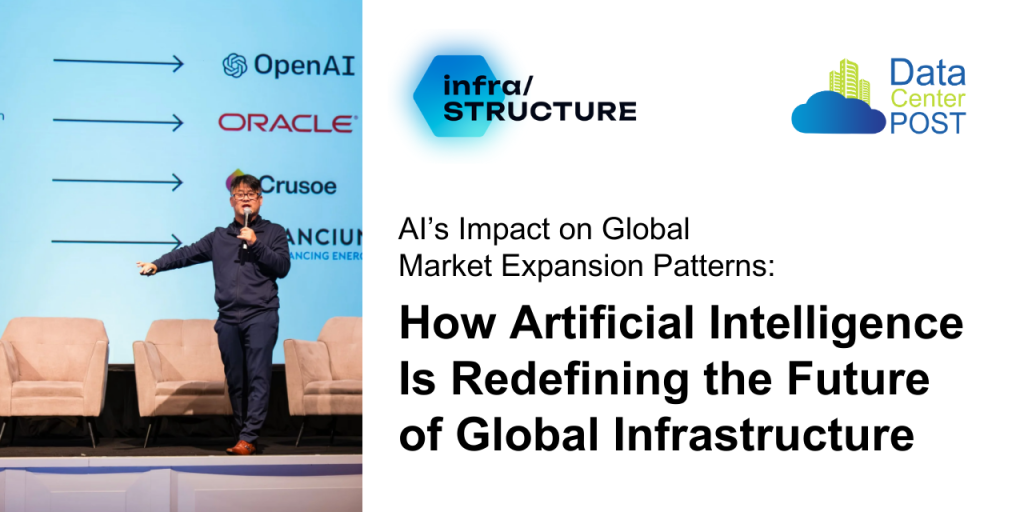
The infra/STRUCTURE Summit 2025, held at The Wynn Las Vegas from October 15–16, 2025 convened the brightest minds in digital infrastructure to explore the seismic shifts underway in the age of artificial intelligence. Among the most forward-looking sessions was “AI Impact on Global Market Expansion Patterns,” a discussion that unpacked how AI is transforming where and how data centers are developed, financed, and operated worldwide.

Moderated by Swapna Subramani, Research Director, IMEA, for Structure Research, the panel featured leading executives including Mike Nguyen, CEO, Inflect; Steve Lim, SVP, Marketing & GTM, NTT Global Data Centers; Craig Scroggie, CEO and Managing Director, NEXTDC. Together, they examined how the explosive demand for AI compute power is pushing developers to rethink long-held assumptions about geography, energy, and risk.

AI Is Rewriting the Rules of Global Expansion

For decades, site selection decisions revolved around a handful of core variables: power cost, connectivity, and proximity to major user populations. But in 2025, those rules are being rewritten by the unprecedented scale of AI workloads.

Regions once considered secondary are suddenly front-runners. Scroggie noted how saturation in markets like Singapore and Hong Kong has forced expansion across Thailand, Indonesia, Malaysia, and India, each now racing to deliver power, land, and permitting capacity fast enough to attract global hyperscalers.

“You can’t build large campuses in Singapore anymore,” Scroggie said. “But throughout Southeast Asia, we’re seeing rapid acceleration as operators balance scale, sustainability, and access to emerging population centers.”

The panelists agreed that energy constraints, not capital, are now the primary limiting factor. “The short term is about finding locations where power exists at scale,” explained Scroggie. “The longer-term challenge is developing new storage and generation models to make that power sustainable.”

Geopolitics and Sovereignty Are Shaping Investment

AI’s global reach has also brought geopolitics and national sovereignty to the forefront of infrastructure strategy.

“We’re living in more challenging times than ever before,” said Nguyen, referencing chip export restrictions and international trade interventions. “AI is no longer just a technological conversation, it’s a matter of national defense and economic competitiveness.”

He noted that ongoing trade restrictions with China are reshaping who gets access to advanced chips and where they can be deployed. “The combination of geopolitical and local legislative pressures determines the future of global trade management,” Nguyen said.

As countries strengthen data sovereignty and privacy laws, regional differentiation is intensifying. “Every geography has a different view,” Nguyen continued. “Some nations are creating frameworks to enable AI and cross-border data sharing, others are locking down their ecosystems entirely.”

Scroggie echoed this, adding that sovereignty-driven strategies are driving a surge in localized buildouts. “We’re seeing more countries push to ensure domestic control of digital assets,” he said. “That’s changing the structure of global supply chains and creating ripple effects that extend well beyond national borders.”

The Industry’s Race Against Time

The conversation turned toward construction velocity, a challenge every developer feels acutely.

“Are we building fast enough?” Subramani, the moderator of the conversation asked.

“Simply put, no,” said Scroggie. “We can’t keep up with demand. Traditional 12-to-24-month build cycles no longer align with AI’s acceleration curve. We have to find a way to build differently.”

The group discussed the need for new modular construction methods, accelerated permitting, and AI-assisted project management to meet scale and speed requirements.

Nguyen framed it within the broader context of industrial history. “We are standing at the dawn of the next industrial revolution,” he said. “Just as steam, electricity, and the internet reshaped economies, AI will redefine global competitiveness. The countries that can deliver sustainable, affordable power will lead.”

He pointed to the “Jacquard Paradox” of AI infrastructure: the more intelligence we produce, the cheaper it becomes, and the more of it the world demands. “The hallmark of global competitiveness will be the unit cost of producing intelligence,” Nguyen explained. “That requires deep collaboration between developers, energy providers, and governments.”

Evolving Deal Structures Reflect a More Complex Market

The financial framework of data center development is also changing dramatically. Traditional “build-to-suit” models are giving way to more creative, multi-tiered partnerships as both hyperscalers and institutional investors seek flexibility and risk mitigation.

“There’s a diversity of players now entering the market, some with deep operational experience, others completely new to the space,” said Scroggie. “Everyone’s chasing the same megawatts, but their risk tolerance and credit profiles vary widely.”

Scroggie also described how education and transparency have become critical. “We’re constantly advising clients on what’s feasible and what’s not. Many are coming in with unrealistic expectations about speed, power, or pricing. It’s part of our job to bridge that gap.”

The consensus was clear: AI-driven demand has transformed data centers from real estate assets into strategic infrastructure platforms, with financial, political, and environmental implications far beyond the industry itself.

Looking Ahead: The Next Decade of AI-Driven Infrastructure

As the discussion drew to a close, the panelists reflected on the extraordinary pace of change. “AI is not replacing, it’s additive,” said Scroggie. “Every new workload, every new inference model adds demand. The scale we’re dealing with is unprecedented.”

In this new era, speed, sustainability, and sovereignty are the defining dimensions of competitiveness. The industry’s success will hinge on its ability to innovate faster than the challenges it faces, whether those are regulatory, environmental, or geopolitical.

“We’re building the highways of the digital era,” said Nguyen in closing. “And like every industrial revolution before it, those who solve the energy equation will lead the world.”

Infra/STRUCTURE 2026: Save the Date

Want to tune in live, received all presentations, gain access to C-level executives, investors and industry leading research? Then save the date for infra/STRUCTURE 2026 set for October 7-8, 2026 at The Wynn Las Vegas.  Pre-Registration for the 2026 event is now open, and you can visit www.infrastructuresummit.io to learn more.

The post AI’s Impact on Global Market Expansion Patterns: How Artificial Intelligence Is Redefining the Future of Global Infrastructure appeared first on Data Center POST.

  •