Login
Login
Company Profile: STT GDC Philippines on Building the Philippines’ Largest AI-Ready Data Center Campus
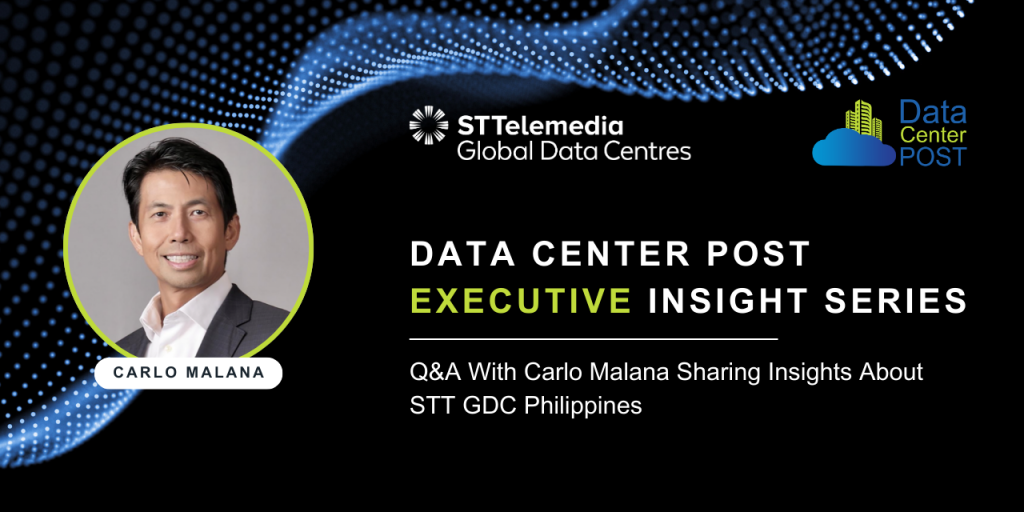
Data Center POST had the opportunity to connect with Carlo Malana, President and CEO of STT GDC Philippines, which is a joint venture among Globe Telecom, Ayala Corporation and ST Telemedia Global Data Centres. The company provides secure, reliable, and sustainable data centers to enable digital transformation for global and local businesses. With more than two decades of diverse leadership experience in the ICT industry, his background includes strategic roles at AT&T and as CIO for Globe. He earned a double degree from the University of California at Berkeley and an MBA from Southern Methodist University.
With over 20 years in Information Communications Technology (ICT) including roles with AT&T, across the United States, Mexico, and the Philippines, he has led both technology and business organizations in such diverse areas as strategy, program management, merger integration, retail, finance, customer operations, and sales.
The interview information below has been summarized to provide readers with clarity into who STT GDC Philippines is, what they do and the problems they are solving in the industry.
What does STT GDC Philippines do?
ST Telemedia Global Data Centres (STT GDC) Philippines empowers business digital transformation through a service model integrating Colocation, Cross connect, and Support Services. We provide Colocation via scalable, sustainable, and secure infrastructure operated to strict global standards, a commitment recently validated by our flagship 124MW STT Fairview Data Center Campus, achieving the IDCA G2 Design Certification, and our STT Cavite 1 data center earning the Uptime Institute Tier III Design Certification. While our Interconnect & Connectivity solutions provide a carrier-neutral platform optimized for seamless access to hybrid and multi-cloud environments, our Support Services complement this technology as your extended technical team, managing critical facility operations so you can focus exclusively on your core business performance.
What problems does STT GDC Philippines solve in the market?
STT GDC Philippines addresses the critical shortage of high-quality digital infrastructure in Southeast Asia (SEA) by replacing outdated systems with massive, scalable facilities built for the future. We solve the capacity shortfall by delivering hyperscale-ready infrastructure, such as our 124MW STT Fairview campus, designed to meet the rigorous TIA-942 Rated 3 and Uptime Institute Tier III standards for concurrent maintainability. We specifically address the urgent demand for AI and high-performance computing by building AI-ready facilities equipped with high power density and advanced liquid cooling support. Most importantly, we eliminate downtime concerns by providing SLA-backed availability, ensuring your mission-critical business operations remain secure and stable 24/7 with a sustainable environment. Finally, we remove connectivity restrictions through our carrier-neutral ecosystem, providing a resilient platform that offers customers superior network choice and the flexibility to connect with the partners that best serve their requirements.
What are STT GDC Philippines’s core products or services?
Our core services are colocation, cross connect, and support services.
What markets do you serve?
ST Telemedia Global Data Centres (STT GDC) Philippines is a leading carrier-neutral provider dedicated to supporting the high-density requirements of Hyperscalers, AI companies, and large enterprises in the banking, financial services, and telecommunications sectors.
As a joint venture between Globe Telecom, Ayala Corporation, and STT GDC, we enable digital transformation by offering scalable, sustainable, and secure infrastructure designed for mission-critical applications. Our facilities are specifically optimized for high-performance workloads, leveraging strategic partnerships with industry leaders and partners to deploy advanced solutions such as liquid cooling for AI-driven demands.
Our data centers provide a flexible technology foundation with direct access to major global cloud platforms and a diverse ecosystem of connectivity partners. This carrier-neutral approach ensures optimal connectivity for hybrid and multi-cloud environments, while our strict operational excellence and 24/7 on-site technical expertise deliver industry-leading uptime. By integrating these best-in-class partnerships, we allow your organization to rely completely on our reliable infrastructure while you focus on driving your core business growth.
What challenges does the global digital infrastructure industry face today?
The industry is currently facing a massive energy and power crisis, where securing reliable electricity has become significantly harder than finding physical land. Because AI operations consume vast amounts of energy, they place an immense strain on local power grids, making it difficult for operators to find suitable locations while sticking to green energy goals.
Secondly, the rapid adoption of AI has created a thermal management challenge; the extreme heat generated by modern high-performance chips exceeds the limits of traditional air cooling, forcing a pivot toward advanced liquid cooling methods even as universal standards remain undefined.
Finally, geopolitical instability and supply chain disruptions are acting as a major brake on progress. Rising global tensions are complicating where secure networks can be built, while acute shortages of essential equipment, like high-voltage transformers and backup generators, are delaying construction and preventing the infrastructure from keeping pace with global demand.
How is STT GDC Philippines adapting to these challenges?
STT GDC Philippines is adapting by building flexible, high-capacity infrastructure, such as the 124 MW STT Fairview Data Center Campus, that is fully ready for AI and liquid cooling but remains adaptable to changing technology rather than being limited to a single purpose. We are addressing the energy challenge by committing to 100% renewable energy for our operations. To navigate global instability, we maintain a fairly neutral position as a carrier-neutral platform, ensuring resilience and open choices for all networks.
What are STT GDC Philippines’s key differentiators?
Our key differentiators begin with our adherence to global standards, ensuring that every facility in our portfolio operates with the same rigor and reliability found across our international platform. This foundation allows us to provide the most extensive capacity in the region, highlighted by the 124MW STT Fairview Data Center Campus, the largest, most interconnected carrier-neutral, and sustainable data center in the Philippines. Our commitment to international, sustainability-driven design is evident in our LEED Gold and TIA-942 Rated 3 certifications, as well as our “AI-ready” infrastructure that supports liquid cooling to reduce environmental impact.
Beyond physical assets, we prioritize our talent through the DC Power Up program, a milestone initiative that trains and certifies the next generation of data center professionals to ensure a future-ready workforce. Our operational excellence is the heartbeat of our business, utilizing advanced automation and AI-powered cooling to maintain peak efficiency 24/7. Finally, we leverage deep local expertise through our powerful partnership with Globe and Ayala, combining the country’s leading telecommunications reach and corporate heritage to provide customers with a seamless, trustworthy gateway into the Philippine digital economy.
What can we expect to see/hear from STT GDC Philippines in the future?
STT GDC Philippines is focused on rapidly scaling its delivery capabilities, a goal already in motion as we begin operating with our first customers at STT Fairview 1. This marks a significant milestone for what will be the largest and most AI-ready data center campus in the Philippines, featuring infrastructure specifically engineered for high-density computing and advanced liquid cooling. Our commitment to innovation is further showcased at our AI Synergy Lab, where we demonstrate the future of thermal management and high-efficiency power solutions. To support this growth, we are accelerating partnerships across the ecosystem by recently onboarding key connectivity partners to ensure our facilities serve as the premier, carrier-neutral gateway for Southeast Asia’s digital future.
What upcoming industry events will you be attending?
We are excited to represent STT GDC Philippines at two of the most influential technology gatherings in the region and the world this year. This February, our team will be in Jakarta for APRICOT 2026, the Asia Pacific region’s premier internet operations and networking summit. This event is a critical forum for us to collaborate with network engineers and policymakers to strengthen the digital fabric of Southeast Asia. Following this, we will be attending NVIDIA GTC in March in San Jose, California. Often called the “Super Bowl of AI,” GTC is where we engage with the latest breakthroughs in AI infrastructure and high-performance computing, ensuring that our data centers remain at the cutting edge of the global AI revolution.
Do you have any recent news you would like us to highlight?
We are excited to share several major milestones that underscore our rapid growth and commitment to the Philippines’ digital future. Most recently, in October 2025, we announced the onboarding of our first connectivity partners at our flagship STT Fairview Data Center campus. These partnerships are significant for our carrier-neutral ecosystem, providing customers with diverse network choices and the resilience needed for AI-powered growth. Additionally, the 124MW STT Fairview Data Center campus recently achieved the prestigious IDCA G2 Design Certification, recognizing its world-class N+1 design and operational excellence. On the sustainability front, we are proud to have transitioned to 100% renewable energy across all our operational data centers as of early 2025.
Is there anything else you would like our readers to know about STT GDC Philippines and capabilities?
Finally, we want your readers to know that STT GDC Philippines is actively pioneering the future of high-performance computing through our AI Synergy Lab. Launched in collaboration with industry leaders, the lab allows enterprises to run actual AI workloads in a controlled environment, providing a live showroom for high-density computing solutions that are essential for modern digital transformation. By bridging the gap between theoretical AI potential and real-world deployment, the AI Synergy Lab ensures that our partners can optimize their hardware configurations for maximum performance and efficiency. This initiative reinforces our commitment to making the Philippines a premier hub for AI innovation in Southeast Asia, providing the specialized environment required to support the next generation of intelligent computing.
Where can our readers learn more about STT GDC Philippines?
Readers can learn more on our company website, www.sttelemediagdc.com/ph-en.
How can our readers contact STT GDC Philippines?
You can contact us through Facebook, Linkedin, or our website.
# # #
About Data Center POST
Data Center POST provides a comprehensive view of the digital infrastructure landscape, delivering industry insights into the global data center ecosystem. As the industry’s only peer-contributed and online publication, we offer relevant information from developers, managers, providers, investors, and trendsetters worldwide.
Data Center POST works hard to get the most current information and thought-provoking ideas most apt to add relevance to the success of the data center industry. Stay informed, visit www.datacenterpost.com.
If you are interested in contributing to Data Center POST, contact us at contributions@datacenterpost.com or submit your article here.
Want more digital infrastructure news? Stay in the know and subscribe to Data Center POST today!
The post Company Profile: STT GDC Philippines on Building the Philippines’ Largest AI-Ready Data Center Campus appeared first on Data Center POST.