Of four all-new vehicles unveiled in New York, two were battery-electric SUVs: one big, one small.
While EVs are supposedly in retreat across the US—don’t believe all the headlines—new battery-electric models continue to launch. Two more debuted this week at the media preview day before the New York International Auto Show that opens to the public this weekend.
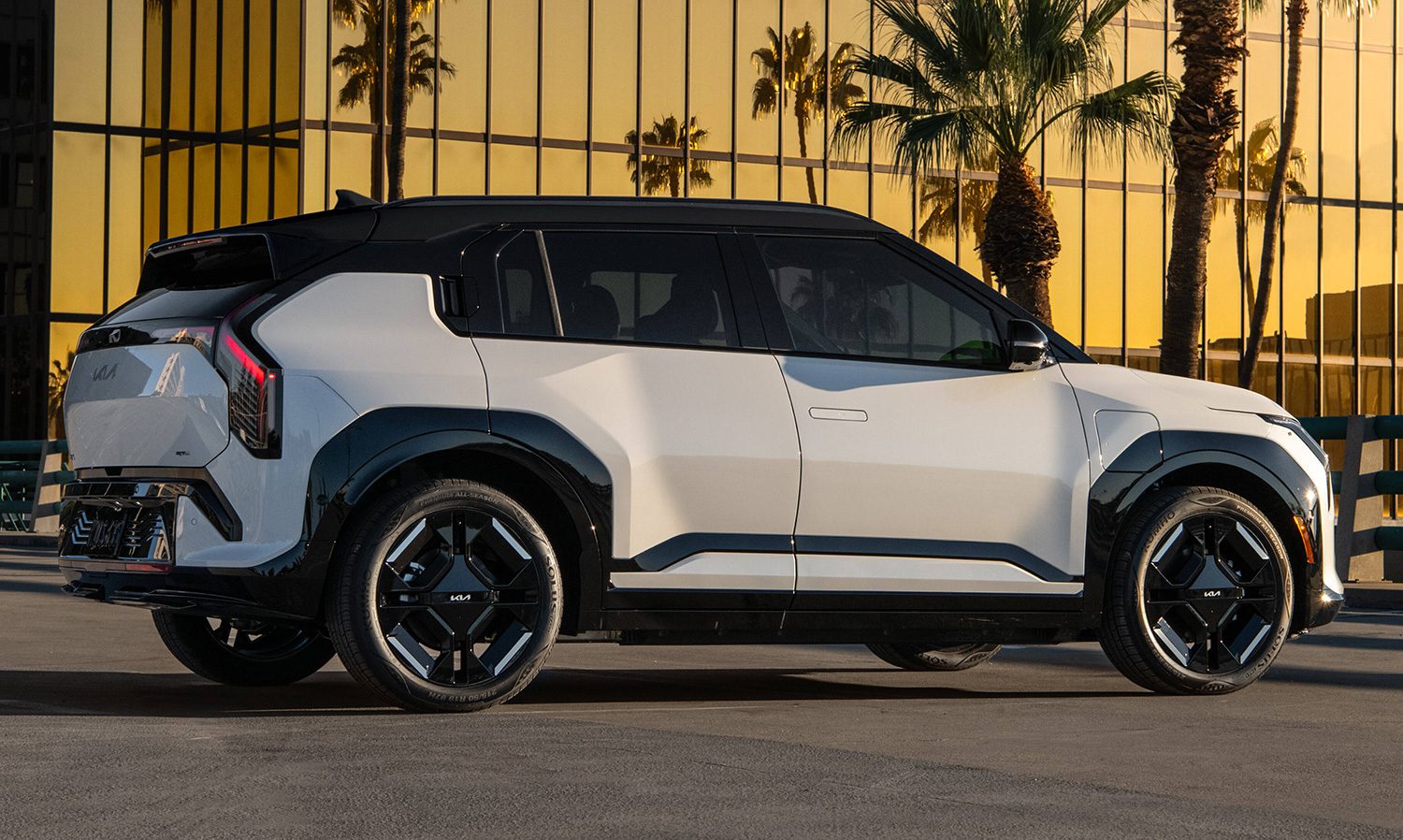
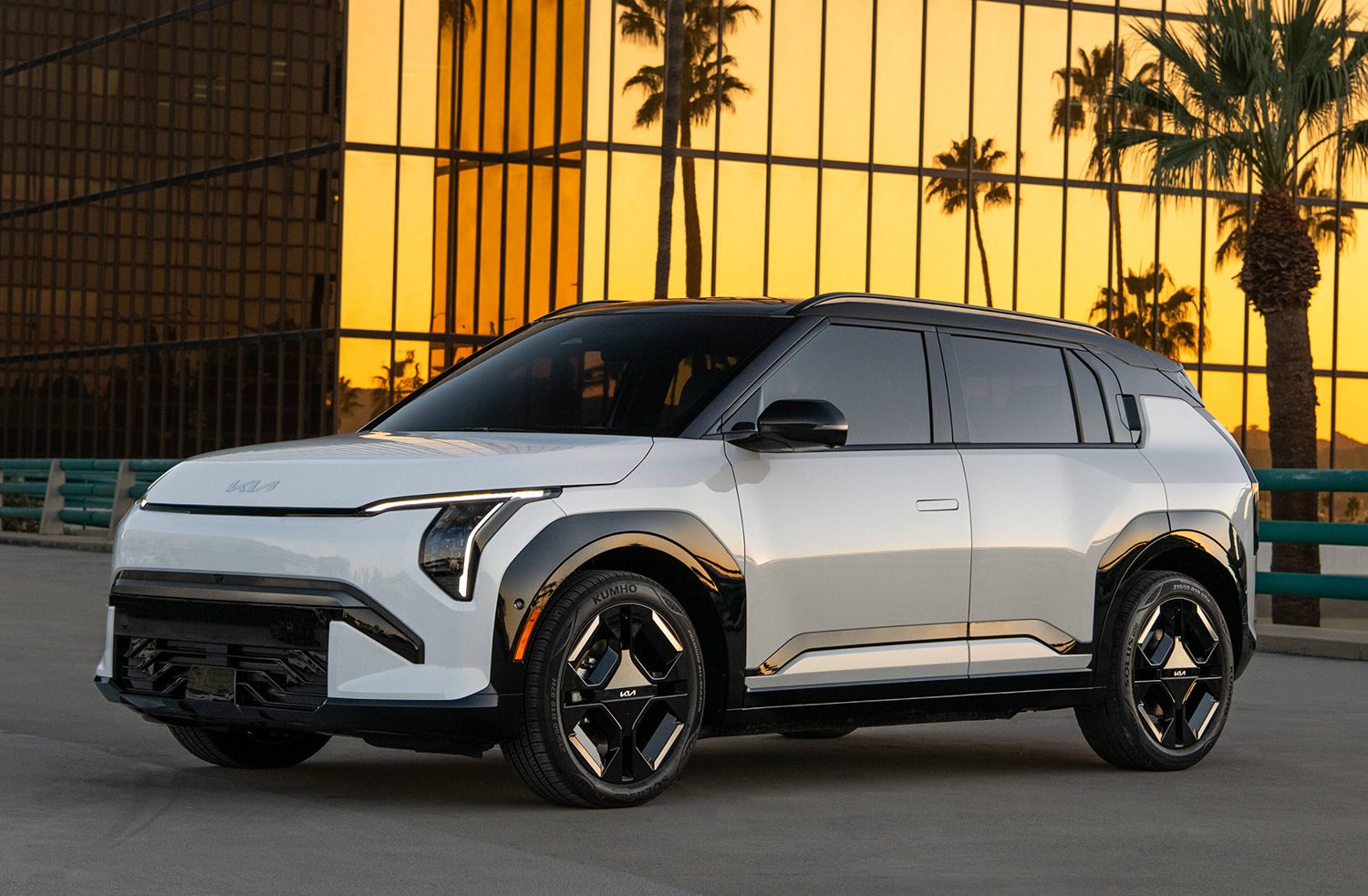
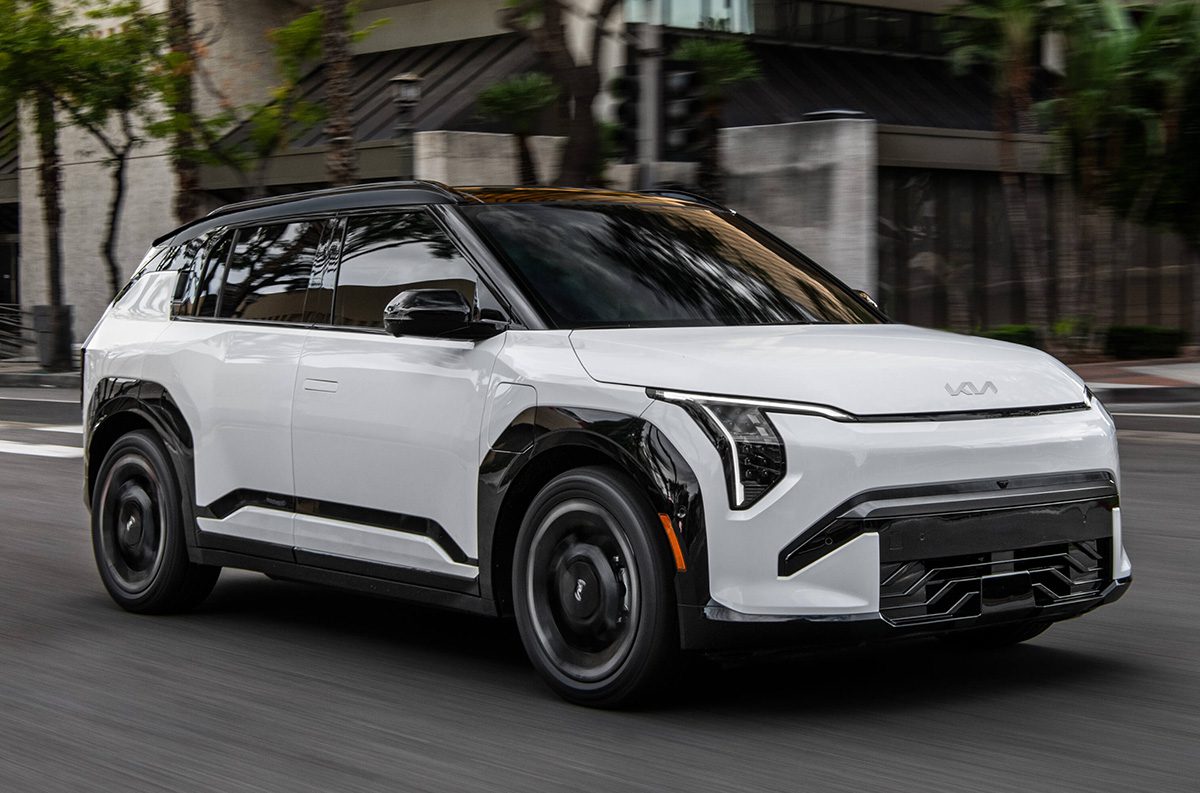
The 2027 Kia EV3 is a small SUV utility vehicle that’ll be the smallest, least expensive entry in Kia’s growing line of EVs; it’s expected to go on sale late this year. At the other end of the scale, the 2027 Subaru Getaway three-row SUV utility vehicle is the brand’s largest among the four EVs it’s announced. It too will land at dealerships in late 2026.
Small SUV, big range
The Kia EV3 has been on sale in South Korea for almost two years, followed by several European countries, Australia, and New Zealand. Demand in those markets has been substantial. In North America, it will compete in the low-priced end of the EV market. Pricing and specs won’t be released until later in the year, but it’s expected to compete with the Chevrolet Bolt (starting at $28,995), the Nissan Leaf ($31,485), and perhaps Ford’s upcoming midsize electric pickup, promised for $30,000 or so. All prices include the mandatory delivery fee.
In its US trim, the EV3 in US trim is promised to have up to 320 miles of EPA-rated battery range on certain versions, comfortably higher than the 300-mile mark that may be the new US standard for buyers concerned about range. Its design nods to the big, square EV9 three-row SUV, and Kia claims a drag coefficient of 0.275, low for such a small, square, upright vehicle.
Kia offers two options for battery capacity: the EV3 Light model uses a 58.3-kilowatt-hour pack, driving only the front wheels, and projected at a range of 220 miles. This is the model whose base price will no doubt be prominently featured in marketing. On higher trims (Wind, Land, GT-Line, and GT), battery capacity is 81.4 kWh. All-wheel drive is optional on Wind and Land, standard on GT-Line and GT. Motor output is 261 hp (192 kW) on all-wheel drive models, which rises to 288 hp (212 kW) on the higher-performance EV3 GT model.
Charging is via a NACS port on the right-front fender. Kia claims DC fast charging from 10 to 80 percent in 29 minutes for the small battery, 31 minutes for the large one. As always, that’s under ideal conditions of battery temperature and ambient temperature, at a charging station capable of delivering the sustained current required. Plug and Charge is standard, allowing “plug it in and walk away” charging once set up. Kia didn’t provide a rating for onboard AC charging.
Reflecting the broad appeal of using an EV as a portable source of electricity, the EV3 will offer vehicle-to-load (V2L) power outputs. Using a bidirectional Wallbox home charging station, it will also offer vehicle-to-home (V2H) capability to power a home during outages.
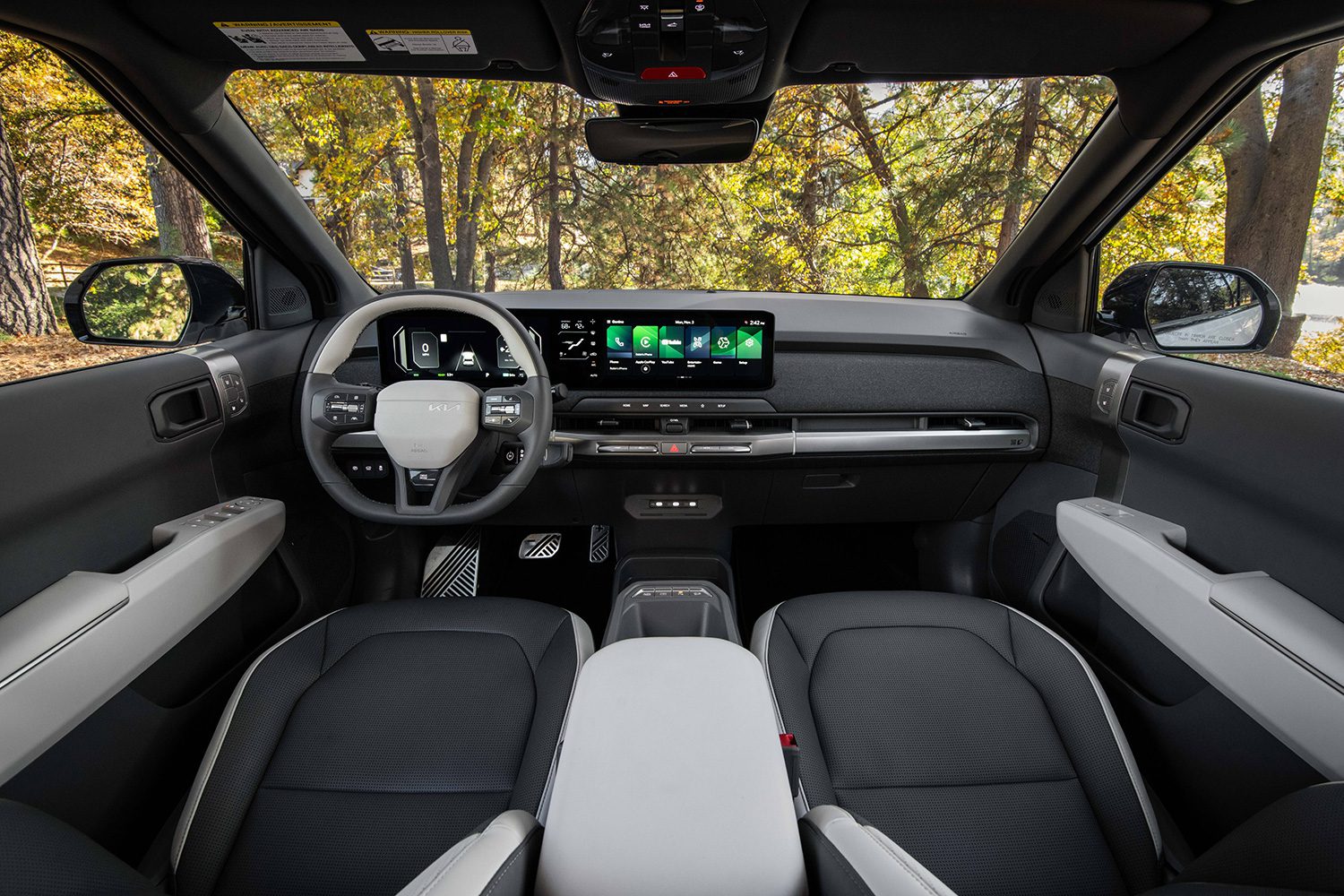
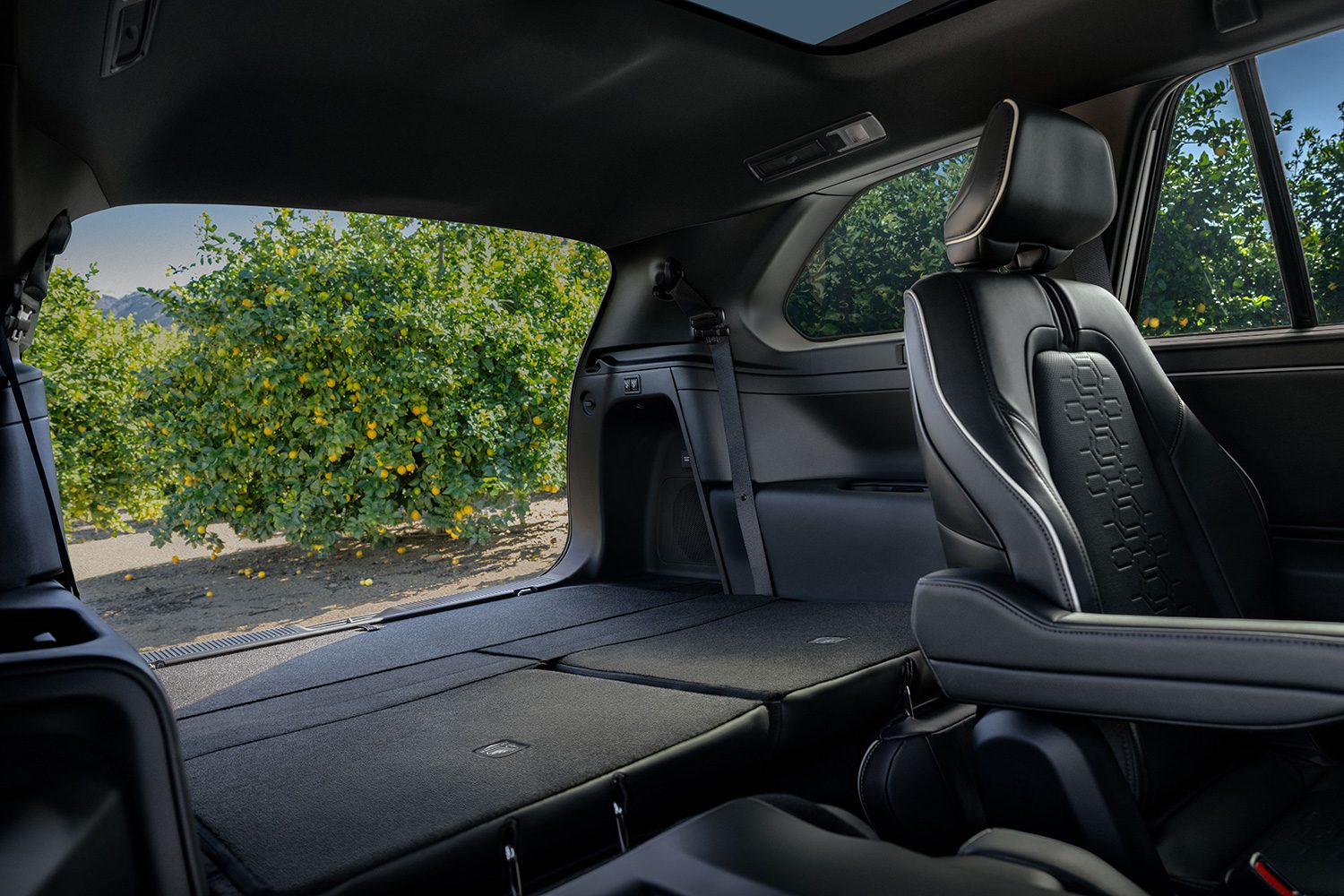
Inside the small SUV, the brand’s characteristic pair of 12.3-inch displays sit horizontally across the dash. The EV3 will offer some features and options rarely found on subcompact cars in the US, including a head-up display and Surround-View monitor. A power liftgate is available, giving access to 26.1 cubic feet of cargo volume behind the second row, or 56.5 cubic feet with the rear seat folded down.
To keep costs down, the EV3 is built on a lower-cost version of the Hyundai-Kia E-GMP battery-electric platform. One salient difference: a 400-volt battery architecture rather than the 800 volts of the EV6 hatchback utility and EV9 three-row SUV, its larger siblings. That lower-cost platform is also used for the Kia EV4, a sleek compact sedan whose US debut was indefinitely delayed in October after it was scheduled to go on sale in the first quarter of this year. With utility vehicles taking a growing share of the market, and sedans losing share, that may have been a smart decision—especially since the North American EV3 is expected to be assembled in Mexico, at the same Kia plant that builds the K4.
Big SUV, small maker
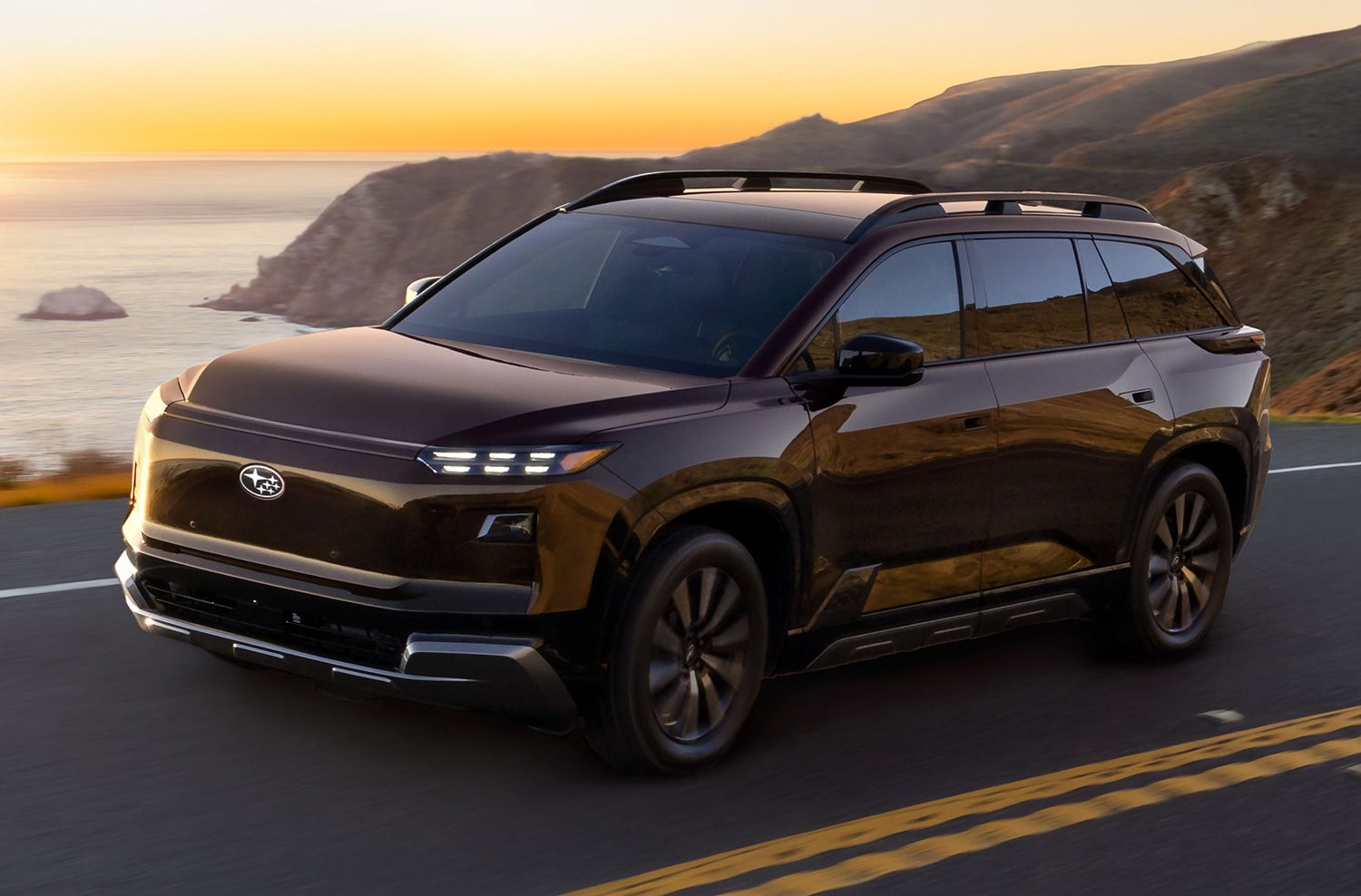
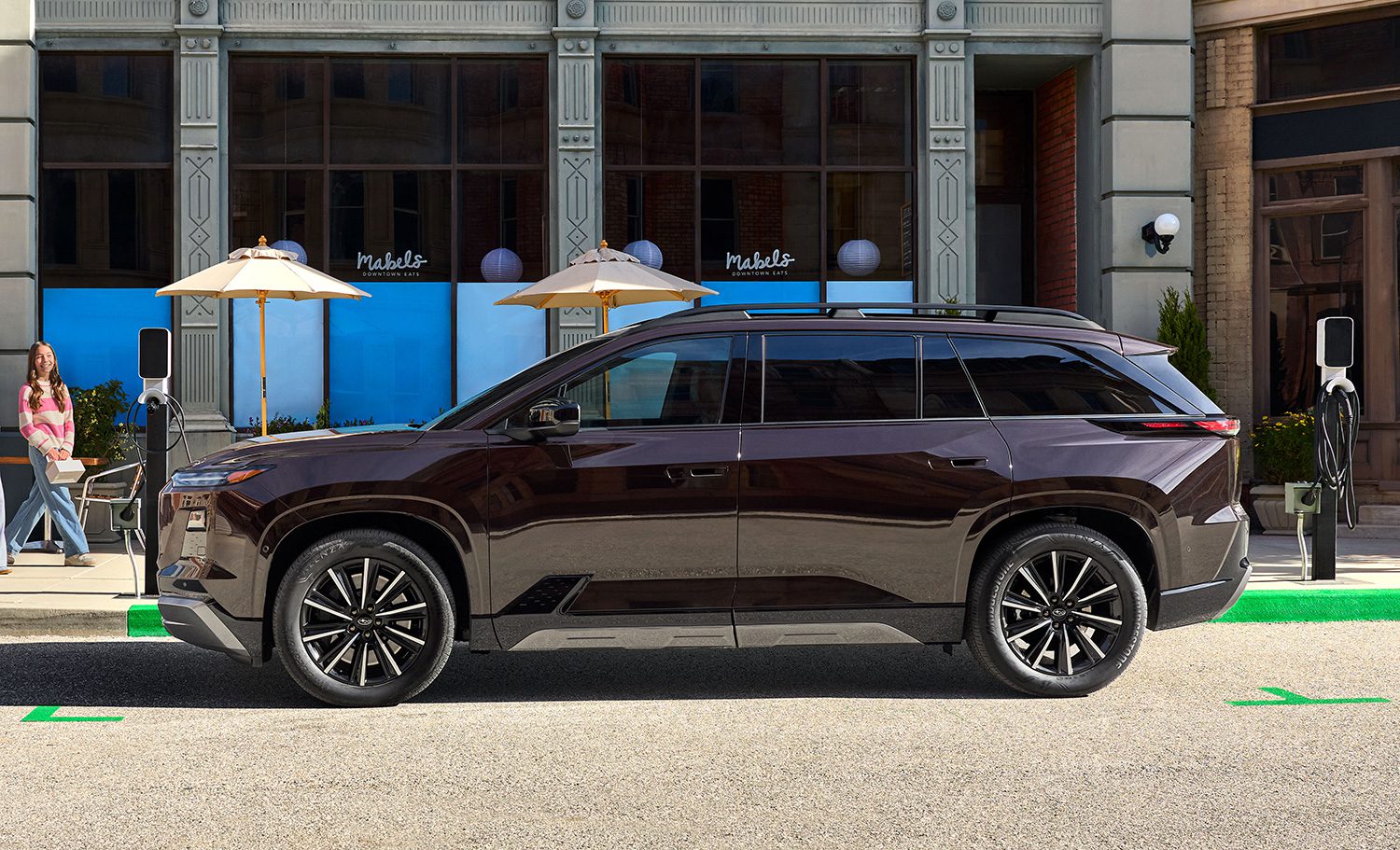
At the other end of the size scale, the 2027 Subaru Getaway 3-row SUV is the largest EV offering from the small Japanese maker that now sells two-thirds of its global output in North America. Like the EV3, it will have a rated range of more than 300 miles, but this seven-passenger crossover utility vehicle is aimed at the high end of Subaru’s range. The Getaway is the EV counterpart to the brand’s aging Ascent gasoline 3-row SUV; it becomes Subaru’s tenth separate US model line.
If the shape looks familiar, that’s because it’s a light redo of the Toyota Highlander battery-electric SUV announced early this year. It’s now the fourth Subaru EV to be a clone of a Toyota, following the Solterra hatchback (Toyota bZ nee bZ4X), Uncharted small hatchback (Toyota C-HR EV), and Trailseeker wagon or utility vehicle (Toyota bZ Woodland)—the latter being the only one whose shape genuinely reads as a Subaru.
Powered by a 95.8-kWh battery pack, every Getaway comes standard with all-wheel drive—a Subaru hallmark since the 1990s—provided by a pair of electric motors rated at 420 hp (309 kW) combined. The 0-to-60-mph acceleration time for this seven-passenger SUV is quoted at “less than 5 seconds,” and its towing capacity is up to 3,500 pounds.
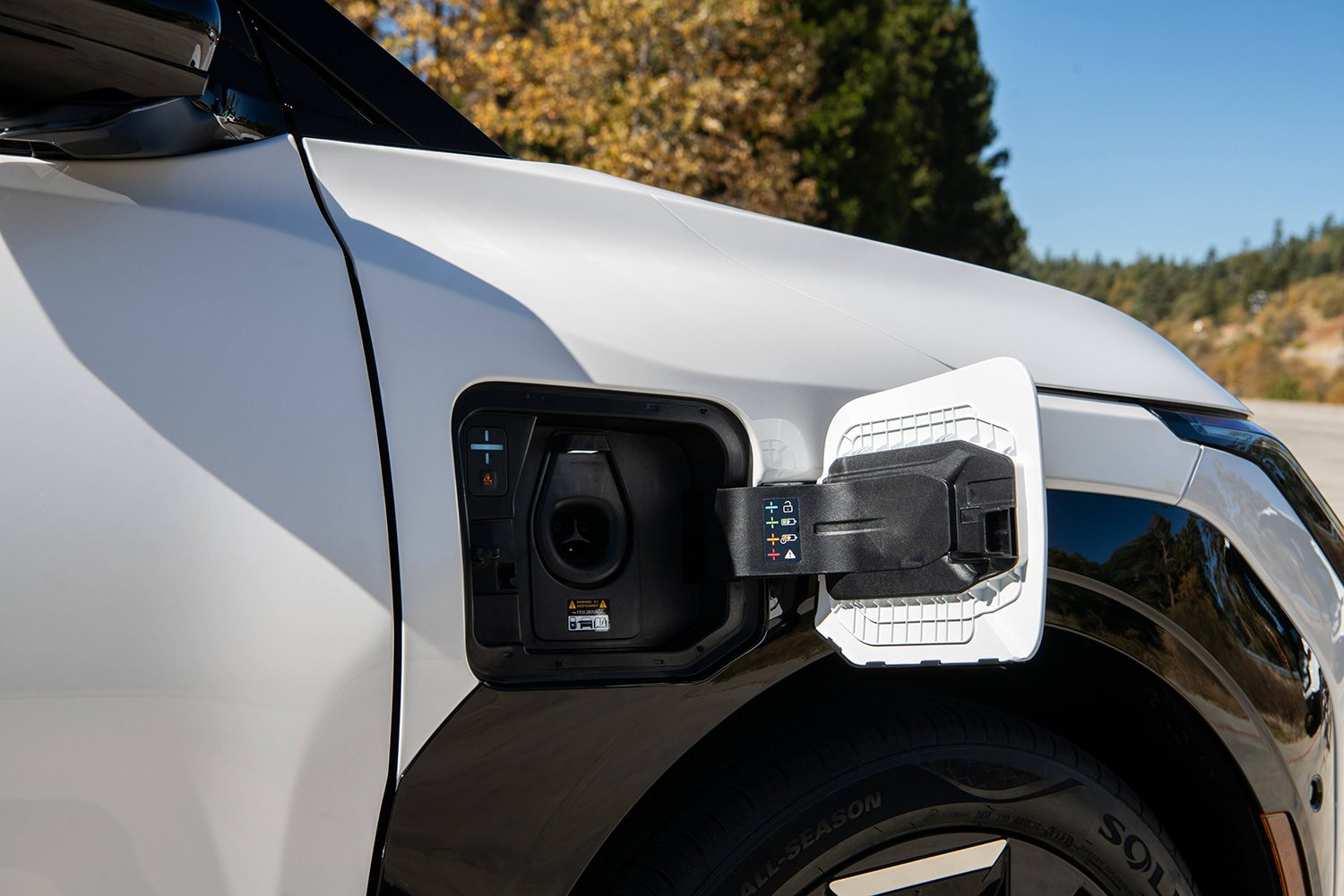
Like the smaller EV3, the Getaway charges via a NACS port on the right-front fender. Subaru quotes a 10-to-80-percent DC fast charging time at up to 150 kW of “approximately 30 minutes”–again under those ideal conditions. Battery preconditioning is standard, and the front Daytime Running Lights double as charging-status indicators when the car is plugged in.
In the first half of 2027, a “standard-range” model with a lower battery capacity of 77.0 kWh will be offered. It too will have AWD standard, but details will have to wait until then.
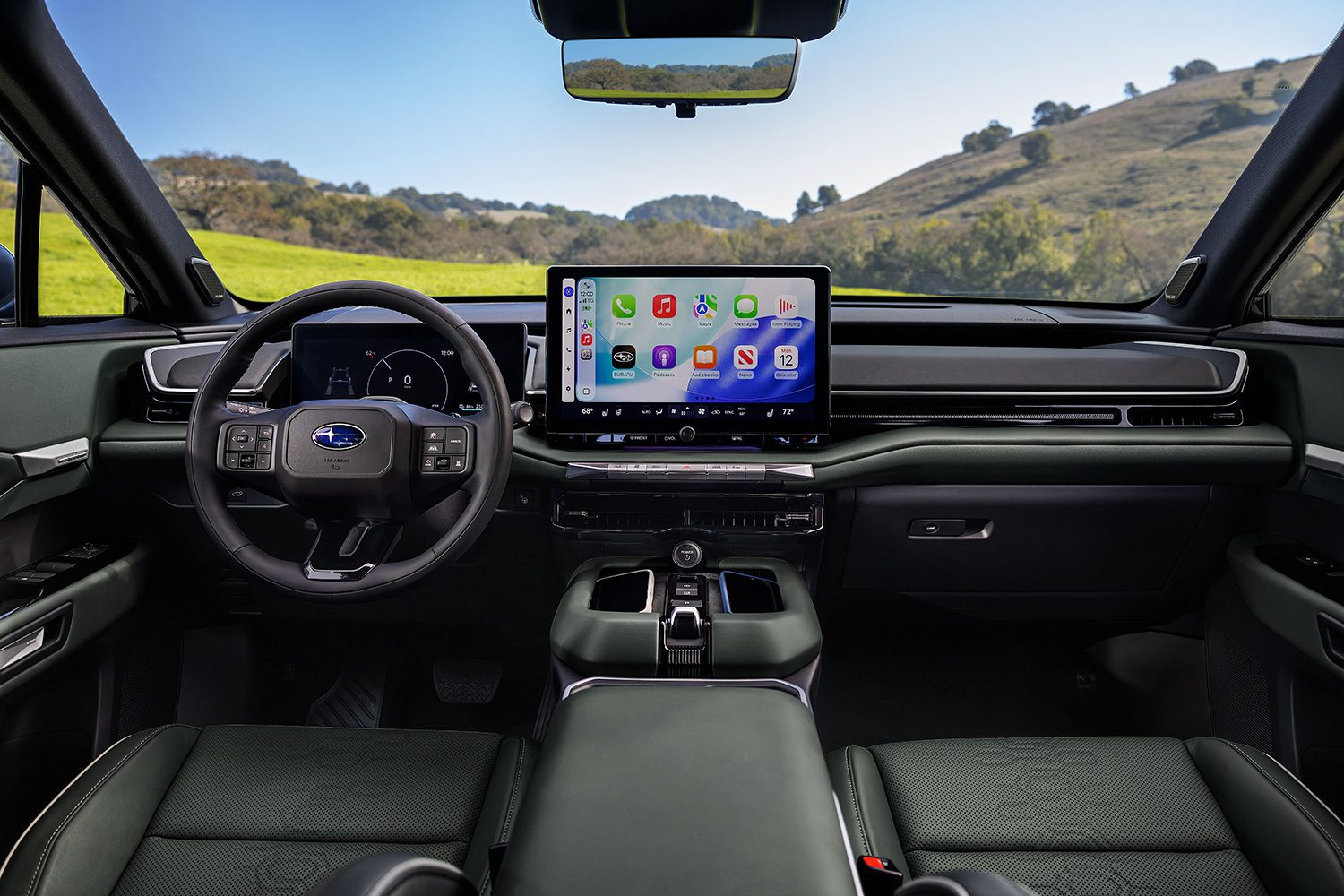
Inside, the Getaway uses a 12.3-inch digital instrument cluster—the standard Toyota setup—and a central 14-inch touchscreen display. Heated front seats are standard, with a heated steering wheel and an array of heated second- and third-row seats, ventilated seats, and more either standard on certain trims or optional.
Other features and options befit a three-row SUV likely used to carry families. Those include three-zone climate control that includes dedicated vents for the third row, a cup holder at every seat, USB-C charge ports for every row, and an optional panoramic moonroof. And “most” versions of the Getaway will have the brand’s characteristic ladder-type roof rails as standard, allowing owners of other Subaru models to use their existing Thule carriers and other roof accessories seen on Subies all across the country.
Unlike the Korea-built EV3, the 2027 Subaru Getaway will be assembled in the United States, at the Toyota plant that builds its Toyota Highlander twin in Georgetown, Kentucky. That exempts it from tariffs on imported vehicles, and it marks only the second US assembly plant for Subaru, which builds a majority of its gasoline models in its Lafayette, Indiana, plant.
Electrification of off-highway vehicles isn’t new. What’s new is the combination of battery economics, tighter urban rules and a rapidly evolving global supply chain—forces that are pushing OEMs to rethink machine architecture, service strategy and the realities of charging on a jobsite.
Danfoss Editron’s Eric Azeroual on off-highway electrification trends
Electrification is often framed as the next big disruption for construction, mining and agricultural equipment. But in the off-highway field, “electric” has been hiding in plain sight for decades. Look at ports and mines and you will find machines that already exploit electric torque, efficiency and controllability, even if a diesel engine is still part of the system. In warehouses, electric forklifts and aerial work platforms have long been mainstream.
So why does electrification feel like a fresh wave now?
Charged recently chatted with Eric Azeroual, Vice President at Danfoss Editron (the electrification arm of Danfoss Power Solutions). He pointed to two accelerants: rapidly improving battery economics and the rising pressure of city-focused emissions standards. As he described it, off-highway is “going through a very big transformation,” moving away from internal combustion engines and conventional hydraulics toward electric and electrified hydraulics.
The real inflection point: batteries got cheaper and cities got louder
Azeroual argues that off-highway didn’t suddenly “discover” electrification. Engineers and end users have long understood the benefits of electric machines: power density, high torque at low speed, and the efficiency advantages that come from precise control.
The first thing that has changed over the last few years is the affordability of the energy storage needed to untether machines from the grid. Azeroual explains that the momentum of passenger-car electrification pushed battery cost down from roughly $1,000 or $1,500 per kWh” to $100 or $150, making it feasible to electrify a much larger slice of off-highway equipment—especially the “middle market” between tiny low-power vehicles and large, grid-connected machines.
The second accelerant is regulation, especially in cities. Emissions standards for machines operating in urban areas are tightening, and OEMs are weighing whether to keep investing in increasingly complex after-treatment systems or to redirect that investment into electric platforms and electrified work functions.
This combination is particularly consequential because construction dominates demand. Azeroual pegs wheel loaders and excavators as roughly 50% of the off-highway market, and he sees them as “poised to electrify quicker” for a very practical reason: their duty cycles often align with electrification better than outsiders assume. Many of these machines do not travel long distances, and they operate in defined spaces, with intermittent work and idle time. And because many operate inside cities, regulation and noise become immediate drivers. He offered a vivid example: an excavator operating in the middle of Paris may need to be electric to meet emissions requirements in the near future.
A two-speed voltage world: 48 V at one end, high voltage everywhere else
One of the clearest signs that off-highway electrification is maturing is that the debate is shifting from whether to electrify to how to electrify. For Azeroual, voltage is becoming the defining design fork.
The first wave is already here: compact wheel loaders and mini excavators built around low-voltage (typically 48 V) architectures. They are “low risk,” relatively straightforward to charge, and avoid the safety and integration complexity that comes with high voltage.
But he does not expect a smooth ladder that includes a significant medium-voltage category. Instead, he predicts a fast jump: either sub-60 V systems (the 48 V class) or high-voltage systems for most platforms beyond that—“two poles,” as he described it.
Two engineering drivers sit behind that jump:
Charging rate and uptime. Higher voltage enables higher power transfer, which reduces charge time and protects equipment uptime, an essential economic variable in off-highway.
Power and efficiency. When power requirements push beyond about 150-200 kW, higher voltage becomes a practical way to reduce current and resistive losses, improving system efficiency and lowering thermal burden.
Danfoss Editron is developing low-voltage and high-voltage solutions because those are the two segments in which OEMs are placing bets.
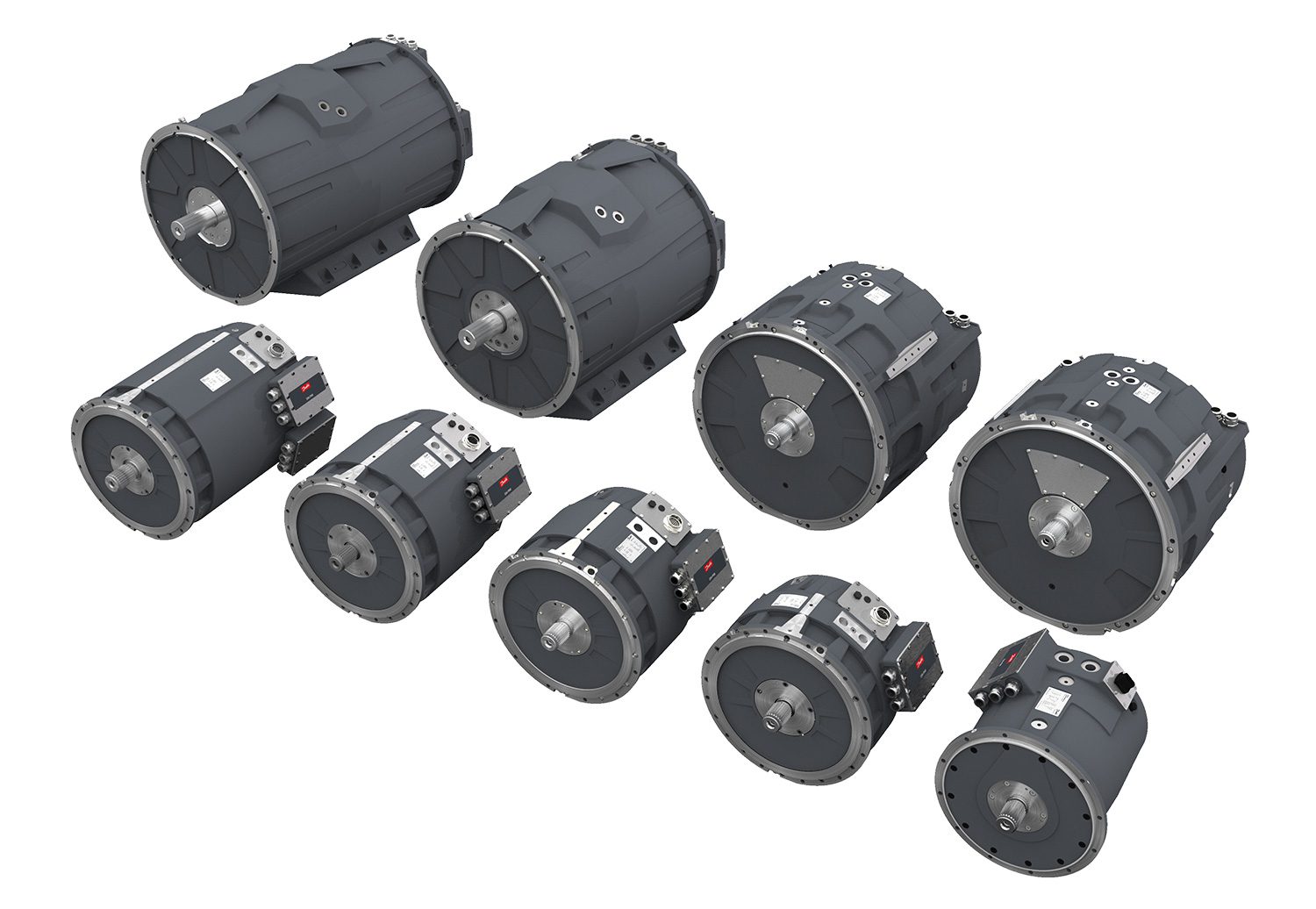
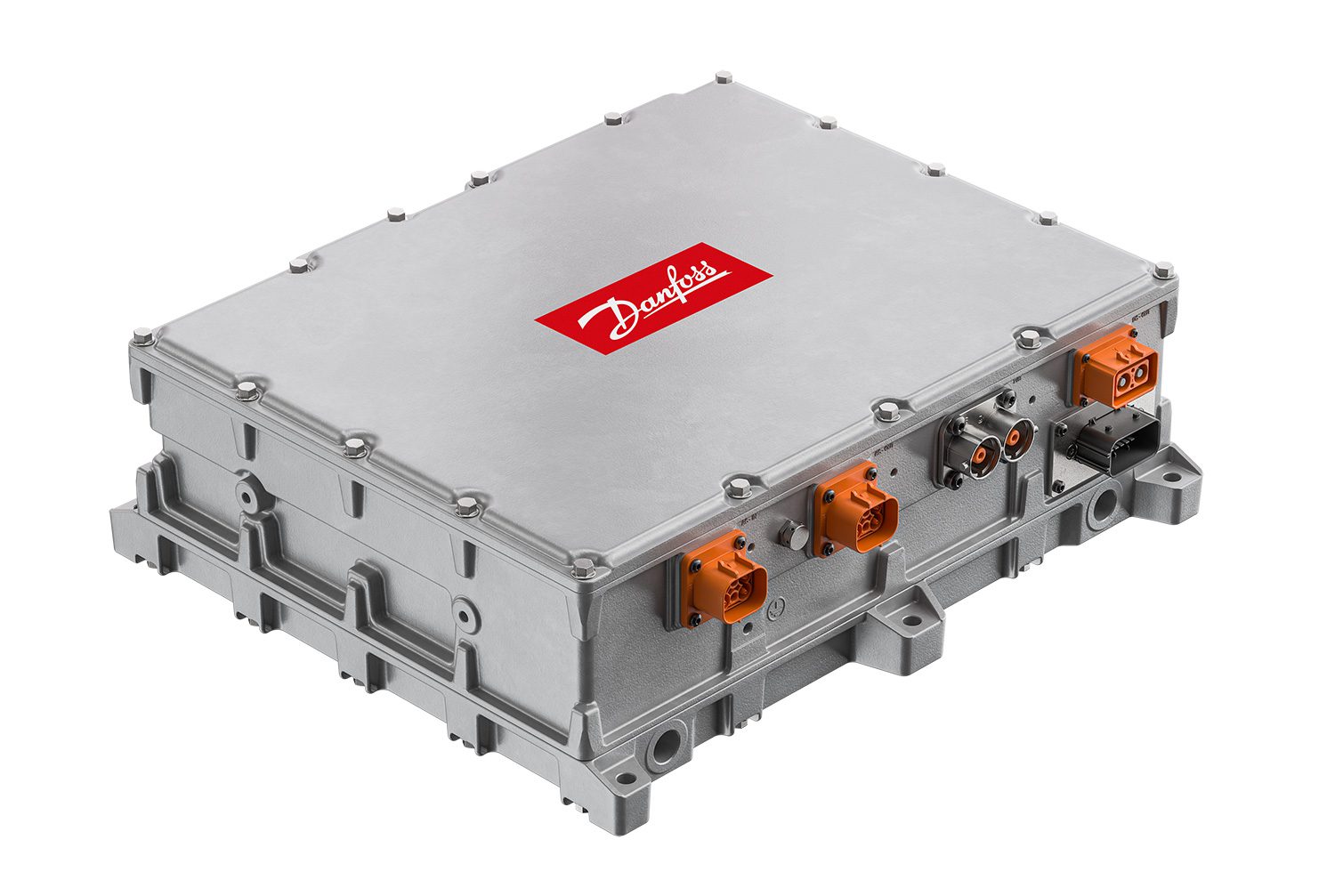
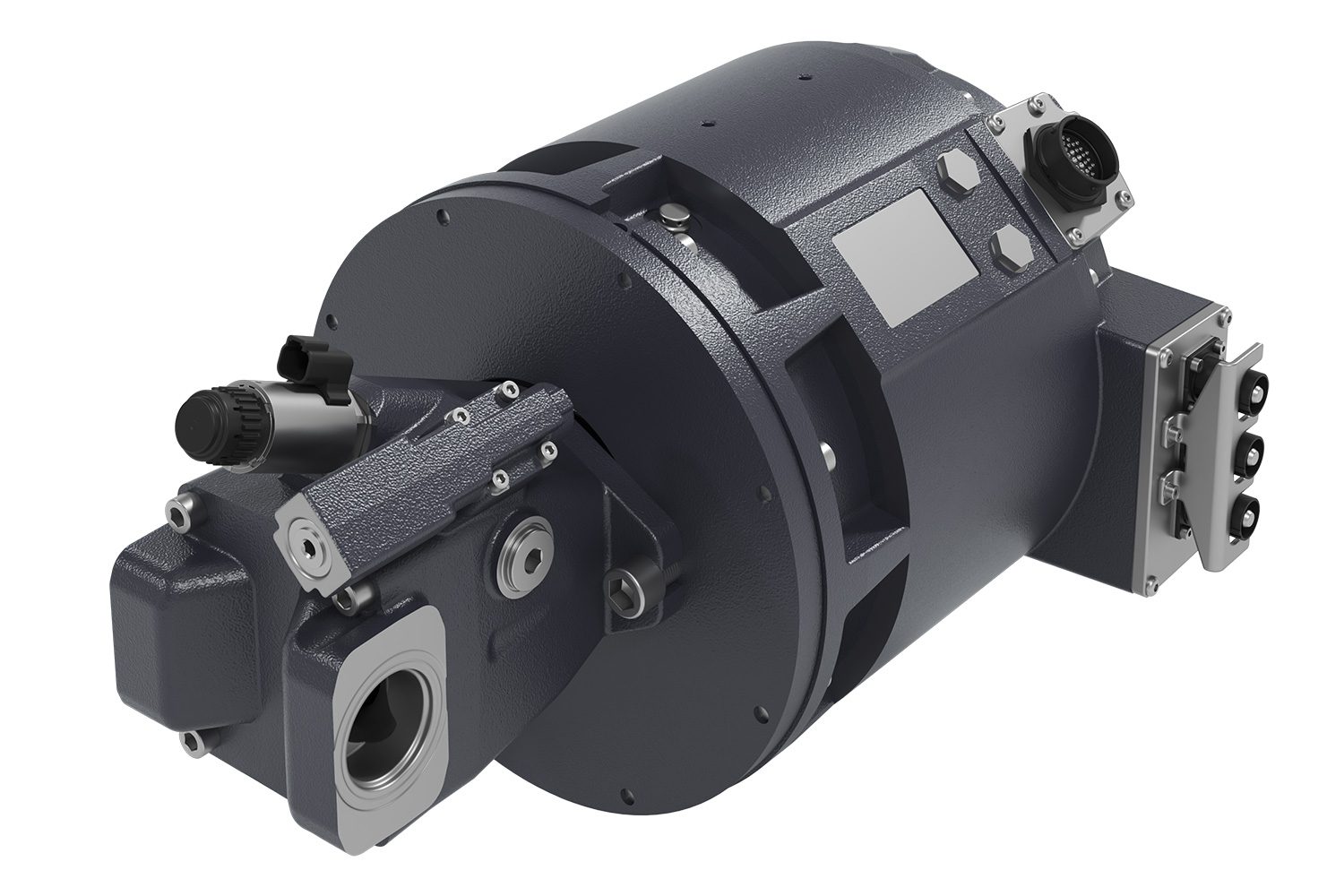
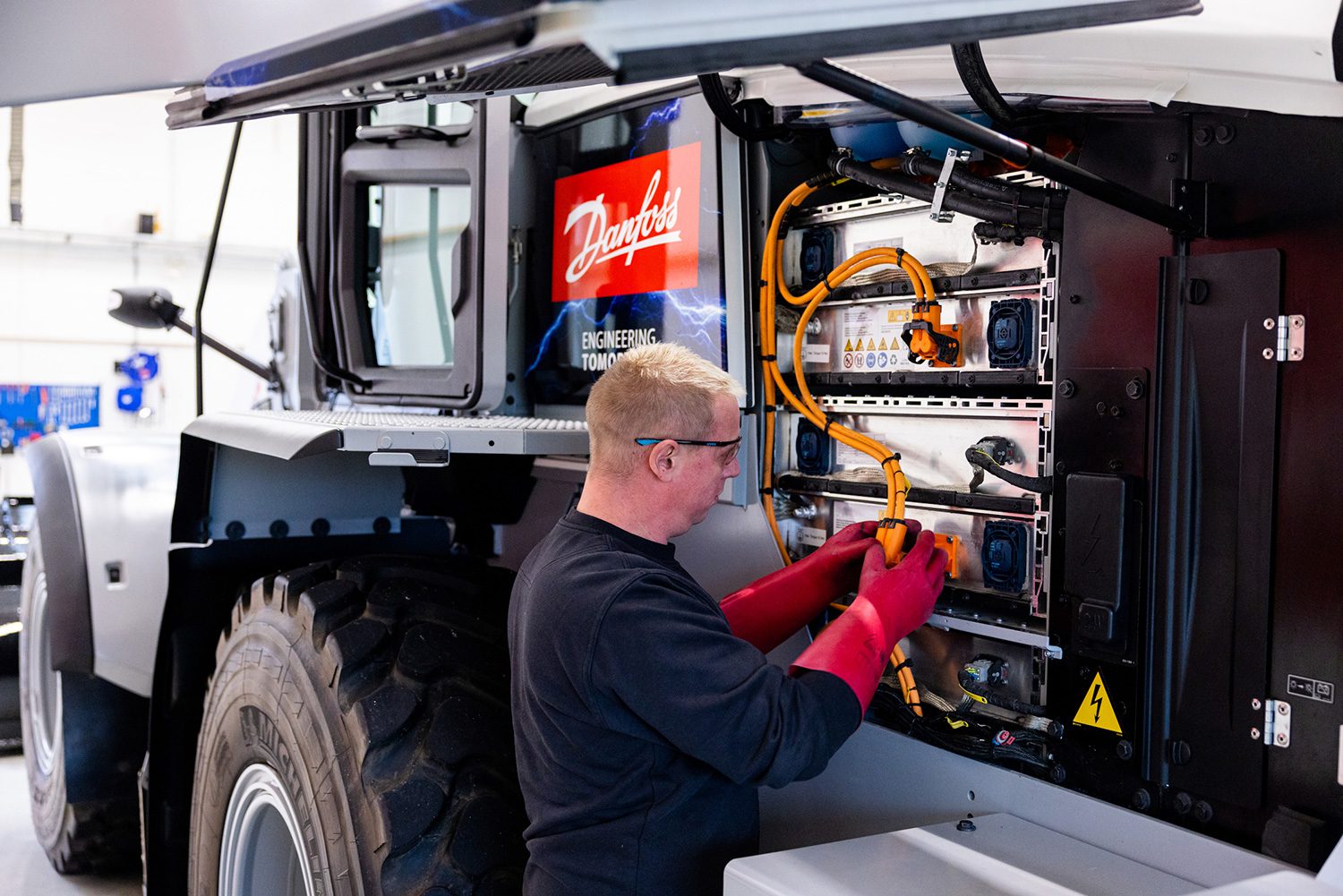
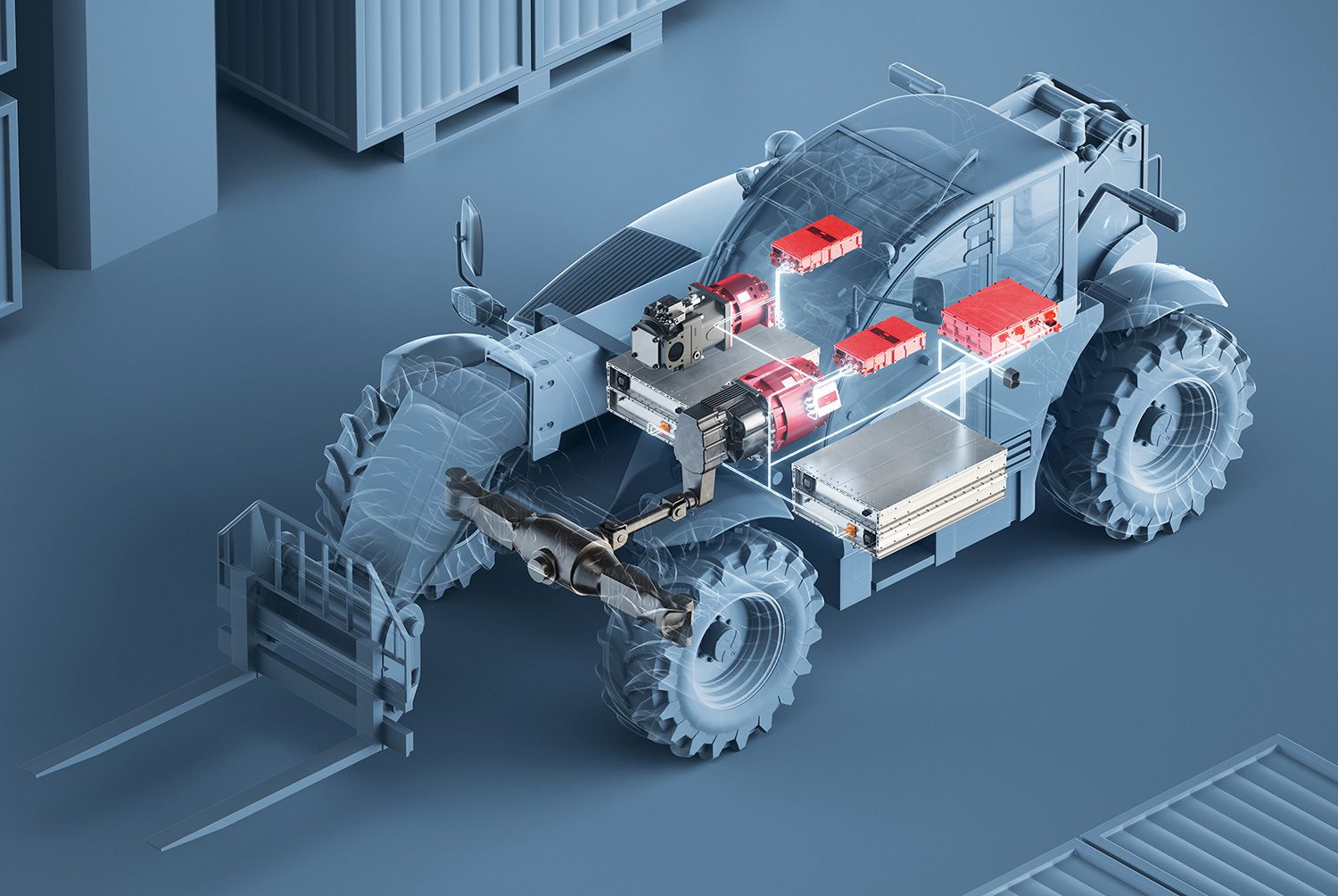
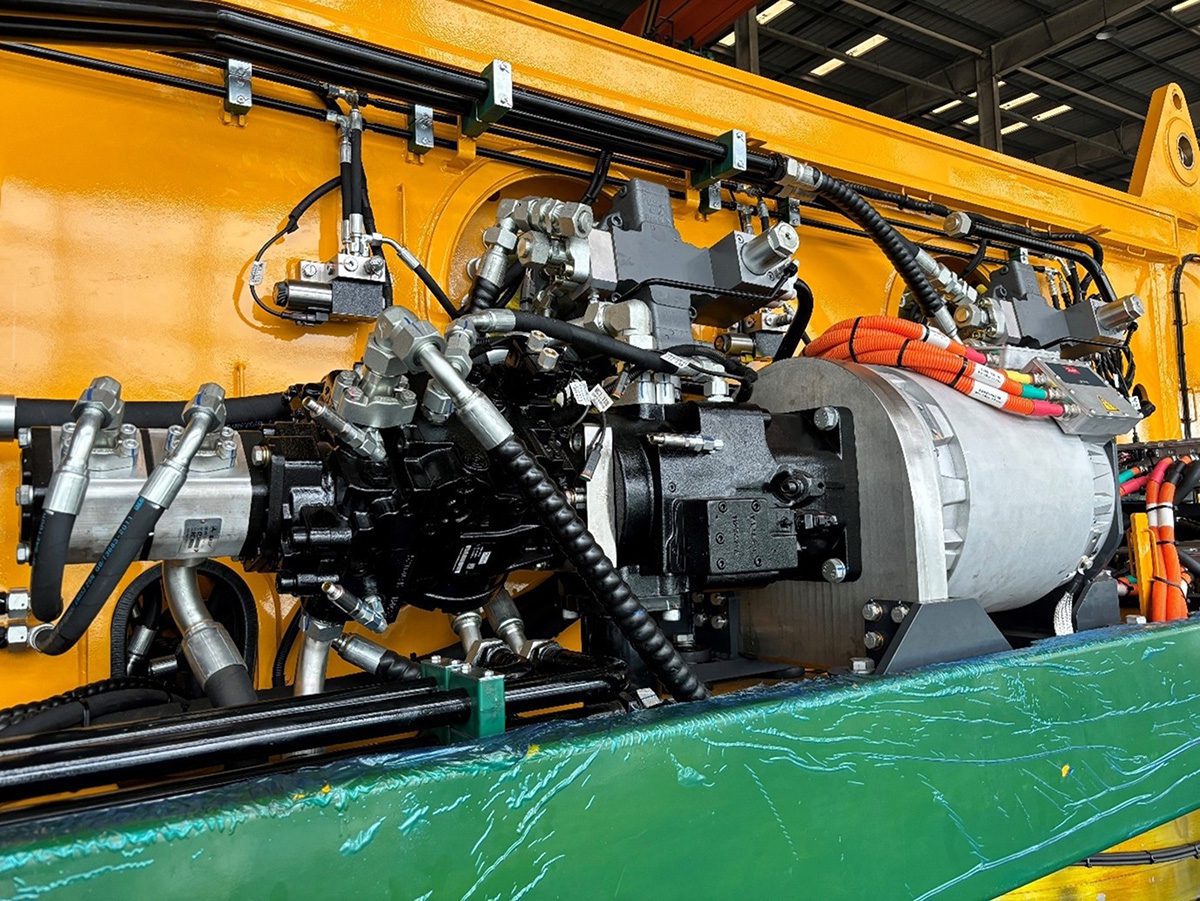
Danfoss Editron electric motors Danfoss Editron ED3 on-board chargerDanfoss Editron 48-voltage electric motor to power hydraulic gear pumpsDanfoss ePump Power Module
Azeroual also sees an important “bridge” between automotive and off-highway: heavy-duty trucks and commercial vehicles. In his view, advancements there are helping close the gap between passenger-car high-voltage ecosystems and off-highway requirements. Danfoss is selectively involved in on-highway electrification, he said, primarily when the technology can be carried back into off-highway products.
Why modularity is not optional in off-highway
In passenger cars, product strategy is built around standardization: a small set of interfaces, high-volume platforms and minimal variation. In off-highway, that assumption fails quickly. OEMs face wide variation in machine layout, packaging space, work functions and customer expectations, and volumes are often low enough that a “one-size-fits-all” approach can become a deal breaker.
Azeroual offers drivetrain topology as an example. An off-highway machine can easily require five motors and five different inverters, and each of those components must mount, route and cool in a way that fits a specific machine layout. Unlike automotive, in which the interface might be standardized around a small set of packaging conventions, off-highway often demands different form factors—“pancake” versus cylindrical—and different mounting realities.
Modularity is not purely mechanical. Off-highway machines are increasingly sensor-rich—OEMs are demanding more inputs and outputs, more diagnostics and more freedom to calibrate software to match unique work cycles. Azeroual describes modularity as the ability to modify interfaces—shaft, spline, connectors—as well as the software itself, so that end users can calibrate behavior to a particular application.
This is where Danfoss leans on its controls background. Azeroual highlighted Danfoss’s long history with the PLUS+1 software architecture—about 20 years—as a framework that allows customers to “pick and choose building blocks” for their vehicle architecture.
The trade-off, he acknowledged, is cost. Adding options and configurability can increase part cost. But in off-highway, flexibility is frequently the price of entry, especially when customers order ten units rather than ten thousand. Azeroual suggested that suppliers built around high-volume standardization often struggle here, and that a lack of flexibility can even be perceived as “arrogant” in what is, despite the equipment size, “a small world” of industrial machinery.
He offered a concrete benchmark for how far this variation can go: a single motor family may exist in “350 different variants,” driven by mechanical interfaces, connector options and related configuration needs.
The business physics: ROI sensitivity and market cycles
Off-highway is an engineering market, but it is also a market governed by simple economics. Azeroual says that end users are “very sensitive to ROI,” and notes the historically incremental pace of machine innovation: if the machine does the job, buyers prioritize reliability and hours-of-operation improvements over radical redesigns.
Electrification is different because it forces a step change across the machine: architecture, components, controls and service. That creates opportunity, but also hesitation when business conditions tighten. He described the market as a “light switch.” When money is tight, innovation slows—when demand rises, appetite returns.
Azeroual also called out a cultural difference that can surprise engineers coming from automotive: in off-highway, prototypes can end up being sold. He contrasted this with passenger cars and commercial vehicles, where prototypes are built for validation and never reach customers. In off-highway, a prototype electric machine may be purchased quickly, because machines are often custom-built and buyers are eager for workable solutions.
That dynamic can create whiplash. Some OEMs built electrified machines and struggled to sell them immediately, leading to a “we did it for nothing” sentiment, which Azeroual described as short-sighted. He contrasted those reactions with OEMs that treat electrification as part of a longer strategy—leveraging learnings from other mobility markets such as marine and on-highway trucks.
China’s gravitational pull on the electrification supply chain
Azeroual did not sugarcoat the role of China in electrification. He conceded that China dominates the electrification supply chain—batteries, motors, inverters—and suggested that global OEMs and suppliers must consider what that means for cost and iteration speed.
China’s strategic focus at the Bauma China trade show in 2024, which was heavily centered on electrification. Chinese OEMs were not simply showing concepts—hey had machines available for purchase and deployment.
From an engineering standpoint, the more uncomfortable point is cost and iteration. Azeroual suggested that Chinese suppliers are further along in development cycles—he describes China as being in the midst of a “seventh evolution” of motor and inverter development, compared with “generation three” elsewhere.
Azeroual’s interpretation is that Chinese manufacturers have iterated aggressively enough to understand the “bare minimum” required to serve real applications, rather than over-designing for edge cases.
A hidden differentiator: distribution, service and local engineering leverage
In off-highway, buying a component is inseparable from buying uptime. Machines operate in harsh environments, under schedule pressure, and downtime can erase any cost savings quickly.
Azeroual framed Danfoss’s large distribution network as a strategic advantage that complements modular design. Distributors are not only sales channels—they can also act as local integrators and solution builders. He described seeing a distributor share an integrated solution built from Danfoss components—motor, pump and controls—and offer it directly to customers.
He also warned about the limits of low-price entrants who lack service infrastructure. A component may be inexpensive, but when the part breaks, the question becomes who can service it and how quickly the machine can return to work—off-highway’s definition of real value.
Right-sizing as cost strategy: what marine and continuous-duty markets teach
Azeroual offered an engineer’s answer to the cost problem: learn from harsh duty cycles where the physics are unforgiving.
He explained how Danfoss’s experience in marine and oil-and-gas applications—markets in which motors can run continuously near their limits—provides data that informs product design for off-highway. In traction, peak power may be brief. In marine, “the peak power is the continuous power,” and the system runs “continuously at the edge.”
That stress testing can reveal that many products are over-designed for off-highway applications.
For engineers, this is a critical theme: electrification is not just about making an electric machine work. It is about making it work at the right cost, with the right lifespan assumptions, and with materials and performance aligned to actual duty cycles.
The bridge technology: electrifying hydraulics before electrifying everything
Azeroual repeatedly returned to a pragmatic adoption path. Off-highway is conservative. If something is “too new,” it can stall. He suggested that this conservatism is part of why fully electric machines have not yet taken off broadly.
Danfoss’s near-term emphasis is electrifying hydraulics and improving hydraulic efficiency—essentially using electric control to reduce wasted energy and to make work functions more responsive. The underlying idea is to stop wasting energy “turning a pump,” and to control pressure and flow so that the system operates as efficiently as possible.
He also suggested that electrification enables new component design choices, such as high-speed pumps better matched to electric motors—on the order of 8,000 to 10,000 RPM—along with the potential for lower noise once the combustion engine is removed from the loop.
Azeroual highlighted one Danfoss example as a “best of the best” combination: pairing a digital displacement pump (DDP) with an electric motor. Digital displacement can modulate pump output to match demand, and electric motors allow speed to be adjusted dynamically, expanding the operating envelope and improving efficiency. He called the combination “a game-changer.”
Then came a forecast that will spark debate: Danfoss anticipates pure battery-electric machines to remain “less than 5% by 2030,” while electrified, efficient hydraulics could rise into the 20-30% range.
Whether or not those exact percentages prove correct, the directional message is clear: for many machine classes, electrifying the work functions may deliver ROI sooner than full battery-electric conversion—and that can be a bridge to deeper electrification later.
Seeing is believing: demos, application centers and operator acceptance
Technical arguments alone rarely shift off-highway buying behavior. Operators, fleet owners and rental companies need proof of performance under real conditions.
Azeroual described Danfoss’s Application Development Centers (ADCs) as a way to generate that proof. Danfoss takes in customer vehicles (or selects platforms with high innovation potential), implements new architectures and then invites customers to test them. He cited ADCs in Ames, Iowa; Haiyan, China; and Nordborg, Denmark; where Danfoss can rapidly prototype and demonstrate solutions.
Demonstrations matter because they reveal benefits that spec sheets rarely capture. One example is jobsite communication: electrified machines can be quiet enough for a spotter to talk to an operator while the machine is digging, potentially improving precision and teamwork. Azeroual agreed that these “other things that we didn’t expect” can shift perceptions quickly.But he also emphasized the counterweight: electrified machines are still more expensive. Adoption depends on solving charging and uptime in a way that fits the ways in which equipment is actually deployed.
Charging is a bottleneck—and it won’t look like highway fast charging
Charging is where off-highway diverges most sharply from passenger cars. Even as on-highway electrification is building an extensive DC fast charging network, off-highway equipment often cannot use it. “You’re not going to bring an excavator on the side of the highway” to charge, Azeroual said.
Instead, the question is what power exists on a jobsite—and how a machine can use it without slowing the work.
Azeroual pointed to a practical Danfoss product development: an onboard AC charging solution, the ED3 (Editron three-in-one). His framing is pragmatic: most construction sites already have access to AC power, while DC power is “very rare” on-site and only possible through new large power banks. By enabling meaningful AC charging—he cited 44 kW as an example—machines can recharge overnight or during breaks without requiring a dedicated DC infrastructure build-out.
He also suggested that equipment-rental economics could become a key enabler. Because machines are often rented, a rental company could match battery size and charging strategy to the job: the same platform with a larger battery for a remote site, or a smaller-battery version when overnight charging is available. That kind of modularity, he argued, could help “break the barriers of entry.”
What this means for engineers designing the next generation of machines
Azeroual’s perspective makes one thing clear: off-highway electrification is not a single technology trend. It is a systems transition shaped by economics, policy and a rapidly evolving global ecosystem.
For engineers, several practical implications stand out:
Architecture decisions are converging. Expect a split between low-voltage compact machines and high-voltage mainstream platforms, driven by charging power, efficiency and the 150-200 kW-plus reality of many work cycles.
Modularity is an engineering requirement. Mechanical interfaces, packaging, I/O and software calibration flexibility are not “nice to have” in off-highway; they are central to winning programs across diverse machines and low-to-medium volumes.
E-hydraulics is likely to be a major near-term lever. Electrifying and optimizing hydraulic work functions can deliver efficiency, noise and controllability gains without requiring every machine to become fully battery-electric overnight.
Charging must match the jobsite. Onboard AC charging, right-sized batteries and fleet/rental planning may matter more than replicating the passenger-car DC fast charging playbook.
Off-highway will not electrify evenly. Some segments—compact urban machines and duty cycles with predictable charging—will move quickly. Others—long-duration field work, remote jobsites and exceptionally harsh duty cycles—will take longer. But the direction is increasingly clear: electrification, in one form or another, is becoming a standard design constraint, not a side project.
More than 97 percent of the new cars Norwegians registered in November 2025 were electric, almost reaching the country’s goal of 100 percent. As a result, the government has begun removing some of the many carrots it used to encourage its successful EV transition. Cecilie Knibe Kroglund, state secretary in the country’s Ministry of Transport, reveals some of the challenges that come with success.
What were the important early steps to promote the EV switch?
Kroglund: Battery-electric vehicles have had exemptions from the 25 percent value-added tax and from the CO2- and weight-based registration tax that apply to combustion-engine vehicles. We used other tax incentives to encourage building charging stations on highways and in rural areas. Cities had the opportunity to exempt zero-emissions cars from toll roads. EV drivers also got reduced ferry fares, free parking, and access to bus lanes in many cities. The technology for the vehicles wasn’t that good at the start of the incentives program, but we had the taxes and incentives to make traditional passenger cars more expensive.
What were the biggest barriers, and how did policymakers overcome them?
Kroglund: Early on the technology was challenging. In summertime it was easy to fuel the EV, but in wintertime it’s double the use of energy. But the technology has improved a lot in the last five years.
The Norwegian tax exemptions on EVs were introduced before EVs came to market and were decisive in offsetting the early disadvantages of EVs compared to conventional cars, especially regarding comfort, vehicle size, and range. The rapid expansion of charging infrastructure along major corridors has also been important to overcome range anxiety.
How have private companies responded to government incentives?
Kroglund: I’m personally surprised that it went so well. This was a long-term commitment from the government, and the market has responded to that. Many Norwegian companies use EVs. The market for charging infrastructure is considered commercially viable and no longer needs financial support. However, we don’t see commercial-vehicle adoption going as fast as passenger vehicles, and we had the same goal. So we will have to review the goals, and we’ll have to review the incentives.
What unexpected new problems is Norway’s success creating?
Kroglund: The success of the passenger-vehicle policies mean EVs are in competition with public transport in the larger cities. Driving an EV remains much cheaper than driving a conventional car even without tax exemptions, and overall car use continues to rise. National, regional, and local governments must find different tools to promote walking, bicycling, and public transport because each city and region is different.
How applicable are these lessons to poorer or less well-administered countries and why?
Kroglund: We are different as countries. The geographies are different, and some countries have even bigger cities than our national population. This is not a policy for L.A., but what we see in Norway is that incentives work. However, tax incentives are only applicable in systems where effective taxation is established, which may not be the case in poorer countries. Other benefits, such as lower local emissions, only apply in places with lots of traffic.
The Norwegian experience shows that the economic incentives work, but it also shows that EVs work even in a country with cold weather.
This article appears in the February 2026 print issue as “Cecilie Knibe Kroglund.”
Charging an EV at home doesn’t seem like an inconvenience—until you find yourself dragging a cord around a garage or down a rainy driveway, then unplugging and coiling it back up every time you drive the kids to school or run an errand. For elderly or disabled drivers, those bulky cords can be a physical challenge.
As it was for smartphones years ago, wireless EV charging has been the dream. But there’s a difference of nearly four orders of magnitude between the roughly 14 watt-hours of a typical smartphone battery and that of a large EV. That’s what makes the wireless charging on the 108-kilowatt-hour pack in the forthcoming Porsche Cayenne Electric so notable.
To offer the first inductive charger on a production car, Porsche had to overcome both technical and practical challenges—such as how to protect a beloved housecat prowling below your car. The German automaker demonstrated the system at September’s IAA Mobility show in Munich.
This article is part of our special report Top Tech 2026.
With its 800-volt architecture, the Cayenne Electric can charge at up to 400 kW at a public DC station, enough to fill its pack from 10 to 80 percent in about 16 minutes. The wireless system delivers about 11 kW for Level 2 charging at home, where Porsche says three out of four of its customers do nearly all their fill-ups. Pull the Cayenne into a garage and align it over a floor-mounted plate, and the SUV will charge from 10 to 80 percent in about 7.5 hours. No plugs, tangled cords, or dirty hands. Porsche will offer a single-phase, 48-ampere version for the United States after buyers see their first Cayennes in mid-2026, and a three-phase, 16-A system in Europe.
Porsche’s Wireless Charging is Based on an Old Concept
The concept of inductive charging has been around for more than a century. Two coils of copper wire are positioned near one another. A current flowing through one coil creates a magnetic field, which induces voltage in the second coil.
In the Porsche system, the floor-mounted pad, 78 centimeters wide, plugs into the home’s electrical panel. Inside the pad, which weighs 50 kilograms, grid electricity (at 60 hertz in the United States, 50 Hz in most of the rest of the world) is converted to DC and then to high-frequency AC at 2,000 V.The resulting 85-kilohertz magnetic field extends from the pad to the Cayenne, where it is converted again to DC voltage.
The waterproof pad can also be placed outdoors, and the company says it’s unaffected by leaves, snow, and the like. In fact, the air-cooled pad can get warm enough to melt any snow, reaching temperatures as high as 50 °C.
The Cayenne’s onboard charging hardware mounts between its front electric motor and battery. The 15-kg induction unit wires directly into the battery.
In most EVs, plug-in (conductive) AC charging tops out at around 95 percent efficiency. Porsche says its wireless system delivers 90 percent efficiency, despite an air gap of roughly 12 to 18 cm between the pad and vehicle.
Last year, Oak Ridge National Laboratory transferred an impressive 270 kilowatts to a Porsche Taycan with 95 percent efficiency.
“We’re super proud that we’re just below conductive AC in charging efficiency,” says Simon Schulze, Porsche’s product manager for charging hardware. Porsche also beats inductive phone chargers, which typically max out at about 70 percent efficiency, Schulze says.
When the car gets within 7.5 meters of the charging pad, the Cayenne’s screen-based parking-assist system turns on automatically. Then comes a kind of video game that requires the driver to align a pair of green circles on-screen, one representing the car, the other the pad. It’s like a digital version of the tennis ball some people hang in their garage to gauge parking distance. There’s ample wiggle room, with tolerances of 20 cm left to right, and 15 cm fore and aft. “You can’t miss it,” according to Schulze.
Induction loops detect any objects between the charging plate and the vehicle; such objects, if they’re metal, could heat up dangerously. Radar sensors detect any living things near the pad, and will halt the charging if necessary. People can walk near the car or hop aboard without affecting a charging session.
Christian Holler, Porsche’s head of charging systems, says the system conforms to International Commission on Non-Ionizing Radiation Protection standards for electromagnetic radiation. The field remains below 15 microteslas, so it’s safe for people with pacemakers, Porsche insists. And the aforementioned cat wouldn’t be harmed even if it strayed into the magnetic field, though “its metal collar might get warm,” Schulze says.
The Porsche system’s 90 percent efficiency is impressive but not record-setting. Last year, Oak Ridge National Laboratory (ORNL) transferred 270 kW to a Porsche Taycan with 95 percent efficiency, boosting its state of charge by 50 percent in 10 minutes. That world-record wireless rate relied on polyphase windings for coils, part of a U.S. Department of Energy project that was backed by Volkswagen, Porsche’s parent company.
That effort, Holler says, spawned a Ph.D. paper from VW engineer Andrew Foote. Yet the project had different goals from the one that led to the Cayenne charging system. ORNL was focused on maximum power transfer, regardless of cost, production feasibility, or reliability, he says.
By contrast, designing a system for showroom cars “requires a completely different level of quality and processes,” Holler says.
High Cost Could Limit Adoption
Cayenne buyers in Europe will pay around €7,000 (roughly US $8,100) for the optional charger. Porsche has yet to price it for the United States.
Loren McDonald, chief executive of Chargeonomics, an EV-charging analysis firm, said wireless charging “is clearly the future,” with use cases such as driverless robotaxis, curbside charging, or at any site “where charging cables might be an annoyance or even a safety issue.”
But for now, inductive charging’s costly, low-volume status will limit it to niche models and high-income adopters, McDonald says. Public adoption will be critical “so that drivers can convenience-charge throughout their driving day—which then increases the benefits of spending more money on the system.”
Porsche acknowledges that issue; the system conforms to wireless standards set by the Society of Automotive Engineers so that other automakers might help popularize the technology.
“We didn’t want this to be proprietary, a Porsche-only solution,” Schulze says. “We only benefit if other brands use it.”
Some bad news from South Africa. In a year which saw the overall market reach levels not seen in well over a decade, BEV sales were unfortunately down 17%. BEV sales were already very low, and one had hoped sales would kick on following years of decent growth, albeit from ... [continued]
Some bad news from South Africa. In a year which saw the overall market reach levels not seen in well over a decade, BEV sales were unfortunately down 17%. BEV sales were already very low, and one had hoped sales would kick on following years of decent growth, albeit from ... [continued]

 Login
Login