By Mike Hodge, AI Solutions Lead, Keysight Technologies
It’s the heart of the AI gold rush, and everyone wants to capitalize on the next big thing. Large language models, multimodal systems, and domain-specific AI workloads are moving from experimentation to production at scale. Across industries, enterprises are building their own proprietary models or integrating pre-trained ones to power applications spanning from video analytics to highly specialized inference services.
This shift has triggered a new wave of infrastructure investment. But while GPUs and accelerators dominate the conversation, scaling AI platforms has produced a less obvious constraint: front-end network performance. In increasingly distributed, multi-tenant AI environments, the ability to move data efficiently into (and across) platforms has become just as critical as raw compute density.
New AI platforms mean new expectations for infrastructure
AI infrastructure is no longer the exclusive domain of a handful of hyperscalers. A growing class of service providers has begun offering end-to-end AI platforms where compute, storage, networking, and orchestration are delivered as a service. Their value proposition is straightforward: customers bring data and models, while the platform handles the complexity of building, operating, and maintaining large-scale data center deployments.
Service models like these, however, place extraordinary demands on networking. Unlike traditional cloud workloads, AI jobs are defined by massive, sustained data movement and tight coupling between data pipelines and compute utilization. GPUs cannot perform at peak efficiency unless data arrives on time, in the right order, and at predictable speeds.
As a result, network performance is now one of the primary determinants of training, inference, and infrastructure efficiency.
The eye of the storm is moving from the fabric to the front end
AI infrastructure discussions often focus on back-end fabrics. Think about things like high-bandwidth, low-latency interconnects between GPUs, for example. However, while these fabrics are indeed essential, they are only part of the picture.
Before training or inference ever begins, data must first traverse the front-end network. This occurs in several ways, but some of the most common paths include:
- From remote object stores or on-premises repositories into the data center
- From ingress points into virtual machines or containers
- From storage into GPU-attached hosts
This is where north-south traffic (external to internal) intersects with east-west traffic (host-to-host and service-to-service). And in AI environments, these flows are not occasional spikes. They are sustained, high-throughput, latency-sensitive streams that run continuously throughout the lifecycle of a job.
When front-end networks underperform, the consequences are costly and immediate: idle accelerators, elongated training windows, unpredictable inference latency, and poor multi-tenant isolation.
Why traditional network validation falls short
Most cloud networks were designed around general-purpose workloads. Think about things like web services, databases, and transactional systems with relatively modest bandwidth demands and fluctuating traffic patterns punctuated by the occasional spike.
AI workloads, on the other hand, break these assumptions. On the front end, AI traffic is characterized by:
- Extremely large data transfers, often using jumbo frames
- Long-lived connections, sustained over hours or days
- Millions of concurrent sessions in multi-tenant environments
- Tight latency and jitter tolerances to avoid starving accelerators
Conventional network testing approaches — such as synthetic benchmarks, isolated link tests, or small-scale simulations — are unable to replicate this behavior. As a result, many issues only surface once customer workloads are already running, which also happens to be when the cost of remediation is highest.
The need for realistic workload emulation
Optimizing front-end AI networks requires the ability to reproduce real workload behavior at scale. That means emulating both north-south and east-west traffic patterns simultaneously, across distributed environments and under sustained load.
For north-south paths, this includes verifying that large datasets can be reliably pulled from diverse external sources into local storage. Moreover, the network must also be able to do so with consistent throughput, predictable latency, and no silent data loss. Transfers like these are essential, as any inefficiency propagates directly into longer training times and underutilized GPUs.
For east-west paths, the challenge shifts to connection density, latency, and scalability. Once workloads are running, virtual machines and services exchange data continuously. Sometimes within the same host, sometimes across racks, and sometimes across geographically separated data centers. Modern AI platforms increasingly rely on SmartNICs and offload technologies to make this feasible, so these components must also be validated under realistic connection rates and protocol behavior.
Without large-scale, workload-accurate testing, subtle bottlenecks — such as rule-processing limits, connection-tracking inefficiencies, or unexpected latency spikes — can remain hidden until production traffic exposes them.
Front-end optimization is a competitive differentiator
In response, the most advanced AI platform operators are shifting left: validating their front-end networks before customers ever deploy workloads. Along the way, their proactive approach is changing the economics of AI infrastructure.
Stress-testing networks under real-world conditions offers a range of benefits for network operators:
- Identifying performance cliffs at high line rates
- Understanding how different layers of the stack interact under load
- Resolving scaling limitations in NICs, virtual networking, or storage paths
- Delivering predictable performance across tenants and geographies
It’s not just about improving peak throughput. It’s about building confidence that platforms perform as expected under peak pressure. And in a market where AI workloads are expensive, time-sensitive, and strategically important, this confidence becomes a differentiator. Customers may never see the network directly, but they feel its impact in faster training cycles, lower inference latency, and fewer production surprises.
Looking ahead: front-end networks and the next generation of AI
AI workloads continue to evolve. Microservices-based architectures, distributed inference pipelines, and increasingly stateful services are placing even more emphasis on low-latency, high-availability front-end connectivity. At the same time, data is becoming more geographically distributed, pushing platforms to span multiple regions and network domains.
In this environment, front-end networks are no longer a supporting actor. They are a core component of AI system design. That means they must be engineered, validated, and optimized with the same rigor applied to compute and accelerators.
The lesson is clear: operators cannot optimize AI infrastructure by focusing on GPUs alone. The performance, efficiency, and reliability of tomorrow’s AI platforms will be defined just as much by how well they move data as by how fast they process it.
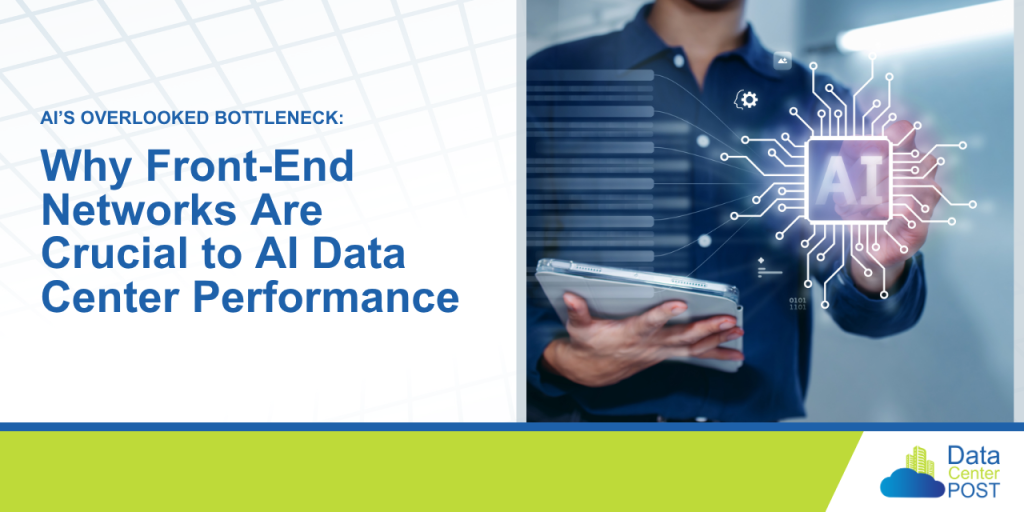
The post AI’s Overlooked Bottleneck: Why Front-End Networks Are Crucial to AI Data Center Performance appeared first on Data Center POST.

 Login
Login