The concept of renewable energy has emerged as a pivotal solution to the pressing global energy challenges of our time. With the world facing escalating concerns over depleting fossil fuel reserves, environmental degradation, and climate change, the need for sustainable and clean energy sources has become increasingly paramount. Renewable energy, derived from sources such as […]
The rapid expansion of solar energy across utility-scale plants, industrial rooftops, and captive power systems has reshaped the dynamics of power generation and grid integration. At the heart of every efficient solar power plant lies a critical link between power generation and transmission – the Inverter Duty Transformer (IDT). Designed to handle the unique electrical […]
Although several global observers have recently stated in their reports that the growth of renewable energy worldwide seems to have slowed down or is slowing down in 2026, this view is not entirely applicable to India; in fact, due to several reasons, our focus has been compelled to shift – and give special importance to […]
As the nation races toward its ambitious target of 500 GW of non-fossil fuel capacity by 2030, the renewable energy revolution has moved from the margins to the mainstream, fundamentally reshaping commercial strategies, regulatory frameworks, and operational paradigms across the entire value chain. For energy regulators, power producers, distribution companies, and industry professionals, understanding this […]
India’s power system is undergoing a structural transition. With ambitious targets for non‑fossil capacity and rapidly falling costs of solar and wind, the generation mix is shifting from predictable, dispatchable sources to variable, weather‑dependent resources. Managing this transition requires technologies that can ensure reliability, grid stability and economic efficiency. Traditionally, intermittency was addressed using fossil‑fuel‑based […]
Valmet will supply automation systems for Daklo 1-3 Power Company Limited’s Daklo 1 and Daklo 3 hydropower plants currently being built in Kon Plong Ward, Quang Ngai Province, Vietnam. The order was placed by Industries Equipment and Solution Company Ltd (IESC), a local Valmet partner, which has signed a contract with the EPC (Engineering, Procurement, […]
Ending 2025 on a high note, UNRWA and the Government of Japan marked the successful completion of a solar power installation project at the Siblin Training Centre (STC) in southern Lebanon, bringing clean electricity to education, health, and water facilities to thousands of Palestine Refugee families across the country. Speaking at the launch of the […]
Uniper and NKT have signed a long-term Power Purchase Agreement (PPA) for electricity from Uniper’s newly developed photovoltaic (PV) asset in Wilhelmshaven. The agreement represents a meaningful step for both companies as they strengthen their sustainability commitments and increase the use of regionally sourced renewable energy. The solar park Voslapper Groden, located on the ash […]
The World Bank Group’s Boards of Executive Directors have approved a financing package to increase the Kingdom of Bhutan’s hydropower generation, facilitate regional clean energy trade, expand economic opportunities, and create jobs. The 1,125 MW Dorjilung Hydroelectric Power Project, located on the Kurichhu River in eastern Bhutan, will generate more than 4,500 GWh of clean […]
EnBW Energie Baden-Württemberg AG (EnBW) and Google have entered into a long-term power purchase agreement (PPA) under which EnBW will supply Google with 100 megawatts of clean electricity from the He Dreiht offshore wind farm over a period of 15 years. Google aims to operate its global operations on 24/7 carbon free energy by 2030, […]
Climate Energy Finance’s Tim Buckley argues that geopolitical instability exposes Australia's oil dependency and positions the country as a safe haven for international renewable energy capital.
The New Jersey Board of Public Utilities (NJBPU) has selected developer and IPP Elevate Renewables’ 600MWh battery energy storage system (BESS) for development in Ridgefield, New Jersey, US.
54% of respondents cited “energy availability and redundancy” as the single greatest obstacle to successful data center development between now and 2030.
aw firm Foley & Lardner LLP released today its 2026 Data Center Development Report, focusing on the growth and challenges in the data center boom that aims to sustain the growth in AI and LLM usage.
A major focus was on energy, with 54% of respondents citing “energy availability and redundancy” as the single greatest obstacle to successful data center development between now and 2030.
Want to learn more about matching renewables with data center demand?
The event will spotlight how solar and energy storage solutions are driving sustainable and reliable infrastructure, with a particular focus on powering the country’s rapidly growing data center sector.
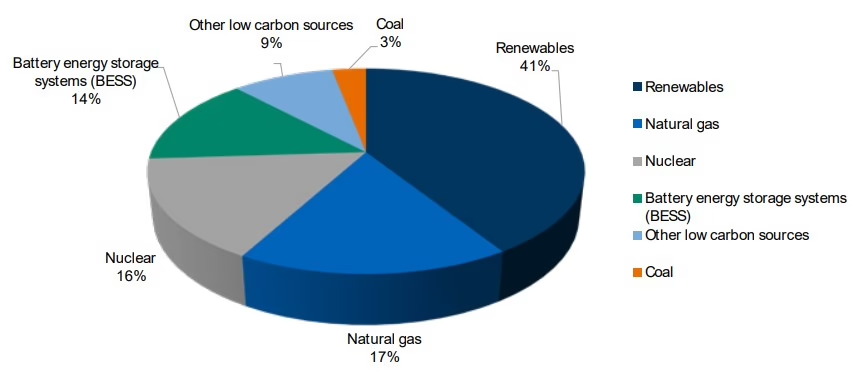
In terms of the right energy mix for data centers, 55% of respondents agreeing that the ideal energy mix to meet the growing power demand of data centers is largely renewables (41%), followed by natural gas (17%), nuclear (16%), and BESS (14%).
Nearly half (48%) of industry participants named advances in energy efficiency (which often includes storage optimization) as the greatest opportunity for development through the end of the decade, and nearly three in four respondents (74%) said advanced energy storage systems like batteries, hybrid solutions, and microgrids are the best way to ensure energy resilience.
Only 14% of developers are actually pursuing modular and small modular nuclear reactors as a viable energy opportunity.
Intriguingly, 63% anticipate a “strategic correction” in the market by 2030, driven by the intense competition for power, with one unnamed banking executive in the report saying, “Once power runs out in 2027 or 2028, that’s where we think deal flow will start to slow down.”
105 U.S.-based respondents were qualified to participate in the survey, including those who had direct experience in data center development, energy procurement, technology delivery, or operations within the past 24 months.
Daniel Farris, partner and co-lead of Foley’s data center and digital infrastructure team: “There is a Gold Rush mentality right now around securing power. That’s a big part of why people feel there’s a bubble,” said “There’s going to a period in the next two to three years where power at necessary levels is going to be really hard to come by.”
Rachel Conrad, senior counsel and co-lead of Foley’s data center and digital infrastructure team: “Over the next five to 10 years, power providers will need to either grow capacity or increase efficiency to meet the demand fueled by data centers.”
Brazil curtailed about one-fifth of its solar and wind generation in 2025, wasting an estimated BRL 6.5 billion ($1.23 billion), as grid constraints and demand mismatches pushed the power system close to operational safety limits on 16 days, according to a report from Volt Robotics.
Brazil failed to use roughly 20% of the solar and wind electricity it generated in 2025, resulting in an estimated loss of BRL 6.5 billion, according to Volt Robotics’ Annual Curtailment Report.
Volt Robotics said the scale of curtailment reflects an unprecedented period of renewable oversupply combined with operational constraints in Brazil’s national electricity system.
Average generation cuts reached 4,021 MW over the year, equivalent to the monthly output of a large hydroelectric plant. On at least 16 days in 2025, system operation approached the lower technical safety limit, a sharp increase from 2024, when only one comparable event was recorded.
Volt Robotics said the 2025 events were driven by excess electricity supply rather than scarcity, marking a structural shift in system risk dynamics.
Curtailment intensified between August and October, when historically high levels of generation coincided with transmission constraints and weaker demand. The report attributes the peak losses to a combination of operational limitations, grid congestion, and insufficient flexibility to absorb surplus power.
Sunday mornings emerged as the most frequent stress point for the grid. Volt Robotics said reduced economic activity during weekends lowers electricity demand, while solar output peaks and is often reinforced by strong wind generation. This recurring mismatch leads to network overloads, forced generation cuts, and system operation near the lower safety threshold.
The report also highlights the risk of system instability caused by excess renewable generation. During the 16 critical days, Brazil’s National System Operator classified conditions as severe and implemented emergency measures, supported by the National Electric Energy Agency, including extraordinary generation curtailments.
Volt Robotics warned that without structural adjustments, surplus clean energy itself can become a source of operational risk.
The economic impact extends beyond immediate revenue losses. Frequent curtailment increases perceived investment risk, raises financing costs, and weakens Brazil’s appeal for new renewable energy projects, the report said. Both regulated and free-market projects were affected, with exposure to contractual penalties and the Settlement Price of Differences.
Regionally, Minas Gerais, Ceará, and Rio Grande do Norte recorded the highest levels of curtailed energy, forming what Volt Robotics described as Brazil’s “curtailment triangle.” Southern states experienced significantly lower losses.
Volt Robotics said the situation reflects a structural mismatch between rapid renewable capacity expansion, rising distributed generation, transmission bottlenecks, and tariff structures that do not adequately signal when electricity consumption is most valuable.
The report recommends the introduction of more dynamic time-of-use tariffs, stronger demand-side participation, and regulatory reforms to reduce curtailment and maintain the stability of Brazil’s electricity system.
Renewables and storage could reliably power data centers, but success requires active grids, coordinated planning, and the right mix of technologies. Hitachi Energy CTO, Gerhard Salge, tells pv magazine that holistic approaches ensure technical feasibility, economic viability, and energy system resilience.
As data centers grow in size and complexity, supplying them with cheap and reliable power has never been more pressing. Gerhard Salge, chief technology officer (CTO) at Hitachi Energy, a unit of Japanese conglomerate Hitachi, shed light on the relationship between renewable energy and data center operations, noting that while technically feasible, success requires careful planning, the right infrastructure, and a holistic approach.
“When we look at what's happening in the grids, then renewables are an active element on the power generation side, and the data centers are an active element on the demand side,” Salge told pv magazine. “What you need in addition to that is in the dimensions of flexibility, for which we need storage and a grid that can actively act also here in order to bring all these elements together.”
Want to learn more about matching renewables with data center demand?
The event will spotlight how solar and energy storage solutions are driving sustainable and reliable infrastructure, with a particular focus on powering the country’s rapidly growing data center sector.
According to Salge, the key is active grids, not passive systems that simply react to conditions. With more renewables, changing demand patterns, new load centers, and storage options like batteries and existing facilities such as pumped hydro, it is crucial to coordinate these resources actively to maintain supply security, power quality, and cost optimization.
“But when you talk about the impact and the correlation between renewables and data centers, you need always to consider this full scope of the flexibility in a power system of all the elements—demand side, generation side, storage side, and the active grid in between,” he said, noting that weak or congested grids would not serve this purpose.
AI data centers
Salge warned that not all data centers are the same. “There are conventional data centers and AI data centers,” he said. “Conventional data centers are essentially high-load systems with some fluctuations on top. They contain many processors handling requests—from search engines or other applications—so the workload is distributed stochastically across them. This creates a baseline load with random ups and downs, which is the typical load pattern of a conventional data center.”
AI workloads, in contrast, rely heavily on GPUs or AI accelerators, which consume significant power continuously. Unlike conventional data centers, AI data centers often run at sustained high load, sometimes close to maximum capacity for long periods.
Htitachi Energy CTO Gerhard Salge
Image: Hitachi Energy
“AI data centers are specifically good in doing parallel computing,” Salge explained. “So many of them are triggered with the same demand pattern at the same time, which creates these spikes up and down in the demand profile, and they come in parallel all together.”
These fluctuations challenge both the power supply and the voltage and frequency quality of the connected grid. “So, you need to transport active power from an energy storage system or a supercapacitor to the demand of the AI data center. And that then needs to involve really the control of the data center’s active power. What you need is the interaction between the storage unit and then the AI data center to provide active power or to absorb it afterwards when the peak goes down. That can be also done by a supercapacitor.”
Batteries can store much more energy than supercapacitors, but the latter can ramp smaller energies more frequently. “However, if you put a battery that is smaller than the load, and you really need to cycle the battery through its full capacity, the battery will not survive very long with your data center, because the frequency of these bursts is so high, then you are aging the battery very, very quickly, yeah, so supercapacitors can do more cycles,” Salge emphasized.
He also noted that batteries and supercapacitors are both mature technologies, but the optimal setup—whether one, the other, or a combination with traditional capacitors—depends on storage size, number of racks, voltage levels, and overall system design.
Managing AI training bursts
Salge stressed the importance of complying with grid codes across geographies. “You need to become a good citizen to the power system,” he said. “You have to collaborate with local utilities to make sure that you are not infringing the grid codes and you are not disturbing with the data center back into the grid. A good way to do this, when renewables and data centers are co-located, is to manage renewable energy supply already inside the data center territory. Moreover, having a future-fit developed grid is a clear advantage. Because you have much more of these flexibility elements and the active elements to manage storage and renewable integration and to manage the dynamic loads of the data centers.”
If the grid is not future-fit with modern, actively operating equipment, operators will see significantly more stress. “With holistic planning, instead, you can even use some of the data center flexibility as a controllable and demand response kind of feature,” Salge said, adding that data center operators could coordinate AI training bursts to periods when the power system has more available capacity. This makes the data center a predictable, controllable demand, stressing the grid only when it is prepared.
“In conclusion, regarding technical feasibility: yes, it’s possible, but it requires the right configuration,” Salge said.
Economic feasibility
On economics, Salge believes solar and wind remain the cheapest power sources, even when accounting for the grid flexibility needed to integrate them with data centers. Solar is fastest to deploy, wind complements it well, and both can be scaled in parallel.
“Any increase in data center demand requires investment, whether from renewables or conventional power. Economics depend on the market, and market mechanisms, regulations, and technical grid planning are interconnected, influencing energy flow, pricing, and system stability,” he said.
“We recommend developers to work with all stakeholders—utilities, technology providers, and planners—from the start to ensure reliability, affordability, and social acceptance. Holistic planning avoids reactive fixes and leads to better long-term outcomes,” Salge concluded.
The Economic Survey of India 2025-26 has highlighted significant progress in energy generation from non-fossil fuels and renewable sources. It highlights that India has surpassed its goal of achieving 50 per cent installed power capacity [...]
NTPC Vidyut Vyapar Nigam (NVVN), a wholly owned subsidiary of NTPC Limited, has announced the result of its 250 MW/500 MWh standalone battery energy storage system (BESS) auction. Shreyas Sortex Industries emerged as the successful [...]
NHPC has commenced commercial operation of the third unit of the Subansiri lower hydroelectric project. The project comprises eight units, each with a capacity of 250 MW, thereby taking the project’s total planned capacity to [...]
The Union Budget 2026-27 aims at strengthening clean energy development, clean technology manufacturing, lithium-ion battery production, and tariff rationalisation. There has been a significant increase in budgetary allocations for the Ministry of New and Renewable [...]

 Login
Login