Reading view

Key takeaways from Solar Flex Prague

Czechia’s first international conference on solar and flexibility highlighted that the combination of solar with storage and flexibility sources is key to not just Czechia’s, but also Europe’s, secure and competitive electricity system.

Solar Flex Prague, jointly organised by SolarPower Europe, Solární Asociace and Asociace AKU-BAT CZ, welcomed visitors to a snowy Czech capital on Thursday (29 January), bringing together stakeholders from across Europe to discuss how flexibility solutions and storage can be further deployed.

The conference began with a speech from SolarPower Europe CEO, Walburga Hemetsberger, who said that while electrification is a lifeline for Europe, there is dwindling confidence in the energy transition among some politicians, some leading businesses and key players in the defence sector.

“The way out of the doubts is to really bank big time on flexibility, on storage and on electrification. This will show very concrete benefits very quickly, make politicians understand and really feel the benefits,” Hemetsberger told attendees, before adding that the combination of solar with storage and flexibility sources can lower energy system costs by €30 billion by 2030, while strengthening Europe’s security by removing dependency on foreign players. 

Paula Dorado represented the European Commission via video call and told attendees work on an electrification action plan is underway, scheduled for adoption this year. The plan is expected to address barriers and provide a way forward on electrification for different sectors including companies, households and industrial processes, Dorado said.

Throughout the day, speakers were in agreement that storage and flexibility now play an integral role in Czechia’s electricity system. Panellists pointed out that solar-plus-storage projects can be implemented in a matter of months, offering companies the ability to save money or open new revenue streams. Other speakers stressed the idea that renewable sources are uncontrollable is now outdated, explaining that modern solar-plus-storage systems are not only manageable, offering the ability to respond to market prices and the needs of both transmission and distribution system operators, but are shifting from grid-following to grid-forming technologies and contribute to the stability of the electricity system.

Czechia appears ahead of the curve when it comes to deploying co-located storage with smaller-scale solar, with figures published by Czechia’s largest electricity distributor, ČEZ Distribuce, last September sharing 86% of solar plants connected during the first half of 2025 were equipped with energy storage. In contrast, the country’s large-scale solar market sits at a pivotal moment following the implementation of a legal framework for large-scale development and operation last year. During an afternoon session on opportunities and challenges related to storage and the grid, Rene Nedela from Czechia’s Ministry of Industry and Trade said up to 180 GW of BESS applications have been registered, although some are without any project readiness.

Several speakers advised Czechia to look to other countries further down the line of large-scale battery deployment, and in particular its neighbour Germany, whose favourable market environment for batteries has helped attract investors and move flexibility efforts forwards.

Attendees also said flexible solar-plus-storage projects could help to solve any power shortages that arise from the gradual shutdown of coal-fired power plants in Czechia. The Czech government has committed to phasing out coal-fired electricity generation by 2033 and the country’s last deep black coal mine shut down last month.

During the afternoon session, Alexandr Cerny from Czechia’s Energy Regulatory Office introduced proposed changes to Czechia’s energy tariffs, expected to come into force from the start of next year. The changes will restructure current tariff categories, particularly at the higher voltage levels, and are in part designed to reward flexibility in both consumption and generation, holding the potential to help ramp up the deployment of batteries while better integrating renewables to the grid.

Solar Flex Prague was SolarPower Europe’s second conference on flexibility following the inaugural Solar Flex Croatia held last March. A second edition of Solar Flex Croatia will take place in Zagreb on March 17 this year and Hemetsberger told pv magazine work is currently underway preparing the first Solar Flex Italy for later this year.

  •  

Bulgaria installs 1.4 GW of solar in 2025

Bulgaria installed over 1 GW of solar for the third consecutive year in 2025 and is forecast to add over 2 GW this year thanks to a large pipeline of utility-scale projects.

Bulgaria added 1,416 MW of solar last year, according to official data published on the ENTSO-E Transparency Platform. The result marks the third consecutive year Bulgaria has deployed over 1 GW of solar and takes the country’s cumulative capacity to 5,984 MW.

Desislava Mateva, project manager at the Sofia-based Association for Production, Storage and Trading of Electricity (APSTE) told pv magazine that Bulgaria’s solar market is currently dominated by ground-mounted, utility-scale solar plants, reflecting the availability of land, strong developer activity and increasing access to project finance.

Utility-scale solar made up around 90% of Bulgaria’s new capacity last year. Mateva said the market was driven by the strong commercial competitiveness of solar, making projects viable without direct subsidies, as well as active support from local and international banks and a large pipeline of development projects that reached the ready-to-build stage or financial close over the past 18 months.

Mateva also noted that Bulgaria is experiencing a wave of standalone battery energy storage system (BESS) deployments and the hybridization of both existing and new solar assets with BESS, as developers look to deal with price cannibalization and declining solar capture rates.

“These developments are expected to reduce price volatility, improve system flexibility, and mitigate capture-price pressure for solar producers,” she explained. “As a result, industry expectations remain positive.”

Among the largest projects to be commissioned in Bulgaria last year was the first phase of the 315 MW/760 MWh Tenevo hybrid project, with a second phase scheduled for commissioning early this year, and the Selanovtsi hybrid project, a 59.8 MW solar plus 107.3 MWh storage site in the northwestern Vratsa region. Bulgaria also commissioned one of the EU's largest standalone BESS facilities last year, located adjacent to a 107 MW solar park.

Bulgaria’s C&I solar market is showing steady momentum, particularly among projects designed for self-consumption, Mateva added, with rising electricity costs incentivizing businesses to invest in on-site solar, often in combination with storage. 

In contrast, Bulgaria’s residential solar sector remains underdeveloped in capacity terms. Mateva said interest among households exists but the market segment has been constrained by regulatory complexity and limited incentives.

She added that the residential sector would benefit from the full liberalization of Bulgaria’s electricity market, as currently household electricity prices remain regulated, accounting for roughly 40% of national electricity demand. “Full liberalization would stimulate demand-side participation and unlock the residential solar and storage market,” she explained.

Looking ahead, Mateva predicted Bulgaria is on course for a record year in solar deployment in 2026. “An estimated 2.5 GW of additional solar projects are either under construction or at an advanced stage of development and expected to start construction soon,” she said. “This pipeline suggests that most of this capacity will be commissioned by the end of 2026.”

Bulgaria’s storage pipeline is looking equally healthy, with 15 GWh expected to be commissioned by half way through the year, supported by the country’s National Recovery and Resilience Plan.

Mateva added that the most significant policy change last year was a sharp increase in eco-taxes and recycling fees for solar panels and batteries. She explained that these fees are currently five to ten times higher than in comparable EU countries, in turn artificially inflating PV and BESS project costs.

“Unless addressed, this issue risks becoming a major bottleneck for new PV and BESS procurement,” Mateva told pv magazine. “Resolving this will require action from the Ministry of Ecology to align recycling fees with real-world costs and EU norms, ensuring that Bulgaria’s strong solar momentum is not undermined by avoidable regulatory distortions.”

Bulgaria opened a new grant program late last year targeting micro, small and medium-sized enterprises looking to deploy PV systems and storage, with a particular focus on those located in the country’s coal regions. The call is set to close next month.

  •  

Bhutan to develop new solar, hydropower projects

Bhutan’s Druk Green Power Corporation and India’s Carbon Resources Private Limited have agreed to collaborate on new solar and hydropower projects in Bhutan with capacities between 100 MW and 250 MW.

Bhutan’s leading renewables company Druk Green Power Corporation (DGPC) has signed a memorandum of understanding with Kolkata-based Carbon Resources Private Limited (CPRL) to jointly pursue renewable energy projects.

Under the terms of the partnership, DGPC and CPRL will collaborate on developing new solar and hydropower projects in Bhutan with capacities ranging between 100 MW and 250 MW.

DGPC will be responsible for sharing project information, past studies and regulatory frameworks to assist CRPL in undertaking required technical, commercial and financial assessments of potential projects.

Identified sites will then be developed through one or more special purpose vehicles incorporated in Bhutan as joint ventures between the two parties. The memorandum of understanding proposes a debt-equity financing structure of 70:30 between DGPC and CPRL.

The signing ceremony was attended by Bhutan’s Minister for Energy and Natural Resources, Lyonpo Gem Tshering, who said memorandums of understanding for more than 12 GW of generation capacity have been signed in the country to date.

Bhutan has a target of reaching 25 GW of installed generation capacity by 2040. A World Bank report published last June reported the country’s total generation capacity stood at 2.5 GW by the end of 2024, made up almost entirely of hydropower plants.

Bhutan’s first utility-scale solar plant, a 17.38 MW array located towards the centre of the country, was commissioned last July. A month later, a consortium consisting of local firm Rigsar Construction and India’s HILD Energy was awarded a contract to develop the 120 MW Jamjee solar project.

In December, DGPC opened a tender for the 120 MW Wobthang solar project. The project’s feasibility study and consultation meetings have since been completed, with DGPC planning to award the contract by June. The project is scheduled to begin construction this September and with the build expected to take around 18 months, is pencilled for operations during the first half of 2028.

Bhutan’s current national energy policy, published last year, aims to add 5 GW of solar capacity by 2040.

  •  

Sweden deploys 652 MW of solar in 2025

Sweden deployed less solar in 2025 than the year prior despite record growth in the large-scale segment. Solar association Svensk Solenergi predicts last year was likely the bottom of Sweden's installation curve.

Sweden commissioned 652 MW of new solar last year, according to estimates from Swedish solar association Svensk Solenergi. The figure is down on the 848 MW installed in 2024 and takes cumulative capacity to around 5.4 GW.

Residential installations totaled 239 MW in 2025, a 39% year-on-year decrease. Alex Jankell, head of politics at Svensk Solenergi, told pv magazine the household market has been impacted by the removal of a tax rebate scheme as of the start of this year. He added that lower energy prices in comparison to massive hikes in 2022, higher interest rates and inflation have also impacted the market segment.

Although the residential market contracted in 2025, installations smaller than 20 kW continue to represent more than half of Sweden’s solar market, with a little over 3 GW of total capacity. There are now just over 287,000 solar power plants of less than 20 kW in Sweden, equivalent to 90% of all grid-connected solar plants.

Cumulative capacity of grid-connected solar plants

Image: Svensk Solenergi

Commercial and industrial installations reached 215 MW in 2025, down 35% year-on-year, but utility-scale installations increased, deploying a record 198 MW for 46% more than in 2024.

The large-scale segment accounted for 30% of new solar power in 2025, compared to 7% in 2024. New installations were led by Sweden’s largest solar plant to date, the 100 MW Hultsfred solar farm, and the 64 MW Ax-el solar park. Last year also saw developer Svea Solar announce plans to build eight new solar parks in Sweden with a total capacity of approximately 500 MW.

Jankell said the market is experiencing a shift to more large-scale solar, often combined with large-scale battery installations, but added that challenges remain in high costs or long waiting times for grid connections. He recommended Sweden adopt proposed changes to permitting procedures to make them quicker and more predictable.

The residential battery market is also broadening, with preliminary figures from the Swedish Tax Agency showing around 75,000 private individuals received a green reduction for battery installations in 2025, a 34% increase on the previous year.

Jankell suggested that Sweden’s solar market could be supported further by abolishing energy tax for all electricity that is produced and consumed behind the same meter and implementing proper power-tariffs which reflectively reward the ability of solar and battery installations to help the grid. He also recommended proposed proper revenue frames for Swedish grid companies that reward flexibility, and not only grid expansion.

Jankell told pv magazine more solar is likely to be installed this year than in 2025. “Given the implementation of solar demands in the Energy Performance of Buildings Directive, new permitting processes on the way, and a general deflation of PV and battery prices, we predict that 2025 is the bottom of the installation curve,” he said.

  •  

Agrivoltaics for tea plantations

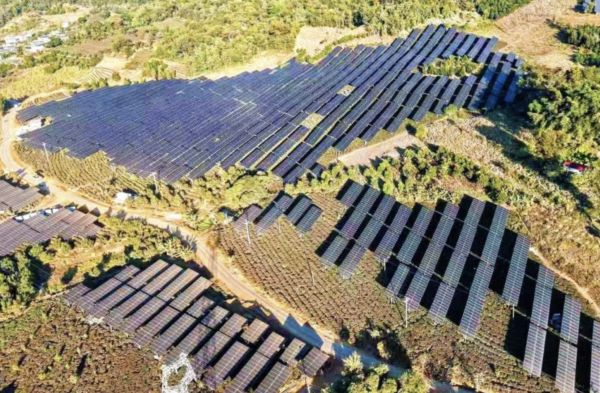
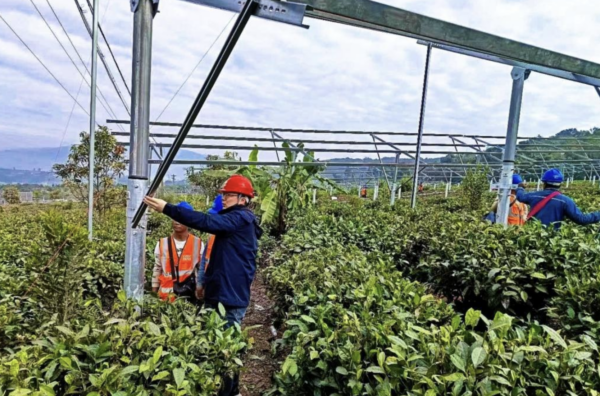
CHN Energy, via its subsidiary Guohua Energy Investment, is constructing a solar project above a tea plantation in southwestern China, with the first 32 MW now connected to the grid. 

China's state-owned CHN Energy has switched on the first 32 MW of an agrivoltaic project constructed among tea terraces.

Located at the Mengsheng Farm in Cangyuan County within the Yunnan province of southwestern China, the project spans an over 666,000 m2 area across a tea plantation. The solar arrays are mounted uniformly at a height of 2.5 meters, allowing mechanized farming to continue underneath.

Construction began in August, with Guohua Energy Investment, a subsidiary of CHN Energy, leading investment and development. Once fully operational, the solar project is expected to feed back approximately 85,000 TWh of energy annually to the local power grid.

Project staff installing solar panels.

Image: CHN Energy

A statement on CHN Energy’s website says the integrated solar-plus-tea plantation model creates a positive micro-cycle system in which the solar panels provide moderate shade that helps improve tea quality, while maintenance of the tea plantation offers environmental protection for the solar array.

The statement adds that the project is also increasing local residents income through land lease payments, direct employment opportunities and skills training.

  •  

UAE’s massive solar-plus-storage project set to redefine baseload power, says Wood Mackenzie

Wood Mackenzie highlights a groundbreaking 5.2 GW solar-plus-storage project in the UAE capable of delivering 1 GW of continuous baseload power, signaling a potential shift in renewable energy deployment despite high costs. The report also forecasts strong global solar growth through 2030, including the rise of residential “balcony solar” in the U.S. and expanded solar shares in Asia Pacific and the U.S.

Wood Mackenzie has said it that a massive solar-plus-storage project currently under construction in the UAE will “redefine baseload power.”

The prediction is one of three Wood Mackenzie has published as part of its “Global solar: Key things to look for in 2026” report.

The 5.2 GW solar plus 19 GWh battery energy storage project, under development by Masdar and Emirates Water and Electricity Company (EWEC), which broke ground in October, is the world’s first first gigawatt-scale renewable project engineered to deliver 1 GW of continuous, around-the-clock baseload power.

Michelle Davis, global head of solar for Wood Mackenzie, said the project represents a structural shift in hybrid project development in the region.

Davis noted that while the project is currently too expensive to replicate broadly, at roughly six times the cost of a new gas-fired combined-cycle gas turbine plant, successful project execution and continued cost declines could redefine baseload power.

“Despite the challenging events of 2025, solar market fundamentals and demand will remain strong in 2026, especially as the global economy continues to electrify,” Davis concluded.

The report also forecasts solar to play a major role in meeting the electricity load growth anticipated over the next decade in several regions of the globe.

Annual solar generation, including distributed solar, is expected to grow by 232 GWh, of 65%, in the U.S. between 2026 and 2030, according to Wood Mackenzie’s analysis. This will bring solar closer to gas, which makes up the largest share of electricity generation in the U.S., which is expected to grow by 340 GWh, or 21%, over the next four years.

In the Asia Pacific, solar made up 11% of the power generation mix in 2025 and is forecast to grow to 17% by 2030. Wood Mackenzie expects solar, wind and storage to make up a third of the power generation mix in the region by the end of the decade, having accounted for less than 10% in 2020. The analysis say new power capacity in the region is overwhelmingly directed towards solar due to price competitiveness.

Wood Mackenzie’s final prediction for 2026 is that balcony solar, or plug-in-solar, will begin to take a foothold in the US this year, while continuing its market penetration in Europe.

The market research company explains that prior to early 2025, there was no market for balcony solar in the U.S.. Utah became the first state to enable residential customers to utilize portable solar generation devices that produce up to 1.2 kW of power without the need for a utility interconnection agreement last March, with more than a dozen states introducing similar legislation since.

Wood Mackenzie expects this number to continue growing but also warned that key challenges lie in fragmented electrical standards, lower voltage in U.S. homes, and a larger share of single-family homes without balconies.


  •  

Solar generates record 13% of EU electricity in 2025

EU solar generation increased by over 20% for the fourth year running in 2025, with its share in the energy mix surpassing coal and hydro. For the first time in history, solar and wind generated more energy in the EU than fossil fuels.

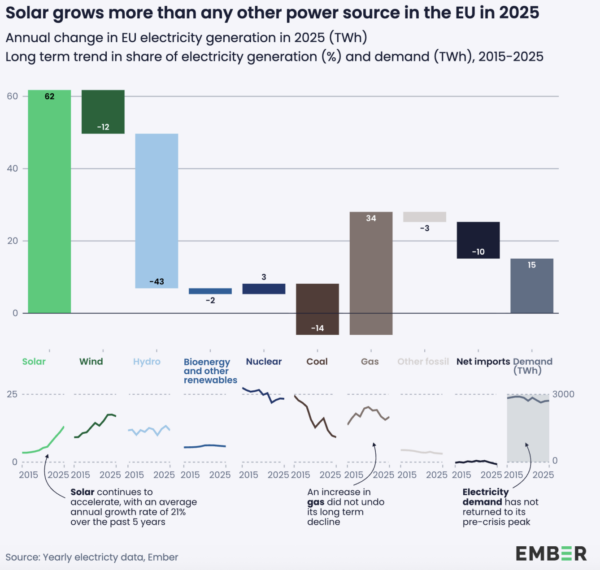
Solar generated a record 369 TWh of energy across the EU in 2025, according to the European Electricity Review published by energy think tank Ember.

The result is an increase of 62 TWh on 2024 and more than doubles the 145 TWh generated in 2020. Ember says solar energy has grown at an average annual growth in generation of 21% over the past five years, a rate far beyond any other energy source.

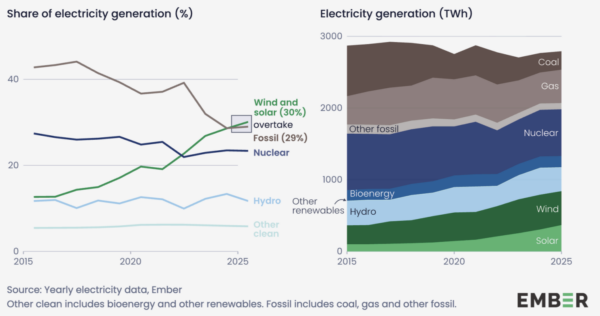
This growth trajectory, buoyed by an added 65.1 GW of solar in the EU last year, led solar to generate a record 13% of the bloc's power in 2025, moving ahead of coal and hydro. Every EU country saw growth in solar generation increase year-on-year last year, led by Hungary with a 28% contribution to its power mix. In Cyprus, Greece, Spain and the Netherlands, solar’s share in the electricity mix was also over 20%. 

For the first time in history, solar and wind energy generated more EU electricity than fossil fuels in 2025, together responsible for a record 30% of EU power ahead of fossil fuels’ 29%. Solar and wind generated more electricity than all fossil sources in 14 of the EU’s 27 member states.

Report author Beatrice Petrovich said the milestone shows just how rapidly the EU is moving towards a power system backed by wind and solar. “As fossil fuel dependencies feed instability on the global stage, the stakes of transitioning to clean energy are clearer than ever,” Petrovich said.

In 2025, 19 EU countries recorded at least one hour when wind and solar combined accounted for over 70% of the country's hourly power generation, compared to only two countries in 2020. Ember found wind and solar supplied more than half of electricity generation during at least one third of all hours in Denmark, Estonia, Germany, Greece, Lithuania, Luxembourg, the Netherlands, Portugal and Spain. 

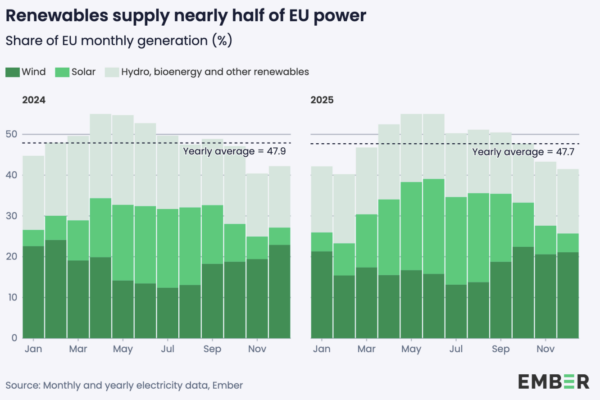
Ember’s report adds that all renewable sources, comprising solar, wind, hydro, bioenergy and other renewables, generated a total 1,331 TWh of energy in the EU last year for a 47.7% share of the total mix, 0.2% down on the year prior. The report says the share remained stable as the weather conditions that caused a drop in wind and hydro output boosted solar generation.

While gas generation rose by 8% compared to 2024, pushing the EU power sector’s gas import bill up to €32 billion, coal power fell to a historic low of 9.2%, with 19 EU countries now generating less than 5% of their energy from coal.

As solar and wind energy becomes the backbone of Europe’s power system, Ember’s report says electricity storage, together with grid enhancements and demand flexibility, will be crucial to put increasingly abundant renewable power to use and displace imported fossil power.

Among a series of recommendations listed in the report is removing barriers to battery deployment in national legislation, EU member states collaboration on permitting for key cross-border power lines, supporting investment in heat pumps and other electric technologies, introducing policy for electrifying transport, heating, and industry via the forthcoming Electrification Action Plan and delivering legislation to ban Russian gap and LNG imports by 2027.

  •  

Self-assembling molecule for organic solar cells

A research team from Osaka Metropolitan University have developed a donor-acceptor-donor molecule that can spontaneously self-assemble into nanoscale structures and offer a more stable route to built-in p/n heterojunctions in organic solar cells.

Scientists from Osaka Metropolitan University have developed a molecular architecture offering a new design strategy toward producing more efficient organic thin-film solar cells.

Their donor-acceptor-donor (DAD) molecule, known as TISQ, integrates a squaraine-based p-type segment and a naphthalene diimide n-type segment within a single molecule. It is capable of naturally forming p/n junctions, otherwise known as the interface between p-type and n-type semiconductors.

The two segments link via amide groups that promote hydrogen bonding, meaning TISQ can spontaneously self-assemble into distinct nanoscale structures, which the scientists believe could offer a more stable route to built-in p/n heterojunctions.

Takeshi Maeda, Associate Professor at the university's Graduate School of Engineering and lead author of the study, explained that depending on the solvent, TISQ can spontaneously organize into nanoparticle-like J-type or nanofiber-like H-type aggregates.

The university’s news release explains polar solvents cause TISQ to form nanoparticle-like J-type aggregates through a cooperative nucleation–elongation process, while low-polarity solvents see it assemble into fibrous H-type aggregates via an isodesmic mechanism. “Both show different electronic behaviors, especially in how efficiently they transport charges when light hits them,” Maeda said.

The team’s research fabricated organic thin-film solar cells incorporating TISQ as a single-component photoactive material in a test of device applicability. The molecule was shown to form nanoscale p/n heterojunctions through self-assembly, which the scientists say highlights the feasibility of molecular designs that autonomously organize into functional electronic structures.

With the power conversion efficiency of the fabricated cells remaining low, the team acknowledged further research is required before it is practically applied. Nevertheless, they concluded that their findings demonstrate how differences in self-assembled nanoscale p/n heterojunction structures directly influence the photocurrent response in a single-component system.

“Our focus is on developing molecular design strategies that use self-assembly to connect nanoscale p/n heterojunction structures with photoelectronic responses in single-component organic systems,” Maeda said. “By deepening this structure–function understanding, we aim to broaden the design space of organic thin-film solar cells and related optoelectronic materials.”

The new molecule is described in the research paper “Solvent-Controlled Supramolecular Polymerization and Morphology-Depended Photoconductivity Modulation in a Squaraine-Naphthalene Diimide-Squaraine Bulk p/n Heterojunction,” available in the journal Angewandte Chemie International Edition.

  •  

US, Europe on track for 2030 solar goals despite pipeline gaps

A report from McKinsey and Company says the relative ease of building out solar projects means the U.S and Europe are likely to meet their end-of-decade deployment targets, despite current pipeline gaps of around 205 GW and 181 GW.

The US and Europe are likely to meet their 2030 solar targets despite current project pipelines being smaller than their end-of-decade targets, according to a report from global management consulting firm McKinsey and Company.

McKinsey’s “Tracking the energy transition: where are we now?” report analyzes the pathway of solar, wind and battery energy storage system (BESS) technologies towards the 2030 deployment targets set by China, the United States and the EU-27, Norway, Switzerland and the UK in Europe.

It says the US is currently around 254 GW away from its 2030 target while Europe is around 275 GW away. In contrast, China has already more than doubled its 2030 target.

Despite the US and Europe currently lacking enough announced capacity to meet their 2030s targets, by around 205 GW and 181 GW respectively, McKinsey's analysis says they are still likely to find this additional capacity and reach their end-of-decade thresholds thanks to the ease of building out solar.

“While it is easier to track project build-out for other clean energy technologies, data visibility for solar is more limited due to individual household use and ease of build-out,” McKinsey’s report explains. “For example, a consumer can install household solar in two months. This means that the announced capacity may be underestimated in this analysis.”

Diego Hernandez Diaz, a partner at McKinsey, told pv magazine that while core markets will continue their build out, further demand growth will also occur in less saturated core markets such as Poland. “The advantage of some of these elements is that the more nascent markets can have a better economic trade off and can be built in an economically pragmatic way,” he explained.

The report does acknowledge that this growth trajectory is not guaranteed, citing supply chain risks, tariffs, shifting policy focus and growing political uncertainty as factors that can slow down progress. Hernandez Diaz added there will likely be an effect from shifting regulation across the board.

“Perhaps more importantly, however, is that beyond any regulation, what we continue to see is that if the underlying economics work, then deployment accelerates,” he stated. “All major geographies covered in the report have the underlying fundamentals to support accretive deployment of further renewable energy sources.”

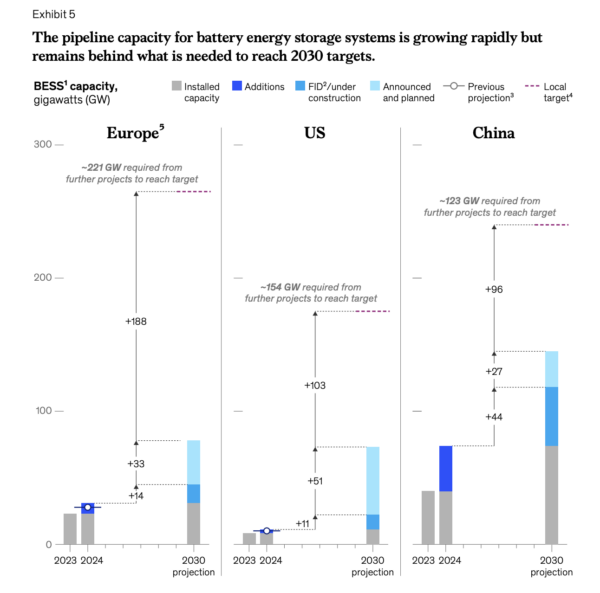
The report also notes that the battery energy storage system (BESS) pipeline is growing rapidly across China, the US and Europe, but remains behind what is needed to meet 2030 targets. McKinsey estimates around an additional 123 GW is required in China, 154 GW in the US and 221 GW in Europe.

The analysts says BESS remains the dominant question mark but can be sited, permitted, constructed, and interconnected far faster than technologies such as nuclear or gas with carbon, capture, utilization and storage (CCUS) contributing to its rapid growth in recent years.

The report attributes the rapid acceleration of BESS installation to a positive business case for both large-scale operators and households when paired with solar. “Load balancing is also becoming a popular source of revenue for battery operators,” the report adds. “Planning and integrating BESS with renewable rollout is critical if 2030 net-zero targets are to be met.”

  •  

Austria’s Andritz to supply South Korean 500 MW pumped storage power plant

Austrian engineering group Andritz has signed a deal to supply the pump turbine units for a 500 MW pumped storage plant in South Korea, the country’s first new pumped storage project in over a decade.

From ESS News

Austrian technology group Andritz has been selected by South Korean industrial company Doosan Enerbility to supply its turbine units for the Yeongdong pumped storage plant.

The 500 MW Yeongdong project, to be built in South Korea’s southwestern province of Chungcheong, is a collaboration between Doosan Enerbility and the country’s largest electric power company, Korea Hydro & Nuclear Power (KHNP). It marks the first large-scale pumped storage project initiated by KHNP since 2011.

According to local press reports, a groundbreaking ceremony for the project took place last April. At the time, it was announced the plant would be built on a 1.18 million square meter site, with project costs in excess of KRW 503 billion ($343 million).

Andritz will be responsible for the design of two pump turbine units, motor-generators and related auxiliaries and supply of key components of the pump turbines and motor-generators, as well as it digital control system, turbine governors and protection systems. The company will also provide installation supervision and commission services.

To continue reading, please visit our ESS News website.

  •