Reading view

Key takeaways from Solar Flex Prague

Czechia’s first international conference on solar and flexibility highlighted that the combination of solar with storage and flexibility sources is key to not just Czechia’s, but also Europe’s, secure and competitive electricity system.

Solar Flex Prague, jointly organised by SolarPower Europe, Solární Asociace and Asociace AKU-BAT CZ, welcomed visitors to a snowy Czech capital on Thursday (29 January), bringing together stakeholders from across Europe to discuss how flexibility solutions and storage can be further deployed.

The conference began with a speech from SolarPower Europe CEO, Walburga Hemetsberger, who said that while electrification is a lifeline for Europe, there is dwindling confidence in the energy transition among some politicians, some leading businesses and key players in the defence sector.

“The way out of the doubts is to really bank big time on flexibility, on storage and on electrification. This will show very concrete benefits very quickly, make politicians understand and really feel the benefits,” Hemetsberger told attendees, before adding that the combination of solar with storage and flexibility sources can lower energy system costs by €30 billion by 2030, while strengthening Europe’s security by removing dependency on foreign players. 

Paula Dorado represented the European Commission via video call and told attendees work on an electrification action plan is underway, scheduled for adoption this year. The plan is expected to address barriers and provide a way forward on electrification for different sectors including companies, households and industrial processes, Dorado said.

Throughout the day, speakers were in agreement that storage and flexibility now play an integral role in Czechia’s electricity system. Panellists pointed out that solar-plus-storage projects can be implemented in a matter of months, offering companies the ability to save money or open new revenue streams. Other speakers stressed the idea that renewable sources are uncontrollable is now outdated, explaining that modern solar-plus-storage systems are not only manageable, offering the ability to respond to market prices and the needs of both transmission and distribution system operators, but are shifting from grid-following to grid-forming technologies and contribute to the stability of the electricity system.

Czechia appears ahead of the curve when it comes to deploying co-located storage with smaller-scale solar, with figures published by Czechia’s largest electricity distributor, ČEZ Distribuce, last September sharing 86% of solar plants connected during the first half of 2025 were equipped with energy storage. In contrast, the country’s large-scale solar market sits at a pivotal moment following the implementation of a legal framework for large-scale development and operation last year. During an afternoon session on opportunities and challenges related to storage and the grid, Rene Nedela from Czechia’s Ministry of Industry and Trade said up to 180 GW of BESS applications have been registered, although some are without any project readiness.

Several speakers advised Czechia to look to other countries further down the line of large-scale battery deployment, and in particular its neighbour Germany, whose favourable market environment for batteries has helped attract investors and move flexibility efforts forwards.

Attendees also said flexible solar-plus-storage projects could help to solve any power shortages that arise from the gradual shutdown of coal-fired power plants in Czechia. The Czech government has committed to phasing out coal-fired electricity generation by 2033 and the country’s last deep black coal mine shut down last month.

During the afternoon session, Alexandr Cerny from Czechia’s Energy Regulatory Office introduced proposed changes to Czechia’s energy tariffs, expected to come into force from the start of next year. The changes will restructure current tariff categories, particularly at the higher voltage levels, and are in part designed to reward flexibility in both consumption and generation, holding the potential to help ramp up the deployment of batteries while better integrating renewables to the grid.

Solar Flex Prague was SolarPower Europe’s second conference on flexibility following the inaugural Solar Flex Croatia held last March. A second edition of Solar Flex Croatia will take place in Zagreb on March 17 this year and Hemetsberger told pv magazine work is currently underway preparing the first Solar Flex Italy for later this year.

  •  

Data center survey reveals majority believe renewables and BESS are the ideal energy mix, power issues start in 2027

54% of respondents cited “energy availability and redundancy” as the single greatest obstacle to successful data center development between now and 2030.

From ESS News

aw firm Foley & Lardner LLP released today its 2026 Data Center Development Report, focusing on the growth and challenges in the data center boom that aims to sustain the growth in AI and LLM usage.

A major focus was on energy, with 54% of respondents citing “energy availability and redundancy” as the single greatest obstacle to successful data center development between now and 2030.

Want to learn more about matching renewables with data center demand?

Join us on April 22 for the 3rd SunRise Arabia Clean Energy Conference in Riyadh.

The event will spotlight how solar and energy storage solutions are driving sustainable and reliable infrastructure, with a particular focus on powering the country’s rapidly growing data center sector.

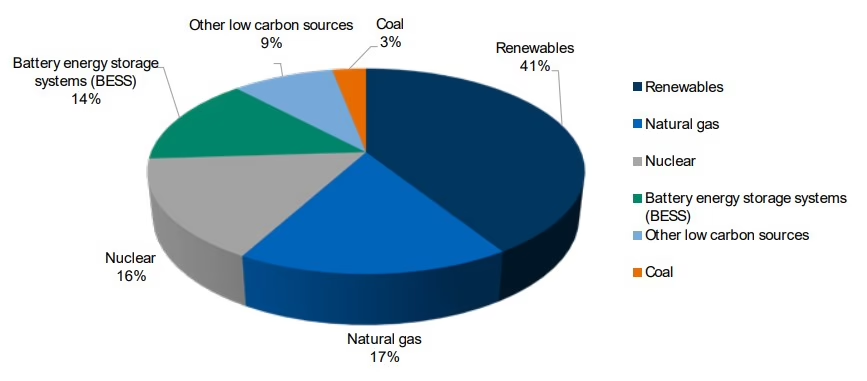
In terms of the right energy mix for data centers, 55% of respondents agreeing that the ideal energy mix to meet the growing power demand of data centers is largely renewables (41%), followed by natural gas (17%), nuclear (16%), and BESS (14%).

Nearly half (48%) of industry participants named advances in energy efficiency (which often includes storage optimization) as the greatest opportunity for development through the end of the decade, and nearly three in four respondents (74%) said advanced energy storage systems like batteries, hybrid solutions, and microgrids are the best way to ensure energy resilience.

Only 14% of developers are actually pursuing modular and small modular nuclear reactors as a viable energy opportunity.

Intriguingly, 63% anticipate a “strategic correction” in the market by 2030, driven by the intense competition for power, with one unnamed banking executive in the report saying, “Once power runs out in 2027 or 2028, that’s where we think deal flow will start to slow down.”

105 U.S.-based respondents were qualified to participate in the survey, including those who had direct experience in data center development, energy procurement, technology delivery, or operations within the past 24 months.

Energy analyst firm Wood Mackenzie identified data centers as one of the five trends to look for in 2026 for global energy storage, and within the past week, a battery storage project decided to give up a grid-connection to a data center and re-tool the batteries, earning revenue without being connected.

What they said:

Daniel Farris, partner and co-lead of Foley’s data center and digital infrastructure team: “There is a Gold Rush mentality right now around securing power. That’s a big part of why people feel there’s a bubble,” said “There’s going to a period in the next two to three years where power at necessary levels is going to be really hard to come by.”

Rachel Conrad, senior counsel and co-lead of Foley’s data center and digital infrastructure team: “Over the next five to 10 years, power providers will need to either grow capacity or increase efficiency to meet the demand fueled by data centers.”

  •  

Europe contracts nearly 24 GWh of BESS under flexibility purchase agreements in 2025

With conventional renewable PPA momentum slowing, Europe’s flexibility market soared in 2025, driven by a surge in fixed-offtake agreements and BESS optimization structures. At the same time, co-located storage gained unprecedented traction, signaling a shift toward more integrated and flexible energy solutions.

From ESS News

In a record-breaking year for flexibility in Europe, nearly 12 GW/24 GWh of BESS capacity was contracted under flexibility purchase agreements (FPAs) and optimization agreements, triple the volume recorded in 2024, according to Pexapark’s Renewables Market Outlook 2026. FPAs have emerged as the backbone of BESS bankability, unlocking infrastructure-style capital and enabling rapid expansion beyond Great Britain into Germany, Italy, and the Netherlands.

Contract innovation accelerated, with tolls, floors, and financial structures such as day-ahead swaps becoming mainstream, while new buyer profiles – including traders, insurers, and hedge funds – entered the flexibility market. By contrast, traditional European PPA momentum cooled in 2025 as markets adjusted to lower capture expectations. Total disclosed contracted PPA capacity fell to 13.1 GW across 247 deals, down from 15.3 GW in 2024.

To continue reading, please visit our ESS News website. 

  •  

Solar-plus-storage for data centers: not a simple switch

Renewables and storage could reliably power data centers, but success requires active grids, coordinated planning, and the right mix of technologies. Hitachi Energy CTO, Gerhard Salge, tells pv magazine that holistic approaches ensure technical feasibility, economic viability, and energy system resilience.

As data centers grow in size and complexity, supplying them with cheap and reliable power has never been more pressing. Gerhard Salge, chief technology officer (CTO) at Hitachi Energy, a unit of Japanese conglomerate Hitachi, shed light on the relationship between renewable energy and data center operations, noting that while technically feasible, success requires careful planning, the right infrastructure, and a holistic approach.

“When we look at what's happening in the grids, then renewables are an active element on the power generation side, and the data centers are an active element on the demand side,” Salge told pv magazine. “What you need in addition to that is in the dimensions of flexibility, for which we need storage and a grid that can actively act also here in order to bring all these elements together.”

Want to learn more about matching renewables with data center demand?

Join us on April 22 for the 3rd SunRise Arabia Clean Energy Conference in Riyadh.

The event will spotlight how solar and energy storage solutions are driving sustainable and reliable infrastructure, with a particular focus on powering the country’s rapidly growing data center sector.

According to Salge, the key is active grids, not passive systems that simply react to conditions. With more renewables, changing demand patterns, new load centers, and storage options like batteries and existing facilities such as pumped hydro, it is crucial to coordinate these resources actively to maintain supply security, power quality, and cost optimization.

“But when you talk about the impact and the correlation between renewables and data centers, you need always to consider this full scope of the flexibility in a power system of all the elements—demand side, generation side, storage side, and the active grid in between,” he said, noting that weak or congested grids would not serve this purpose.

AI data centers

Salge warned that not all data centers are the same. “There are conventional data centers and AI data centers,” he said. “Conventional data centers are essentially high-load systems with some fluctuations on top. They contain many processors handling requests—from search engines or other applications—so the workload is distributed stochastically across them. This creates a baseline load with random ups and downs, which is the typical load pattern of a conventional data center.”

AI workloads, in contrast, rely heavily on GPUs or AI accelerators, which consume significant power continuously. Unlike conventional data centers, AI data centers often run at sustained high load, sometimes close to maximum capacity for long periods.

Htitachi Energy CTO Gerhard Salge

Image: Hitachi Energy

“AI data centers are specifically good in doing parallel computing,” Salge explained. “So many of them are triggered with the same demand pattern at the same time, which creates these spikes up and down in the demand profile, and they come in parallel all together.”

These fluctuations challenge both the power supply and the voltage and frequency quality of the connected grid. “So, you need to transport active power from an energy storage system or a supercapacitor to the demand of the AI data center. And that then needs to involve really the control of the data center’s active power. What you need is the interaction between the storage unit and then the AI data center to provide active power or to absorb it afterwards when the peak goes down. That can be also done by a supercapacitor.”

Batteries can store much more energy than supercapacitors, but the latter can ramp smaller energies more frequently. “However, if you put a battery that is smaller than the load, and you really need to cycle the battery through its full capacity, the battery will not survive very long with your data center, because the frequency of these bursts is so high, then you are aging the battery very, very quickly, yeah, so supercapacitors can do more cycles,” Salge emphasized.

He also noted that batteries and supercapacitors are both mature technologies, but the optimal setup—whether one, the other, or a combination with traditional capacitors—depends on storage size, number of racks, voltage levels, and overall system design.

Managing AI training bursts

Salge stressed the importance of complying with grid codes across geographies. “You need to become a good citizen to the power system,” he said. “You have to collaborate with local utilities to make sure that you are not infringing the grid codes and you are not disturbing with the data center back into the grid. A good way to do this, when renewables and data centers are co-located, is to manage renewable energy supply already inside the data center territory. Moreover, having a future-fit developed grid is a clear advantage. Because you have much more of these flexibility elements and the active elements to manage storage and renewable integration and to manage the dynamic loads of the data centers.”

If the grid is not future-fit with modern, actively operating equipment, operators will see significantly more stress. “With holistic planning, instead, you can even use some of the data center flexibility as a controllable and demand response kind of feature,” Salge said, adding that data center operators could coordinate AI training bursts to periods when the power system has more available capacity. This makes the data center a predictable, controllable demand, stressing the grid only when it is prepared.

“In conclusion, regarding technical feasibility: yes, it’s possible, but it requires the right configuration,” Salge said.

Economic feasibility

On economics, Salge believes solar and wind remain the cheapest power sources, even when accounting for the grid flexibility needed to integrate them with data centers. Solar is fastest to deploy, wind complements it well, and both can be scaled in parallel.

“Any increase in data center demand requires investment, whether from renewables or conventional power. Economics depend on the market, and market mechanisms, regulations, and technical grid planning are interconnected, influencing energy flow, pricing, and system stability,” he said.

“We recommend developers to work with all stakeholders—utilities, technology providers, and planners—from the start to ensure reliability, affordability, and social acceptance. Holistic planning avoids reactive fixes and leads to better long-term outcomes,” Salge concluded.

  •  

Bulgaria installs 1.4 GW of solar in 2025

Bulgaria installed over 1 GW of solar for the third consecutive year in 2025 and is forecast to add over 2 GW this year thanks to a large pipeline of utility-scale projects.

Bulgaria added 1,416 MW of solar last year, according to official data published on the ENTSO-E Transparency Platform. The result marks the third consecutive year Bulgaria has deployed over 1 GW of solar and takes the country’s cumulative capacity to 5,984 MW.

Desislava Mateva, project manager at the Sofia-based Association for Production, Storage and Trading of Electricity (APSTE) told pv magazine that Bulgaria’s solar market is currently dominated by ground-mounted, utility-scale solar plants, reflecting the availability of land, strong developer activity and increasing access to project finance.

Utility-scale solar made up around 90% of Bulgaria’s new capacity last year. Mateva said the market was driven by the strong commercial competitiveness of solar, making projects viable without direct subsidies, as well as active support from local and international banks and a large pipeline of development projects that reached the ready-to-build stage or financial close over the past 18 months.

Mateva also noted that Bulgaria is experiencing a wave of standalone battery energy storage system (BESS) deployments and the hybridization of both existing and new solar assets with BESS, as developers look to deal with price cannibalization and declining solar capture rates.

“These developments are expected to reduce price volatility, improve system flexibility, and mitigate capture-price pressure for solar producers,” she explained. “As a result, industry expectations remain positive.”

Among the largest projects to be commissioned in Bulgaria last year was the first phase of the 315 MW/760 MWh Tenevo hybrid project, with a second phase scheduled for commissioning early this year, and the Selanovtsi hybrid project, a 59.8 MW solar plus 107.3 MWh storage site in the northwestern Vratsa region. Bulgaria also commissioned one of the EU's largest standalone BESS facilities last year, located adjacent to a 107 MW solar park.

Bulgaria’s C&I solar market is showing steady momentum, particularly among projects designed for self-consumption, Mateva added, with rising electricity costs incentivizing businesses to invest in on-site solar, often in combination with storage. 

In contrast, Bulgaria’s residential solar sector remains underdeveloped in capacity terms. Mateva said interest among households exists but the market segment has been constrained by regulatory complexity and limited incentives.

She added that the residential sector would benefit from the full liberalization of Bulgaria’s electricity market, as currently household electricity prices remain regulated, accounting for roughly 40% of national electricity demand. “Full liberalization would stimulate demand-side participation and unlock the residential solar and storage market,” she explained.

Looking ahead, Mateva predicted Bulgaria is on course for a record year in solar deployment in 2026. “An estimated 2.5 GW of additional solar projects are either under construction or at an advanced stage of development and expected to start construction soon,” she said. “This pipeline suggests that most of this capacity will be commissioned by the end of 2026.”

Bulgaria’s storage pipeline is looking equally healthy, with 15 GWh expected to be commissioned by half way through the year, supported by the country’s National Recovery and Resilience Plan.

Mateva added that the most significant policy change last year was a sharp increase in eco-taxes and recycling fees for solar panels and batteries. She explained that these fees are currently five to ten times higher than in comparable EU countries, in turn artificially inflating PV and BESS project costs.

“Unless addressed, this issue risks becoming a major bottleneck for new PV and BESS procurement,” Mateva told pv magazine. “Resolving this will require action from the Ministry of Ecology to align recycling fees with real-world costs and EU norms, ensuring that Bulgaria’s strong solar momentum is not undermined by avoidable regulatory distortions.”

Bulgaria opened a new grant program late last year targeting micro, small and medium-sized enterprises looking to deploy PV systems and storage, with a particular focus on those located in the country’s coal regions. The call is set to close next month.

  •  

Bhutan to develop new solar, hydropower projects

Bhutan’s Druk Green Power Corporation and India’s Carbon Resources Private Limited have agreed to collaborate on new solar and hydropower projects in Bhutan with capacities between 100 MW and 250 MW.

Bhutan’s leading renewables company Druk Green Power Corporation (DGPC) has signed a memorandum of understanding with Kolkata-based Carbon Resources Private Limited (CPRL) to jointly pursue renewable energy projects.

Under the terms of the partnership, DGPC and CPRL will collaborate on developing new solar and hydropower projects in Bhutan with capacities ranging between 100 MW and 250 MW.

DGPC will be responsible for sharing project information, past studies and regulatory frameworks to assist CRPL in undertaking required technical, commercial and financial assessments of potential projects.

Identified sites will then be developed through one or more special purpose vehicles incorporated in Bhutan as joint ventures between the two parties. The memorandum of understanding proposes a debt-equity financing structure of 70:30 between DGPC and CPRL.

The signing ceremony was attended by Bhutan’s Minister for Energy and Natural Resources, Lyonpo Gem Tshering, who said memorandums of understanding for more than 12 GW of generation capacity have been signed in the country to date.

Bhutan has a target of reaching 25 GW of installed generation capacity by 2040. A World Bank report published last June reported the country’s total generation capacity stood at 2.5 GW by the end of 2024, made up almost entirely of hydropower plants.

Bhutan’s first utility-scale solar plant, a 17.38 MW array located towards the centre of the country, was commissioned last July. A month later, a consortium consisting of local firm Rigsar Construction and India’s HILD Energy was awarded a contract to develop the 120 MW Jamjee solar project.

In December, DGPC opened a tender for the 120 MW Wobthang solar project. The project’s feasibility study and consultation meetings have since been completed, with DGPC planning to award the contract by June. The project is scheduled to begin construction this September and with the build expected to take around 18 months, is pencilled for operations during the first half of 2028.

Bhutan’s current national energy policy, published last year, aims to add 5 GW of solar capacity by 2040.

  •  

China added 66.43 GW of new-type energy storage in 2025

CNESA says China’s non-pumped storage technologies hit 144.7 GW in 2025, with 66.43 GW added.

From ESS News

China’s cumulative power-sector energy storage capacity reached 213.3 GW by the end of 2025, up 54% year on year, according to data from the China Energy Storage Alliance (CNESA). Pumped hydro accounted for 31.3% of the total, while “new-type” energy storage made up 67.9% – around 144.7 GW.

Based on CNESA DataLink 2025 annual energy storage dataset, presented at a press conference in Beijing on Jan. 22, a total of 66.43 GW/189.48 GWh of new-type energy storage systems were commissioned in 2025.

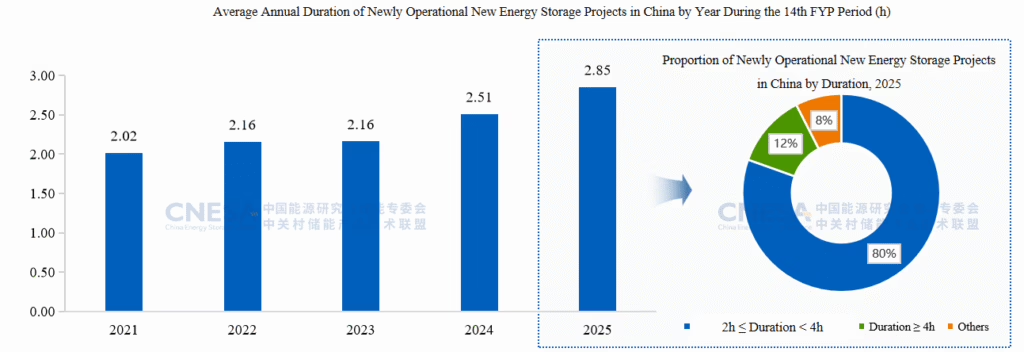
The added power and energy scales increased 52% and 73% year on year, respectively, which CNESA linked to a continued shift toward longer-duration configurations, it reported the average duration rising to 2.58 hours in 2025 (from 2.11 hours in 2021).

CNESA said the leading application scenario has shifted toward standalone energy storage, which accounted for 58%, while user-side storage fell to 8% and thermal-plus-storage frequency regulation to 1.4%; “renewables-paired storage” was described as stable.

Geographically, CNESA reported that the top 10 provinces each exceeded 5 GWh of newly commissioned capacity and together represented about 90% of additions. Inner Mongolia ranked first by both power and energy capacity, and Yunnan entered the top 10 for the first time.

Lithium iron phosphate (LFP) batteries continued to dominate, with CNESA reporting over 98% of new-type installed capacity. CNESA also noted emerging deployments of sodium-ion, vanadium flow, compressed air, gravity storage, and hybrid systems, separately citing a 40 MW/40 MWh grid-forming sodium-ion project in Wenshan, Yunnan as an example.

On procurement, CNESA reported 690 energy storage system tenders (excluding centralized/framework procurement), down 10.4%, while EPC tenders rose to 1,536, up 4.5%. Winning bid volumes (excluding centralized/framework procurement) reached 121.5 GWh for systems and 206.3 GWh for EPC.

CNESA’s tender-price analysis for LFP systems (excluding user-side applications) reported a 2025 winning bid price range of CNY 391.14/kWh ($55/kWh) to CNY 913.00/kWh ($128/kWh). For EPC (excluding user-side), CNESA reported average winning bid prices of CNY 1,043.82/kWh ($146/kWh) for 2-hour projects and CNY 935.40/kWh ($131/kWh) for 4-hour projects.

CNESA also launched a policy “map” for standalone storage market mechanisms covering 21 provinces.

  •  

The Hydrogen Stream: Repsol, Sunfire advance 200 MW of green H2 in Spain

Repsol and Sunfire are advancing 200 MW of renewable hydrogen projects in Spain, while new collaborations and funding across Europe and India aim to accelerate electrolyzer development and hydrogen infrastructure.

Repsol has approved its second 100 MW electrolyzer at the Petronor industrial complex in Bilbao. “The electrolyzer will have the capacity to produce up to 15,000 tons of renewable hydrogen annually, which will mainly be used at the company’s Petronor refinery outside Bilbao in Northern Spain,” said the Spanish oil and gas company, adding that the new plant for producing renewable hydrogen will require an investment of €292 million ($347.9 million). The company did not explain the timing of the installation.

Sunfire said it will supply two 100 MW electrolyzers for renewable hydrogen projects in Spain. The first project, led by Repsol and Enagás Renovable, will install a 100 MW electrolyzer near Repsol’s industrial complex in Cartagena. The second 100 MW plant will be located at Petronor’s refinery in Muskiz (Bilbao), which is owned by Repsol and Kutxabank,” said the German company. For each of the two 100 MW projects, Sunfire will deliver ten of its 10 MW pressurized alkaline electrolyzer modules.

Matteco and Dunia Innovations have kicked off a strategic collaboration to accelerate the development of catalyst layers used inside AEM (Anion Exchange Membrane) electrolyzers. “Matteco contributes deep expertise in electrocatalysts, functional inks, and scalable electrodes, while Dunia brings its AI-guided experimentation platform, which helps test and compare many different material options quickly and consistently, under conditions that reflect how real electrolyzers operate,” said Spain-based Matteco. Dunia Innovations is based in Germany.

The European Commission said it will allocate nearly €650 million in grants to help finance 14 cross-border energy infrastructure projects. More than €176 million will be dedicated to boost hydrogen infrastructure. “The grant of €120 million for the hydrogen storage in Gronau project in Germany marks the first time CEF funding will be used for a works project for hydrogen,” said the European executive body, adding that other hydrogen projects in Austria, Bulgaria, France, Germany, the Netherlands and Slovakia will receive grants to support studies.

Tubos Reunidos (TR) said it is developing a seamless pipe that meets the specific requirements of the hydrogen sector. “The project aims to develop a 1.25 MW experimental portable electrolyzer, conceived as an enabling solution for the supply of green hydrogen to final industrial users,” said Eurometal, the European federation of steel tubes and metals distribution and trading. “The initiative is being led by a Basque consortium including Tubos Reunidos, ArcelorMittal Sestao, Sarralle, ABC Compresores, Matz-Erreka, Flubetech Coatings, Mugape, Sener, Team Group, Torraval Cooling, and Zigor Corporación.”

Deutsche Gesellschaft für Internationale Zusammenarbeit (GIZ) and thyssenkrupp nucera have entered into a new cooperation to accelerate the development of green hydrogen and Power-to-X (PtX) markets in India. “India is one of the most promising future markets for green hydrogen electrolysis. This cooperation enables us to deepen our understanding of the local market and engage more closely with India’s hydrogen ecosystem. It also reflects our strong commitment to supporting India’s ambitious National Green Hydrogen Mission,” said Kiran Paul Joseph, CEO of thyssenkrupp nucera India.

Greenzo Energy India has secured the contract for India’s first port-based 5 MW Green Hydrogen Plant at Deendayal Port, Kandla. The project has been awarded to Oswal Greenzo Energies, the JV between Oswal Energies Limited and Greenzo Energy India Limited. “Designed on an EPC basis, the project is scalable beyond the initial 5 MW up to 10 MW and is expected to produce approximately 800 tonnes of green hydrogen annually,” said Greenzo Energy.

Orlen has entered into cooperation agreements with three Finnish partners for the production and supply of renewable hydrogen and its derivatives. “The agreements signed with ABO Energy Suomi, Nordic Ren-Gas and VolagHy Kuopio SPV will help secure hydrogen supplies during a period of growing demand in the years ahead,” said Orlen.

Powerhouse Energy (PHE) has secured a site on Silverwood Business Park in Ballymena, Northern Ireland, on which the company submitted a planning application for a 40-ton per day (TPD) waste-to hydrogen facility. The site, 1.98 acres, will use a pilot unit.

  •  

TheStorage launches its first industrial-scale sand-based heat storage system

The Finnish start-up says its sand battery technology is scalable from 20 to 500 MWh with charging power from 1 to 20 MW, depending on industrial needs.

From ESS News

Finnish cleantech startup TheStorage says that its thermal storage technology could reduce industrial energy costs by up to 70% and cut carbon emissions by as much as 90%. The system converts renewable electricity into heat, stores it in sand, and delivers it on-demand for industrial heating.

The concept emerged in Finland in 2023, with engineering work beginning in 2024. In January 2026, TheStorage installed its first industrial-scale pilot at a brewery, putting the technology to the test in a real-world setting. There, it produces fossil-free steam for the brewery’s production lines.

“Producing steam without fossil fuels is a major step toward carbon-neutral production,” says Vesa Peltola, Production Director of the brewery.

TheStorage’s technology captures electricity when it is abundant and inexpensive, converts it into high-temperature heat, and stores it in sand. This stored heat can later be used in industrial processes independently of real-time electricity availability.

To continue reading, please visit our ESS News website.

  •  

Cubenergy releases energy storage block for utility, C&I applications

Cubenergy has launched FlexCombo 2.0, a scalable battery energy storage system for utility, commercial, and industrial applications, offering up to 16 MWh capacity with LFP batteries. Its modular design, advanced BMS, and cloud-based operations enable easy installation, seamless expansion, and efficient grid integration, according to the manufacturer.

Cubenergy, a Chinese manufacturer of battery energy storage systems (BESS), has introduced a new energy block designed for utility, commercial, and industrial (C&I) applications.

The product, named FlexCombo 2.0, uses the company’s 835 kWh FlexCombo D2 batteries. It is available in three configurations: 10, 12, or 12 batteries, providing a total capacity of 8 MWh, 10 MWh, or 16 MWh, respectively.

“With the FlexCombo D2 modular design and parallel architecture, FlexCombo’s core advantage lies in its long-term scalability,” the company said in a statement. “It enables seamless capacity growth and effortless integration with power generation systems (PGS), simplifying deployment and accelerating delivery for ultimate flexibility.”

The FlexCombo D2 batteries feature lithium iron phosphate (LFP) chemistry, offering a lifespan of 8,000 cycles at 70% capacity retention, according to the manufacturer.

Each battery measures 2 m x 1.68 m x 2.55 m and has a weight of up to eight tons. They carry an IP55 protection rating. Each block also comes with a power conversion system (PCS) rated at 430 kW AC with an IP66 protection grade. Optional medium-voltage (MV) transformers are available, with AC power ratings of either 8,800 kVA or 5,250 kVA.

“The FlexCombo 2.0 is designed primarily for utility and C&I applications, including renewable energy arbitrage, stand-alone grid stabilization, factories, and commercial buildings,” the company stated. “This integrated, easy-to-install BESS can be quickly connected and aligned with project requirements, while the advanced Active Balancing battery management system (BMS) and cloud-based operations provide a superior user experience.”

  •  

Sweden deploys 652 MW of solar in 2025

Sweden deployed less solar in 2025 than the year prior despite record growth in the large-scale segment. Solar association Svensk Solenergi predicts last year was likely the bottom of Sweden's installation curve.

Sweden commissioned 652 MW of new solar last year, according to estimates from Swedish solar association Svensk Solenergi. The figure is down on the 848 MW installed in 2024 and takes cumulative capacity to around 5.4 GW.

Residential installations totaled 239 MW in 2025, a 39% year-on-year decrease. Alex Jankell, head of politics at Svensk Solenergi, told pv magazine the household market has been impacted by the removal of a tax rebate scheme as of the start of this year. He added that lower energy prices in comparison to massive hikes in 2022, higher interest rates and inflation have also impacted the market segment.

Although the residential market contracted in 2025, installations smaller than 20 kW continue to represent more than half of Sweden’s solar market, with a little over 3 GW of total capacity. There are now just over 287,000 solar power plants of less than 20 kW in Sweden, equivalent to 90% of all grid-connected solar plants.

Cumulative capacity of grid-connected solar plants

Image: Svensk Solenergi

Commercial and industrial installations reached 215 MW in 2025, down 35% year-on-year, but utility-scale installations increased, deploying a record 198 MW for 46% more than in 2024.

The large-scale segment accounted for 30% of new solar power in 2025, compared to 7% in 2024. New installations were led by Sweden’s largest solar plant to date, the 100 MW Hultsfred solar farm, and the 64 MW Ax-el solar park. Last year also saw developer Svea Solar announce plans to build eight new solar parks in Sweden with a total capacity of approximately 500 MW.

Jankell said the market is experiencing a shift to more large-scale solar, often combined with large-scale battery installations, but added that challenges remain in high costs or long waiting times for grid connections. He recommended Sweden adopt proposed changes to permitting procedures to make them quicker and more predictable.

The residential battery market is also broadening, with preliminary figures from the Swedish Tax Agency showing around 75,000 private individuals received a green reduction for battery installations in 2025, a 34% increase on the previous year.

Jankell suggested that Sweden’s solar market could be supported further by abolishing energy tax for all electricity that is produced and consumed behind the same meter and implementing proper power-tariffs which reflectively reward the ability of solar and battery installations to help the grid. He also recommended proposed proper revenue frames for Swedish grid companies that reward flexibility, and not only grid expansion.

Jankell told pv magazine more solar is likely to be installed this year than in 2025. “Given the implementation of solar demands in the Energy Performance of Buildings Directive, new permitting processes on the way, and a general deflation of PV and battery prices, we predict that 2025 is the bottom of the installation curve,” he said.

  •  

Sungrow brings grid-forming PowerTitan 3.0 storage system to Europe

Sungrow is introducing its large-scale energy storage system, PowerTitan 3.0, to Europe, featuring grid-forming capability, next-generation battery cells, DC coupling for co-located solar projects, and streamlined commissioning to accelerate deployment.

Sungrow is introducing its large-scale energy storage system, PowerTitan 3.0, to the European market. With the option to connect the battery to a central inverter on the DC side, the company is responding to strong demand for co-located solar-storage projects. The system was first presented at SNEC in Shanghai in June 2025 and has now been showcased to European developers at an event in Madrid.

The storage system is available in standard 10- and 20-foot container formats. The 20-foot version integrates a 1.78 MW power conversion system (PCS) with a 7.14 MWh battery, providing four hours of storage in a single container. A 30-foot version with roughly 12 MWh, also displayed in China, will not be offered in Europe due to logistics and transport costs, which could reduce project profitability. Larger systems in Europe can be achieved by connecting four units to form an AC block with approximately 7.2 MW of power and 28.5 MWh of capacity.

The higher energy density is enabled by new 648 Ah battery cells, with a volumetric energy density exceeding 440 Wh/L. A full liquid-cooling system and updated software maintain all cells within their optimal temperature range, reducing the system’s own energy consumption by around 10%, according to Sungrow. The company guarantees 10,000 cycles at 60% remaining capacity. State of charge is monitored at the rack level and synchronized across the system.

“We are seeing growing demand for stand-alone projects and a significant increase in co-location projects across Europe,” said Moritz Rolf, VP DACH at Sungrow. The DC coupling option is key to meeting this demand.

Paired with a PV system and Sungrow’s “1+X” central inverter, no separate PCS or medium-voltage switchgear is needed. The company estimates hardware and cabling savings for a 150 MWh project at around €1 million.

When connected on the AC side, the system includes an integrated PCS using silicon carbide MOSFETs. Maximum PCS efficiency is 99.5%, with a round-trip efficiency of 92%.

Fast commissioning

The PowerTitan 3.0 is delivered fully assembled and pre-configured. Commissioning is largely autonomous, taking about one hour per unit. A project can be connected to the grid in approximately 12 days, with no on-site parameterization required.

The system can also serve as an AC power source for plant certification tests. If a grid connection is not yet available, the battery can energize medium-voltage switchgear, inverters, and other equipment, simplifying logistics for commissioning and testing.

“Having completed the first stage of the energy transition—the expansion of renewables and their market integration—we are now entering the next phase: electrification, flexibility, and supply security,” said James Li, VP Europe of Sungrow, during a panel discussion.

Grid-forming capabilities were a central theme of the presentation. The system can provide short-circuit current with a ratio of 1.2, deliver instantaneous reserve power within five milliseconds, and contribute to harmonic attenuation, supporting grid strength and stability.

Antonio Arruebo, battery storage analyst at SolarPower Europe, highlighted the growing importance of these functions. Beyond frequency services, markets for instantaneous reserve, short-circuit current, and black-start capability are emerging across Europe. He stressed the need for early development of corresponding markets at EU and national levels, faster approval and certification processes for storage systems, and reduction of duplicate grid fees.

Key challenges

Discussions with event participants highlighted that, while the European battery storage market is developing positively overall, project financing remains a critical bottleneck. Highly leveraged projects are subject to intensive risk assessments by lenders, particularly regarding the valuation of future revenues from arbitrage and frequency markets. The long-term development of these markets is difficult to predict, directly affecting risk premiums and financing terms. Multi-bank financing structures appear to be becoming increasingly common.

From an investor perspective, the stability of revenue streams and technological risks are central. “The crucial factors are the resilience of the revenues and the likelihood of market mechanisms changing over time,” said Paula Renedo, Principal Engineer Director at Nuveen Infrastructure, during a panel discussion.

For battery storage, the balance between exposure to the stock market and contractually secured revenues is evolving. Creditworthiness of customers and technological reliability are gaining greater importance. “We look closely at proven technologies with robust operational experience, particularly regarding availability and degradation over the system’s lifespan,” Renedo added. Nuveen adopts conservative assumptions and engages external technical consultants to assess and mitigate these risks.

On pricing trends in the battery segment, and the Chinese government’s announcement requiring battery cell manufacturers to adopt “sustainable pricing,” Moritz Rolf noted that comparisons with recent photovoltaic module price trends are limited. PV modules have reached a high degree of commodification, whereas integrated large-scale storage systems involve numerous complex integration steps. As a result, prices equivalent to fractions of a cent per kilowatt, as seen in the module market, are not expected. After-sales service and local support remain critical for developers and operators. Sungrow currently employs around 800 people in Europe.

  •  

Testing fault at 100 MW battery disrupts Estonia-Finland power link

During testing at Estonia’s 100 MW Kiisa battery park, both EstLink 1 and EstLink 2 tripped, triggering the most severe disturbance to the regional power grid since desynchronization from the Russian electricity system. As a result, nearly 1 GW of capacity was lost within seconds. The park’s owner has since publicly pointed to the battery manufacturer.

From ESS News

A disturbance in Estonia’s power system on Jan. 20 forced both EstLink interconnections between Estonia and Finland offline, cutting roughly 1,000 MW of capacity, equivalent to about 20% of the Baltic region’s winter electricity load.

The shortfall was initially covered by support from the continental European grid, as the 500 MW AC connection between Poland and Lithuania operated at double its rated capacity to compensate. Later, reserve capacity within the Baltic states was deployed.

The oscillations were triggered by a 100 MW/200 MWh battery energy storage system in Kiisa, just south of Tallinn, one of the largest battery storage systems in the Baltics. The incident occurred during final grid connection testing, which caused the DC cables to trip.

The €100 million facility, developed by Estonian company Evecon in partnership with French firms Corsica Sole and Mirova, features 54 battery containers supplied by Nidec Conversion.

To continue reading, please visit our ESS News website. 

  •  

Moonwatt brings DC-coupled, passively cooled sodium-ion tech to solar projects

The Dutch start-up, founded by former Tesla leaders, is taking a novel approach to sodium-ion battery technology, optimizing it for integration with solar power plants. Its technology is set to be deployed for the first time in a Dutch solar-plus-storage project later this year.

From ESS News

Amsterdam-based Moonwatt has developed a new type of battery storage system based on sodium-ion NFPP chemistry, purpose-built for seamless solar hybridization. The system integrates battery enclosures with hybrid string inverters, enabling efficient DC-coupled solar-plus-storage integration.

The company gained attention in March 2025 when it raised $8.3 million in seed funding to accelerate growth. Moonwatt operates as an energy storage system integrator, designing, developing, and supplying string battery enclosures, hybrid string inverters, and battery management and site control systems, while sourcing sodium-ion cells globally.

“Initially, we’re sourcing them from Asia, but we aim to add American and European cell sourcing options as soon as they become available and create value for our customers,” Valentin Rota, co-founder and CCO of Moonwatt, said in an earlier interview with ESS News.

To continue reading, please visit our ESS News website.

  •  

The Hydrogen Stream: EU Commission invites offtakers under Hydrogen Mechanism

The European Commission is advancing market matching for renewable and low-carbon hydrogen by inviting European offtakers to signal supply interest under the Hydrogen Mechanism, while Germany’s electrolysis rollout continues to lag official targets despite new EU-backed funding schemes.

The European Commission said it is inviting European offtakers to express interest in supply offers under the Hydrogen Mechanism, adding that the current phase runs until March 20, 2026, under the EU Energy and Raw Materials Platform that links buyers with suppliers of renewable and low-carbon hydrogen and derivatives including ammonia, methanol, eMethane and electro-sustainable aviation fuel, after companies submitted supply offers from more than 260 projects from Nov. 12, 2025, to Jan. 2, 2026, with the European Commission set to outline further details at an online webinar on Jan. 27. Separately, the European Commission has also approved a €200 million ($234.9 million) German plan to support the production of renewable hydrogen and its derivatives in Canada. “The scheme will support the construction of up to 300 MW of electrolysis capacity. The aid will be awarded through a competitive bidding process, planned to be concluded in 2027,” wrote the European executive body.

The Institute of Energy Economics at the University of Cologne (EWI) said Germany’s rollout of electrolysis capacity is progressing far more slowly than planned. The institute said installed electrolyser capacity currently stands at 181 MW, with a further 1.3 GW having reached a final investment decision (FID) or being under construction. On that basis, EWI said total operating capacity could reach up to 1.5 GW by the end of 2027, leaving Germany on course to fall well short of its target of 10 GW of electrolysis capacity by 2030.

BKW plans to take a 40%stake in the planned hydrogen-ready (H2-ready) gas-fired power plant at the Hamm site (North Rhine-Westphalia), Germany. “BKW is developing the project together with the German municipal utility cooperation Trianel,” said the German company. “The location offers ideal conditions: sufficient space, existing grid and gas connections, and a well-developed infrastructure.”

Lhyfe said it expects to increase by 70% its installed renewable hydrogen production capacity in 2026. The French company currently has four renewable hydrogen production sites installed in France and Germany (21 MW). “Lhyfe has been supplying France’s first motorway hydrogen station accessible to heavy goods vehicles, operated by TEAL Mobility, since November 2025”, said the company this week, underlining that the four sites received RFNBO certifications in May and September 2025.

Honda Motor said it has decided to discontinue production, before the end of 2026, of the current model of fuel cell system now produced at Fuel Cell System Manufacturing, a joint venture between Honda and General Motors (GM). “After the discontinuation, Honda will utilize the next-generation fuel-cell system being developed independently by Honda”, said the Japanese company, referring to the joint venture established in January 2017 in Brownstown, Michigan.

  •  

Scientists design low-cost sodium-ion battery with cheap electrode materials

Conceived for stationary energy storage, the proposed sodium-ion battery configuration relies on an P2-type cathode material and an hard carbon anode material that reportedly ensure full-cell performance. Electrochemical testing revealed initial capacities of 200 mAh/g for the cathode and 360 mAh/g for the anode with capacity retentions of 42% and 67.4% after 100 cycles.

An international research team has designed a sodium-ion battery (SIB) storage system based on a P2-type cathode material known as Na0.67Mn0.33Ni0.33Fe0.33O2 and an anode relying on a hard carbon material fabricated from lavender flowers.

The proposed system configuration is intended for low-cost fabrication while ensuring scalability and environmental sustainability, as the two electrode materials are described as “widely accessible” precursors.

“Plant diversity and production capacity are important factors affecting the commercialization of SIBs, as plant-derived hard carbons s are both sustainable and economical,” the researchers explained. “Hard carbon derived from plants preserves the microstructures of the plant tissues, thereby enhancing the penetration of the electrolyte and sodium diffusivity.

The scientists estimated global lavender production at approximately 1,000–1,500 tons annually. However, only a small fraction of this production can be used for electrode materials, as only the flower residue is suitable for conversion into hard carbon.

They also noted that the hard carbon anode and P2-type cathode in the full cell have insufficient sodium reservoirs, leading to poor electrochemical performance. “The present work addresses this gap by evaluating the full-cell performance of P2-Na0.67Mn0.9Ni0.1O2 coupled with lavender flower waste-derived hard carbon under different presodiation approaches,” they further explained.

The scientists used X-ray diffraction (XRD), scanning electron microscopy (SEM), X-ray photoelectron spectroscopy (XPS), Fourier-transform infrared spectroscopy (FTIR), and Raman spectroscopy to characterized the SIB system's cathode and anode and found the cathode has an hexagonal P63/mmc structure, while the anode showed characteristic broad peaks of amorphous carbon.

SEM and TEM revealed, in particular, micrometer-sized cathode grains and a porous hard carbon surface, with EDS and XPS indicated the material has good structural stability. Further analysis also demonstrated that nickel (Ni) incorporation improved the cathode’s structural, electronic, and electrochemical performance.

Moreover, electrochemical testing revealed initial capacities of 200 mAh/g for the cathode and 360 mAh/g for the anode with capacity retentions of 42% and 67.4% after 100 cycles. Overall, Ni doping was found to improve the cathode’s conductivity and stability, and the anode demonstrated good sodium storage performance, supporting strong half-cell and potential full-cell performance, according to the researchers.

“This comprehensive study highlights the potential for developing SIBs with low-cost and sustainable electrode materials,” they concluded. “The optimization of presodiation strategies offers an opportunity for advanced commercial and scalable SIB technologies.”

The system was described in the study “Cost-effective sodium-ion batteries using a Na0.67Mn0.9Ni0.1O2 cathode and lavender-flower-waste-derived hard carbon with a comparative presodiation approach,” published in the Journal of Power Sources. The research team comprised scientists from Turkey's Inonu University, Istanbul Technical University, Malatya Turgut Ozal University and Aksaray University, as well as from Korea Institute of Science and Technology and Pakistan's Quaid-i-Azam University, among others. 

  •  

US, Europe on track for 2030 solar goals despite pipeline gaps

A report from McKinsey and Company says the relative ease of building out solar projects means the U.S and Europe are likely to meet their end-of-decade deployment targets, despite current pipeline gaps of around 205 GW and 181 GW.

The US and Europe are likely to meet their 2030 solar targets despite current project pipelines being smaller than their end-of-decade targets, according to a report from global management consulting firm McKinsey and Company.

McKinsey’s “Tracking the energy transition: where are we now?” report analyzes the pathway of solar, wind and battery energy storage system (BESS) technologies towards the 2030 deployment targets set by China, the United States and the EU-27, Norway, Switzerland and the UK in Europe.

It says the US is currently around 254 GW away from its 2030 target while Europe is around 275 GW away. In contrast, China has already more than doubled its 2030 target.

Despite the US and Europe currently lacking enough announced capacity to meet their 2030s targets, by around 205 GW and 181 GW respectively, McKinsey's analysis says they are still likely to find this additional capacity and reach their end-of-decade thresholds thanks to the ease of building out solar.

“While it is easier to track project build-out for other clean energy technologies, data visibility for solar is more limited due to individual household use and ease of build-out,” McKinsey’s report explains. “For example, a consumer can install household solar in two months. This means that the announced capacity may be underestimated in this analysis.”

Diego Hernandez Diaz, a partner at McKinsey, told pv magazine that while core markets will continue their build out, further demand growth will also occur in less saturated core markets such as Poland. “The advantage of some of these elements is that the more nascent markets can have a better economic trade off and can be built in an economically pragmatic way,” he explained.

The report does acknowledge that this growth trajectory is not guaranteed, citing supply chain risks, tariffs, shifting policy focus and growing political uncertainty as factors that can slow down progress. Hernandez Diaz added there will likely be an effect from shifting regulation across the board.

“Perhaps more importantly, however, is that beyond any regulation, what we continue to see is that if the underlying economics work, then deployment accelerates,” he stated. “All major geographies covered in the report have the underlying fundamentals to support accretive deployment of further renewable energy sources.”

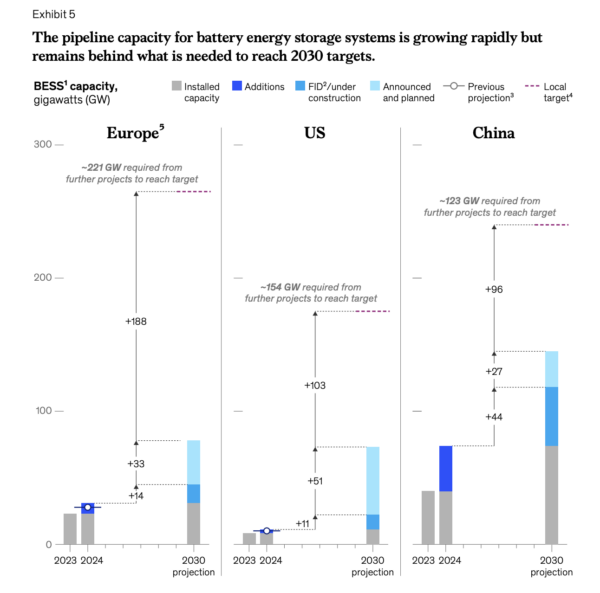
The report also notes that the battery energy storage system (BESS) pipeline is growing rapidly across China, the US and Europe, but remains behind what is needed to meet 2030 targets. McKinsey estimates around an additional 123 GW is required in China, 154 GW in the US and 221 GW in Europe.

The analysts says BESS remains the dominant question mark but can be sited, permitted, constructed, and interconnected far faster than technologies such as nuclear or gas with carbon, capture, utilization and storage (CCUS) contributing to its rapid growth in recent years.

The report attributes the rapid acceleration of BESS installation to a positive business case for both large-scale operators and households when paired with solar. “Load balancing is also becoming a popular source of revenue for battery operators,” the report adds. “Planning and integrating BESS with renewable rollout is critical if 2030 net-zero targets are to be met.”

  •  

Austria’s Andritz to supply South Korean 500 MW pumped storage power plant

Austrian engineering group Andritz has signed a deal to supply the pump turbine units for a 500 MW pumped storage plant in South Korea, the country’s first new pumped storage project in over a decade.

From ESS News

Austrian technology group Andritz has been selected by South Korean industrial company Doosan Enerbility to supply its turbine units for the Yeongdong pumped storage plant.

The 500 MW Yeongdong project, to be built in South Korea’s southwestern province of Chungcheong, is a collaboration between Doosan Enerbility and the country’s largest electric power company, Korea Hydro & Nuclear Power (KHNP). It marks the first large-scale pumped storage project initiated by KHNP since 2011.

According to local press reports, a groundbreaking ceremony for the project took place last April. At the time, it was announced the plant would be built on a 1.18 million square meter site, with project costs in excess of KRW 503 billion ($343 million).

Andritz will be responsible for the design of two pump turbine units, motor-generators and related auxiliaries and supply of key components of the pump turbines and motor-generators, as well as it digital control system, turbine governors and protection systems. The company will also provide installation supervision and commission services.

To continue reading, please visit our ESS News website.

  •