Reading view

Malaysia’s solar capacity surpasses 5.7 GW

Reports from the International Energy Agency's Photovoltaic Power Systems Programme (IEA-PVPS) indicate Malaysia added over 1.4 GW of solar in 2025, with more than 5.7 GW now deployed across multiple government schemes.

Malaysia’s solar capacity reached 5,777 MW by the end of 2025, according to figures from the International Energy Agency's IEA-PVPS.

The figure includes solar deployed across Malaysia’s large-scale solar (LSS), feed-in tariff (FiT), and net energy metering (NEM) schemes. An IEA-PVPS report from 2024 put the country’s cumulative solar capacity at 4,329 MW at the end of that year, implying additions of around 1,448 MW in 2025.

The country's total solar capacity may stand even higher, as the figure does not account for any solar installed outside the government schemes, such as off-grid installations.

Malaysia's LSS program is a competitive auction scheme targeting utility projects that had deployed 2,648 MW of solar by the end of 2025. The most recent auction round kicked off in January 2025, tendering 2 GW of large-scale solar projects with capacities ranging from 10 MW to 500 MW.

It approved 13 projects in September 2025 with a combined capacity of 1,975 MW. Figures from Malaysia's Ministry of Energy Transition and Water Transformation published in October said the LSS has now approved 6,028 MW of solar capacity to 117 companies since its inception.

IEA-PVPS adds that a total 345 MW of solar was deployed under Malaysia's feed-in tariff scheme, an earlier policy offering a fixed tariff for small-scale rooftop solar, before it was replaced by a net-metering scheme at the start of 2016.

The three rounds of Malaysia's net-metering schemes, which have expanded over time to include residential, commercial and industrial (C&I), and government-owned buildings, had deployed 2,747 MW of solar, IEA-PVPS' figures add, by the time of its conclusion in June 2025.

At the start of 2026, Malaysia replaced its net-metering program with the Solar Accelerated Transition Action Program (ATAP), aimed at both residential and commercial customers.

Lam Pham and Alnie Demoral, energy analysts at Ember specializing in Asian markets, told pv magazine that the LSS program and third net metering scheme were key drivers of Malaysia's solar market last year, as well as high commercial tariffs helping to make solar competitive for the C&I market.

Looking ahead, Pham and Demoral forecast that more solar will be deployed in Malaysia in 2026 than in 2025, driven by the launch of the ATAP and completion of utility-scale solar projects awarded in the most recent LSS rounds.

“The ATAP in 2026 removes quota constraints and expands rooftop adoption which previously constrained distributed solar,” the pair told pv magazine. They also explained the program will bring easier approval compared to the NEM but focuses on self-consumption by offering no export benefits.

Pham and Demoral said allowing the monetization of excess generation under ATAP would help support Malaysia’s solar market further. They also suggested standardizing and speeding up grid connection approvals and publishing hosting capacity maps for improved transparency, as well electricity pricing and subsidies reform, explaining that natural gas and coal remain indirectly subsidized, in turn distorting solar competitiveness.

Data centre developments also appear poised to play a growing role in the development of Malaysia's solar sector. Among the largest solar project under development in the country is a 1.5 GW project to be tied with battery storage to supply hyperscale data centres under the country's Corporate Renewable Energy Supply Scheme scheme, which allows businesses to purchase green electricity directly from renewable energy developers via the grid. 
In February, Malaysian Prime Minister Datuk Seri Anwar Ibrahim said that, due to their role in increasing energy and water usage, the government will restrict the entry of new data centers unrelated to AI.
  •  

Hydro-Québec launches grant for residential, commercial solar

Hydro-Québec has introduced a grant offering up to CAD 1,000 ($718.40) per kilowatt installed, covering up to 40% of eligible costs to accelerate rooftop solar adoption and reduce payback periods for residential and business customers in the Canadian province of Québec.

Provincial utility Hydro-Québec has launched a new grant program aimed at residential and commercial customers installing PV systems, as part of its broader strategy to expand solar generation in Québec, Canada.

The program provides CAD 1,000/kW of installed capacity and can cover up to 40% of eligible project costs. According to the utility, typical residential systems range between CAD 5,000 and CAD 6,000 in total costs, while business installations average around CAD 45,000.

Hydro-Québec said the initiative is designed to shorten payback periods for customers who choose to become self-generators. It expects typical payback times to fall from between 25 and 30 years to around 10 to 12 years under the new program.

Residential customers can apply through the LogiVert Efficient Homes Program, provided installations were completed on or after June 30, 2025, and meet program eligibility requirements. Business customers must apply via the OSE calculation tool under the Efficient Solutions Program, with projects required to meet technical and administrative criteria and be purchased after March 31, 2026.

The utility also allows participants to enroll in a net metering option, enabling them to export surplus electricity to the grid in exchange for kilowatt-hour credits. Hydro-Québec has increased the maximum self-generation capacity under this option from 50 kW to 1 MW over the past months.

To qualify for the grant, all installations must secure authorization for grid connection from Hydro-Québec and comply with the technical standards set out under the relevant residential and commercial program frameworks.

Canada's installed PV capacity stood at around 5.4 GW at the end of 2025, with Québec contributing just 17 MW of the cumulative total. The new grant program is part of Hydro-Québec's broader push to close that gap, alongside a 300 MW utility-scale solar tender launched last year and a long-term target of integrating 3 GW of solar into the provincial grid by 2035, driven by rising electricity demand.

  •  

Heat dome and high pressure boost southern US solar as polar vortex clouds the north

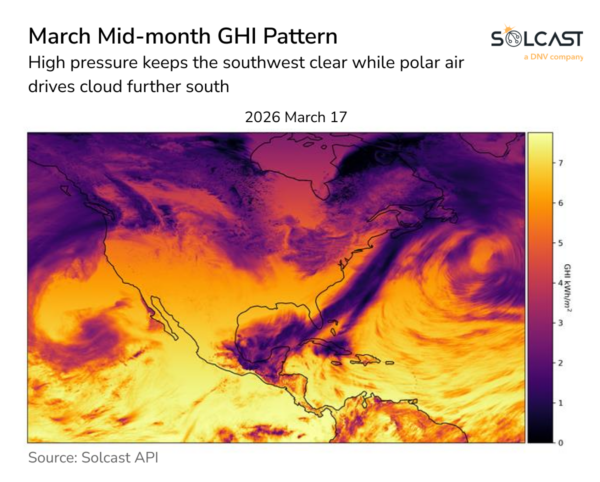
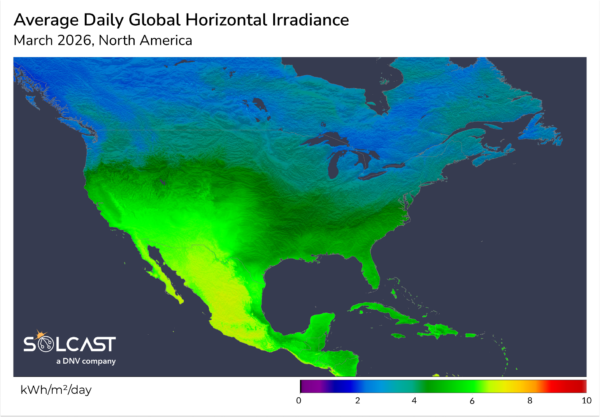
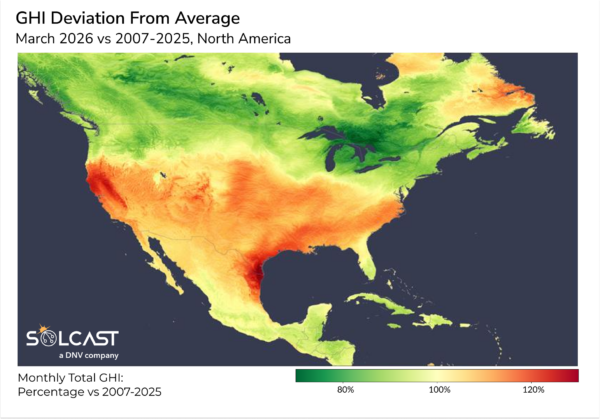
In a new weekly update for pv magazine, Solcast, a DNV company, reports that last month North America saw a stark solar divide, with southern regions like northeastern Mexico, southeastern Texas, and much of California experiencing 20–25% above-average irradiance, while Canada, the Great Lakes, and the northeastern U.S. faced persistent cloudiness and below-normal solar conditions. This contrast was driven by high-pressure systems and a southwestern heat dome in the south versus a polar vortex bringing cold air and storms to the north.

North America experienced a pronounced divide in solar conditions through March, with the southern half of the continent recording widespread increases in solar resource while the north faced persistent cloud and storm activity, according to analysis using the Solcast API.

The strongest gains were centered on northeastern Mexico and southeastern Texas where deviations reached roughly 20–25% above the long-term March average, with much of California also seeing similar increases. Canada, the Great Lakes and the northeastern United States recorded lower-than-normal irradiance as polar air and storm systems dominated conditions. This produced a month in which the usual seasonal contrast between north and south was sharpened, with clearer skies in the south and cloudier conditions in the north compared with the 2007–2025 average.

Much of the southern United States and northern Mexico benefited from a pair of high-pressure systems positioned over the Pacific and Atlantic coasts of North America. These systems stabilised the atmosphere and kept skies clearer than normal across large areas. Southern Mexico and Florida were exceptions to the southern trend, each experiencing slightly below average irradiance where localised cloud cover persisted.

A pronounced heat dome over the southwestern United States further reinforced these conditions, driving temperatures 10–19 C (18-35 F) above seasonal norms and breaking multiple records, as localized areas saw even large increases. These warm conditions, more like summer temperatures than spring, were the result of high atmospheric stability, which also suppressed cloud formation and supported extended periods of clear skies. As a result, California emerged as one of the strongest-performing regions relative to average conditions, with irradiance levels significantly elevated through much of the month. The scale of the heat anomalies was notable, with attribution studies indicating these extremes would be highly unlikely without the influence of climate change.

At the same time, northern parts of the continent experienced a very different pattern as an unstable polar vortex pushed cold polar air into Canada and the northern United States. This brought snowstorms and blizzards across several regions, particularly around the Great Lakes and the Northeast, where irradiance fell far below normal for March. These stormy conditions contributed to the largest percentage drops from average in areas north of the Great Lakes.

The push of polar air extended unusually far south, reaching into Florida and contributing to its slightly below normal irradiance despite the generally sunnier conditions across most of the southern half of North America. Collectively, these factors reinforced the strong contrast between the sunnier southern regions and the cloudier, storm affected conditions across the north.

Solcast produces these figures by tracking clouds and aerosols at 1-2km resolution globally, using satellite data and proprietary AI/ML algorithms. This data is used to drive irradiance models, enabling Solcast to calculate irradiance at high resolution, with typical bias of less than 2%, and also cloud-tracking forecasts. This data is used by more than 350 companies managing over 300 GW of solar assets globally.

  •  

Rooftop solar now accounts for one-fifth of Puerto Rico’s generation capacity

Distributed solar additions have vastly outpaced all other forms of generation as Puerto Rico’s overall power generation capacity continues to grow.

From pv magazine USA

Recently released data from the US Energy Information Administration (EIA) indicates that 20% of all power generation capacity in Puerto Rico now comes from rooftop solar, surpassing natural gas to become the second-largest capacity source in the territory.

Growth in rooftop solar capacity has outpaced all other energy sources in Puerto Rico over the past decade. According to EIA data, distributed solar installations accounted for 81% of all new generating capacity added to the island’s grid between 2016 and 2025.

During 2025 alone, an average of 3,850 rooftop systems were installed each month at homes and businesses, bringing the total number of active systems to 191,929 by year-end.

Rooftop solar capacity growth has been a bright spot in Puerto Rico’s energy story. The 1,456 MW of rooftop capacity far exceeds the estimated 165 MW of utility-scale solar installed on the island.

PJ Wilson, president of the Solar Energy and Storage Association Puerto Rico, said the industry group remains committed to expanding distributed solar across the territory.

“We are committed to building on this momentum and ensuring rooftop solar and storage continue to grow as a key part of Puerto Rico’s energy system to strengthen the grid and expand energy independence,” he told pv magazine USA.

Notably, the growth in solar capacity has not displaced other generation sources, with capacity from petroleum, natural gas, and coal showing little change over the past five years.

In 2025, Puerto Rico Governor Jenniffer González Colón signed Act 1-2025 into law, extending the lifespan of the territory’s only coal-fired power plant through 2032, despite opposition from local communities. The legislation also revised renewable portfolio standards, removing interim targets of 40% by 2025 and 60% by 2040, while retaining the long-term goal of 100% renewable energy by 2050.

Battery storage and virtual power plants

Grid resilience has become increasingly important in Puerto Rico in recent years. Data shows that the average utility customer experiences a minimum of 27 hours of outages annually, with some locations facing up to nearly 200 hours depending on severe weather events.

In response, adoption of distributed energy storage has grown rapidly. The Puerto Rico Energy Bureau estimates more than 171,000 households and businesses had installed battery systems by the end of 2025, representing a combined capacity of 2,864 MWh.

Analysts at Wood Mackenzie expect an additional 3,000 MWh of distributed storage to be added by 2030.

Many battery owners participate in virtual power plants (VPPs) through the Customer Battery Energy Sharing (CBES) program operated by grid operator LUMA. Through the program, LUMA works with storage aggregators that manage fleets of customer-sited batteries across the territory. During periods of peak demand, the utility can call on these aggregators to temporarily control distributed batteries in “CBES events” to help balance the grid.

LUMA currently lists seven aggregators on its website, allowing customers to enroll and receive compensation in exchange for participation.

Grid challenges have also prompted changes at LUMA. New CEO Janisse Quiñones began her tenure on March 30, 2026, bringing experience from her previous role as CEO and chief engineer of LADWP, with a stated focus on improving grid reliability.

Wilson said the industry group is optimistic about increased collaboration under new leadership.

“SESA remains focused on advancing policies that allow rooftop solar and battery storage to keep growing as a central pillar of Puerto Rico’s energy future, and we’re encouraged by the opportunity for stronger collaboration under LUMA’s new leadership,” he said.

  •  

Bauer Solar launches 480 W back-contact solar module

The German manufacturer said its new back-contact solar panel has a power conversion efficiency of up to 23.52%.

From pv magazine Germany

German module manufacturer Bauer Solar is expanding its product portfolio with a new back-contact panel.

Initially, it will launch a full-black glass-glass version with an output of 480 W. It is built on 108 bifacial half-cells and measure 1,800 mm × 1,134 mm × 30 mm, with a listed weight of 24.8 kg. The module power conversion efficiency is 23.52%.

The company said that both the front and rear glass panes are 2 mm thick and feature anti-reflective coatings. The frame is made of anodized black aluminum alloy. The modules are rated for operating temperatures from –40 C to 85 C and a maximum system voltage of 1,500 V. They can reportedly withstand static loads up to 5,400 Pa and carry a hail resistance rating of HW3. Certifications include fire protection class A.

Bauer Solar is offering a 30-year product and performance warranty on the new modules. The linear performance warranty guarantees a minimum output of 88.85 % of the original capacity after 30 years. The company also plans to increase the output of its back-contact modules to 500 W later this year with the “Pure” and “Performance” variants.

Alongside back-contact modules, Bauer Solar will continue to focus on its TOPCon technology. This portfolio will be expanded this summer with the “Pure” and “Black” variants, which will reach an output of 465 W. While the company did not disclose pricing, it emphasized that the modules are aimed at the residential rooftop solar market as “an economical solution with an optimal price-performance ratio.”

  •  

TNO unveils 12.4%-efficient perovksite solar tile

The Dutch research institute has presented what it describes as the world’s first perovskite-based roof tile, achieving up to 13.8% efficiency on standalone modules and 12.4% when installed on a curved surface. The flexible modules were produced using TNO’s experimental roll-to-roll platform,

The Netherlands Organization for Applied Scientific Research (TNO) has unveiled today a building-integrated photovoltaic (BIPV) tile based on perovskite solar cell technology.

The new product is billed as the world's first perovskite solar tile.

“This demonstrator is supported by the Province of North Brabant through the project ‘Solar manufacturing industry to Brabant, Solliance 2.0’. Additional funding was received from the European Union’s Horizon Europe programme for the Luminosity project,” TNO said in a statement. “The work was also partly funded by the National Growth Fund programme SolarNL.”

The Dutch research institute partnered with Netherlands-based BIPV specialist Asat BV in deploying 10 cm x 10 cm perovskite solar modules built on flexible foil onto a curved composite roof tile. Testing indicates that bending the modules to fit the curved surface has minimal impact on their performance.

Standalone modules reached energy conversion efficiencies of up to 13.8%, while the modules retained an efficiency of 12.4% after installation on the curved roof tile.

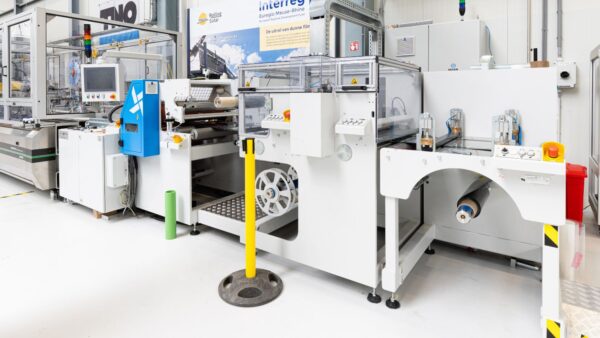
The experimental production line used to encapsulate the solar tiles

Image: TNO

The perovksite modules were encapsulated with an experimental roll-to-roll manufacturing platform developed by TNO itself. Roll-to-roll manufacturing – similar to the process used in newspaper printing – enables continuous production of solar cells on long rolls of flexible material. The technique is widely seen as a potential pathway to lower production costs and high-volume manufacturing for emerging thin-film technologies such as perovskites.

More technical details about the solar tile were not disclosed. TNO said it will be commercialized by its spinoff Perovion Technologies, which was launched last month. 

TNO's recent research on perovskite solar cells, includes developing roll-to-roll and spatial atomic layer deposition (SALD) processes for the deposition of functional materials, solar cell layers, and flexible foils.

In July, Solarge, a manufacturer of lightweight silicon PV modules based in the Netherlands, and TNO unveiled a 32 cm x 34 cm lightweight prototype perovskite solar panel.

A month earlier, Japan’s Sekisui Solar Film, part of Sekisui Chemical, the Brabant Development Agency (BOM), which serves the Dutch province of Noord-Brabant, and TNO signed a letter of intent in Osaka, Japan to explore collaboration related to flexible perovskite solar PV module technologies.

As pv magazine has reported, Sekisui Solar Film is developing technology for lightweight, flexible perovskite solar module manufacturing using an advanced roll-to-roll process. It is working on a 100 MW plant in Japan for large-scale production, is undertaking field demonstrations, and signed a perovskite solar-related memorandum of understanding with Slovakia.


  •  

Spain deploys 1.13 GW of solar for self-consumption in 2025

Spain installed 1.14 GW of solar capacity for self-consumption in 2025, lifting cumulative capacity to 9.3 GW, as residential and commercial installations declined while industrial and off-grid segments showed greater resilience, according to data from the Spanish Photovoltaic Union.

From pv magazine Spain

Solar self-consumption capacity in Spain reached a cumulative 9.3 GW in 2025, according to data from the Spanish Photovoltaic Union (UNEF).

Spain added 1,139 MW of new self-consumption capacity during the year, representing a 3.7% slowdown compared with 2024. UNEF said the deceleration signals a phase of market stabilization following several years of rapid growth.

The residential segment accounted for 229 MW across 36,330 new installations, a year-on-year decline of 17%. UNEF attributed the contraction to the phase-out of tax incentives linked to energy-efficient home renovations and lower compensation for surplus electricity exported to the grid under deregulated market contracts.

UNEF said falling surplus compensation prices are reducing the attractiveness of oversized systems designed primarily for grid injection. As a result, demand is shifting toward installations optimized for instantaneous self-consumption. The association is calling for revisions to the simplified regulated compensation mechanism to enable broader settlement of surplus energy and improve economic signals for small-scale systems.

The commercial segment installed 176 MW in 2025, down 15% from the previous year. Collective self-consumption remains limited despite its potential to optimize shared generation and demand. Industry representatives said pending regulatory updates are needed to enable aggregated management models, dynamic energy allocation, and an expansion of eligible self-consumption areas.

Industrial self-consumption installations totaled 679 MW, marking a slight increase compared with 2024. UNEF said growth in this segment is being driven by larger medium-voltage systems aimed at reducing electricity costs and partially covering electrified thermal demand. Project viability increasingly depends on tariff structures with a higher variable component and more streamlined permitting for medium-sized installations.

Off-grid installations reached 55 MW in 2025, reflecting growing uptake of hybrid solar-plus-storage systems in rural areas and locations without grid access. Battery integration in grid-connected installations also continued to rise, improving controllability of generation and supporting system flexibility.

UNEF said Spain will need to deploy an average of around 2 GW of self-consumption capacity per year to meet the 19 GW target set out in the country’s National Integrated Energy and Climate Plan. Achieving that level will require regulatory stability, administrative simplification, and more effective integration of distributed energy storage.

  •  

Brazil curtails 20% of solar and wind output in 2025, with losses at $1.2 billion

Brazil curtailed about one-fifth of its solar and wind generation in 2025, wasting an estimated BRL 6.5 billion ($1.23 billion), as grid constraints and demand mismatches pushed the power system close to operational safety limits on 16 days, according to a report from Volt Robotics.

From pv magazine Brazil

Brazil failed to use roughly 20% of the solar and wind electricity it generated in 2025, resulting in an estimated loss of BRL 6.5 billion, according to Volt Robotics’ Annual Curtailment Report.

Volt Robotics said the scale of curtailment reflects an unprecedented period of renewable oversupply combined with operational constraints in Brazil’s national electricity system.

Average generation cuts reached 4,021 MW over the year, equivalent to the monthly output of a large hydroelectric plant. On at least 16 days in 2025, system operation approached the lower technical safety limit, a sharp increase from 2024, when only one comparable event was recorded.

Volt Robotics said the 2025 events were driven by excess electricity supply rather than scarcity, marking a structural shift in system risk dynamics.

Curtailment intensified between August and October, when historically high levels of generation coincided with transmission constraints and weaker demand. The report attributes the peak losses to a combination of operational limitations, grid congestion, and insufficient flexibility to absorb surplus power.

Sunday mornings emerged as the most frequent stress point for the grid. Volt Robotics said reduced economic activity during weekends lowers electricity demand, while solar output peaks and is often reinforced by strong wind generation. This recurring mismatch leads to network overloads, forced generation cuts, and system operation near the lower safety threshold.

The report also highlights the risk of system instability caused by excess renewable generation. During the 16 critical days, Brazil’s National System Operator classified conditions as severe and implemented emergency measures, supported by the National Electric Energy Agency, including extraordinary generation curtailments.

Volt Robotics warned that without structural adjustments, surplus clean energy itself can become a source of operational risk.

The economic impact extends beyond immediate revenue losses. Frequent curtailment increases perceived investment risk, raises financing costs, and weakens Brazil’s appeal for new renewable energy projects, the report said. Both regulated and free-market projects were affected, with exposure to contractual penalties and the Settlement Price of Differences.

Regionally, Minas Gerais, Ceará, and Rio Grande do Norte recorded the highest levels of curtailed energy, forming what Volt Robotics described as Brazil’s “curtailment triangle.” Southern states experienced significantly lower losses.

Volt Robotics said the situation reflects a structural mismatch between rapid renewable capacity expansion, rising distributed generation, transmission bottlenecks, and tariff structures that do not adequately signal when electricity consumption is most valuable.

The report recommends the introduction of more dynamic time-of-use tariffs, stronger demand-side participation, and regulatory reforms to reduce curtailment and maintain the stability of Brazil’s electricity system.

  •  

The impact of microclimate effects on floating PV plants

French researchers have developed a high-resolution computational framework to model microclimate effects of large floating solar PV systems, enabling accurate predictions of heat transfer, ambient temperatures, and water evaporation based on panel configuration and wind conditions. The model can inform thermal performance, environmental impacts, and optimize designs for utility-scale floating PV, as well as ground-mounted and agrivoltaic installations.

French researchers have developed a framework to model microclimate effects of large-sized floating PV systems.

The new model can be used to determine wind-dependent convective heat transfer coefficients (CHTC), ambient temperatures, and to estimate evaporation patterns in partially covered bodies of water based on a variety tilt angles, module heights, and pitch distances.

“The main novelty of this work lies in the numerical methodology we developed, specifically an upscaling method to quantify panel-atmosphere interactions at the module scale then model the micrometeorology at the power plant scale with a relatively fine resolution of about 4 meters,” Baptiste Amiot, corresponding author of the research told pv magazine, adding that the resolution is significantly higher than others in this field.

“Applying this methodology enables us to map the thermal performance across utility-scale installations and to provide insights into local environmental effects, such as evaporative losses,” he said.

The precursor model is geometrically adaptable: tt can handle various tilt angles, mounting heights, and inter-row spacings, according to Amiot. “It is particularly well-suited for large-scale installations exposed to sufficiently windy conditions,” Amiot added.

The researchers used a computational fluid dynamics (CFD) precursor model, a microclimate CFD model supporting the PV parameterization, and an experimental survey. A wind-tunnel setup typical of a land-based application was used to confirm accuracy of altitude-based wind profiles.

In addition, a geometrical layout of a commercial floating PV (FPV) installation was used for the atmosphere boundary layer parameters. The wind direction effects were assessed using the microclimate CFD model that reproduced the localized conditions of the commercial FPV array.

“The atmospheric component is fundamentally similar to regional climate models (RCMs) but deploying it within a CFD framework offers advantages in terms of surface element parameterization and the spatial discretization we can achieve,” said Amiot.

Some of the findings included temperature gradients range between 1.3 C/km and 5.8 C/km; headwinds and tailwinds relative to the front surface of the PV modules generate the greatest turbulence levels. Furthermore, the team was able investigate how turbulent flows influence water-saving gains based on PV coverage of the water surface.

Assessing the results, the researchers noted that the precursor method “readily determines” heat transfer coefficient correlations as a function of wind speed and direction. “This is essential to obtain the thermal U-values that govern panel cooling,” added Amiot.

The model can be extended to model large ground-mounted systems and agrivoltaics, including dynamic configurations where panels adjust orientation throughout the day, according to Amiot. It is suitable for inland and nearshore FPV, but not offshore FPV.

The work is detailed in “Boundary-layer parameterization for assessing temperature and evaporation in floating photovoltaics at the utility-scale,” published in Renewable Energy. Research participants include Ecole nationale des ponts et chaussees, Electricité de France RD, and Université Claude Bernard.

The researchers are currently focused on developing CFD models to predict both the energy output and environmental trade-offs of dual-use photovoltaics systems and FPV evaporation research at finer spatial scales, coupled with in-situ measurements. It is also working on an agrivoltaics CFD-plant model to predict crop response below PV canopies.

  •  

Bulgaria installs 1.4 GW of solar in 2025

Bulgaria installed over 1 GW of solar for the third consecutive year in 2025 and is forecast to add over 2 GW this year thanks to a large pipeline of utility-scale projects.

Bulgaria added 1,416 MW of solar last year, according to official data published on the ENTSO-E Transparency Platform. The result marks the third consecutive year Bulgaria has deployed over 1 GW of solar and takes the country’s cumulative capacity to 5,984 MW.

Desislava Mateva, project manager at the Sofia-based Association for Production, Storage and Trading of Electricity (APSTE) told pv magazine that Bulgaria’s solar market is currently dominated by ground-mounted, utility-scale solar plants, reflecting the availability of land, strong developer activity and increasing access to project finance.

Utility-scale solar made up around 90% of Bulgaria’s new capacity last year. Mateva said the market was driven by the strong commercial competitiveness of solar, making projects viable without direct subsidies, as well as active support from local and international banks and a large pipeline of development projects that reached the ready-to-build stage or financial close over the past 18 months.

Mateva also noted that Bulgaria is experiencing a wave of standalone battery energy storage system (BESS) deployments and the hybridization of both existing and new solar assets with BESS, as developers look to deal with price cannibalization and declining solar capture rates.

“These developments are expected to reduce price volatility, improve system flexibility, and mitigate capture-price pressure for solar producers,” she explained. “As a result, industry expectations remain positive.”

Among the largest projects to be commissioned in Bulgaria last year was the first phase of the 315 MW/760 MWh Tenevo hybrid project, with a second phase scheduled for commissioning early this year, and the Selanovtsi hybrid project, a 59.8 MW solar plus 107.3 MWh storage site in the northwestern Vratsa region. Bulgaria also commissioned one of the EU's largest standalone BESS facilities last year, located adjacent to a 107 MW solar park.

Bulgaria’s C&I solar market is showing steady momentum, particularly among projects designed for self-consumption, Mateva added, with rising electricity costs incentivizing businesses to invest in on-site solar, often in combination with storage. 

In contrast, Bulgaria’s residential solar sector remains underdeveloped in capacity terms. Mateva said interest among households exists but the market segment has been constrained by regulatory complexity and limited incentives.

She added that the residential sector would benefit from the full liberalization of Bulgaria’s electricity market, as currently household electricity prices remain regulated, accounting for roughly 40% of national electricity demand. “Full liberalization would stimulate demand-side participation and unlock the residential solar and storage market,” she explained.

Looking ahead, Mateva predicted Bulgaria is on course for a record year in solar deployment in 2026. “An estimated 2.5 GW of additional solar projects are either under construction or at an advanced stage of development and expected to start construction soon,” she said. “This pipeline suggests that most of this capacity will be commissioned by the end of 2026.”

Bulgaria’s storage pipeline is looking equally healthy, with 15 GWh expected to be commissioned by half way through the year, supported by the country’s National Recovery and Resilience Plan.

Mateva added that the most significant policy change last year was a sharp increase in eco-taxes and recycling fees for solar panels and batteries. She explained that these fees are currently five to ten times higher than in comparable EU countries, in turn artificially inflating PV and BESS project costs.

“Unless addressed, this issue risks becoming a major bottleneck for new PV and BESS procurement,” Mateva told pv magazine. “Resolving this will require action from the Ministry of Ecology to align recycling fees with real-world costs and EU norms, ensuring that Bulgaria’s strong solar momentum is not undermined by avoidable regulatory distortions.”

Bulgaria opened a new grant program late last year targeting micro, small and medium-sized enterprises looking to deploy PV systems and storage, with a particular focus on those located in the country’s coal regions. The call is set to close next month.

  •  

Early tropical storm cuts solar in Philippines, while East Asia sees La Niña gains

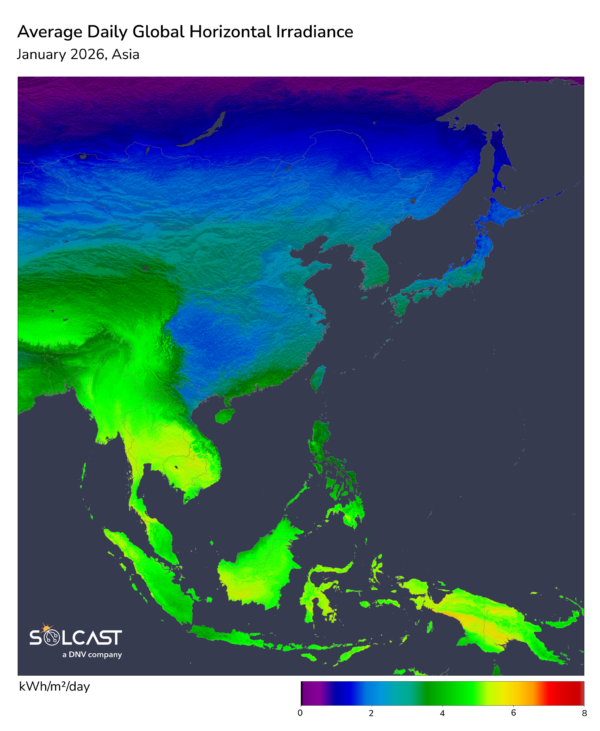
In a new weekly update for pv magazine, Solcast, a DNV company, reports that in January most of East Asia experienced normal to above-average solar irradiance, with southeastern China seeing surges due to reduced clouds and low aerosol levels under lingering La Niña effects. In contrast, the Philippines faced below-average irradiance from early Tropical Storm Nokaen, while other regional cities like Seoul, Tokyo, and Taipei recorded modest gains.

Most of East Asia recorded normal to above‑normal solar irradiance in January, as weak La Niña conditions continued to influence regional weather patterns. The largest gains were observed across southeastern China, where suppressed cloud formation and reduced aerosol-effects delivered a strong start to the year for solar operators, while unusual early tropical storm activity brought significant rainfall and irradiance losses to parts of the Philippines. With two days left in January at time of publishing, this data uses live data from 1-29 January, and forecasts for 30-31 Jan from the Solcast API.

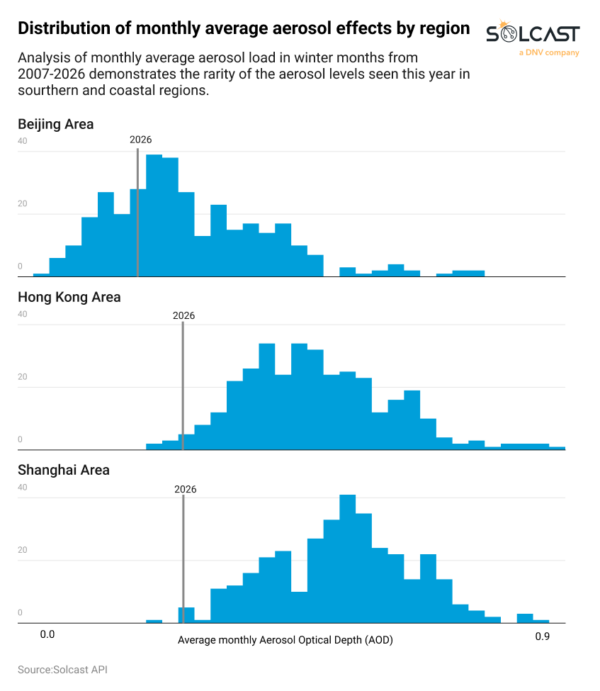
Irradiance in southeastern China surged well above historical averages in January, with Hong Kong exceeding 25% above average. A dominant Siberian high pressure system, with temperatures in parts of Siberia more than 10 C below normal, extended into western China. The resulting northerly flow delivered drier air into southeastern China, reducing both precipitation and cloud formation. This irradiance pattern aligns with typical La Niña effects, even though the La Niña signal was weak and fading toward neutral by late January. Additionally, lower than normal aerosol levels contributed to above average irradiance in coastal parts of China.

In a continuation of the irradiance and aerosol pattern seen in 2025, many parts of China, in particular low-lying industrial areas saw significant drops in aerosol load and a corresponding increase in available irradiance. Both Hong Kong and Shanghai regions saw significantly lower winter average aerosol loads, than the historical average for winter months from 2007-2026. Whilst this supported the exceptionally high irradiance in Hong Kong through January, Shanghai recorded slightly above-average irradiance, despite experiencing a rare snowfall late in the month. By contrast, Beijing has historically lower aerosol loads, however still saw slightly below-average irradiance due to prevailing cloud levels.

Elsewhere in East Asia, irradiance levels were generally normal to above normal for this month. Seoul and Tokyo recorded irradiance 5–10% above January averages and Taipei saw gains exceeding 10%. Across the maritime continent, irradiance and precipitation anomalies were near normal.

The most significant negative irradiance anomaly in the region was associated with Tropical Storm Nokaen (Ada), which marked an unusually early start to the 2026 Pacific typhoon season. Making landfall in January—the first such occurrence since 2019— Nokaen delivered intense rainfall and heavy cloud cover to the central and northern Philippines. Daily rainfall totals reached up to 200 mm, triggering mudslides and widespread disruption. Irradiance across the northern Philippines dropped by as much as 10% below average, while the southern parts of the archipelago, spared from the worst of the storm, saw irradiance climb to 10% above average.

Solcast produces these figures by tracking clouds and aerosols at 1-2km resolution globally, using satellite data and proprietary AI/ML algorithms. This data is used to drive irradiance models, enabling Solcast to calculate irradiance at high resolution, with typical bias of less than 2%, and also cloud-tracking forecasts. This data is used by more than 350 companies managing over 300 GW of solar assets globally.

  •  

Study finds much lower-than-expected degradation in 1980s and 1990s solar modules

Researchers at SUPSI found that six Swiss PV systems installed in the late 1980s and early 1990s show exceptionally low degradation rates of just 0.16% to 0.24% per year after more than 30 years of operation. The study shows that thermal stress, ventilation, and material design play a greater role in long-term module reliability than altitude or irradiance alone.

A research group led by Switzerland's University of Applied Sciences (SUPSI) has carried out a long-term analysis of six south-facing, grid-connected PV systems installed in Switzerland in the late 1980s and early 1990s. The researchers found that the systems’ annual power loss rates averaged 0.16% to 0.24%, significantly lower than the 0.75% to 1% per year commonly reported in the literature.

The study examined four low-altitude rooftop systems located in Möhlin (310m-VR-AM55), Tiergarten East and West in Burgdorf (533m-VR-SM55(HO)), and Burgdorf Fink (552m-BA-SM55). These installations use ventilated or building-applied rooftop configurations. The analysis also included a mid-altitude utility-scale plant in Mont-Soleil (1270m-OR-SM55) and two high-altitude, facade-mounted systems in Birg (2677m-VF-AM55) and Jungfraujoch (3462m-VF-SM75).

All systems are equipped with either ARCO AM55 modules manufactured by US-based Arco Solar, which was the world’s largest PV manufacturer with just 1 MW capacity at the time, or Siemens SM55, SM55-HO, and SM75 modules. Siemens became Arco Solar’s largest shareholder in 1990. The modules have rated power outputs between 48 W and 55 W and consist of a glass front sheet, ethylene-vinyl acetate (EVA) encapsulant layers, monocrystalline silicon cells, and a polymer backsheet laminate.

The test setup included on-site monitoring of AC and DC power output, ambient and module temperatures, and plane-of-array irradiance measured using pyranometers. Based on site conditions, the researchers classified the installations into low-, mid-, and high-altitude climate zones.

“For benchmarking purposes, two Siemens SM55 modules have been stored in a controlled indoor environment at the Photovoltaic Laboratory of the Bern University of Applied Sciences since the start of the monitoring campaign,” the researchers said. They also applied the multi-annual year-on-year (multi-YoY) method to determine system-level performance loss rates (PLR).

The results show that PLRs across all systems range from -0.12% to -0.55% per year, with an average of -0.24% to -0.16% per year, well below typical degradation rates reported for both older and modern PV systems. The researchers also found that higher-altitude systems generally exhibit higher average performance ratios and lower degradation rates than comparable low-altitude installations, despite exposure to higher irradiance and ultraviolet radiation.

The study further revealed that modules of the same nominal type but with different internal designs show markedly different degradation behaviour. Standard SM55 modules exhibited recurring solder bond failures, leading to increased series resistance and reduced fill factor. By contrast, SM55-HO modules benefited from a modified backsheet design that provides higher internal reflectance and improved long-term stability.

Overall, the findings indicate that long-term degradation in early-generation PV modules is driven primarily by thermal stress, ventilation conditions, and material design, rather than altitude or irradiance alone. Modules installed in cooler, better-ventilated environments demonstrated particularly stable performance over multiple decades.

The test results were presented in the paper “Three decades, three climates: environmental and material impacts on the long-term reliability of photovoltaic modules,” published in EES Solar.

“The study identified the bill-of-material (BOM) as the most critical factor influencing PV module longevity,” they concluded. “Despite all modules belonging to the same product family, variations in encapsulant quality, filler materials, and manufacturing processes resulted in significant differences in degradation rates. Early-generation encapsulants without UV stabilisation showed accelerated ageing, while later module designs with optimised backsheets and improved production quality demonstrated outstanding long-term stability.”


  •  

Sweden deploys 652 MW of solar in 2025

Sweden deployed less solar in 2025 than the year prior despite record growth in the large-scale segment. Solar association Svensk Solenergi predicts last year was likely the bottom of Sweden's installation curve.

Sweden commissioned 652 MW of new solar last year, according to estimates from Swedish solar association Svensk Solenergi. The figure is down on the 848 MW installed in 2024 and takes cumulative capacity to around 5.4 GW.

Residential installations totaled 239 MW in 2025, a 39% year-on-year decrease. Alex Jankell, head of politics at Svensk Solenergi, told pv magazine the household market has been impacted by the removal of a tax rebate scheme as of the start of this year. He added that lower energy prices in comparison to massive hikes in 2022, higher interest rates and inflation have also impacted the market segment.

Although the residential market contracted in 2025, installations smaller than 20 kW continue to represent more than half of Sweden’s solar market, with a little over 3 GW of total capacity. There are now just over 287,000 solar power plants of less than 20 kW in Sweden, equivalent to 90% of all grid-connected solar plants.

Cumulative capacity of grid-connected solar plants

Image: Svensk Solenergi

Commercial and industrial installations reached 215 MW in 2025, down 35% year-on-year, but utility-scale installations increased, deploying a record 198 MW for 46% more than in 2024.

The large-scale segment accounted for 30% of new solar power in 2025, compared to 7% in 2024. New installations were led by Sweden’s largest solar plant to date, the 100 MW Hultsfred solar farm, and the 64 MW Ax-el solar park. Last year also saw developer Svea Solar announce plans to build eight new solar parks in Sweden with a total capacity of approximately 500 MW.

Jankell said the market is experiencing a shift to more large-scale solar, often combined with large-scale battery installations, but added that challenges remain in high costs or long waiting times for grid connections. He recommended Sweden adopt proposed changes to permitting procedures to make them quicker and more predictable.

The residential battery market is also broadening, with preliminary figures from the Swedish Tax Agency showing around 75,000 private individuals received a green reduction for battery installations in 2025, a 34% increase on the previous year.

Jankell suggested that Sweden’s solar market could be supported further by abolishing energy tax for all electricity that is produced and consumed behind the same meter and implementing proper power-tariffs which reflectively reward the ability of solar and battery installations to help the grid. He also recommended proposed proper revenue frames for Swedish grid companies that reward flexibility, and not only grid expansion.

Jankell told pv magazine more solar is likely to be installed this year than in 2025. “Given the implementation of solar demands in the Energy Performance of Buildings Directive, new permitting processes on the way, and a general deflation of PV and battery prices, we predict that 2025 is the bottom of the installation curve,” he said.

  •  

Dutch utility testing ‘silent’ residential heat pumps

Dutch utility Eneco is testing low-noise air-to-water heat pumps from startup Whspr in around 20 homes, aiming to ease installation constraints near property boundaries. The systems reportedly achieve coefficients of performance of up to 5 and show up to 80% noise reduction in laboratory testing.

Dutch utility Eneco has begun testing an”innovative” type of air-to-water heat pump with low sound levels in residential buildings.

The company said conventional heat pumps rely on outdoor units that emit a constant hum, requiring installations several metres from property boundaries under Dutch building regulations and often forcing placement in prominent locations on terraced houses. By contrast, the “silent” heat pumps under test can be installed just 30 cm from the boundary.

“The pilot will provide insight into both ease of installation and real-world performance,” Eneco said in a statement. “The results will be used to further optimize the system, with the aim of making it widely available by the end of the summer.” The company added that around 20 homes are currently equipped with the systems to assess noise levels without “compromising residents’ everyday heating comfort.”

The heat pumps are supplied by Dutch startup Whspr. “Our 4 kW freestanding hybrid monoblock systems are designed for domestic space heating,” founder Hugo Huis in ’t Veld told pv magazine.

The unit measures 60 cm × 60 cm × 90 cm and weighs around 70 kg. “It is compact yet robust,” Huis in ’t Veld said, adding that initial measurements show efficiencies in line with the market, with coefficients of performance (COP) of between 4.5 and 5.0.

According to the manufacturer, the heat pump uses propane (R290) as its refrigerant and shows up to 80% noise reduction in laboratory testing.

Whspr also highlights ease of installation, stating that a single installer can fit and connect the unit, including the water side, in one day. A dedicated control and thermostat system has also been developed to reduce compatibility issues and simplify commissioning.

Further technical details have not yet been disclosed. “We are not at liberty to share designs at this stage, as patents are still pending,” Huis in ’t Veld said.

Eneco noted that pilot installations include both standard locations and more complex sites, such as rooftops and sheds at the end of gardens. The systems have also been installed in several rental homes owned by housing association Wooncompagnie. “Testing will continue until the end of April, after which the heat pumps will be further optimized,” the company said.


  •  

A closer look at Tesla’s new residential solar panels

The new Tesla Solar Panel and mounting system pairs with the company’s inverter, Powerwall battery, EV charging and vehicles, creating an all-Tesla residential solar offering for the first time.

From pv magazine USA

In the residential solar sector, the industry has long sought the “holy grail” of vertical integration, creating a single point of contact for hardware, software, and energy management.

While Tesla has been a dominant player in storage with the Powerwall, a market leader with its inverter, and in electric vehicles, the company has historically relied on third-party solar panels.

With the launch of the Tesla Solar Panel (TSP-415 and TSP-420), the company is closing that loop. The company’s new modules, assembled at its Gigafactory in Buffalo, New York, represent a significant shift toward a proprietary, integrated ecosystem designed to solve the common rooftop challenges of shading, aesthetic clutter, and installation friction.

“This panel completes the full package of the residential energy ecosystem,” Colby Hastings, senior director, Tesla Energy, told pv magazine USA. “It is based on our long history of innovation and engineering when it comes to solar.”

Domestic manufacturing

Tesla said the new modules are assembled at its Buffalo, NY facility, the same site where it continues to produce Solar Roof components, which inspired the design of the panel. The factory is currently scaling to an initial capacity of over 300 MW per year.

This domestic assembly allows Tesla to leverage federal manufacturing incentives while securing a local supply chain for its growing network of installers.

Power zones

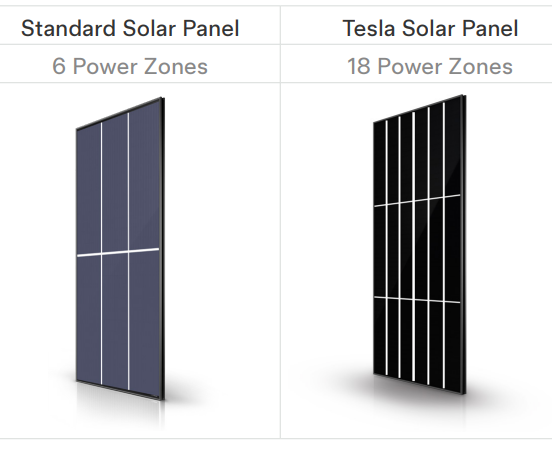
The most technically significant departure from industry norms in the TSP series is the implementation of 18 independent “Power Zones.” Standard residential modules typically utilize three bypass diodes, creating six distinct zones. In traditional architectures, a single shadow from a chimney or vent pipe can effectively “shut down” large swaths of a string’s production.

Tesla’s design essentially triples the granularity of the module. By dividing the electrical architecture into 18 zones, the panel behaves more like a digital screen with a higher pixel count; if one “pixel” is shaded, the remaining 17 continue to harvest energy at near-peak efficiency.

Image: Tesla

While high-density substring architectures have been explored in the utility space, Tesla’s specific 18-zone layout is unique to the residential market, engineered to deliver optimizer-like performance without the added cost and potential failure points of module-level power electronics (MLPE) on the roof.

Inverters, batteries, and mounts

The TSP modules are designed to pair specifically with the Tesla Solar Inverter and Powerwall 3. While Tesla offers these as a unified “Home Energy Ecosystem,” they are not strictly sold as a single, inseparable bundle. However, the hardware is optimized to work as a package; for instance, the panel’s 18-zone design is specifically tuned to perform with Tesla’s string inverter technology.

Tesla is not keeping this technology exclusive to its own crews. While Tesla’s direct installation business leads the rollout, the package is available to Tesla’s network of over 1,000 certified installers.

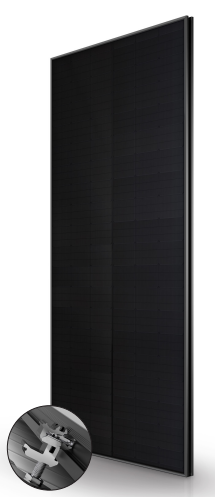
This “installer-first” approach is further evidenced by the new Tesla Panel Mount. The new rail-less mounting system, made of black anodized aluminum alloy, uses the module frame itself as the structural rail.

The new rail-less mounting system, made of black anodized aluminum alloy, uses the module frame itself as the structural rail.
Image: Tesla

By eliminating traditional rails and visible clamps, Tesla said the system is 33% faster to install. The mount sits closer to the roof and is enhanced by aesthetic front and side skirts, maintaining the “minimalist” look Tesla consumers expect.

Product specs

The modules are competitive with the current Tier 1 market, pushing into the 20% efficiency bracket while maintaining a robust mechanical profile, said the company.

Parameter  TSP-415  TSP-420 
Nominal Power (Pmax)  415 W  420 W 
Module Efficiency  20.3%  20.5% 
Open Circuit Voltage (Voc)  40.92 V  40.95 V 
Short Circuit Current (Isc)  12.93 A  13.03 A 
Max System Voltage  DC 1000V  DC 1000V 
Weight  22.3 kg (49 lbs.)  22.3 kg (49 lbs.) 
Dimensions  1805 x 1135 x 40 mm  1805 x 1135 x 40 mm 

 The new Tesla Solar Panels are now available nationwide. 

Solar roof 

For those wondering about the Tesla Solar Roof, the company maintains that the glass tile product remains a core part of its “premium” offering for customers needing a full roof replacement.

The cascading cell technology used in the new TSP modules, which overlaps cells to eliminate visible silver busbars, was originally designed in its Solar Roof product. Tesla is essentially taking the aesthetic and electrical innovations of its luxury roof product and integrating it into a traditional module form factor.

Virtual power plant

Tesla also highlighted the ability for virtual power plant (VPP) participation to increase value for its customers. VPPs coordinate the dispatch of energy stored in Powerwalls, acting as a distributed energy network. 

“We’re working more closely with utilities than ever to ensure that these assets participate in virtual power plants and support the grid and opening up new value streams, both for utilities and consumers that have these assets at home,” said Hastings. “We announced recently that we have a million Powerwalls deployed worldwide and 25% of those are enrolled in a virtual power plant program of some kind.”

Market strategy

The timing of this launch comes at a volatile moment for U.S. solar. With the passage of the “One Big Beautiful Bill” Act (OBBBA), the industry is navigating the early expiration of the 25D residential credit at the end of 2025 and the sunsetting of the 48E commercial credit.

Tesla’s move now is an opportunistic play for standardization and soft-cost reduction. By controlling the entire stack, Tesla can drive down customer acquisition and labor costs, which currently represent the largest portion of a system’s price tag.

“Utility rates across the country are going up, electricity is becoming increasingly unaffordable for homeowners,” said Hastings. “We’re still very bullish on the future of distributed energy here in the United States.”

  •  

Samsung releases new all-in-one heat pump for residential use

The South Korean giant said its new EHS All-in-One provides air heating and cooling, floor heating, and hot water from a single outdoor unit. It can supply hot water up to 65 C in below-zero weather.

South Korean tech giant Samsung has launched a new all-in-one heat pump for residential and commercial use.

Dubbed EHS All-in-One, the system provides air heating and cooling, floor heating, and hot water from a single outdoor unit. It is initially released for the European market, with a Korean rollout expected within a year.

“It delivers stable performance across diverse weather conditions. It can supply hot water up to 65 C even in below-zero weather and is designed to operate heating even in severe cold down to -25 C,” the company said in a statement. “The system also uses the R32 refrigerant, which has a substantially lower impact on global warming compared with the older R410A refrigerant.”

The product is an upgrade to the EHS Mono R290 monobloc heat pump that the company released in 2023. The company has enlarged the propeller fan and used a high-capacity motor in the novel model, reducing the number of fans from two to one. That results in a design with a height of about 850 mm, approximately 40% lower than before.

“The system also introduces a new Heat Recovery feature, which does not release waste heat from the cooling process to the outside but recycles it. Using this feature can boost the energy efficiency of water heating by more than twice under certain conditions,” Samsung added. “It also includes an ‘AI Saving Mode’ that can reduce energy consumption by up to 17%.”

  •  

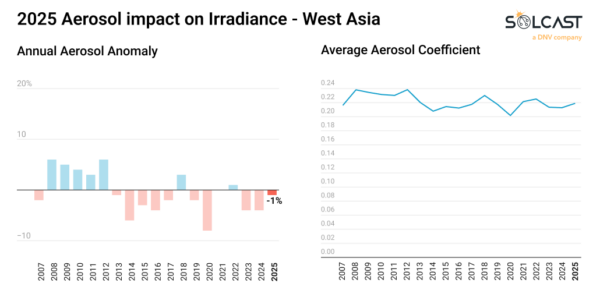
Aerosol divide in 2025 brings clearer skies to China and smoke to Europe

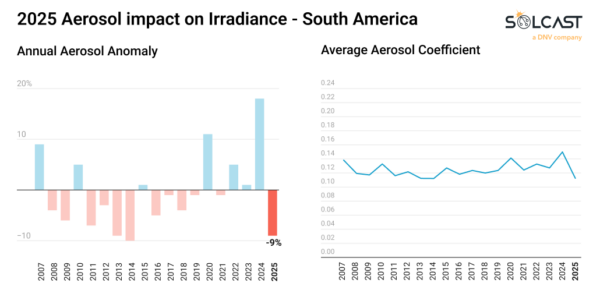
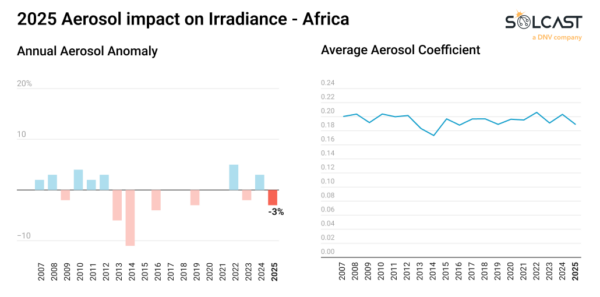
In a new weekly update for pv magazine, Solcast, a DNV company, reveales that last year extreme Canadian wildfires drove aerosol levels around 30% above normal, sharply reducing solar irradiance across Canada and even impacting Europe, while the Congo Basin also saw worsening aerosol conditions. In contrast, China and South America experienced unusually low aerosol levels, supporting stronger solar irradiance due to cleaner air, reduced fires, and favorable climate and policy conditions.

Aerosol anomalies in 2025 reveal the outsized impact of Canadian wildfires on solar conditions, with smoke and particulates from one of the worst fire seasons in the country’s history driving major reductions in solar irradiance across Canada and beyond. While Canada saw a marked increase in aerosol loading, China and South America experienced anomalously low levels, supporting stronger irradiance conditions. Meanwhile, the Congo Basin registered worsening aerosol conditions, highlighting growing concerns for central Africa's solar outlook, according to analysis using the Solcast API. Aerosols impact solar irradiance by scattering and absorbing solar radiation as it passes through the atmosphere, when calculated this effect is called ‘aerosol extinction’.

Across Canada, 2025 aerosol extinction values were around 30% above climatological norms, indicating significantly higher levels of sunlight absorption and scattering by particulate matter. This spike is directly linked to the extreme wildfire season, with the total burned area in 2025 reaching twice the 10-year average. The timing of the peak fire activity, which aligned with the high-irradiance months of May and June, compounded the impact on solar conditions.
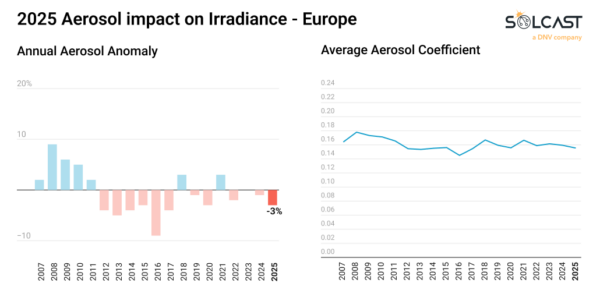
Smoke plumes from Canada were transported across the Atlantic by prevailing westerly winds, impacting solar production as far as Western Europe, where they overlapped with Spain's worst wildfire season in over a decade, further amplifying the regional aerosol burden.

Despite having a higher aerosol load than other solar generation regions, China experienced one of its cleanest atmospheric years in recent history. Aerosol extinction anomalies were approximately 20% below the recent climatology, driven by a combination of favourable meteorological patterns and continued reductions in industrial emissions. These conditions supported a strong irradiance performance throughout the past year when irradiance was already tracking 30% above average.

South America also recorded a notable improvement in aerosol conditions following a turbulent 2024. Anomalies in 2025 were generally 20% to 30% below average, allowing for clearer skies across the region. Solar production in Brazil, benefited from reduced smoke associated with a 45% reduction in burned areas within the Amazon Basin, as detected by the DETER satellite system. This significant decrease is part of a broader post-Bolsonaro shift in environmental management, further supported by La Niña-associated wetter conditions that helped suppress fire activity.

Meanwhile, the Congo Basin experienced worsening aerosol conditions, with extinction anomalies 20% to 30% above climatology. Unlike the declining trends in Saharan dust seen across northern Africa, this spike in aerosols is attributed to increasing fire activity within wet forest regions. The number of active fires in these forests has doubled over the past two decades, largely due to a combination of hotter, drier weather and anthropogenic factors such as conflict or agricultural-driven deforestation

Solcast produces these figures by tracking clouds and aerosols at 1-2km resolution globally, using satellite data and proprietary AI/ML algorithms. This data is used to drive irradiance models, enabling Solcast to calculate irradiance at high resolution, with typical bias of less than 2%, and also cloud-tracking forecasts. This data is used by more than 350 companies managing over 300 GW of solar assets globally.

  •  

Solar PV will have a major role in marshalling our productivity to create a sustainable civilization

In all ages, humankind decided to spend considerable amounts of the available productivity on special monumental projects. Managing climate change and rebalancing within the planetary boundaries is such an activity. The enormous energetic productivity of solar PV may evolve as the central pillar to create a sustainable civilization.

Since civilizations have existed, monumental projects have been undertaken, such as the Pyramids of Giza, the Great Wall of China, the Gothic cathedrals, or the Apollo programme. Substantial labour and resources were invested in such projects, ranging from 0.5% up to 10% of the available productivity in the respective society, and lasting between a few years and more than a century. Such monumental projects can be grouped into five categories: culture, infrastructure, technology, war and conflict, and disaster response. A recent study from Forschungszentrum Jülich, Helmholtz Institute Erlangen Nürnberg for Renewable Energies and LUT University entitled Marshalling our productivity to create a sustainable global civilization investigated monumental projects and their link to excess productivity.

Since the industrial revolution, unprecedented wealth around the world, along with an enormous increase in life expectancy, reduction of infant mortality, reduction of starvation, freeing people from poverty, and creating unparalleled standards of living for many. These benefits were made possible by an ever-increasing use of fuel. At the same time, excessive fossil fuel consumption has led to various repercussions, in particular environmental destruction and climate change.

Reaching a global net-zero emission energy system can be considered a monumental project. Depending on different sources, such as McKinsey, BNEF, the International Energy Agency, or the United Nations, the required annual expenditures to achieve this goal may lie between 0.7 and 1.3% of the global gross domestic product (GDP) to be allocated for a few decades. Such expenditures are in the range of accepted societal choices in the past, for instance the military spending during the Cold War (3% of GDP of the United States for decades, for example) or the Belt and Road Initiative (an estimated 0.75% of GDP of China).

Solar PV gaining ground in the energy system driven by sustainability

The ongoing global energy transition has various facets, with solar PV at its core reaching over 70% of all newly installed power capacity in the world in the recent past as the fastest ramping energy source since the industrial revolution, and positioning solar PV as a prime energy supply solution around the world. Plummeting costs of solar PV and additional renewable energy technologies, complemented by growing battery storage, form the basis of a comprehensive electrification. Since the mid-1990s, global energy transition studies regularly find the contribution of solar PV to the global energy supply by mid-century to be in the order of about 70%.

The energetic sustainability of solar PV has been improved since the invention of the silicon solar cell. The rate at which solar panels have improved over time has been consistent and high for decades. For example, the energy required to make a solar panel has been reduced by 14% every time installations doubled between the 1970s and the 2010s. This learning has been enabled by continuously rising efficiencies, an increase in technology lifetimes, and a reduction in the use of materials per rated power output, as summarized in a recent publication by international PV experts. The energy payback time for PV systems ranges globally between 0.44 – 1.42 years and in Europe between 0.89 – 1.24 years depending on location. The low payback time also results in a large value for the energy returned on investment – a PV system that is operated for 30 years generates between twenty and seventy times the energy that was needed for its production. The lifetime of PV systems may be further increased up to 50 years in the longer term. System-level studies have shown that the energetic sustainability of solar PV remains robust even when accounting for additional energy investments required for batteries, complementary renewable energy technologies, and curtailment, both at global and regional scales.

Rebalancing withing safe and just planetary boundaries enabled by solar PV

Solar PV may emerge as the key driver for a sustainable civilization. This would mean supplying all humans with all needed energy for the highest standards of living, which is estimated to require 150-200 TWp of solar PV installations by the end of this century. A comprehensive Solar-to-X Economy across energy sectors will become a major characteristic in many regions around the world. The upper limit of the range of solar PV installations would even include the energy demand for massive carbon dioxide removal activities to rebalance civilization within safe und just planetary boundaries, which equals to about 10 – 12% of global primary energy supply and may cost about 0.4 – 0.7% of the global GDP to return to 1.0℃ with about 350 ppm of atmospheric CO2 concentration. In this way, PV installations could help in powering carbon dioxide removal to avoid global GDP loss of about 8% if the unintended consequences of our productivity are not addressed. Reaching permanent climate safety and its respective investments can be regarded as a highly profitable venture of civilization in the row of monumental projects in history. The high energetic productivity of solar PV is a major driver to reach a sustainable civilization.

Authors: Christian Breyer, Ian Marius Peters, and Dominik Keiner

This article is part of a monthly column by LUT University.

Research at LUT University encompasses various analyses related to power, heat, transport, desalination, industry, and negative CO2 emission options. Power-to-X research is a core topic at the university, integrated into the focus areas of Planetary Resources, Business and Society, Digital Revolution, and Energy Transition. Solar energy plays a key role in all research aspects.

  •  

Ikea, Svea Solar launch dynamic electricity tariff in Germany

Ikea is expanding its energy offerings in Germany with a dynamic electricity tariff in partnership with Svea Solar, changing every 15 minutes based on day-ahead market prices and available even to customers without its PV systems, storage solutions, or heat pumps.

From pv magazine Germany

Ikea is expanding its energy footprint in Germany. After offering PV systems, balcony solar panels, storage solutions, wallboxes, and heat pumps, the retailer now provides a dynamic electricity tariff. Prices fluctuate every 15 minutes according to activity on the day-ahead electricity market.

The offer is in partnership with the German subsidiary of Swedish PV installer Svea Solar. Ikea acts solely as an intermediary, while Svea Solar is the contractual partner. Customers can subscribe to the tariff without owning any solar or storage systems. Germany is the first market worldwide where Ikea is introducing this tariff.

Called Svea Strom, the tariff supplies electricity exclusively from TÜV-certified renewable sources. An app displays expected electricity prices for the following day. Ikea has not detailed the calculation method for the energy charge but confirmed there is no price cap. A test inquiry with Svea Solar indicated a two-cent-per-kilowatt-hour procurement fee on top of the market price. Network charges, taxes, levies, and surcharges also apply.

The monthly basic fee is €6.99 ($8.21) or €5.95 for Ikea Family and Ikea Business Network members. Members signing up by Feb. 1, 2026, receive a six-month fee waiver. After six months of loyalty, Ikea provides a €25 shopping voucher. The tariff is immediately available and can be canceled monthly.

Eligible households receive a free smart meter if electricity consumption exceeds 6,000 kWh per year or if a heat pump or wallbox is installed according to Section 14a of the German Energy Industry Act (EnWG).

Ikea projects households with battery storage could save around €300 per year, with potential savings up to €500 if a PV system, wallbox, or heat pump is installed.

“We want to make sustainable energy affordable and accessible for the many people, regardless of housing situation, income, or technical expertise,” said Jacqueline Polak, expert for sustainable energy solutions at Ikea Germany. “Our goal is to create more transparency, flexibility, independence, and social participation in the energy market. Sustainable energy should not be a privilege, but the new normal.”

  •  

Solar generates record 13% of EU electricity in 2025

EU solar generation increased by over 20% for the fourth year running in 2025, with its share in the energy mix surpassing coal and hydro. For the first time in history, solar and wind generated more energy in the EU than fossil fuels.

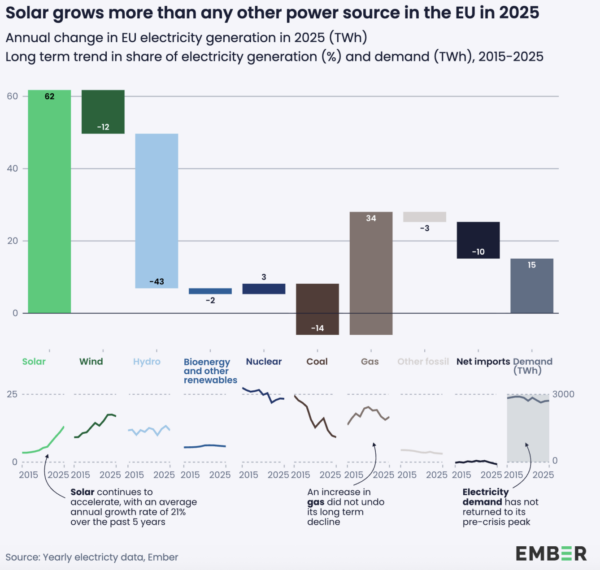
Solar generated a record 369 TWh of energy across the EU in 2025, according to the European Electricity Review published by energy think tank Ember.

The result is an increase of 62 TWh on 2024 and more than doubles the 145 TWh generated in 2020. Ember says solar energy has grown at an average annual growth in generation of 21% over the past five years, a rate far beyond any other energy source.

This growth trajectory, buoyed by an added 65.1 GW of solar in the EU last year, led solar to generate a record 13% of the bloc's power in 2025, moving ahead of coal and hydro. Every EU country saw growth in solar generation increase year-on-year last year, led by Hungary with a 28% contribution to its power mix. In Cyprus, Greece, Spain and the Netherlands, solar’s share in the electricity mix was also over 20%. 

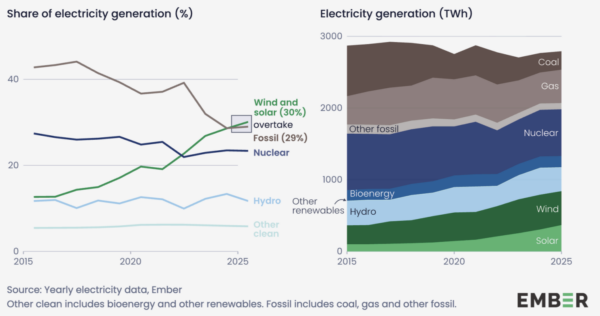
For the first time in history, solar and wind energy generated more EU electricity than fossil fuels in 2025, together responsible for a record 30% of EU power ahead of fossil fuels’ 29%. Solar and wind generated more electricity than all fossil sources in 14 of the EU’s 27 member states.

Report author Beatrice Petrovich said the milestone shows just how rapidly the EU is moving towards a power system backed by wind and solar. “As fossil fuel dependencies feed instability on the global stage, the stakes of transitioning to clean energy are clearer than ever,” Petrovich said.

In 2025, 19 EU countries recorded at least one hour when wind and solar combined accounted for over 70% of the country's hourly power generation, compared to only two countries in 2020. Ember found wind and solar supplied more than half of electricity generation during at least one third of all hours in Denmark, Estonia, Germany, Greece, Lithuania, Luxembourg, the Netherlands, Portugal and Spain. 

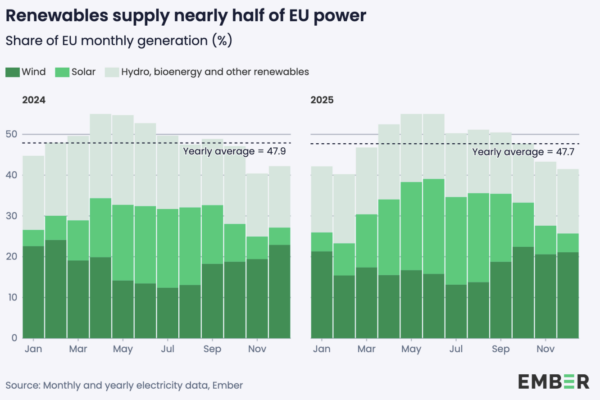
Ember’s report adds that all renewable sources, comprising solar, wind, hydro, bioenergy and other renewables, generated a total 1,331 TWh of energy in the EU last year for a 47.7% share of the total mix, 0.2% down on the year prior. The report says the share remained stable as the weather conditions that caused a drop in wind and hydro output boosted solar generation.

While gas generation rose by 8% compared to 2024, pushing the EU power sector’s gas import bill up to €32 billion, coal power fell to a historic low of 9.2%, with 19 EU countries now generating less than 5% of their energy from coal.

As solar and wind energy becomes the backbone of Europe’s power system, Ember’s report says electricity storage, together with grid enhancements and demand flexibility, will be crucial to put increasingly abundant renewable power to use and displace imported fossil power.

Among a series of recommendations listed in the report is removing barriers to battery deployment in national legislation, EU member states collaboration on permitting for key cross-border power lines, supporting investment in heat pumps and other electric technologies, introducing policy for electrifying transport, heating, and industry via the forthcoming Electrification Action Plan and delivering legislation to ban Russian gap and LNG imports by 2027.

  •