Reading view

Reducing PV module temperature with leaf vein–inspired fins

Researchers in Iraq have developed biomimetic leaf vein–inspired fins for photovoltaic panels, with reticulate (RET) venation reducing panel temperature by 33.6 C and boosting efficiency by 18% using passive cooling. Their study combines 3D CFD simulations and electrical evaluations to optimize fin geometry, offering a sustainable alternative to conventional cooling methods.

A research group from Iraq’s Al-Furat Al-Awsat Technical University has numerically investigated the thermal and electrical performance of PV panels integrated with leaf vein–inspired fins. They have simulated four types of venation used by plants, namely pinnate venation (PIN), reticulate venation (RET), parallel venation along the vertical axis (PAR-I), and parallel venation along the horizontal axis (PAR-II).

“The key novelty of our research lies in introducing and systematically optimizing biomimetic leaf vein–inspired fin geometries as passive heat sinks for photovoltaic panels,” corresponding author Yasser A. Jebbar told pv magazine. “While conventional cooling approaches rely on simple straight fins, fluids, or active systems, our study is among the first to directly translate natural leaf venation patterns—particularly RET structures—into manufacturable backside fins specifically tailored for PV thermal and electrical performance.”

The team combined detailed 3D computational fluid dynamics (CFD) modeling with electrical efficiency analysis to identify geometries that maximize heat dissipation without additional energy input or water consumption. Next steps include experimental validation of the leaf vein fin designs under real outdoor conditions, particularly in hot climates.

The simulated PV panel consisted of five layers: glass, two ethylene-vinyl acetate (EVA) layers, a solar cell layer, and a Tedlar layer, with a copper heat sink and fins attached. All fin configurations were initially 0.002 m thick, 0.03 m high, and spaced 0.05 m apart. Panels measured 0.5 m × 0.5 m, with a surrounding air velocity of 1.5 m/s and incident irradiance of 1,000 W/m².

RET fins outperformed all other designs, reducing operating temperature by 33.6 C and increasing electrical efficiency from 12.0% to 14.19% —an 18 % relative improvement—compared to uncooled panels.

“This temperature reduction rivals, and in some cases exceeds, water-based or hybrid cooling methods, despite relying solely on passive air cooling,” Jebbar noted. The study also highlighted the significant impact of fin height, more than spacing or thickness, on cooling performance.

The team further optimized the RET fins, varying spacing from 0.02–0.07 m, height from 0.02–0.07 m, and thickness from 0.002–0.007 m. The optimal geometry—0.03 m spacing, 0.05 m height, and 0.006 m thickness—achieved the maximum 33.6 C temperature reduction and 18% efficiency gain.

The novel cooling technique was described in “Improving Thermal and Electrical Performance of PV Panels Using Leaf Vein Fins,” published in Solar Energy. Researchers from Iraq’s Al-Furat Al-Awsat Technical University, University of Kerbala, and Sweden’s University of Gävle have participated in the study.

  •  

UNSW researchers identify new damp heat-induced failure mechanism in TOPCon solar modules

UNSW researchers identified a new damp-heat degradation mechanism in TOPCon modules with laser-fired contacts, driven primarily by rear-side recombination and open-circuit voltage loss rather than series-resistance increase. The study highlights that magnesium in white EVA encapsulants accelerates degradation, guiding improved encapsulant and backsheet selection for more reliable modules in humid environments.

A research team from the University of New South Wales (UNSW) has identifed a new damp heat-induced degradation pathway in TOPCon modules fabricated with laser-assisted fired contacts.

“Unlike earlier studies dominated by series-resistance increase, the primary degradation driver here is a reduction in open-circuit voltage, linked to enhanced rear-side recombination,” the research's lead author, Bram Hoex, told pv magazine. “The new degradation mechanism emerged under extended damp-heat (DH) exposure.”

The scientists conducted their analysis on 182 mm × 182 mm TOPCon cells fabricated in 2024 with laser-assisted firing.

The TOPCon solar cells employed a boron-doped p⁺ emitter, along with a front-side passivation stack consisting of unintentionally grown silicon dioxide (SiOₓ), aluminium oxide (Al₂O₃), and hydrogenated silicon nitride (SiNₓ:H), capped with a screen-printed H-pattern silver (Ag) contact grid. On the rear side, the structure comprised a SiO₂/phosphorus-doped n⁺ polycrystalline silicon/SiNₓ:H stack, also contacted by a screen-printed H-pattern Ag grid.

The researchers encapsulated the cells with different bill of materials (BOMs): two types of ethylene vinyl acetate (EVA); two types of polyolefin elastomer (POE); and one type of EVA-POE-EVA (EPE). They also used commercial coated polyethylene terephthalate (PET) composite (CPC) backsheets.

“The mini modules were laminated at 153 C for 8 min under standard industrial lamination conditions,” the academics explained. “All modules underwent DH test at 85 C and 85% relative humidity (RH) in an ASLi climate chamber for up to 2,000 h to study humidity-induced failures.

Schematic of the TOPCon solar cells and modules

Image: UNSW, Solar Energy Materials and Solar Cells, CC BY 4.0

The tests showed that maximum power losses ranged from 6% to 16%, with the difference among these values depending strongly on the encapsulation BOM.

“The modules with POE on both sides were the most stable at around 8%, while those using white EVA on the rear side, especially in combination with EPE, showed the largest losses at around 16%,” said Hoex. “The primary driver of the degradation was a reduction in open-circuit voltage rather than the increased series resistance after DH testing, which diverges from previous findings that predominantly attributed DH-induced degradation to metallisation corrosion.”

The research team explained that higher levels of degradation were attributable to additives containing magnesium (Mg) in white EVA, which migrate under DH, hydrate, and create an alkaline micro-environment. “This alkaline chemistry corrodes the rear SiNx passivation layer, increases interfacial hydrogen concentration, induces local pinhole-like defects, and raises dark saturation current, ultimately reducing open-circuit voltage,” Hoex emphasized.

The scientists also explained that, although Mg in white EVA encapsulants and its role in acetic acid–induced degradation was previously reported, the effect of MgO on performance degradation in TOPCon modules was not explicitly studied.

Their findings are available in the paper “A novel damp heat-induced failure mechanism in PV modules (with case study in TOPCon),”  published in Solar Energy Materials and Solar Cells.

“We hope this work helps refine encapsulant and BOM selection strategies for next-generation TOPCon modules, particularly for humid-climate deployment,” Hoex concluded. “It provides clear guidance for controlling Mg content in rear encapsulants and optimising rear-side passivation robustness. The mechanistic insights from this study have already informed upstream design changes, substantially reducing risk in commercial modules.”

Other research by UNSW showed the impact of POE encapsulants in TOPCon module corrosion, soldering flux on TOPCon solar cell performancedegradation mechanisms of industrial TOPCon solar modules encapsulated with ethylene vinyl acetate (EVA) under accelerated damp-heat conditions, as well as the vulnerability of TOPCon solar cells to contact corrosion and three types of TOPCon solar module failures that were never detected in PERC panels.

Furthermore, UNSW scientists investigated sodium-induced degradation of TOPCon solar cells under damp-heat exposure, the role of ‘hidden contaminants’ in the degradation of both TOPCon and heterojunction devices, and the impact of electron irradiation on PERC, TOPCon solar cell performance.

More recently, another UNSW rsearch team developed an experimentally validated model linking UV-induced degradation in TOPCon solar cells to hydrogen transport, charge trapping, and permanent structural changes in the passivation stack.

  •  

China added 66.43 GW of new-type energy storage in 2025

CNESA says China’s non-pumped storage technologies hit 144.7 GW in 2025, with 66.43 GW added.

From ESS News

China’s cumulative power-sector energy storage capacity reached 213.3 GW by the end of 2025, up 54% year on year, according to data from the China Energy Storage Alliance (CNESA). Pumped hydro accounted for 31.3% of the total, while “new-type” energy storage made up 67.9% – around 144.7 GW.

Based on CNESA DataLink 2025 annual energy storage dataset, presented at a press conference in Beijing on Jan. 22, a total of 66.43 GW/189.48 GWh of new-type energy storage systems were commissioned in 2025.

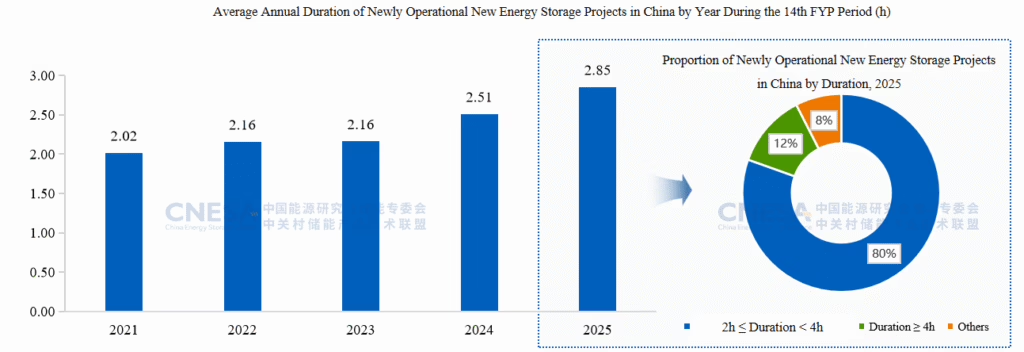
The added power and energy scales increased 52% and 73% year on year, respectively, which CNESA linked to a continued shift toward longer-duration configurations, it reported the average duration rising to 2.58 hours in 2025 (from 2.11 hours in 2021).

CNESA said the leading application scenario has shifted toward standalone energy storage, which accounted for 58%, while user-side storage fell to 8% and thermal-plus-storage frequency regulation to 1.4%; “renewables-paired storage” was described as stable.

Geographically, CNESA reported that the top 10 provinces each exceeded 5 GWh of newly commissioned capacity and together represented about 90% of additions. Inner Mongolia ranked first by both power and energy capacity, and Yunnan entered the top 10 for the first time.

Lithium iron phosphate (LFP) batteries continued to dominate, with CNESA reporting over 98% of new-type installed capacity. CNESA also noted emerging deployments of sodium-ion, vanadium flow, compressed air, gravity storage, and hybrid systems, separately citing a 40 MW/40 MWh grid-forming sodium-ion project in Wenshan, Yunnan as an example.

On procurement, CNESA reported 690 energy storage system tenders (excluding centralized/framework procurement), down 10.4%, while EPC tenders rose to 1,536, up 4.5%. Winning bid volumes (excluding centralized/framework procurement) reached 121.5 GWh for systems and 206.3 GWh for EPC.

CNESA’s tender-price analysis for LFP systems (excluding user-side applications) reported a 2025 winning bid price range of CNY 391.14/kWh ($55/kWh) to CNY 913.00/kWh ($128/kWh). For EPC (excluding user-side), CNESA reported average winning bid prices of CNY 1,043.82/kWh ($146/kWh) for 2-hour projects and CNY 935.40/kWh ($131/kWh) for 4-hour projects.

CNESA also launched a policy “map” for standalone storage market mechanisms covering 21 provinces.

  •  

Uncertainty looms as U.S. solar PPA prices climb for second straight quarter

A report from LevelTen Energy finds solar PPA prices in North America rose 3.2% in Q4 2025, marking a nearly 9% year-over-year increase as developers and buyers navigate a complex “post-OBBBA” regulatory environment.

From pv magazine USA

Renewable energy power purchase agreement (PPA) prices continued their upward trajectory in the final quarter of 2025, driven by persistent policy headwinds and a shifting tax credit landscape.

According to the Q4 2025 PPA Price Index from marketplace operator LevelTen Energy, solar P25 prices rose by 3.2% following a 4% increase in the third quarter.

While solar costs climbed, wind PPA prices saw a slight dip, declining 1%. However, on an annual basis, both technologies have seen prices surge by nearly 9% compared to the same period last year.

Post-OBBBA

The market is currently adjusting to the “One Big Beautiful Bill Act” (OBBBA), which introduced tax credit cuts. LevelTen noted the second half of 2025 was defined by “ruthless” prioritization as firms scrambled to safe-harbor projects.

Despite these challenges, a November survey of developers representing over 230 GW of capacity found that more than 75% of projects slated to go online before 2029 expect to successfully retain access to tax credits.

This clarity has allowed some developers to dial in pricing by removing risk premiums that had previously accounted for OBBBA-related uncertainties, said the report.

Regional pricing

The report highlights significant price disparity across North American ISOs. For solar, P25 prices reached as high as $115 per MWh in ISO-NE and $81.03/MWh in PJM, while ERCOT remained the most competitive at $49 per MWh.

ISO Market  Solar P25 Price ($/MWh) 
ISO-NE  $115.00  
PJM  $81.03  
MISO  $64.95  
CAISO  $62.00  
ERCOT  $49.00 

In the wind sector, ERCOT has seen a massive 19% year-over-year price hike, fueled by an ongoing boom in data center development and a premium on available capacity. 

Buyer headwinds

LevelTen pointed to several factors that could continue to apply upward pressure on prices:

  • Tariff uncertainties: Ongoing Section 232 investigation tariffs are adding direct development costs.
  • Permitting hurdles: “Harsh” new federal permitting procedures have stalled substantial amounts of development nationwide.
  • FEOC: The industry is still awaiting guidance on Foreign Entity of Concern (FEOC) rules, which are expected to add compliance costs and further complicate tax credit qualification.

Corporate strategy

Many corporate buyers are now pausing or adjusting their procurement strategies due to proposed updates to the Greenhouse Gas Protocol (GHGP) Scope 2 standards, said the report. The updates, expected to be finalized in 2027, may introduce more stringent accounting for hourly matching and physical deliverability.

“The current uncertainty has caused some buyers… to adjust or even delay their procurement strategies,” the report said.

LevelTen encourages industry players to weigh in on the proposal, as 97% of companies tracking emissions currently utilize the GHGP.

As buyers and sellers work to establish a “pricing equilibrium,” the report said in markets where contract values are challenging, sellers may need to find more transactable pricing levels to get deals done.


  •  

Extension of Bid Submission Deadline: Tender for Balance of System for 700 MW (AC) Solar PV Power Plant at Radha Nesda, Banaskantha, Gujarat, India – EQ

Tender for Balance of System for 700 MW (AC) Solar PV Power Plant at Radha Nesda, Banaskantha, Gujarat, India.

Tender No: SECI/C&P/OP/11/023/2025-26

ETS ID: SECI-2026-TN000001

CPPP ID: 2026_SECI_825234_1

Revised Bid Submission Deadline: 19.02.2026 (Thursday, 1400 Hrs.)

Revised Bid Opening Timeline: 19.02.2026 (Thursday, 1600 Hrs.)

  •  

The Hydrogen Stream: Repsol, Sunfire advance 200 MW of green H2 in Spain

Repsol and Sunfire are advancing 200 MW of renewable hydrogen projects in Spain, while new collaborations and funding across Europe and India aim to accelerate electrolyzer development and hydrogen infrastructure.

Repsol has approved its second 100 MW electrolyzer at the Petronor industrial complex in Bilbao. “The electrolyzer will have the capacity to produce up to 15,000 tons of renewable hydrogen annually, which will mainly be used at the company’s Petronor refinery outside Bilbao in Northern Spain,” said the Spanish oil and gas company, adding that the new plant for producing renewable hydrogen will require an investment of €292 million ($347.9 million). The company did not explain the timing of the installation.

Sunfire said it will supply two 100 MW electrolyzers for renewable hydrogen projects in Spain. The first project, led by Repsol and Enagás Renovable, will install a 100 MW electrolyzer near Repsol’s industrial complex in Cartagena. The second 100 MW plant will be located at Petronor’s refinery in Muskiz (Bilbao), which is owned by Repsol and Kutxabank,” said the German company. For each of the two 100 MW projects, Sunfire will deliver ten of its 10 MW pressurized alkaline electrolyzer modules.

Matteco and Dunia Innovations have kicked off a strategic collaboration to accelerate the development of catalyst layers used inside AEM (Anion Exchange Membrane) electrolyzers. “Matteco contributes deep expertise in electrocatalysts, functional inks, and scalable electrodes, while Dunia brings its AI-guided experimentation platform, which helps test and compare many different material options quickly and consistently, under conditions that reflect how real electrolyzers operate,” said Spain-based Matteco. Dunia Innovations is based in Germany.

The European Commission said it will allocate nearly €650 million in grants to help finance 14 cross-border energy infrastructure projects. More than €176 million will be dedicated to boost hydrogen infrastructure. “The grant of €120 million for the hydrogen storage in Gronau project in Germany marks the first time CEF funding will be used for a works project for hydrogen,” said the European executive body, adding that other hydrogen projects in Austria, Bulgaria, France, Germany, the Netherlands and Slovakia will receive grants to support studies.

Tubos Reunidos (TR) said it is developing a seamless pipe that meets the specific requirements of the hydrogen sector. “The project aims to develop a 1.25 MW experimental portable electrolyzer, conceived as an enabling solution for the supply of green hydrogen to final industrial users,” said Eurometal, the European federation of steel tubes and metals distribution and trading. “The initiative is being led by a Basque consortium including Tubos Reunidos, ArcelorMittal Sestao, Sarralle, ABC Compresores, Matz-Erreka, Flubetech Coatings, Mugape, Sener, Team Group, Torraval Cooling, and Zigor Corporación.”

Deutsche Gesellschaft für Internationale Zusammenarbeit (GIZ) and thyssenkrupp nucera have entered into a new cooperation to accelerate the development of green hydrogen and Power-to-X (PtX) markets in India. “India is one of the most promising future markets for green hydrogen electrolysis. This cooperation enables us to deepen our understanding of the local market and engage more closely with India’s hydrogen ecosystem. It also reflects our strong commitment to supporting India’s ambitious National Green Hydrogen Mission,” said Kiran Paul Joseph, CEO of thyssenkrupp nucera India.

Greenzo Energy India has secured the contract for India’s first port-based 5 MW Green Hydrogen Plant at Deendayal Port, Kandla. The project has been awarded to Oswal Greenzo Energies, the JV between Oswal Energies Limited and Greenzo Energy India Limited. “Designed on an EPC basis, the project is scalable beyond the initial 5 MW up to 10 MW and is expected to produce approximately 800 tonnes of green hydrogen annually,” said Greenzo Energy.

Orlen has entered into cooperation agreements with three Finnish partners for the production and supply of renewable hydrogen and its derivatives. “The agreements signed with ABO Energy Suomi, Nordic Ren-Gas and VolagHy Kuopio SPV will help secure hydrogen supplies during a period of growing demand in the years ahead,” said Orlen.

Powerhouse Energy (PHE) has secured a site on Silverwood Business Park in Ballymena, Northern Ireland, on which the company submitted a planning application for a 40-ton per day (TPD) waste-to hydrogen facility. The site, 1.98 acres, will use a pilot unit.

  •  

DKEM seeks $57.5 million in twin patent suits against Chinese PV rivals

Wuxi DK Electronic Materials is pursuing two patent infringement cases against domestic competitors, seeking injunctions, equipment destruction, and combined damages of CNY 400 million ($57.5 million).

Wuxi DK Electronic Materials has filed two patent infringement lawsuits with the Jiangsu High People’s Court against Jiangsu Riyu Photovoltaic New Materials and Suzhou Jinyin New Materials Technology , seeking CNY 200 million in damages and related legal costs in each case.

The company said both filings have been formally accepted and registered by the court, although hearing dates have not yet been scheduled.

The lawsuits concern two Chinese invention patents, ZL201180032359.1 and ZL201180032701.8, covering thick-film conductive paste formulations for semiconductor devices, including solar cells. DKEM said the patents are held by its subsidiary Solamet Electronic Materials and relate to lead-tellurium-lithium and oxide-based paste technologies.

DKEM is seeking injunctions to halt the manufacture, sale, and offering for sale of the allegedly infringing pastes. The company is also requesting the destruction of dedicated production equipment and molds, and compensation for economic losses, enforcement costs, and related expenses.

The patents trace back to the intellectual property portfolio of DuPont’s former Solamet photovoltaic paste business, acquired by another entity in 2021 for $190 million. DKEM later consolidated control of the Solamet assets and associated intellectual property.

Suzhou Jinyin is described in Chinese financial reporting as a leading supplier of front-side silver paste for solar cells, ranking third globally by market share. Founded in 2011, it was later acquired by listed electronics firm Suzhou Good-Ark Electronics. Jiangsu Riyu is a fast-growing paste supplier that filed a Hong Kong listing application in 2025, with plans to expand into n-type and back-contact paste products.

This follows earlier high-value patent actions by DKEM. In 2025, its subsidiary filed a suit against Zhejiang Guangda Electronic Technology seeking similar remedies. A Solamet-linked entity also pursued related claims against Changzhou Juhe New Materials in 2021, with domestic and overseas disputes reportedly settled in August 2022.

Separately, DKEM flagged earnings pressure, forecasting a net loss of CNY 200 million to CNY 300 million for 2025, primarily linked to non-operating factors, according to Chinese financial media.

  •  

TheStorage launches its first industrial-scale sand-based heat storage system

The Finnish start-up says its sand battery technology is scalable from 20 to 500 MWh with charging power from 1 to 20 MW, depending on industrial needs.

From ESS News

Finnish cleantech startup TheStorage says that its thermal storage technology could reduce industrial energy costs by up to 70% and cut carbon emissions by as much as 90%. The system converts renewable electricity into heat, stores it in sand, and delivers it on-demand for industrial heating.

The concept emerged in Finland in 2023, with engineering work beginning in 2024. In January 2026, TheStorage installed its first industrial-scale pilot at a brewery, putting the technology to the test in a real-world setting. There, it produces fossil-free steam for the brewery’s production lines.

“Producing steam without fossil fuels is a major step toward carbon-neutral production,” says Vesa Peltola, Production Director of the brewery.

TheStorage’s technology captures electricity when it is abundant and inexpensive, converts it into high-temperature heat, and stores it in sand. This stored heat can later be used in industrial processes independently of real-time electricity availability.

To continue reading, please visit our ESS News website.

  •  

Agrivoltaics can help lettuce survive extreme heat

Scientists have grown organic romaine lettuce under 13 different types of PV modules, in an unusual hot Canadian summer. Their analysis showed lettuce yields increased by over 400% compared to unshaded control plants.

A research group from Canada’s Western University has investigated the performance of organic romaine lettuce, a heat-sensitive crop, under a broad range of agrivoltaic conditions. The test was conducted in London, Ontario, in the summer of 2025, during which 18 days had temperatures over 30 C.

“Our study explores how agrivoltaic systems can be tailored to optimize crop growth, especially under extreme heat conditions, while contributing to sustainable energy generation,” corresponding researcher Uzair Jamil told pv magazine.

“This becomes especially relevant in the context of climate change, where we are experiencing temperature extremes across the world,” Jamil added. “We examined the performance of organic romaine lettuce under thirteen different agrivoltaic configurations – ranging from crystalline silicon PV to thin-film-colored modules (red, blue, green) – in outdoor, high-temperature stress conditions.”

More specifically, the experiment included c-Si modules with 8%, 44% and 69% transparency rate; blue c-Si modules with transparency of 60%, 70%, and 80%; green c-Si modules with transparency of 60%, 70%, and 80%; and red c-Si modules with transparency of of 40%, 50%, 70%, and 80%.

All agrivoltaics installations had a leading-edge height of 2.0 m and a trailing-edge height of 2.8 m, and the modules were oriented southwards at 34◦. Pots with organic romaine lettuce were placed under all configurations, along with three pots fully exposed to ambient sunlight without shading, used as controls.

In addition to measurements against the control, the scientific group has compared the results to the national average per-pot yield for 2022, which included less high-temperature days and was therefore considered typical. Those data points were taken from agricultural census data, which later enabled the researcher also to create nationwide projections of their results.

“Lettuce yields increased by over 400% compared to unshaded control plants, and 200% relative to national average yields,” Jamil said about the results. “60% transparent blue Cd-Te and 44% transparent crystalline silicon PV modules delivered the highest productivity gains, demonstrating the importance of both shading intensity and spectral quality in boosting plant growth.”

Jamil further added that if agrivoltaic were to scale up to protect Canada’s entire lettuce crop, they could add 392,000 tonnes of lettuce.

“That translates into CAD $62.9 billion (USD $46.6 billion) in revenue over 25 years,” he said. “If scaled across Canada, agrivoltaics could also reduce 6.4 million tonnes of CO2 emissions over 25 years, making it a key player in reducing the agricultural sector’s environmental footprint.”

The results of the research work were presented in “Enhancing heat stress tolerance in organic romaine lettuce using crystalline silicon and red, blue & green-colored thin film agrivoltaic systems,” published in Solar Energy.

  •  

Chinese PV Industry Brief: Polysilicon output set to fall by 15% in January

Polysilicon trading in China remained largely inactive, with production cuts accelerating and wafer prices falling week on week, while downstream cell prices continued to rise and module prices held steady, according to a trade group representing China's nonferrous metals sector.

The China Nonferrous Metals Industry Association (CNMA) said polysilicon trading remained largely stalled, with only limited exploratory orders completed. One leading producer has halted operations, while two others have implemented production cuts. January output is expected to fall by about 15% month on month, broadly in line with wafer production schedules, with February output forecast at 82,000 to 85,000 metric tons. The association said most wafer prices declined week on week, with average transaction prices at CNY 1.26 per piece for n-type G10L wafers, down 3.82%; CNY 1.32 for n-type G12R wafers, down 7.04%; and CNY 1.52 for n-type G12 wafers, down 8.43%. Downstream cell prices rose to CNY 0.41/W to CNY 0.45/W, up 4.88%, while module prices were stable at CNY 0.71/W to CNY 0.75/W.

Hoymiles has signed a supply contract with Indian renewable energy solutions provider KOSOL Energie to deliver 360 MW of its HMS series microinverters in 2026. The company said the products are optimized for India’s high-temperature, high-humidity, and high-irradiance conditions, as well as for larger module formats, large-scale commercial and industrial rooftops, and complex grid environments.

Boway Alloy has issued a profit warning, forecasting full-year 2025 net profit attributable to shareholders of CNY 100 million to CNY 150 million, down 88.9% to 92.6% year on year. The China-listed parent of Vietnam-based Boviet Solar said the decline reflects impairment charges linked to high US anti-dumping and countervailing duties on Vietnam-manufactured products, which made relocating production uneconomic, as well as reduced subsidies and order losses at its United States subsidiary following passage of the United States “Big and Beautiful” Act. Boway Alloy said it is exploring equity divestment options.

PowerChina has signed an engineering, procurement and construction (EPC) contract through its Colombia branch for a 251 MW solar project in Santander province, Colombia. The scope includes PV plant development, equipment supply, installation and commissioning, with a string inverter plus tracking system configuration intended to improve generation efficiency and operational stability.

Deye said it submitted an application on Jan. 27 to issue H shares and list on the main board of the Hong Kong Stock Exchange. The company said its listing application materials were published on the exchange’s website the same day.

  •  

Cubenergy releases energy storage block for utility, C&I applications

Cubenergy has launched FlexCombo 2.0, a scalable battery energy storage system for utility, commercial, and industrial applications, offering up to 16 MWh capacity with LFP batteries. Its modular design, advanced BMS, and cloud-based operations enable easy installation, seamless expansion, and efficient grid integration, according to the manufacturer.

Cubenergy, a Chinese manufacturer of battery energy storage systems (BESS), has introduced a new energy block designed for utility, commercial, and industrial (C&I) applications.

The product, named FlexCombo 2.0, uses the company’s 835 kWh FlexCombo D2 batteries. It is available in three configurations: 10, 12, or 12 batteries, providing a total capacity of 8 MWh, 10 MWh, or 16 MWh, respectively.

“With the FlexCombo D2 modular design and parallel architecture, FlexCombo’s core advantage lies in its long-term scalability,” the company said in a statement. “It enables seamless capacity growth and effortless integration with power generation systems (PGS), simplifying deployment and accelerating delivery for ultimate flexibility.”

The FlexCombo D2 batteries feature lithium iron phosphate (LFP) chemistry, offering a lifespan of 8,000 cycles at 70% capacity retention, according to the manufacturer.

Each battery measures 2 m x 1.68 m x 2.55 m and has a weight of up to eight tons. They carry an IP55 protection rating. Each block also comes with a power conversion system (PCS) rated at 430 kW AC with an IP66 protection grade. Optional medium-voltage (MV) transformers are available, with AC power ratings of either 8,800 kVA or 5,250 kVA.

“The FlexCombo 2.0 is designed primarily for utility and C&I applications, including renewable energy arbitrage, stand-alone grid stabilization, factories, and commercial buildings,” the company stated. “This integrated, easy-to-install BESS can be quickly connected and aligned with project requirements, while the advanced Active Balancing battery management system (BMS) and cloud-based operations provide a superior user experience.”

  •  

‘Women with young children are frequently expected to prove they are prioritizing work’

This week Women in Solar+ Europe gives voice to Alba Sande, lawyer at Spanish law firm ASande Legal. She states that, despite progress, women remain underrepresented in the renewable energy industry. "As a woman and a mother, I have often encountered the unspoken assumption that professional ambition must take a backseat to family life, a bias rarely applied to men," she says.

The solar, energy storage, EV charging, and grid infrastructure sectors sit at the heart of the energy transition. What makes these industries particularly suited to, and in need of, gender diversity and inclusion is the nature of the challenge itself. The energy transition demands innovative thinking, long-term vision, and the ability to manage complexity across technical, legal, regulatory, and social dimensions. Gender diversity brings varied perspectives, leadership styles, and problem-solving approaches. Inclusion ensures those voices are heard and valued.

These industries work best when they reflect the diversity of the communities they serve. Decision-making becomes stronger when collaboration replaces uniformity. Diverse teams are not only fairer; they are more effective, more resilient, and better prepared to build a sustainable future.

From my experience, diversity, equity, and inclusion are directly linked to the resilience and success of the renewable energy sector. DEI broadens the range of inputs organizations rely on to navigate complexity. Inclusive workplaces foster trust and psychological safety, encouraging open dialogue and the kind of bold ideas that innovation requires. This is essential in a fast-evolving sector like renewable energy, where adaptation is constant. When professionals feel empowered to contribute, retention improves, decision-making becomes more robust, and strategies are better aligned with societal needs. DEI is not separate from business success, it is integral to long-term impact.

Looking back at my own career, I encountered systemic barriers that many women in male-dominated industries will recognise. Implicit biases about how leadership should look and sound, often shaped by traditional models, were persistent. The absence of visible female role models and the lack of structural support, particularly for those balancing care responsibilities, created additional friction. Overcoming these challenges required building strong support networks, staying grounded in purpose, and allowing results to speak clearly. It also meant resisting pressure to “fit the mould” and instead demonstrating that strategic thinking, empathy, and consistency are powerful leadership traits.

Over time, I have observed important shifts in how the industry approaches gender inclusion in leadership. There is greater recognition that diverse leadership is not simply desirable; it is necessary. We are seeing more women in strategic roles and greater openness to flexible career paths. That said, inclusion at senior levels still requires deliberate effort. True progress happens when organisations understand that leadership potential is not tied to a single profile or personal circumstance. Valuing varied life experiences, including those shaped by caregiving, strengthens leadership culture and builds resilience.

Navigating bias and scepticism has been a defining part of my professional journey. As a woman and a mother, I have often encountered the unspoken assumption that professional ambition must take a backseat to family life, a bias rarely applied to men. Yet this is not about choosing one over the other; it is about integration. Early on, I realised that women with young children are frequently expected to prove they are prioritising work in order to be taken seriously. My response was consistency, results, and a clear message: commitment is not gendered.

Even today, driving DEI initiatives at an executive level remains challenging. Despite progress, women remain underrepresented in decision-making spaces. In my experience, around 80% of strategic meetings still involve only men, particularly when critical decisions are being made. One of the greatest challenges is feeling like an equal, owning expertise, and expressing it with confidence in environments where women are often required to repeatedly prove their competence, while male colleagues are assumed to be capable by default. This imbalance makes DEI both essential and deeply personal to lead.

There are still specific gender dynamics within the energy sector that influence career progression. Women, especially mothers, are more frequently questioned about long-term commitment or availability. There remains an unequal expectation to prove expertise. While these dynamics are evolving, progress is slow. Acknowledging them and addressing them without penalising different life experiences is essential for building an inclusive, high-performing industry.

To young women entering the solar and renewable energy sector today, my advice is simple: believe in your voice and your contribution from day one. This industry needs critical thinkers, communicators, and leaders who reflect the diversity of society. Do not allow outdated assumptions to shape your path. Seek mentors who support your growth and organisations that recognise potential beyond traditional models. Being a woman is not a limitation, even when you are the only one in the room. Trust your expertise, ask questions boldly, and bring your full self to the table. The sector will be stronger for it.

Alba Sande is an administrative and regulatory lawyer specialised in energy, environment, and infrastructure. After several years advising major national and international clients at Clifford Chance Madrid, she founded Asandelegal, a boutique legal practice focused on strategic regulatory support for the energy transition. Her experience includes advising banks, funds, and energy companies on permitting, litigation, and regulatory matters in large-scale renewable energy projects—especially wind, solar PV, and storage. Alba holds a double degree in Law and Economics (ICADE) and a Master’s in Energy from the Spanish Energy Club. She is a regular contributor to industry publications and a speaker at sectoral forums. As a woman and mother working in a traditionally male-dominated industry, she is an advocate for inclusive leadership and visibility of diverse talent in energy law and infrastructure. She believes that legal certainty, diversity, and sustainability must go hand in hand to meet the challenges of the green transition.

Interested in joining Alba Sande and other women industry leaders and experts at Women in Solar+ Europe? Find out more: www.wiseu.network

  •  

Early tropical storm cuts solar in Philippines, while East Asia sees La Niña gains

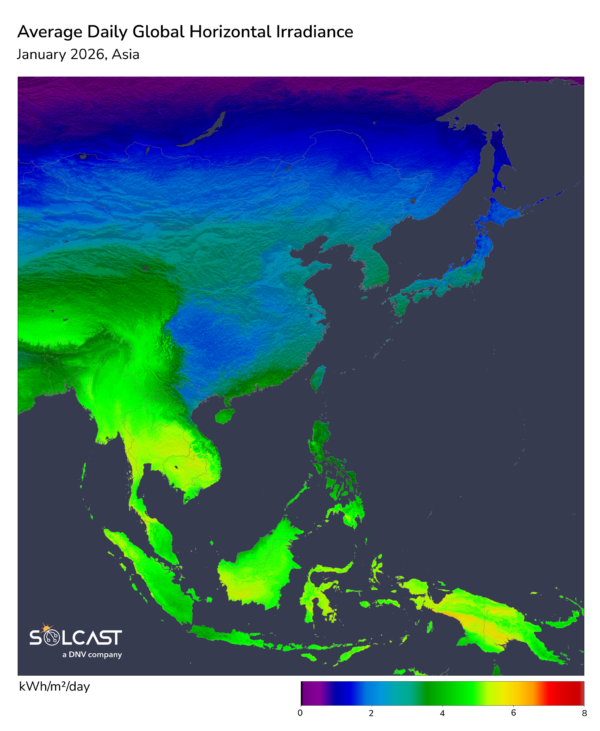
In a new weekly update for pv magazine, Solcast, a DNV company, reports that in January most of East Asia experienced normal to above-average solar irradiance, with southeastern China seeing surges due to reduced clouds and low aerosol levels under lingering La Niña effects. In contrast, the Philippines faced below-average irradiance from early Tropical Storm Nokaen, while other regional cities like Seoul, Tokyo, and Taipei recorded modest gains.

Most of East Asia recorded normal to above‑normal solar irradiance in January, as weak La Niña conditions continued to influence regional weather patterns. The largest gains were observed across southeastern China, where suppressed cloud formation and reduced aerosol-effects delivered a strong start to the year for solar operators, while unusual early tropical storm activity brought significant rainfall and irradiance losses to parts of the Philippines. With two days left in January at time of publishing, this data uses live data from 1-29 January, and forecasts for 30-31 Jan from the Solcast API.

Irradiance in southeastern China surged well above historical averages in January, with Hong Kong exceeding 25% above average. A dominant Siberian high pressure system, with temperatures in parts of Siberia more than 10 C below normal, extended into western China. The resulting northerly flow delivered drier air into southeastern China, reducing both precipitation and cloud formation. This irradiance pattern aligns with typical La Niña effects, even though the La Niña signal was weak and fading toward neutral by late January. Additionally, lower than normal aerosol levels contributed to above average irradiance in coastal parts of China.

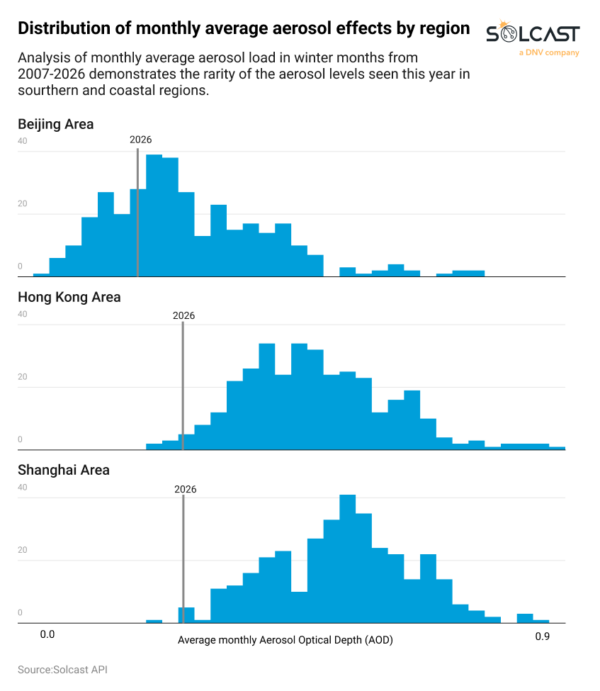
In a continuation of the irradiance and aerosol pattern seen in 2025, many parts of China, in particular low-lying industrial areas saw significant drops in aerosol load and a corresponding increase in available irradiance. Both Hong Kong and Shanghai regions saw significantly lower winter average aerosol loads, than the historical average for winter months from 2007-2026. Whilst this supported the exceptionally high irradiance in Hong Kong through January, Shanghai recorded slightly above-average irradiance, despite experiencing a rare snowfall late in the month. By contrast, Beijing has historically lower aerosol loads, however still saw slightly below-average irradiance due to prevailing cloud levels.

Elsewhere in East Asia, irradiance levels were generally normal to above normal for this month. Seoul and Tokyo recorded irradiance 5–10% above January averages and Taipei saw gains exceeding 10%. Across the maritime continent, irradiance and precipitation anomalies were near normal.

The most significant negative irradiance anomaly in the region was associated with Tropical Storm Nokaen (Ada), which marked an unusually early start to the 2026 Pacific typhoon season. Making landfall in January—the first such occurrence since 2019— Nokaen delivered intense rainfall and heavy cloud cover to the central and northern Philippines. Daily rainfall totals reached up to 200 mm, triggering mudslides and widespread disruption. Irradiance across the northern Philippines dropped by as much as 10% below average, while the southern parts of the archipelago, spared from the worst of the storm, saw irradiance climb to 10% above average.

Solcast produces these figures by tracking clouds and aerosols at 1-2km resolution globally, using satellite data and proprietary AI/ML algorithms. This data is used to drive irradiance models, enabling Solcast to calculate irradiance at high resolution, with typical bias of less than 2%, and also cloud-tracking forecasts. This data is used by more than 350 companies managing over 300 GW of solar assets globally.

  •  

Study finds much lower-than-expected degradation in 1980s and 1990s solar modules

Researchers at SUPSI found that six Swiss PV systems installed in the late 1980s and early 1990s show exceptionally low degradation rates of just 0.16% to 0.24% per year after more than 30 years of operation. The study shows that thermal stress, ventilation, and material design play a greater role in long-term module reliability than altitude or irradiance alone.

A research group led by Switzerland's University of Applied Sciences (SUPSI) has carried out a long-term analysis of six south-facing, grid-connected PV systems installed in Switzerland in the late 1980s and early 1990s. The researchers found that the systems’ annual power loss rates averaged 0.16% to 0.24%, significantly lower than the 0.75% to 1% per year commonly reported in the literature.

The study examined four low-altitude rooftop systems located in Möhlin (310m-VR-AM55), Tiergarten East and West in Burgdorf (533m-VR-SM55(HO)), and Burgdorf Fink (552m-BA-SM55). These installations use ventilated or building-applied rooftop configurations. The analysis also included a mid-altitude utility-scale plant in Mont-Soleil (1270m-OR-SM55) and two high-altitude, facade-mounted systems in Birg (2677m-VF-AM55) and Jungfraujoch (3462m-VF-SM75).

All systems are equipped with either ARCO AM55 modules manufactured by US-based Arco Solar, which was the world’s largest PV manufacturer with just 1 MW capacity at the time, or Siemens SM55, SM55-HO, and SM75 modules. Siemens became Arco Solar’s largest shareholder in 1990. The modules have rated power outputs between 48 W and 55 W and consist of a glass front sheet, ethylene-vinyl acetate (EVA) encapsulant layers, monocrystalline silicon cells, and a polymer backsheet laminate.

The test setup included on-site monitoring of AC and DC power output, ambient and module temperatures, and plane-of-array irradiance measured using pyranometers. Based on site conditions, the researchers classified the installations into low-, mid-, and high-altitude climate zones.

“For benchmarking purposes, two Siemens SM55 modules have been stored in a controlled indoor environment at the Photovoltaic Laboratory of the Bern University of Applied Sciences since the start of the monitoring campaign,” the researchers said. They also applied the multi-annual year-on-year (multi-YoY) method to determine system-level performance loss rates (PLR).

The results show that PLRs across all systems range from -0.12% to -0.55% per year, with an average of -0.24% to -0.16% per year, well below typical degradation rates reported for both older and modern PV systems. The researchers also found that higher-altitude systems generally exhibit higher average performance ratios and lower degradation rates than comparable low-altitude installations, despite exposure to higher irradiance and ultraviolet radiation.

The study further revealed that modules of the same nominal type but with different internal designs show markedly different degradation behaviour. Standard SM55 modules exhibited recurring solder bond failures, leading to increased series resistance and reduced fill factor. By contrast, SM55-HO modules benefited from a modified backsheet design that provides higher internal reflectance and improved long-term stability.

Overall, the findings indicate that long-term degradation in early-generation PV modules is driven primarily by thermal stress, ventilation conditions, and material design, rather than altitude or irradiance alone. Modules installed in cooler, better-ventilated environments demonstrated particularly stable performance over multiple decades.

The test results were presented in the paper “Three decades, three climates: environmental and material impacts on the long-term reliability of photovoltaic modules,” published in EES Solar.

“The study identified the bill-of-material (BOM) as the most critical factor influencing PV module longevity,” they concluded. “Despite all modules belonging to the same product family, variations in encapsulant quality, filler materials, and manufacturing processes resulted in significant differences in degradation rates. Early-generation encapsulants without UV stabilisation showed accelerated ageing, while later module designs with optimised backsheets and improved production quality demonstrated outstanding long-term stability.”


  •  

Sweden deploys 652 MW of solar in 2025

Sweden deployed less solar in 2025 than the year prior despite record growth in the large-scale segment. Solar association Svensk Solenergi predicts last year was likely the bottom of Sweden's installation curve.

Sweden commissioned 652 MW of new solar last year, according to estimates from Swedish solar association Svensk Solenergi. The figure is down on the 848 MW installed in 2024 and takes cumulative capacity to around 5.4 GW.

Residential installations totaled 239 MW in 2025, a 39% year-on-year decrease. Alex Jankell, head of politics at Svensk Solenergi, told pv magazine the household market has been impacted by the removal of a tax rebate scheme as of the start of this year. He added that lower energy prices in comparison to massive hikes in 2022, higher interest rates and inflation have also impacted the market segment.

Although the residential market contracted in 2025, installations smaller than 20 kW continue to represent more than half of Sweden’s solar market, with a little over 3 GW of total capacity. There are now just over 287,000 solar power plants of less than 20 kW in Sweden, equivalent to 90% of all grid-connected solar plants.

Cumulative capacity of grid-connected solar plants

Image: Svensk Solenergi

Commercial and industrial installations reached 215 MW in 2025, down 35% year-on-year, but utility-scale installations increased, deploying a record 198 MW for 46% more than in 2024.

The large-scale segment accounted for 30% of new solar power in 2025, compared to 7% in 2024. New installations were led by Sweden’s largest solar plant to date, the 100 MW Hultsfred solar farm, and the 64 MW Ax-el solar park. Last year also saw developer Svea Solar announce plans to build eight new solar parks in Sweden with a total capacity of approximately 500 MW.

Jankell said the market is experiencing a shift to more large-scale solar, often combined with large-scale battery installations, but added that challenges remain in high costs or long waiting times for grid connections. He recommended Sweden adopt proposed changes to permitting procedures to make them quicker and more predictable.

The residential battery market is also broadening, with preliminary figures from the Swedish Tax Agency showing around 75,000 private individuals received a green reduction for battery installations in 2025, a 34% increase on the previous year.

Jankell suggested that Sweden’s solar market could be supported further by abolishing energy tax for all electricity that is produced and consumed behind the same meter and implementing proper power-tariffs which reflectively reward the ability of solar and battery installations to help the grid. He also recommended proposed proper revenue frames for Swedish grid companies that reward flexibility, and not only grid expansion.

Jankell told pv magazine more solar is likely to be installed this year than in 2025. “Given the implementation of solar demands in the Energy Performance of Buildings Directive, new permitting processes on the way, and a general deflation of PV and battery prices, we predict that 2025 is the bottom of the installation curve,” he said.

  •  

TOPCon cell prices rise for fourth week amid elevated silver costs and export rebate uncertainty

In a new weekly update for pv magazine, OPIS, a Dow Jones company, provides a quick look at the main price trends in the global PV industry.

China’s TOPCon cell prices rose for a fourth consecutive week, led by higher production costs from surging silver prices and ongoing discussions around the removal of export tax rebates. In contrast, PERC cell prices declined amid weakening demand, due to the industry’s continued technological shift towards TOPCon cells, according to trade sources.

According to the OPIS Global Solar Markets Report released on January 20, Chinese TOPCon M10 cell prices were assessed 2.24% higher on the week at $0.0547/W Free-On-Board (FOB) China. Meanwhile, FOB China Mono PERC M10 cells fell 2.53% to $0.0463/W over the same period.

Have you missed our Webinar+ webinar on solar module procurement challenges? You can the full recording and resources from the session to catch up on key insights, strategies, and expert tips for navigating solar module procurement challenges.

Join us on Jan. 28 for pv magazine Webinar+ | The Solar Module Market Playbook: Managing pricing, risks, and other procurement challenges.

We analyzed real-time market data and offered insights to help EPCs, developers, investors, and distributors secure high-quality PV modules at competitive prices, thereby safeguarding project bankability.

Silver prices have surged to record highs, gaining more than 40% year-to-date, driven by rising industrial demand and increased investment flows. Chinese policy developments have also further tightened the market, with authorities introducing export restrictions on silver through 2027.

Under the new framework, only 44 approved companies are permitted to export silver under a quota-based licensing system, requiring exporters to secure approval for overseas shipments.

Market sources said silver prices have become a key variable for cell pricing, as silver now represents one of the largest cost components in TOPCon cell manufacturing. Several sources noted that even if upstream prices soften from Q2 2026, cell and module prices are unlikely to retreat to 2025 price levels should silver prices remain elevated.

Since the start of this year, downstream OPIS TOPCon cell prices have surged 46%, while TOPCon module prices climbed nearly 35%. Upstream cost increases have been more modest, with OPIS China Mono Premium—OPIS' assessment for mono-grade polysilicon used in N-type ingot production—up 0.15% and N-type wafer prices up around 13% over the same period.

This week, upstream polysilicon and wafers segments showed early signs of weakness, with OPIS China Mono Premium and N-type M10 wafers down 2.34% and 2.20%, respectively. In contrast, FOB China TOPCon modules continued to edge higher by 3.48% over the same period.

According to the China Nonferrous Metals Industry Association (CNMIA), sentiment in the wafer segment remained cautious this week, with upstream and downstream players locked in a stalemate. Despite continued price gains in cells and modules, driven by export tax rebate policy changes and rising silver prices, price increases have yet to effectively transmit upstream.

CNMIA noted that domestic end demand remains sluggish, and under cost pressure, cell manufacturers have become increasingly reluctant to accept high-priced wafers, resulting in few wafer procurement orders.

With downstream demand unlikely to recover meaningfully before the Lunar New Year, and polysilicon prices showing signs of softening, the wafer market is expected to stay weak in the near term, the association added.

Downstream sources added that higher production costs, combined with weak end-user module demand, could limit cell output levels in the longer term.

Market analysts have previously projected China’s installation demand to fall by over 20% in 2026, following the transition from feed-in-tariffs to a market-based electricity pricing mechanism. Furthermore, the planned removal of export tax rebates may weigh on overseas demand, reinforcing a bearish demand outlook for cells later this year, sources said.

OPIS, a Dow Jones company, provides energy prices, news, data, and analysis on gasoline, diesel, jet fuel, LPG/NGL, coal, metals, and chemicals, as well as renewable fuels and environmental commodities. It acquired pricing data assets from Singapore Solar Exchange in 2022 and now publishes the OPIS APAC Solar Weekly Report.

  •  

Dutch utility testing ‘silent’ residential heat pumps

Dutch utility Eneco is testing low-noise air-to-water heat pumps from startup Whspr in around 20 homes, aiming to ease installation constraints near property boundaries. The systems reportedly achieve coefficients of performance of up to 5 and show up to 80% noise reduction in laboratory testing.

Dutch utility Eneco has begun testing an”innovative” type of air-to-water heat pump with low sound levels in residential buildings.

The company said conventional heat pumps rely on outdoor units that emit a constant hum, requiring installations several metres from property boundaries under Dutch building regulations and often forcing placement in prominent locations on terraced houses. By contrast, the “silent” heat pumps under test can be installed just 30 cm from the boundary.

“The pilot will provide insight into both ease of installation and real-world performance,” Eneco said in a statement. “The results will be used to further optimize the system, with the aim of making it widely available by the end of the summer.” The company added that around 20 homes are currently equipped with the systems to assess noise levels without “compromising residents’ everyday heating comfort.”

The heat pumps are supplied by Dutch startup Whspr. “Our 4 kW freestanding hybrid monoblock systems are designed for domestic space heating,” founder Hugo Huis in ’t Veld told pv magazine.

The unit measures 60 cm × 60 cm × 90 cm and weighs around 70 kg. “It is compact yet robust,” Huis in ’t Veld said, adding that initial measurements show efficiencies in line with the market, with coefficients of performance (COP) of between 4.5 and 5.0.

According to the manufacturer, the heat pump uses propane (R290) as its refrigerant and shows up to 80% noise reduction in laboratory testing.

Whspr also highlights ease of installation, stating that a single installer can fit and connect the unit, including the water side, in one day. A dedicated control and thermostat system has also been developed to reduce compatibility issues and simplify commissioning.

Further technical details have not yet been disclosed. “We are not at liberty to share designs at this stage, as patents are still pending,” Huis in ’t Veld said.

Eneco noted that pilot installations include both standard locations and more complex sites, such as rooftops and sheds at the end of gardens. The systems have also been installed in several rental homes owned by housing association Wooncompagnie. “Testing will continue until the end of April, after which the heat pumps will be further optimized,” the company said.


  •  

Power Roll testing new metrology for perovskite solar

The UK-based perovskite solar PV specialist has announced a new metrology research project with Swansea University and a new development agreement with Renolit, a German plastic films, sheets and polymer solutions company.

Power Roll, a UK-based perovskite solar PV specialist, has announced a new metrology research project with Swansea University and a joint development agreement with Renolit, a German plastic films, sheets and polymer solutions company, which will begin with an outdoor field trial in Germany.

In the U.K., samples of Power Roll's patented flexible, micro-groove perovskite solar PV film will be provided to researchers at Swansea University and the National Physical Laboratory in a six-month feasibility project to support the development of inline and end-of-line testing tools for perovskite solar cells.

It also involves the development of stability guidelines for industry standards. Without these advancements, perovskite solar cell companies “could face significant hurdles in achieving product accreditation,” noted the company.

“The project will support scalable roll-to-roll manufacturing of lightweight perovskite PV, delivering commercial prototypes, testing protocols, and an invited academic review to strengthen UK capability in advanced semiconductor photovoltaics,” Nathan Hill, Power Roll Senior Scientist, told pv magazine.

It entails assessment of standards, metrology techniques, equipment, routes to characterize large scale devices and artificial intelligence (AI) pertaining to monitoring during manufacture.

In December, Renolit and Power Roll announced an 18-month joint development agreement that will begin with an outdoor trial of the UK company’s micro-groove perovskite prototypes on a Renolit building façade in Germany.

The initial deployment will be one to two square meters. There are plans to scale it up in size and power capacity as the project progresses, according to Hill.

“The purpose is to monitor and validate real-world performance and durability, and to understand the potential of the micro-groove solar technology,” Neil Spann, Power Roll CEO, told pv magazine.

Renolit has a commercial interest as a potential supplier of certain film layers to Power Roll, but also to explore integrating Power Roll's solar film into its existing building materials product lines, and to explore the potential of manufacturing under license in Europe, according to Spann.

Power Roll has also completed tests of smaller devices at its headquarters.

Renolit France, the French branch of the German company, recently launched a new PVC-based mounting product for rooftop PV systems.

Power Roll, founded in 2012, has proven its technology and manufacturing process, and secured 27 patent families.

  •