Spain installed 1.14 GW of solar capacity for self-consumption in 2025, lifting cumulative capacity to 9.3 GW, as residential and commercial installations declined while industrial and off-grid segments showed greater resilience, according to data from the Spanish Photovoltaic Union.
Solar self-consumption capacity in Spain reached a cumulative 9.3 GW in 2025, according to data from the Spanish Photovoltaic Union (UNEF).
Spain added 1,139 MW of new self-consumption capacity during the year, representing a 3.7% slowdown compared with 2024. UNEF said the deceleration signals a phase of market stabilization following several years of rapid growth.
The residential segment accounted for 229 MW across 36,330 new installations, a year-on-year decline of 17%. UNEF attributed the contraction to the phase-out of tax incentives linked to energy-efficient home renovations and lower compensation for surplus electricity exported to the grid under deregulated market contracts.
UNEF said falling surplus compensation prices are reducing the attractiveness of oversized systems designed primarily for grid injection. As a result, demand is shifting toward installations optimized for instantaneous self-consumption. The association is calling for revisions to the simplified regulated compensation mechanism to enable broader settlement of surplus energy and improve economic signals for small-scale systems.
The commercial segment installed 176 MW in 2025, down 15% from the previous year. Collective self-consumption remains limited despite its potential to optimize shared generation and demand. Industry representatives said pending regulatory updates are needed to enable aggregated management models, dynamic energy allocation, and an expansion of eligible self-consumption areas.
Industrial self-consumption installations totaled 679 MW, marking a slight increase compared with 2024. UNEF said growth in this segment is being driven by larger medium-voltage systems aimed at reducing electricity costs and partially covering electrified thermal demand. Project viability increasingly depends on tariff structures with a higher variable component and more streamlined permitting for medium-sized installations.
Off-grid installations reached 55 MW in 2025, reflecting growing uptake of hybrid solar-plus-storage systems in rural areas and locations without grid access. Battery integration in grid-connected installations also continued to rise, improving controllability of generation and supporting system flexibility.
UNEF said Spain will need to deploy an average of around 2 GW of self-consumption capacity per year to meet the 19 GW target set out in the country’s National Integrated Energy and Climate Plan. Achieving that level will require regulatory stability, administrative simplification, and more effective integration of distributed energy storage.
Czechia’s first international conference on solar and flexibility highlighted that the combination of solar with storage and flexibility sources is key to not just Czechia’s, but also Europe’s, secure and competitive electricity system.
Solar Flex Prague, jointly organised by SolarPower Europe, Solární Asociace and Asociace AKU-BAT CZ, welcomed visitors to a snowy Czech capital on Thursday (29 January), bringing together stakeholders from across Europe to discuss how flexibility solutions and storage can be further deployed.
The conference began with a speech from SolarPower Europe CEO, Walburga Hemetsberger, who said that while electrification is a lifeline for Europe, there is dwindling confidence in the energy transition among some politicians, some leading businesses and key players in the defence sector.
“The way out of the doubts is to really bank big time on flexibility, on storage and on electrification. This will show very concrete benefits very quickly, make politicians understand and really feel the benefits,” Hemetsberger told attendees, before adding that the combination of solar with storage and flexibility sources can lower energy system costs by €30 billion by 2030, while strengthening Europe’s security by removing dependency on foreign players.
Paula Dorado represented the European Commission via video call and told attendees work on an electrification action plan is underway, scheduled for adoption this year. The plan is expected to address barriers and provide a way forward on electrification for different sectors including companies, households and industrial processes, Dorado said.
Throughout the day, speakers were in agreement that storage and flexibility now play an integral role in Czechia’s electricity system. Panellists pointed out that solar-plus-storage projects can be implemented in a matter of months, offering companies the ability to save money or open new revenue streams. Other speakers stressed the idea that renewable sources are uncontrollable is now outdated, explaining that modern solar-plus-storage systems are not only manageable, offering the ability to respond to market prices and the needs of both transmission and distribution system operators, but are shifting from grid-following to grid-forming technologies and contribute to the stability of the electricity system.
Czechia appears ahead of the curve when it comes to deploying co-located storage with smaller-scale solar, with figures published by Czechia’s largest electricity distributor, ČEZ Distribuce, last September sharing 86% of solar plants connected during the first half of 2025 were equipped with energy storage. In contrast, the country’s large-scale solar market sits at a pivotal moment following the implementation of a legal framework for large-scale development and operation last year. During an afternoon session on opportunities and challenges related to storage and the grid, Rene Nedela from Czechia’s Ministry of Industry and Trade said up to 180 GW of BESS applications have been registered, although some are without any project readiness.
Several speakers advised Czechia to look to other countries further down the line of large-scale battery deployment, and in particular its neighbour Germany, whose favourable market environment for batteries has helped attract investors and move flexibility efforts forwards.
Attendees also said flexible solar-plus-storage projects could help to solve any power shortages that arise from the gradual shutdown of coal-fired power plants in Czechia. The Czech government has committed to phasing out coal-fired electricity generation by 2033 and the country’s last deep black coal mine shut down last month.
During the afternoon session, Alexandr Cerny from Czechia’s Energy Regulatory Office introduced proposed changes to Czechia’s energy tariffs, expected to come into force from the start of next year. The changes will restructure current tariff categories, particularly at the higher voltage levels, and are in part designed to reward flexibility in both consumption and generation, holding the potential to help ramp up the deployment of batteries while better integrating renewables to the grid.
Solar Flex Prague was SolarPower Europe’s second conference on flexibility following the inaugural Solar Flex Croatia held last March. A second edition of Solar Flex Croatia will take place in Zagreb on March 17 this year and Hemetsberger told pv magazine work is currently underway preparing the first Solar Flex Italy for later this year.
54% of respondents cited “energy availability and redundancy” as the single greatest obstacle to successful data center development between now and 2030.
aw firm Foley & Lardner LLP released today its 2026 Data Center Development Report, focusing on the growth and challenges in the data center boom that aims to sustain the growth in AI and LLM usage.
A major focus was on energy, with 54% of respondents citing “energy availability and redundancy” as the single greatest obstacle to successful data center development between now and 2030.
Want to learn more about matching renewables with data center demand?
The event will spotlight how solar and energy storage solutions are driving sustainable and reliable infrastructure, with a particular focus on powering the country’s rapidly growing data center sector.
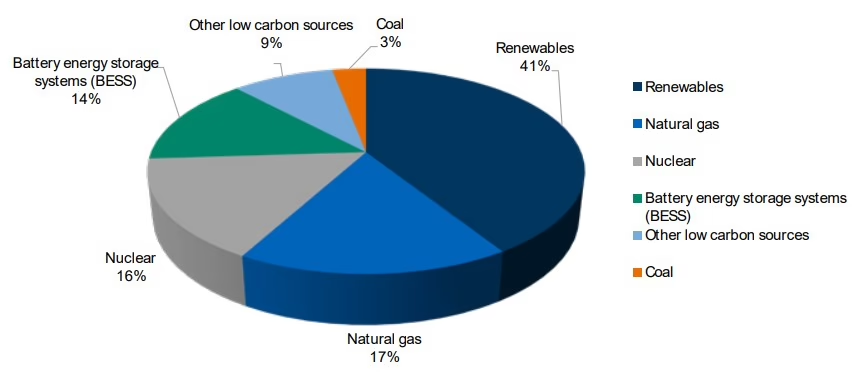
In terms of the right energy mix for data centers, 55% of respondents agreeing that the ideal energy mix to meet the growing power demand of data centers is largely renewables (41%), followed by natural gas (17%), nuclear (16%), and BESS (14%).
Nearly half (48%) of industry participants named advances in energy efficiency (which often includes storage optimization) as the greatest opportunity for development through the end of the decade, and nearly three in four respondents (74%) said advanced energy storage systems like batteries, hybrid solutions, and microgrids are the best way to ensure energy resilience.
Only 14% of developers are actually pursuing modular and small modular nuclear reactors as a viable energy opportunity.
Intriguingly, 63% anticipate a “strategic correction” in the market by 2030, driven by the intense competition for power, with one unnamed banking executive in the report saying, “Once power runs out in 2027 or 2028, that’s where we think deal flow will start to slow down.”
105 U.S.-based respondents were qualified to participate in the survey, including those who had direct experience in data center development, energy procurement, technology delivery, or operations within the past 24 months.
Daniel Farris, partner and co-lead of Foley’s data center and digital infrastructure team: “There is a Gold Rush mentality right now around securing power. That’s a big part of why people feel there’s a bubble,” said “There’s going to a period in the next two to three years where power at necessary levels is going to be really hard to come by.”
Rachel Conrad, senior counsel and co-lead of Foley’s data center and digital infrastructure team: “Over the next five to 10 years, power providers will need to either grow capacity or increase efficiency to meet the demand fueled by data centers.”
Brazil curtailed about one-fifth of its solar and wind generation in 2025, wasting an estimated BRL 6.5 billion ($1.23 billion), as grid constraints and demand mismatches pushed the power system close to operational safety limits on 16 days, according to a report from Volt Robotics.
Brazil failed to use roughly 20% of the solar and wind electricity it generated in 2025, resulting in an estimated loss of BRL 6.5 billion, according to Volt Robotics’ Annual Curtailment Report.
Volt Robotics said the scale of curtailment reflects an unprecedented period of renewable oversupply combined with operational constraints in Brazil’s national electricity system.
Average generation cuts reached 4,021 MW over the year, equivalent to the monthly output of a large hydroelectric plant. On at least 16 days in 2025, system operation approached the lower technical safety limit, a sharp increase from 2024, when only one comparable event was recorded.
Volt Robotics said the 2025 events were driven by excess electricity supply rather than scarcity, marking a structural shift in system risk dynamics.
Curtailment intensified between August and October, when historically high levels of generation coincided with transmission constraints and weaker demand. The report attributes the peak losses to a combination of operational limitations, grid congestion, and insufficient flexibility to absorb surplus power.
Sunday mornings emerged as the most frequent stress point for the grid. Volt Robotics said reduced economic activity during weekends lowers electricity demand, while solar output peaks and is often reinforced by strong wind generation. This recurring mismatch leads to network overloads, forced generation cuts, and system operation near the lower safety threshold.
The report also highlights the risk of system instability caused by excess renewable generation. During the 16 critical days, Brazil’s National System Operator classified conditions as severe and implemented emergency measures, supported by the National Electric Energy Agency, including extraordinary generation curtailments.
Volt Robotics warned that without structural adjustments, surplus clean energy itself can become a source of operational risk.
The economic impact extends beyond immediate revenue losses. Frequent curtailment increases perceived investment risk, raises financing costs, and weakens Brazil’s appeal for new renewable energy projects, the report said. Both regulated and free-market projects were affected, with exposure to contractual penalties and the Settlement Price of Differences.
Regionally, Minas Gerais, Ceará, and Rio Grande do Norte recorded the highest levels of curtailed energy, forming what Volt Robotics described as Brazil’s “curtailment triangle.” Southern states experienced significantly lower losses.
Volt Robotics said the situation reflects a structural mismatch between rapid renewable capacity expansion, rising distributed generation, transmission bottlenecks, and tariff structures that do not adequately signal when electricity consumption is most valuable.
The report recommends the introduction of more dynamic time-of-use tariffs, stronger demand-side participation, and regulatory reforms to reduce curtailment and maintain the stability of Brazil’s electricity system.
French researchers have developed a high-resolution computational framework to model microclimate effects of large floating solar PV systems, enabling accurate predictions of heat transfer, ambient temperatures, and water evaporation based on panel configuration and wind conditions. The model can inform thermal performance, environmental impacts, and optimize designs for utility-scale floating PV, as well as ground-mounted and agrivoltaic installations.
French researchers have developed a framework to model microclimate effects of large-sized floating PV systems.
The new model can be used to determine wind-dependent convective heat transfer coefficients (CHTC), ambient temperatures, and to estimate evaporation patterns in partially covered bodies of water based on a variety tilt angles, module heights, and pitch distances.
“The main novelty of this work lies in the numerical methodology we developed, specifically an upscaling method to quantify panel-atmosphere interactions at the module scale then model the micrometeorology at the power plant scale with a relatively fine resolution of about 4 meters,” Baptiste Amiot, corresponding author of the research told pv magazine, adding that the resolution is significantly higher than others in this field.
“Applying this methodology enables us to map the thermal performance across utility-scale installations and to provide insights into local environmental effects, such as evaporative losses,” he said.
The precursor model is geometrically adaptable: tt can handle various tilt angles, mounting heights, and inter-row spacings, according to Amiot. “It is particularly well-suited for large-scale installations exposed to sufficiently windy conditions,” Amiot added.
The researchers used a computational fluid dynamics (CFD) precursor model, a microclimate CFD model supporting the PV parameterization, and an experimental survey. A wind-tunnel setup typical of a land-based application was used to confirm accuracy of altitude-based wind profiles.
In addition, a geometrical layout of a commercial floating PV (FPV) installation was used for the atmosphere boundary layer parameters. The wind direction effects were assessed using the microclimate CFD model that reproduced the localized conditions of the commercial FPV array.
“The atmospheric component is fundamentally similar to regional climate models (RCMs) but deploying it within a CFD framework offers advantages in terms of surface element parameterization and the spatial discretization we can achieve,” said Amiot.
Some of the findings included temperature gradients range between 1.3 C/km and 5.8 C/km; headwinds and tailwinds relative to the front surface of the PV modules generate the greatest turbulence levels. Furthermore, the team was able investigate how turbulent flows influence water-saving gains based on PV coverage of the water surface.
Assessing the results, the researchers noted that the precursor method “readily determines” heat transfer coefficient correlations as a function of wind speed and direction. “This is essential to obtain the thermal U-values that govern panel cooling,” added Amiot.
The model can be extended to model large ground-mounted systems and agrivoltaics, including dynamic configurations where panels adjust orientation throughout the day, according to Amiot. It is suitable for inland and nearshore FPV, but not offshore FPV.
The researchers are currently focused on developing CFD models to predict both the energy output and environmental trade-offs of dual-use photovoltaics systems and FPV evaporation research at finer spatial scales, coupled with in-situ measurements. It is also working on an agrivoltaics CFD-plant model to predict crop response below PV canopies.
Renewables and storage could reliably power data centers, but success requires active grids, coordinated planning, and the right mix of technologies. Hitachi Energy CTO, Gerhard Salge, tells pv magazine that holistic approaches ensure technical feasibility, economic viability, and energy system resilience.
As data centers grow in size and complexity, supplying them with cheap and reliable power has never been more pressing. Gerhard Salge, chief technology officer (CTO) at Hitachi Energy, a unit of Japanese conglomerate Hitachi, shed light on the relationship between renewable energy and data center operations, noting that while technically feasible, success requires careful planning, the right infrastructure, and a holistic approach.
“When we look at what's happening in the grids, then renewables are an active element on the power generation side, and the data centers are an active element on the demand side,” Salge told pv magazine. “What you need in addition to that is in the dimensions of flexibility, for which we need storage and a grid that can actively act also here in order to bring all these elements together.”
Want to learn more about matching renewables with data center demand?
The event will spotlight how solar and energy storage solutions are driving sustainable and reliable infrastructure, with a particular focus on powering the country’s rapidly growing data center sector.
According to Salge, the key is active grids, not passive systems that simply react to conditions. With more renewables, changing demand patterns, new load centers, and storage options like batteries and existing facilities such as pumped hydro, it is crucial to coordinate these resources actively to maintain supply security, power quality, and cost optimization.
“But when you talk about the impact and the correlation between renewables and data centers, you need always to consider this full scope of the flexibility in a power system of all the elements—demand side, generation side, storage side, and the active grid in between,” he said, noting that weak or congested grids would not serve this purpose.
AI data centers
Salge warned that not all data centers are the same. “There are conventional data centers and AI data centers,” he said. “Conventional data centers are essentially high-load systems with some fluctuations on top. They contain many processors handling requests—from search engines or other applications—so the workload is distributed stochastically across them. This creates a baseline load with random ups and downs, which is the typical load pattern of a conventional data center.”
AI workloads, in contrast, rely heavily on GPUs or AI accelerators, which consume significant power continuously. Unlike conventional data centers, AI data centers often run at sustained high load, sometimes close to maximum capacity for long periods.
Htitachi Energy CTO Gerhard Salge
Image: Hitachi Energy
“AI data centers are specifically good in doing parallel computing,” Salge explained. “So many of them are triggered with the same demand pattern at the same time, which creates these spikes up and down in the demand profile, and they come in parallel all together.”
These fluctuations challenge both the power supply and the voltage and frequency quality of the connected grid. “So, you need to transport active power from an energy storage system or a supercapacitor to the demand of the AI data center. And that then needs to involve really the control of the data center’s active power. What you need is the interaction between the storage unit and then the AI data center to provide active power or to absorb it afterwards when the peak goes down. That can be also done by a supercapacitor.”
Batteries can store much more energy than supercapacitors, but the latter can ramp smaller energies more frequently. “However, if you put a battery that is smaller than the load, and you really need to cycle the battery through its full capacity, the battery will not survive very long with your data center, because the frequency of these bursts is so high, then you are aging the battery very, very quickly, yeah, so supercapacitors can do more cycles,” Salge emphasized.
He also noted that batteries and supercapacitors are both mature technologies, but the optimal setup—whether one, the other, or a combination with traditional capacitors—depends on storage size, number of racks, voltage levels, and overall system design.
Managing AI training bursts
Salge stressed the importance of complying with grid codes across geographies. “You need to become a good citizen to the power system,” he said. “You have to collaborate with local utilities to make sure that you are not infringing the grid codes and you are not disturbing with the data center back into the grid. A good way to do this, when renewables and data centers are co-located, is to manage renewable energy supply already inside the data center territory. Moreover, having a future-fit developed grid is a clear advantage. Because you have much more of these flexibility elements and the active elements to manage storage and renewable integration and to manage the dynamic loads of the data centers.”
If the grid is not future-fit with modern, actively operating equipment, operators will see significantly more stress. “With holistic planning, instead, you can even use some of the data center flexibility as a controllable and demand response kind of feature,” Salge said, adding that data center operators could coordinate AI training bursts to periods when the power system has more available capacity. This makes the data center a predictable, controllable demand, stressing the grid only when it is prepared.
“In conclusion, regarding technical feasibility: yes, it’s possible, but it requires the right configuration,” Salge said.
Economic feasibility
On economics, Salge believes solar and wind remain the cheapest power sources, even when accounting for the grid flexibility needed to integrate them with data centers. Solar is fastest to deploy, wind complements it well, and both can be scaled in parallel.
“Any increase in data center demand requires investment, whether from renewables or conventional power. Economics depend on the market, and market mechanisms, regulations, and technical grid planning are interconnected, influencing energy flow, pricing, and system stability,” he said.
“We recommend developers to work with all stakeholders—utilities, technology providers, and planners—from the start to ensure reliability, affordability, and social acceptance. Holistic planning avoids reactive fixes and leads to better long-term outcomes,” Salge concluded.
Bulgaria installed over 1 GW of solar for the third consecutive year in 2025 and is forecast to add over 2 GW this year thanks to a large pipeline of utility-scale projects.
Bulgaria added 1,416 MW of solar last year, according to official data published on the ENTSO-E Transparency Platform. The result marks the third consecutive year Bulgaria has deployed over 1 GW of solar and takes the country’s cumulative capacity to 5,984 MW.
Desislava Mateva, project manager at the Sofia-based Association for Production, Storage and Trading of Electricity (APSTE) told pv magazine that Bulgaria’s solar market is currently dominated by ground-mounted, utility-scale solar plants, reflecting the availability of land, strong developer activity and increasing access to project finance.
Utility-scale solar made up around 90% of Bulgaria’s new capacity last year. Mateva said the market was driven by the strong commercial competitiveness of solar, making projects viable without direct subsidies, as well as active support from local and international banks and a large pipeline of development projects that reached the ready-to-build stage or financial close over the past 18 months.
Mateva also noted that Bulgaria is experiencing a wave of standalone battery energy storage system (BESS) deployments and the hybridization of both existing and new solar assets with BESS, as developers look to deal with price cannibalization and declining solar capture rates.
“These developments are expected to reduce price volatility, improve system flexibility, and mitigate capture-price pressure for solar producers,” she explained. “As a result, industry expectations remain positive.”
Among the largest projects to be commissioned in Bulgaria last year was the first phase of the 315 MW/760 MWh Tenevo hybrid project, with a second phase scheduled for commissioning early this year, and the Selanovtsi hybrid project, a 59.8 MW solar plus 107.3 MWh storage site in the northwestern Vratsa region. Bulgaria also commissioned one of the EU's largest standalone BESS facilities last year, located adjacent to a 107 MW solar park.
Bulgaria’s C&I solar market is showing steady momentum, particularly among projects designed for self-consumption, Mateva added, with rising electricity costs incentivizing businesses to invest in on-site solar, often in combination with storage.
In contrast, Bulgaria’s residential solar sector remains underdeveloped in capacity terms. Mateva said interest among households exists but the market segment has been constrained by regulatory complexity and limited incentives.
She added that the residential sector would benefit from the full liberalization of Bulgaria’s electricity market, as currently household electricity prices remain regulated, accounting for roughly 40% of national electricity demand. “Full liberalization would stimulate demand-side participation and unlock the residential solar and storage market,” she explained.
Looking ahead, Mateva predicted Bulgaria is on course for a record year in solar deployment in 2026. “An estimated 2.5 GW of additional solar projects are either under construction or at an advanced stage of development and expected to start construction soon,” she said. “This pipeline suggests that most of this capacity will be commissioned by the end of 2026.”
Bulgaria’s storage pipeline is looking equally healthy, with 15 GWh expected to be commissioned by half way through the year, supported by the country’s National Recovery and Resilience Plan.
Mateva added that the most significant policy change last year was a sharp increase in eco-taxes and recycling fees for solar panels and batteries. She explained that these fees are currently five to ten times higher than in comparable EU countries, in turn artificially inflating PV and BESS project costs.
“Unless addressed, this issue risks becoming a major bottleneck for new PV and BESS procurement,” Mateva told pv magazine. “Resolving this will require action from the Ministry of Ecology to align recycling fees with real-world costs and EU norms, ensuring that Bulgaria’s strong solar momentum is not undermined by avoidable regulatory distortions.”
Bulgaria opened a new grant program late last year targeting micro, small and medium-sized enterprises looking to deploy PV systems and storage, with a particular focus on those located in the country’s coal regions. The call is set to close next month.
Scientists have grown organic romaine lettuce under 13 different types of PV modules, in an unusual hot Canadian summer. Their analysis showed lettuce yields increased by over 400% compared to unshaded control plants.
A research group from Canada’s Western University has investigated the performance of organic romaine lettuce, a heat-sensitive crop, under a broad range of agrivoltaic conditions. The test was conducted in London, Ontario, in the summer of 2025, during which 18 days had temperatures over 30 C.
“Our study explores how agrivoltaic systems can be tailored to optimize crop growth, especially under extreme heat conditions, while contributing to sustainable energy generation,” corresponding researcher Uzair Jamil told pv magazine.
“This becomes especially relevant in the context of climate change, where we are experiencing temperature extremes across the world,” Jamil added. “We examined the performance of organic romaine lettuce under thirteen different agrivoltaic configurations – ranging from crystalline silicon PV to thin-film-colored modules (red, blue, green) – in outdoor, high-temperature stress conditions.”
More specifically, the experiment included c-Si modules with 8%, 44% and 69% transparency rate; blue c-Si modules with transparency of 60%, 70%, and 80%; green c-Si modules with transparency of 60%, 70%, and 80%; and red c-Si modules with transparency of of 40%, 50%, 70%, and 80%.
All agrivoltaics installations had a leading-edge height of 2.0 m and a trailing-edge height of 2.8 m, and the modules were oriented southwards at 34◦. Pots with organic romaine lettuce were placed under all configurations, along with three pots fully exposed to ambient sunlight without shading, used as controls.
In addition to measurements against the control, the scientific group has compared the results to the national average per-pot yield for 2022, which included less high-temperature days and was therefore considered typical. Those data points were taken from agricultural census data, which later enabled the researcher also to create nationwide projections of their results.
“Lettuce yields increased by over 400% compared to unshaded control plants, and 200% relative to national average yields,” Jamil said about the results. “60% transparent blue Cd-Te and 44% transparent crystalline silicon PV modules delivered the highest productivity gains, demonstrating the importance of both shading intensity and spectral quality in boosting plant growth.”
Jamil further added that if agrivoltaic were to scale up to protect Canada’s entire lettuce crop, they could add 392,000 tonnes of lettuce.
“That translates into CAD $62.9 billion (USD $46.6 billion) in revenue over 25 years,” he said. “If scaled across Canada, agrivoltaics could also reduce 6.4 million tonnes of CO2 emissions over 25 years, making it a key player in reducing the agricultural sector’s environmental footprint.”
Cubenergy has launched FlexCombo 2.0, a scalable battery energy storage system for utility, commercial, and industrial applications, offering up to 16 MWh capacity with LFP batteries. Its modular design, advanced BMS, and cloud-based operations enable easy installation, seamless expansion, and efficient grid integration, according to the manufacturer.
Cubenergy, a Chinese manufacturer of battery energy storage systems (BESS), has introduced a new energy block designed for utility, commercial, and industrial (C&I) applications.
The product, named FlexCombo 2.0, uses the company’s 835 kWh FlexCombo D2 batteries. It is available in three configurations: 10, 12, or 12 batteries, providing a total capacity of 8 MWh, 10 MWh, or 16 MWh, respectively.
“With the FlexCombo D2 modular design and parallel architecture, FlexCombo’s core advantage lies in its long-term scalability,” the company said in a statement. “It enables seamless capacity growth and effortless integration with power generation systems (PGS), simplifying deployment and accelerating delivery for ultimate flexibility.”
The FlexCombo D2 batteries feature lithium iron phosphate (LFP) chemistry, offering a lifespan of 8,000 cycles at 70% capacity retention, according to the manufacturer.
Each battery measures 2 m x 1.68 m x 2.55 m and has a weight of up to eight tons. They carry an IP55 protection rating. Each block also comes with a power conversion system (PCS) rated at 430 kW AC with an IP66 protection grade. Optional medium-voltage (MV) transformers are available, with AC power ratings of either 8,800 kVA or 5,250 kVA.
“The FlexCombo 2.0 is designed primarily for utility and C&I applications, including renewable energy arbitrage, stand-alone grid stabilization, factories, and commercial buildings,” the company stated. “This integrated, easy-to-install BESS can be quickly connected and aligned with project requirements, while the advanced Active Balancing battery management system (BMS) and cloud-based operations provide a superior user experience.”
In a new weekly update for pv magazine, Solcast, a DNV company, reports that in January most of East Asia experienced normal to above-average solar irradiance, with southeastern China seeing surges due to reduced clouds and low aerosol levels under lingering La Niña effects. In contrast, the Philippines faced below-average irradiance from early Tropical Storm Nokaen, while other regional cities like Seoul, Tokyo, and Taipei recorded modest gains.
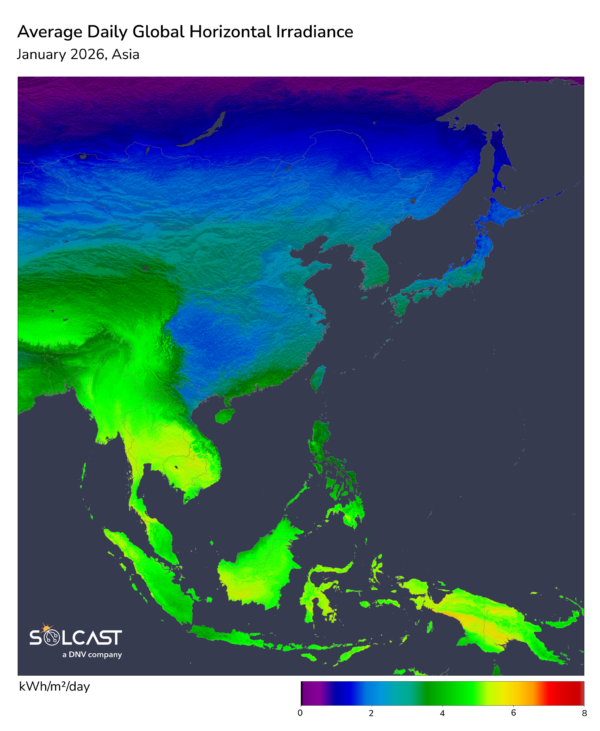
Most of East Asia recorded normal to above‑normal solar irradiance in January, as weak La Niña conditions continued to influence regional weather patterns. The largest gains were observed across southeastern China, where suppressed cloud formation and reduced aerosol-effects delivered a strong start to the year for solar operators, while unusual early tropical storm activity brought significant rainfall and irradiance losses to parts of the Philippines. With two days left in January at time of publishing, this data uses live data from 1-29 January, and forecasts for 30-31 Jan from the Solcast API.
Irradiance in southeastern China surged well above historical averages in January, with Hong Kong exceeding 25% above average. A dominant Siberian high pressure system, with temperatures in parts of Siberia more than 10 C below normal, extended into western China. The resulting northerly flow delivered drier air into southeastern China, reducing both precipitation and cloud formation. This irradiance pattern aligns with typical La Niña effects, even though the La Niña signal was weak and fading toward neutral by late January. Additionally, lower than normal aerosol levels contributed to above average irradiance in coastal parts of China.
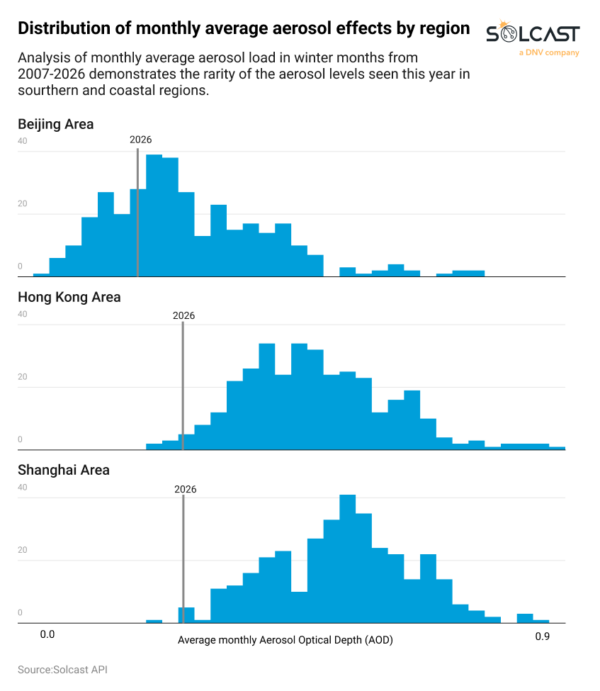
In a continuation of the irradiance and aerosol pattern seen in 2025, many parts of China, in particular low-lying industrial areas saw significant drops in aerosol load and a corresponding increase in available irradiance. Both Hong Kong and Shanghai regions saw significantly lower winter average aerosol loads, than the historical average for winter months from 2007-2026. Whilst this supported the exceptionally high irradiance in Hong Kong through January, Shanghai recorded slightly above-average irradiance, despite experiencing a rare snowfall late in the month. By contrast, Beijing has historically lower aerosol loads, however still saw slightly below-average irradiance due to prevailing cloud levels.
Elsewhere in East Asia, irradiance levels were generally normal to above normal for this month. Seoul and Tokyo recorded irradiance 5–10% above January averages and Taipei saw gains exceeding 10%. Across the maritime continent, irradiance and precipitation anomalies were near normal.
The most significant negative irradiance anomaly in the region was associated with Tropical Storm Nokaen (Ada), which marked an unusually early start to the 2026 Pacific typhoon season. Making landfall in January—the first such occurrence since 2019— Nokaen delivered intense rainfall and heavy cloud cover to the central and northern Philippines. Daily rainfall totals reached up to 200 mm, triggering mudslides and widespread disruption. Irradiance across the northern Philippines dropped by as much as 10% below average, while the southern parts of the archipelago, spared from the worst of the storm, saw irradiance climb to 10% above average.
Solcast produces these figures by tracking clouds and aerosols at 1-2km resolution globally, using satellite data and proprietary AI/ML algorithms. This data is used to drive irradiance models, enabling Solcast to calculate irradiance at high resolution, with typical bias of less than 2%, and also cloud-tracking forecasts. This data is used by more than 350 companies managing over 300 GW of solar assets globally.
Researchers at SUPSI found that six Swiss PV systems installed in the late 1980s and early 1990s show exceptionally low degradation rates of just 0.16% to 0.24% per year after more than 30 years of operation. The study shows that thermal stress, ventilation, and material design play a greater role in long-term module reliability than altitude or irradiance alone.
A research group led by Switzerland's University of Applied Sciences (SUPSI) has carried out a long-term analysis of six south-facing, grid-connected PV systems installed in Switzerland in the late 1980s and early 1990s. The researchers found that the systems’ annual power loss rates averaged 0.16% to 0.24%, significantly lower than the 0.75% to 1% per year commonly reported in the literature.
The study examined four low-altitude rooftop systems located in Möhlin (310m-VR-AM55), Tiergarten East and West in Burgdorf (533m-VR-SM55(HO)), and Burgdorf Fink (552m-BA-SM55). These installations use ventilated or building-applied rooftop configurations. The analysis also included a mid-altitude utility-scale plant in Mont-Soleil (1270m-OR-SM55) and two high-altitude, facade-mounted systems in Birg (2677m-VF-AM55) and Jungfraujoch (3462m-VF-SM75).
All systems are equipped with either ARCO AM55 modules manufactured by US-based Arco Solar, which was the world’s largest PV manufacturer with just 1 MW capacity at the time, or Siemens SM55, SM55-HO, and SM75 modules. Siemens became Arco Solar’s largest shareholder in 1990. The modules have rated power outputs between 48 W and 55 W and consist of a glass front sheet, ethylene-vinyl acetate (EVA) encapsulant layers, monocrystalline silicon cells, and a polymer backsheet laminate.
The test setup included on-site monitoring of AC and DC power output, ambient and module temperatures, and plane-of-array irradiance measured using pyranometers. Based on site conditions, the researchers classified the installations into low-, mid-, and high-altitude climate zones.
“For benchmarking purposes, two Siemens SM55 modules have been stored in a controlled indoor environment at the Photovoltaic Laboratory of the Bern University of Applied Sciences since the start of the monitoring campaign,” the researchers said. They also applied the multi-annual year-on-year (multi-YoY) method to determine system-level performance loss rates (PLR).
The results show that PLRs across all systems range from -0.12% to -0.55% per year, with an average of -0.24% to -0.16% per year, well below typical degradation rates reported for both older and modern PV systems. The researchers also found that higher-altitude systems generally exhibit higher average performance ratios and lower degradation rates than comparable low-altitude installations, despite exposure to higher irradiance and ultraviolet radiation.
The study further revealed that modules of the same nominal type but with different internal designs show markedly different degradation behaviour. Standard SM55 modules exhibited recurring solder bond failures, leading to increased series resistance and reduced fill factor. By contrast, SM55-HO modules benefited from a modified backsheet design that provides higher internal reflectance and improved long-term stability.
Overall, the findings indicate that long-term degradation in early-generation PV modules is driven primarily by thermal stress, ventilation conditions, and material design, rather than altitude or irradiance alone. Modules installed in cooler, better-ventilated environments demonstrated particularly stable performance over multiple decades.
“The study identified the bill-of-material (BOM) as the most critical factor influencing PV module longevity,” they concluded. “Despite all modules belonging to the same product family, variations in encapsulant quality, filler materials, and manufacturing processes resulted in significant differences in degradation rates. Early-generation encapsulants without UV stabilisation showed accelerated ageing, while later module designs with optimised backsheets and improved production quality demonstrated outstanding long-term stability.”
Sweden deployed less solar in 2025 than the year prior despite record growth in the large-scale segment. Solar association Svensk Solenergi predicts last year was likely the bottom of Sweden's installation curve.
Sweden commissioned 652 MW of new solar last year, according to estimates from Swedish solar association Svensk Solenergi. The figure is down on the 848 MW installed in 2024 and takes cumulative capacity to around 5.4 GW.
Residential installations totaled 239 MW in 2025, a 39% year-on-year decrease. Alex Jankell, head of politics at Svensk Solenergi, told pv magazine the household market has been impacted by the removal of a tax rebate scheme as of the start of this year. He added that lower energy prices in comparison to massive hikes in 2022, higher interest rates and inflation have also impacted the market segment.
Although the residential market contracted in 2025, installations smaller than 20 kW continue to represent more than half of Sweden’s solar market, with a little over 3 GW of total capacity. There are now just over 287,000 solar power plants of less than 20 kW in Sweden, equivalent to 90% of all grid-connected solar plants.
Cumulative capacity of grid-connected solar plants
Image: Svensk Solenergi
Commercial and industrial installations reached 215 MW in 2025, down 35% year-on-year, but utility-scale installations increased, deploying a record 198 MW for 46% more than in 2024.
The large-scale segment accounted for 30% of new solar power in 2025, compared to 7% in 2024. New installations were led by Sweden’s largest solar plant to date, the 100 MW Hultsfred solar farm, and the 64 MW Ax-el solar park. Last year also saw developer Svea Solar announce plans to build eight new solar parks in Sweden with a total capacity of approximately 500 MW.
Jankell said the market is experiencing a shift to more large-scale solar, often combined with large-scale battery installations, but added that challenges remain in high costs or long waiting times for grid connections. He recommended Sweden adopt proposed changes to permitting procedures to make them quicker and more predictable.
The residential battery market is also broadening, with preliminary figures from the Swedish Tax Agency showing around 75,000 private individuals received a green reduction for battery installations in 2025, a 34% increase on the previous year.
Jankell suggested that Sweden’s solar market could be supported further by abolishing energy tax for all electricity that is produced and consumed behind the same meter and implementing proper power-tariffs which reflectively reward the ability of solar and battery installations to help the grid. He also recommended proposed proper revenue frames for Swedish grid companies that reward flexibility, and not only grid expansion.
Jankell told pv magazine more solar is likely to be installed this year than in 2025. “Given the implementation of solar demands in the Energy Performance of Buildings Directive, new permitting processes on the way, and a general deflation of PV and battery prices, we predict that 2025 is the bottom of the installation curve,” he said.
The South Korean giant said its new EHS All-in-One provides air heating and cooling, floor heating, and hot water from a single outdoor unit. It can supply hot water up to 65 C in below-zero weather.
South Korean tech giant Samsung has launched a new all-in-one heat pump for residential and commercial use.
Dubbed EHS All-in-One, the system provides air heating and cooling, floor heating, and hot water from a single outdoor unit. It is initially released for the European market, with a Korean rollout expected within a year.
“It delivers stable performance across diverse weather conditions. It can supply hot water up to 65 C even in below-zero weather and is designed to operate heating even in severe cold down to -25 C,” the company said in a statement. “The system also uses the R32 refrigerant, which has a substantially lower impact on global warming compared with the older R410A refrigerant.”
The product is an upgrade to the EHS Mono R290 monobloc heat pump that the company released in 2023. The company has enlarged the propeller fan and used a high-capacity motor in the novel model, reducing the number of fans from two to one. That results in a design with a height of about 850 mm, approximately 40% lower than before.
“The system also introduces a new Heat Recovery feature, which does not release waste heat from the cooling process to the outside but recycles it. Using this feature can boost the energy efficiency of water heating by more than twice under certain conditions,” Samsung added. “It also includes an ‘AI Saving Mode’ that can reduce energy consumption by up to 17%.”
Helioplant will leverage SolarEdge’s inverter and power optimization technology to power its cross-shaped bifacial solar system specially designed for snowy Alpine regions with high elevation. They anticipate ski resorts will be a big market for the solution which uses SolarEdge's technology to overcome shading issues caused by the cross-structure.
The first large-scale installation combining SolarEdge technology and Helioplant’s design is already under construction, and on completion the 6.3 MW system will power three ski resorts in Sölden, Austria.
SolarEdge and Helioplant foresee significant demand for their system from ski resorts located in snowy, mountainous areas where conventional PV installations are a challenge. Standard linear PV systems tend to lose productivity with extreme Alpine conditions, such as snow drifts caused by rapidly changing wind conditions. They are also often difficult, and therefore more expensive, to build in challenging terrain areas.
Helioplant’s cross design, which resembles a tree or a flagpole with four wings, features 15 or 16 bifacial modules depending on the slope. The cross-shaped structure creates air turbulence even at low wind speeds, which prevents snow build-up from accumulating and decreasing efficiency. Snow around the base of the tree-like structure reflects light to the underside of the modules to further boost energy yields in what is known as the albedo effect.
Helioplant piloted an installation with 12 bifacial tree-like structures at 2,850 m in Sölden underneath the Tiefenbach glacier in Austria’s Ötztal Valley in 2023. The PV system powered a ski-lift for an entire season, reducing reliance on grid electricity. It was powered by SolarEdge’s technology.
The 6.3 MW installation now under construction in Austria has around 800 of Helioplant’s structures set at an altitude of 2,850 m to 3,000 m. Completion is expected in the second half of this year, and the installation will cover around one third of the three ski resorts’ annual energy needs – approximately 28 GWh.
Patrick Janak, Head of C&I DACH at SolarEdge said that by combining Helioplant's bifacial structures with SolarEdge inverter and power optimizer technology, the two companies “are bringing superior economics to the table to unlock this largely untapped market.” He claimed that conventional PV systems would not work in this scenario.
“Bifacial PV systems are ideal for alpine regions because they can capture both direct sunlight and reflected light from snow, boosting overall energy yields. With our patented cross-shaped support structure, our solar panels stay snow-free providing maximum yields of clean solar energy to offset the high electricity demands of busy ski resorts. With around 6,000 ski resorts worldwide, there is enormous market potential,” said Florian Jamschek, Co-Founder of Helioplant.
Jamschek added that SolarEdge's technology made it possible to address the problem of shading on the panels which he said is exacerbated by the tree-like structure. “While our tree-like structure for bifacial PV addresses the challenges of solar in high-altitude alpine regions, it also is susceptible to more shading on the panels. The only solution to overcome this problem and maximize energy yields was to incorporate SolarEdge technology. This means we can deliver on our promise to supply reliable and stable clean energy that ski resorts can rely on to offset their high energy demands.”
Check out the February edition of pv magazine Global, available February 5, which features interviews with Helioplant and other developers of solar systems for snowy regions.
The largest single-unit rooftop solar power plant in Europe, developed by French independent power producer Urbasolar, is under construction on the Delta 3 multimodal logistics platform in Dourges, in France’s Hauts-de-France region.
Construction has started on what Urbasolar says will be France’s largest rooftop solar installation, as the developer builds a 17.5 MW system on the Delta 3 multimodal logistics platform in northern France.
The project is being developed on the Omega building at the Delta 3 platform in Dourges, in the Hauts-de-France region, near Lille. The logistics hub, led primarily by local authorities, has long planned to integrate rooftop solar and is partially occupied by PepsiCo, which employs about 450 people at the site.
Following a tender concluded in 2024, French independent power producer Urbasolar was selected to finance, design, supply, build, and operate the system under a 30-year lease agreement.
The installation will cover 128,568 square meters and is divided into 12 sections of 10,714 square meters each. About 50% of construction has been completed, Maria Pedicini, France business development director at Urbasolar, told pv magazine France.
The system will use 28,971 Jinko Solar modules rated at 465 W, connected to about 100 inverters. Once completed, Urbasolar says it will be the largest single-span rooftop solar installation in Europe. By comparison, an 18-MW rooftop system in Germany is distributed across multiple buildings.
Pedicini said the project is technically complex due to the size of the roof and the need to coordinate multiple trades working in parallel, requiring detailed planning and phased execution.
Commissioning is scheduled for late 2026 or early 2027. The system is expected to generate up to 17 GWh of electricity per year, including about 1 GWh consumed on site at the Omega building. The remaining output will be fed into the grid and sold under a French Energy Regulation Commission tender awarded to Urbasolar at the end of 2024. The company did not disclose the strike price.
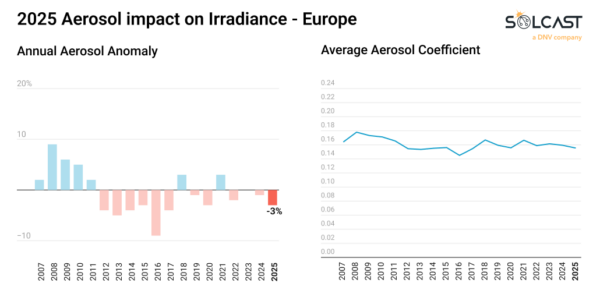
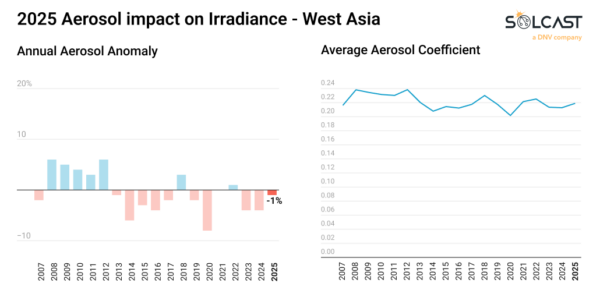
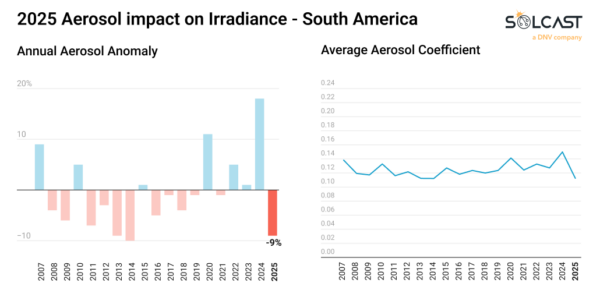
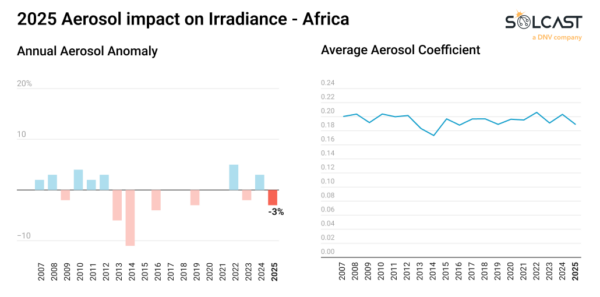
In a new weekly update for pv magazine, Solcast, a DNV company, reveales that last year extreme Canadian wildfires drove aerosol levels around 30% above normal, sharply reducing solar irradiance across Canada and even impacting Europe, while the Congo Basin also saw worsening aerosol conditions. In contrast, China and South America experienced unusually low aerosol levels, supporting stronger solar irradiance due to cleaner air, reduced fires, and favorable climate and policy conditions.
Aerosol anomalies in 2025 reveal the outsized impact of Canadian wildfires on solar conditions, with smoke and particulates from one of the worst fire seasons in the country’s history driving major reductions in solar irradiance across Canada and beyond. While Canada saw a marked increase in aerosol loading, China and South America experienced anomalously low levels, supporting stronger irradiance conditions. Meanwhile, the Congo Basin registered worsening aerosol conditions, highlighting growing concerns for central Africa's solar outlook, according to analysis using the Solcast API. Aerosols impact solar irradiance by scattering and absorbing solar radiation as it passes through the atmosphere, when calculated this effect is called ‘aerosol extinction’.
Across Canada, 2025 aerosol extinction values were around 30% above climatological norms, indicating significantly higher levels of sunlight absorption and scattering by particulate matter. This spike is directly linked to the extreme wildfire season, with the total burned area in 2025 reaching twice the 10-year average. The timing of the peak fire activity, which aligned with the high-irradiance months of May and June, compounded the impact on solar conditions.
Smoke plumes from Canada were transported across the Atlantic by prevailing westerly winds, impacting solar production as far as Western Europe, where they overlapped with Spain's worst wildfire season in over a decade, further amplifying the regional aerosol burden.
Despite having a higher aerosol load than other solar generation regions, China experienced one of its cleanest atmospheric years in recent history. Aerosol extinction anomalies were approximately 20% below the recent climatology, driven by a combination of favourable meteorological patterns and continued reductions in industrial emissions. These conditions supported a strong irradiance performance throughout the past year when irradiance was already tracking 30% above average.
South America also recorded a notable improvement in aerosol conditions following a turbulent 2024. Anomalies in 2025 were generally 20% to 30% below average, allowing for clearer skies across the region. Solar production in Brazil, benefited from reduced smoke associated with a 45% reduction in burned areas within the Amazon Basin, as detected by the DETER satellite system. This significant decrease is part of a broader post-Bolsonaro shift in environmental management, further supported by La Niña-associated wetter conditions that helped suppress fire activity.
Meanwhile, the Congo Basin experienced worsening aerosol conditions, with extinction anomalies 20% to 30% above climatology. Unlike the declining trends in Saharan dust seen across northern Africa, this spike in aerosols is attributed to increasing fire activity within wet forest regions. The number of active fires in these forests has doubled over the past two decades, largely due to a combination of hotter, drier weather and anthropogenic factors such as conflict or agricultural-driven deforestation
Solcast produces these figures by tracking clouds and aerosols at 1-2km resolution globally, using satellite data and proprietary AI/ML algorithms. This data is used to drive irradiance models, enabling Solcast to calculate irradiance at high resolution, with typical bias of less than 2%, and also cloud-tracking forecasts. This data is used by more than 350 companies managing over 300 GW of solar assets globally.
In all ages, humankind decided to spend considerable amounts of the available productivity on special monumental projects. Managing climate change and rebalancing within the planetary boundaries is such an activity. The enormous energetic productivity of solar PV may evolve as the central pillar to create a sustainable civilization.
Since civilizations have existed, monumental projects have been undertaken, such as the Pyramids of Giza, the Great Wall of China, the Gothic cathedrals, or the Apollo programme. Substantial labour and resources were invested in such projects, ranging from 0.5% up to 10% of the available productivity in the respective society, and lasting between a few years and more than a century. Such monumental projects can be grouped into five categories: culture, infrastructure, technology, war and conflict, and disaster response. A recent study from Forschungszentrum Jülich, Helmholtz Institute Erlangen Nürnberg for Renewable Energies and LUT University entitled Marshalling our productivity to create a sustainable global civilization investigated monumental projects and their link to excess productivity.
Since the industrial revolution, unprecedented wealth around the world, along with an enormous increase in life expectancy, reduction of infant mortality, reduction of starvation, freeing people from poverty, and creating unparalleled standards of living for many. These benefits were made possible by an ever-increasing use of fuel. At the same time, excessive fossil fuel consumption has led to various repercussions, in particular environmental destruction and climate change.
Reaching a global net-zero emission energy system can be considered a monumental project. Depending on different sources, such as McKinsey, BNEF, the International Energy Agency, or the United Nations, the required annual expenditures to achieve this goal may lie between 0.7 and 1.3% of the global gross domestic product (GDP) to be allocated for a few decades. Such expenditures are in the range of accepted societal choices in the past, for instance the military spending during the Cold War (3% of GDP of the United States for decades, for example) or the Belt and Road Initiative (an estimated 0.75% of GDP of China).
Solar PV gaining ground in the energy system driven by sustainability
The ongoing global energy transition has various facets, with solar PV at its core reaching over 70% of all newly installed power capacity in the world in the recent past as the fastest ramping energy source since the industrial revolution, and positioning solar PV as a prime energy supply solution around the world. Plummeting costs of solar PV and additional renewable energy technologies, complemented by growing battery storage, form the basis of a comprehensive electrification. Since the mid-1990s, global energy transition studies regularly find the contribution of solar PV to the global energy supply by mid-century to be in the order of about 70%.
The energetic sustainability of solar PV has been improved since the invention of the silicon solar cell. The rate at which solar panels have improved over time has been consistent and high for decades. For example, the energy required to make a solar panel has been reduced by 14% every time installations doubled between the 1970s and the 2010s. This learning has been enabled by continuously rising efficiencies, an increase in technology lifetimes, and a reduction in the use of materials per rated power output, as summarized in a recent publication by international PV experts. The energy payback time for PV systems ranges globally between 0.44 – 1.42 years and in Europe between 0.89 – 1.24 years depending on location. The low payback time also results in a large value for the energy returned on investment – a PV system that is operated for 30 years generates between twenty and seventy times the energy that was needed for its production. The lifetime of PV systems may be further increased up to 50 years in the longer term. System-level studies have shown that the energetic sustainability of solar PV remains robust even when accounting for additional energy investments required for batteries, complementary renewable energy technologies, and curtailment, both at global and regional scales.
Rebalancing withing safe and just planetary boundaries enabled by solar PV
Solar PV may emerge as the key driver for a sustainable civilization. This would mean supplying all humans with all needed energy for the highest standards of living, which is estimated to require 150-200 TWp of solar PV installations by the end of this century. A comprehensive Solar-to-X Economy across energy sectors will become a major characteristic in many regions around the world. The upper limit of the range of solar PV installations would even include the energy demand for massive carbon dioxide removal activities to rebalance civilization within safe und just planetary boundaries, which equals to about 10 – 12% of global primary energy supply and may cost about 0.4 – 0.7% of the global GDP to return to 1.0℃ with about 350 ppm of atmospheric CO2 concentration. In this way, PV installations could help in powering carbon dioxide removal to avoid global GDP loss of about 8% if the unintended consequences of our productivity are not addressed. Reaching permanent climate safety and its respective investments can be regarded as a highly profitable venture of civilization in the row of monumental projects in history. The high energetic productivity of solar PV is a major driver to reach a sustainable civilization.
Authors: Christian Breyer, Ian Marius Peters, and Dominik Keiner
This article is part of a monthly column by LUT University.
Research at LUT University encompasses various analyses related to power, heat, transport, desalination, industry, and negative CO2 emission options. Power-to-X research is a core topic at the university, integrated into the focus areas of Planetary Resources, Business and Society, Digital Revolution, and Energy Transition. Solar energy plays a key role in all research aspects.
Wood Mackenzie highlights a groundbreaking 5.2 GW solar-plus-storage project in the UAE capable of delivering 1 GW of continuous baseload power, signaling a potential shift in renewable energy deployment despite high costs. The report also forecasts strong global solar growth through 2030, including the rise of residential “balcony solar” in the U.S. and expanded solar shares in Asia Pacific and the U.S.
Wood Mackenzie has said it that a massive solar-plus-storage project currently under construction in the UAE will “redefine baseload power.”
The 5.2 GW solar plus 19 GWh battery energy storage project, under development by Masdar and Emirates Water and Electricity Company (EWEC), which broke ground in October, is the world’s first first gigawatt-scale renewable project engineered to deliver 1 GW of continuous, around-the-clock baseload power.
Michelle Davis, global head of solar for Wood Mackenzie, said the project represents a structural shift in hybrid project development in the region.
Davis noted that while the project is currently too expensive to replicate broadly, at roughly six times the cost of a new gas-fired combined-cycle gas turbine plant, successful project execution and continued cost declines could redefine baseload power.
“Despite the challenging events of 2025, solar market fundamentals and demand will remain strong in 2026, especially as the global economy continues to electrify,” Davis concluded.
The report also forecasts solar to play a major role in meeting the electricity load growth anticipated over the next decade in several regions of the globe.
Annual solar generation, including distributed solar, is expected to grow by 232 GWh, of 65%, in the U.S. between 2026 and 2030, according to Wood Mackenzie’s analysis. This will bring solar closer to gas, which makes up the largest share of electricity generation in the U.S., which is expected to grow by 340 GWh, or 21%, over the next four years.
In the Asia Pacific, solar made up 11% of the power generation mix in 2025 and is forecast to grow to 17% by 2030. Wood Mackenzie expects solar, wind and storage to make up a third of the power generation mix in the region by the end of the decade, having accounted for less than 10% in 2020. The analysis say new power capacity in the region is overwhelmingly directed towards solar due to price competitiveness.
Wood Mackenzie’s final prediction for 2026 is that balcony solar, or plug-in-solar, will begin to take a foothold in the US this year, while continuing its market penetration in Europe.
The market research company explains that prior to early 2025, there was no market for balcony solar in the U.S.. Utah became the first state to enable residential customers to utilize portable solar generation devices that produce up to 1.2 kW of power without the need for a utility interconnection agreement last March, with more than a dozen states introducing similar legislation since.
Wood Mackenzie expects this number to continue growing but also warned that key challenges lie in fragmented electrical standards, lower voltage in U.S. homes, and a larger share of single-family homes without balconies.
EU solar generation increased by over 20% for the fourth year running in 2025, with its share in the energy mix surpassing coal and hydro. For the first time in history, solar and wind generated more energy in the EU than fossil fuels.
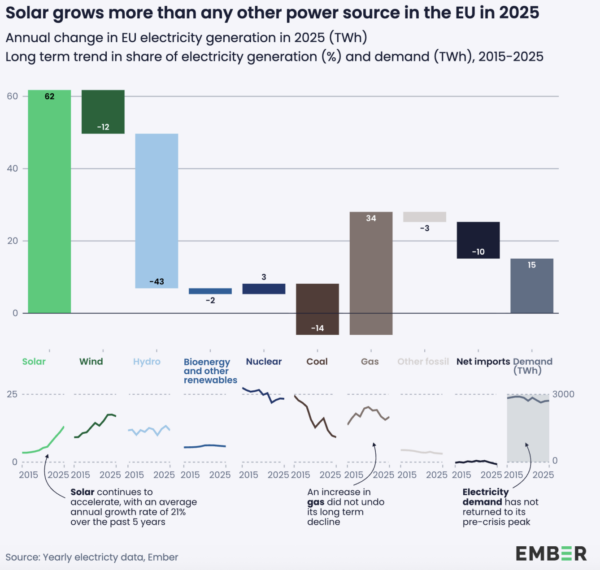
Solar generated a record 369 TWh of energy across the EU in 2025, according to the European Electricity Review published by energy think tank Ember.
The result is an increase of 62 TWh on 2024 and more than doubles the 145 TWh generated in 2020. Ember says solar energy has grown at an average annual growth in generation of 21% over the past five years, a rate far beyond any other energy source.
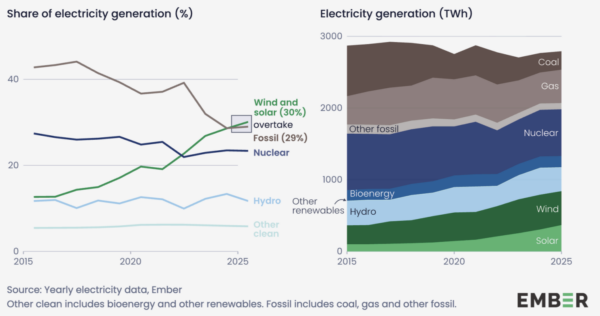
This growth trajectory, buoyed by an added 65.1 GW of solar in the EU last year, led solar to generate a record 13% of the bloc's power in 2025, moving ahead of coal and hydro. Every EU country saw growth in solar generation increase year-on-year last year, led by Hungary with a 28% contribution to its power mix. In Cyprus, Greece, Spain and the Netherlands, solar’s share in the electricity mix was also over 20%.
For the first time in history, solar and wind energy generated more EU electricity than fossil fuels in 2025, together responsible for a record 30% of EU power ahead of fossil fuels’ 29%. Solar and wind generated more electricity than all fossil sources in 14 of the EU’s 27 member states.
Report author Beatrice Petrovich said the milestone shows just how rapidly the EU is moving towards a power system backed by wind and solar. “As fossil fuel dependencies feed instability on the global stage, the stakes of transitioning to clean energy are clearer than ever,” Petrovich said.
In 2025, 19 EU countries recorded at least one hour when wind and solar combined accounted for over 70% of the country's hourly power generation, compared to only two countries in 2020. Ember found wind and solar supplied more than half of electricity generation during at least one third of all hours in Denmark, Estonia, Germany, Greece, Lithuania, Luxembourg, the Netherlands, Portugal and Spain.
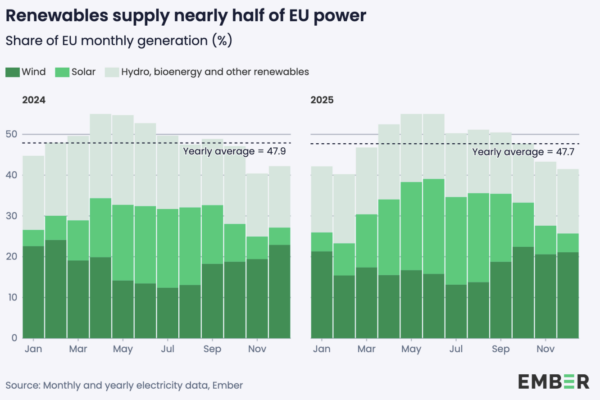
Ember’s report adds that all renewable sources, comprising solar, wind, hydro, bioenergy and other renewables, generated a total 1,331 TWh of energy in the EU last year for a 47.7% share of the total mix, 0.2% down on the year prior. The report says the share remained stable as the weather conditions that caused a drop in wind and hydro output boosted solar generation.
While gas generation rose by 8% compared to 2024, pushing the EU power sector’s gas import bill up to €32 billion, coal power fell to a historic low of 9.2%, with 19 EU countries now generating less than 5% of their energy from coal.
As solar and wind energy becomes the backbone of Europe’s power system, Ember’s report says electricity storage, together with grid enhancements and demand flexibility, will be crucial to put increasingly abundant renewable power to use and displace imported fossil power.
Among a series of recommendations listed in the report is removing barriers to battery deployment in national legislation, EU member states collaboration on permitting for key cross-border power lines, supporting investment in heat pumps and other electric technologies, introducing policy for electrifying transport, heating, and industry via the forthcoming Electrification Action Plan and delivering legislation to ban Russian gap and LNG imports by 2027.
A report from McKinsey and Company says the relative ease of building out solar projects means the U.S and Europe are likely to meet their end-of-decade deployment targets, despite current pipeline gaps of around 205 GW and 181 GW.
The US and Europe are likely to meet their 2030 solar targets despite current project pipelines being smaller than their end-of-decade targets, according to a report from global management consulting firm McKinsey and Company.
McKinsey’s “Tracking the energy transition: where are we now?” report analyzes the pathway of solar, wind and battery energy storage system (BESS) technologies towards the 2030 deployment targets set by China, the United States and the EU-27, Norway, Switzerland and the UK in Europe.
It says the US is currently around 254 GW away from its 2030 target while Europe is around 275 GW away. In contrast, China has already more than doubled its 2030 target.
Despite the US and Europe currently lacking enough announced capacity to meet their 2030s targets, by around 205 GW and 181 GW respectively, McKinsey's analysis says they are still likely to find this additional capacity and reach their end-of-decade thresholds thanks to the ease of building out solar.
“While it is easier to track project build-out for other clean energy technologies, data visibility for solar is more limited due to individual household use and ease of build-out,” McKinsey’s report explains. “For example, a consumer can install household solar in two months. This means that the announced capacity may be underestimated in this analysis.”
Diego Hernandez Diaz, a partner at McKinsey, told pv magazine that while core markets will continue their build out, further demand growth will also occur in less saturated core markets such as Poland. “The advantage of some of these elements is that the more nascent markets can have a better economic trade off and can be built in an economically pragmatic way,” he explained.
The report does acknowledge that this growth trajectory is not guaranteed, citing supply chain risks, tariffs, shifting policy focus and growing political uncertainty as factors that can slow down progress. Hernandez Diaz added there will likely be an effect from shifting regulation across the board.
“Perhaps more importantly, however, is that beyond any regulation, what we continue to see is that if the underlying economics work, then deployment accelerates,” he stated. “All major geographies covered in the report have the underlying fundamentals to support accretive deployment of further renewable energy sources.”
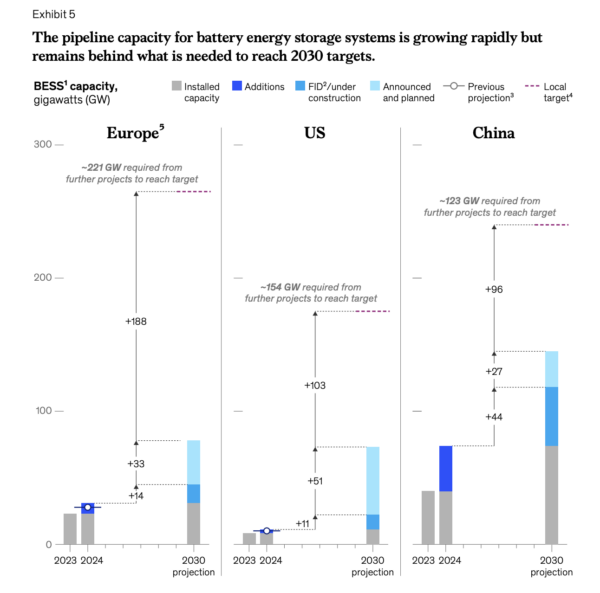
The report also notes that the battery energy storage system (BESS) pipeline is growing rapidly across China, the US and Europe, but remains behind what is needed to meet 2030 targets. McKinsey estimates around an additional 123 GW is required in China, 154 GW in the US and 221 GW in Europe.
The analysts says BESS remains the dominant question mark but can be sited, permitted, constructed, and interconnected far faster than technologies such as nuclear or gas with carbon, capture, utilization and storage (CCUS) contributing to its rapid growth in recent years.
The report attributes the rapid acceleration of BESS installation to a positive business case for both large-scale operators and households when paired with solar. “Load balancing is also becoming a popular source of revenue for battery operators,” the report adds. “Planning and integrating BESS with renewable rollout is critical if 2030 net-zero targets are to be met.”

 Login
Login



 Across Canada, 2025 aerosol extinction values were around 30% above climatological norms, indicating significantly higher levels of sunlight absorption and scattering by particulate matter. This spike is directly linked to the extreme wildfire season, with the total burned area in 2025 reaching twice the 10-year average. The timing of the peak fire activity, which aligned with the high-irradiance months of May and June, compounded the impact on solar conditions.