Reading view

Mercedes-Benz Trucks opens orders for its eArocs 400 electric construction truck
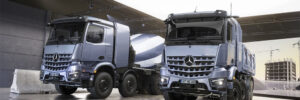

Mercedes-Benz Trucks will begin sales of its new battery-electric eArocs 400 in April, expanding its electric portfolio to include the construction segment.

Customers in an initial 13 EU markets can now order the eArocs 400, which made its debut at last year’s bauma trade fair in Munich. Beginning in the third quarter of 2026, the base vehicle will be produced at the Mercedes-Benz plant in Wörth am Rhein, followed by integration of the electric drivetrain by Paul Group, headquartered in Vilshofen an der Donau.

The eArocs 400 is equipped with two LFP battery packs, each offering 207 kWh of capacity, housed in a battery tower behind the cab. It’s designed specifically for urban and near-road construction work, and in many use cases, it can complete a full work day without intermediate charging.

The eArocs 400 is initially offered in two versions, with technically permissible gross vehicle weights of 37 and 44 tonnes. It is available in an 8×4/4 axle configuration and four wheelbase options, and is suitable for applications such as dump bodies and concrete mixer bodies.

Key components from the second-generation Mercedes Benz eActros portfolio have been incorporated into the eArocs 400.

The eArocs 400 features an 800-volt onboard electrical architecture, as well as an integrated 3-speed transmission, providing a continuous output of 380 kW and a peak output of 450 kW. The truck supports charging at up to 400 kW via the standard CCS2 charging interface, available on both sides of the vehicle.

“The new battery-electric eArocs 400 combines the robustness required with an efficient electric drive system, covering key use cases in near-road construction,” said Stina Fagerman, Head of Marketing, Sales and Services at Mercedes Benz Trucks.

Source: Mercedes-Benz Trucks

  •  

WattEV doubles capacity, adds megawatt chargers at San Bernardino electric truck charging depot


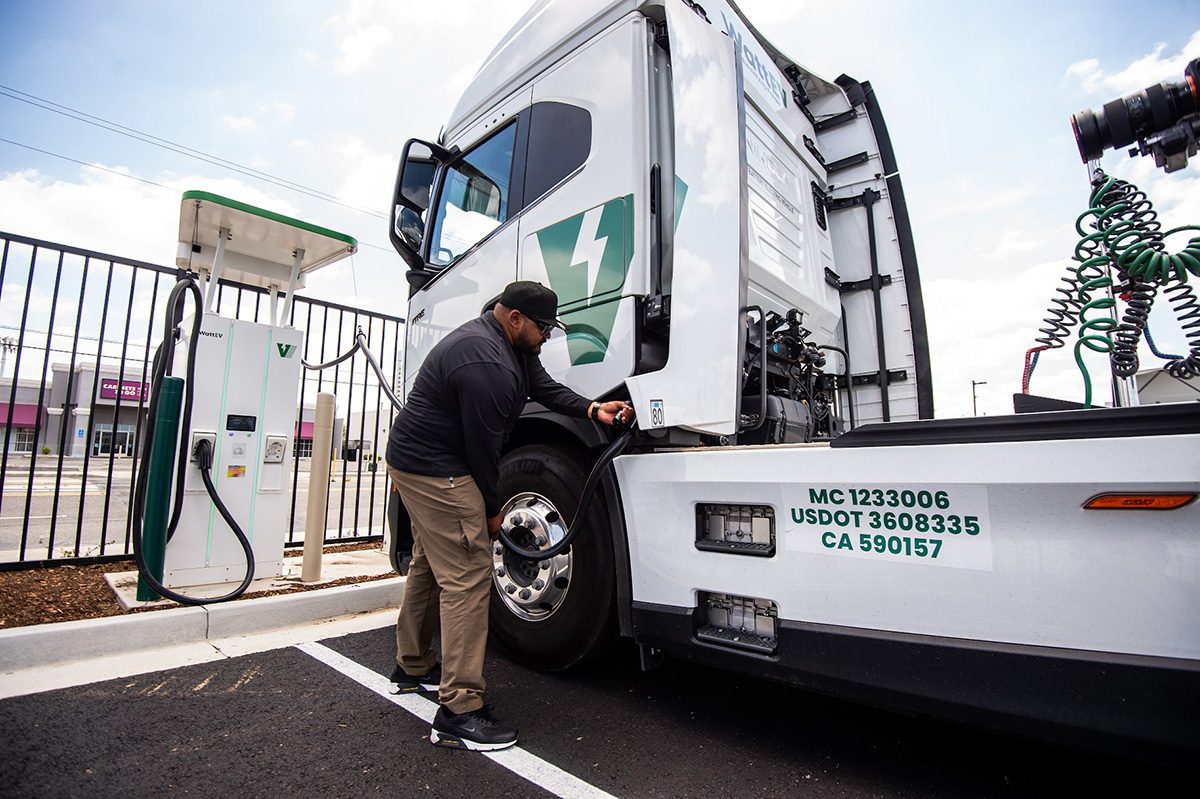
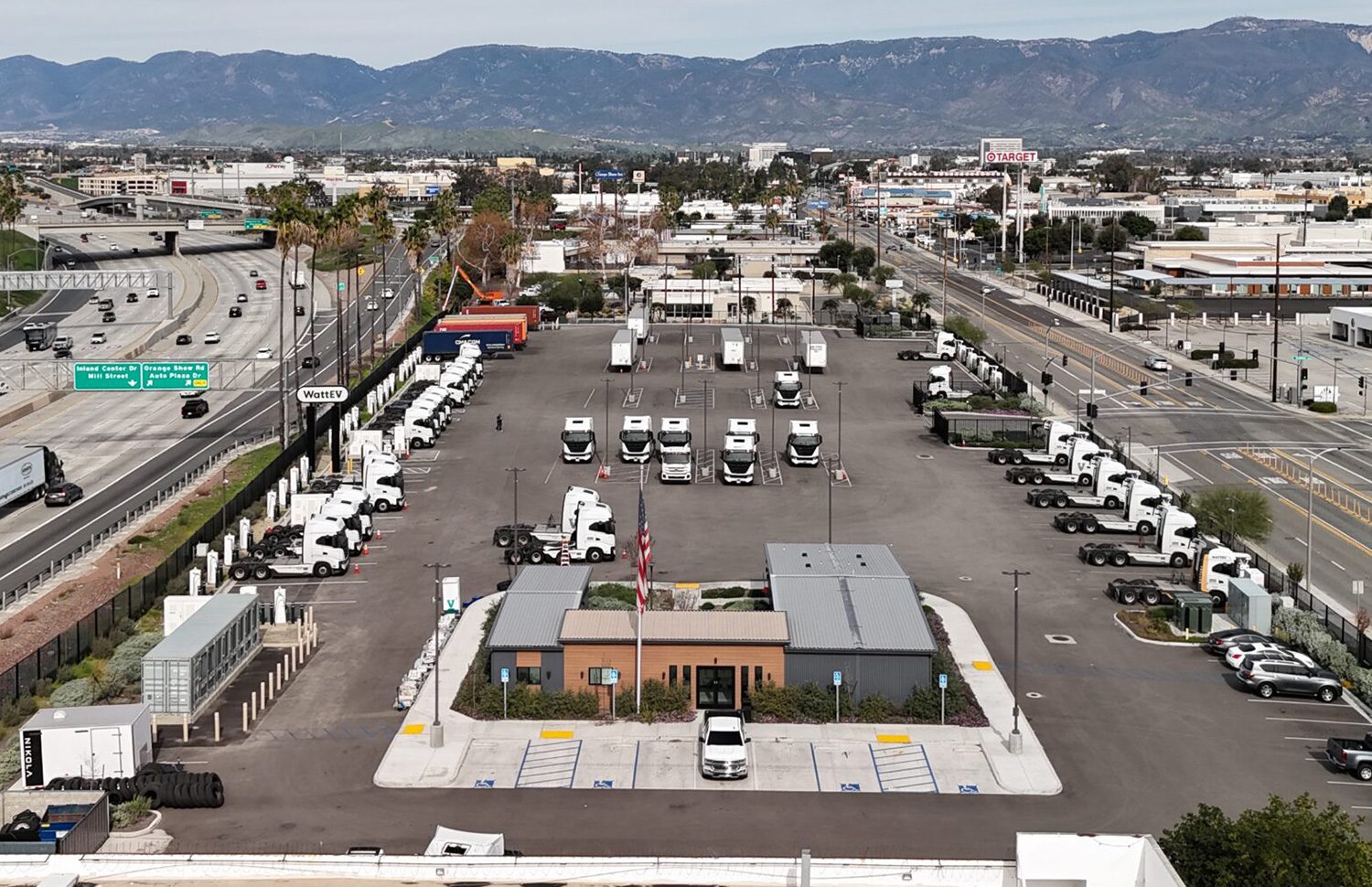
WattEV offers a Truck-as-a-Service solution for carriers and owner-operators—not only does the company have its own fleet of electric trucks, it also operates five heavy-duty EV charging depots, and has 15 more under development. Now the company has added more charging ports and increased the available charging power at its busiest electric truck charging depot, located in San Bernardino, California.

The San Bernardino truck charging depot, located adjacent to I-215, one of Southern California’s busiest freight corridors, has added thirty 250 kW CCS ports and six 1.2 MW MCS ports to its existing 24 ports, and offers 11.5 MW of total charging power. The site will now be able to charge up to 200 electric trucks per day while offering megawatt charging capability for trucks compatible with the MCS standard.

“At our San Bernardino depot, strong and sustained utilization—currently averaging approximately 700 MWh per month—has created the need to more than double the site’s capacity” said CEO Salim Youssefzadeh. “San Bernardino sits at the center of some of the most freight-dense corridors in the country, and scaling this depot enables us to support real-world fleet growth with reliable charging, dependable operations and infrastructure designed for long-term commercial deployment.”

Source: WattEV

  •  

Tesla Semi Chargers Planned For Pilot Travel Centers

Recently, there has been some encouraging EV charger news for passenger vehicles, with new chargers announced for retail outlets owned by Kroger and Walmart in a variety of states. Sheetz and WaWa also have an impressive number of EV chargers operating at some of their stores. Pilot is recognized as ... [continued]

The post Tesla Semi Chargers Planned For Pilot Travel Centers appeared first on CleanTechnica.

  •  

Tesla Semi Chargers Planned For Pilot Travel Centers

Recently, there has been some encouraging EV charger news for passenger vehicles, with new chargers announced for retail outlets owned by Kroger and Walmart in a variety of states. Sheetz and WaWa also have an impressive number of EV chargers operating at some of their stores. Pilot is recognized as ... [continued]

The post Tesla Semi Chargers Planned For Pilot Travel Centers appeared first on CleanTechnica.

  •  

Pilot Travel Centers to deploy heavy-duty EV charging stations for Tesla Semis


Truck stop operator Pilot Travel Centers has entered into an agreement with Tesla to install charging stations for Tesla’s Semi heavy-duty electric trucks.

The Tesla charging stations will be built at select Pilot locations in California, Georgia, Nevada, New Mexico and Texas, along I-5, I-10 and “several major corridors where the need for heavy-duty charging is highest.” The first sites are expected to open in Summer 2026.

Each location will host four to eight charging stalls featuring Tesla’s V4 cabinet charging technology, which can deliver up to 1.2 megawatts of power at each stall.

Pilot says that in the future, the sites may be expanded to be compatible with heavy-duty electric vehicles from other manufacturers.

“Heavy-duty charging is yet another extension of our exploration into alternative fuel offerings, and we’re happy to partner with a leader in the space that provides turnkey solutions and deploys them quickly,” said Shannon Sturgil, Senior VP, Alternative Fuels at Pilot.

Source: Pilot Travel Centers

  •  

The Assumptions That Broke: China, India, and the End of Fossil Growth Models

The idea that heavy freight would be the last redoubt of diesel has been repeated for decades, often with confidence and rarely with evidence. In December 2025, that idea finally collapsed. Battery-electric heavy duty trucks crossed 50% of new sales in China, a segment that had long been treated as ... [continued]

The post The Assumptions That Broke: China, India, and the End of Fossil Growth Models appeared first on CleanTechnica.

  •  

EU Cannot Afford to Pause Zero-Emission Heavy-Duty Charging Deployment

IRU, the European Automobile Manufacturers’ Association (ACEA) and T&E urge the European Commission to ensure continuity of EU funding for heavy-duty vehicle charging and hydrogen refuelling infrastructure, warning that a break in support in 2026–2027 would risk slowing the deployment of zero-emission vehicles. In a joint letter addressed to European Commission President ... [continued]

The post EU Cannot Afford to Pause Zero-Emission Heavy-Duty Charging Deployment appeared first on CleanTechnica.

  •  

The Assumptions That Broke: China, India, and the End of Fossil Growth Models

The idea that heavy freight would be the last redoubt of diesel has been repeated for decades, often with confidence and rarely with evidence. In December 2025, that idea finally collapsed. Battery-electric heavy duty trucks crossed 50% of new sales in China, a segment that had long been treated as ... [continued]

The post The Assumptions That Broke: China, India, and the End of Fossil Growth Models appeared first on CleanTechnica.

  •  

Mercedes-Benz eActros electric trucks drive 2,400 km in long-haul endurance test of Megawatt Charging System


Development engineers from Mercedes‑Benz Trucks tested the Megawatt Charging System on a long‑distance test drive with two MCS‑compatible eActros 600 electric trucks.

The aim was to ensure optimal compatibility between the vehicle and megawatt charging stations from various manufacturers, as well as to gain insights into real‑world usability—including under winter conditions—ranging from the charging curve and average charging power to the overall performance of the MCS infrastructure.

The test run covered a route of approximately 2,400 kilometers, from the Mercedes‑Benz plant in Wörth am Rhein, Germany, through the Netherlands, Belgium and Denmark, to Linköping in southern Sweden. The vehicles were recharged at both public and private MCS charging sites specifically designed for trucks.

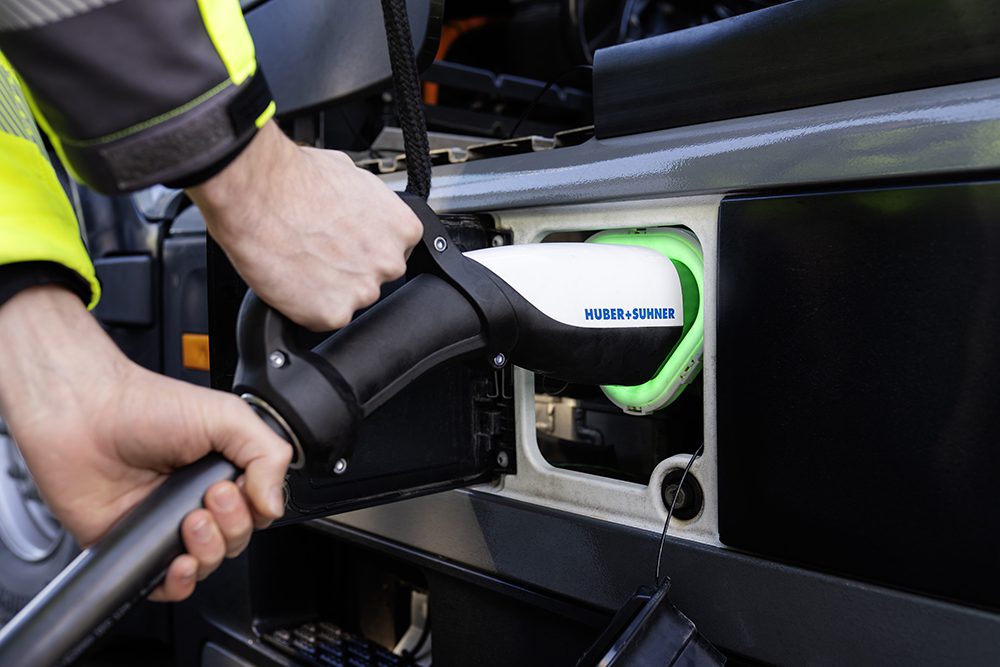
The MCS standard enables charging at power levels of up to 1,000 kW. Global standards organization CharIN is working to promote uniform interfaces between charging stations and electric trucks, and to facilitate the development of a pan‑European fast‑charging network for heavy‑duty commercial vehicles.

“The key challenges in megawatt charging lie in harmonizing the vehicle with various charging systems,” said Peter Ziegler, Head of E Charging Components, Mercedes Benz Trucks. “At the same time, the extreme charging currents in MCS charging place high demands on thermal management. The current test run provides an important opportunity to evaluate these aspects under real-world operating conditions.”

Source: Daimler Truck

  •  

Even in extreme cold, EVs outperform diesel AND save drivers money

Fleet managers don’t get paid to argue on Facebook. They get paid to look at the numbers, and make decisions in the best financial interests of their companies. According to studies that follow real-world fleets in the most extreme, cold-weather conditions in America, EVs don’t just survive — they thrive, beating out diesel on the balance sheet.

more…
  •