The Union Budget 2026-27 aims at strengthening clean energy development, clean technology manufacturing, lithium-ion battery production, and tariff rationalisation. There has been a significant increase in budgetary allocations for the Ministry of New and Renewable [...]
Researchers in Iraq have developed biomimetic leaf vein–inspired fins for photovoltaic panels, with reticulate (RET) venation reducing panel temperature by 33.6 C and boosting efficiency by 18% using passive cooling. Their study combines 3D CFD simulations and electrical evaluations to optimize fin geometry, offering a sustainable alternative to conventional cooling methods.
A research group from Iraq’s Al-Furat Al-Awsat Technical University has numerically investigated the thermal and electrical performance of PV panels integrated with leaf vein–inspired fins. They have simulated four types of venation used by plants, namely pinnate venation (PIN), reticulate venation (RET), parallel venation along the vertical axis (PAR-I), and parallel venation along the horizontal axis (PAR-II).
“The key novelty of our research lies in introducing and systematically optimizing biomimetic leaf vein–inspired fin geometries as passive heat sinks for photovoltaic panels,” corresponding author Yasser A. Jebbar told pv magazine. “While conventional cooling approaches rely on simple straight fins, fluids, or active systems, our study is among the first to directly translate natural leaf venation patterns—particularly RET structures—into manufacturable backside fins specifically tailored for PV thermal and electrical performance.”
The team combined detailed 3D computational fluid dynamics (CFD) modeling with electrical efficiency analysis to identify geometries that maximize heat dissipation without additional energy input or water consumption. Next steps include experimental validation of the leaf vein fin designs under real outdoor conditions, particularly in hot climates.
The simulated PV panel consisted of five layers: glass, two ethylene-vinyl acetate (EVA) layers, a solar cell layer, and a Tedlar layer, with a copper heat sink and fins attached. All fin configurations were initially 0.002 m thick, 0.03 m high, and spaced 0.05 m apart. Panels measured 0.5 m × 0.5 m, with a surrounding air velocity of 1.5 m/s and incident irradiance of 1,000 W/m².
RET fins outperformed all other designs, reducing operating temperature by 33.6 C and increasing electrical efficiency from 12.0% to 14.19% —an 18 % relative improvement—compared to uncooled panels.
“This temperature reduction rivals, and in some cases exceeds, water-based or hybrid cooling methods, despite relying solely on passive air cooling,” Jebbar noted. The study also highlighted the significant impact of fin height, more than spacing or thickness, on cooling performance.
The team further optimized the RET fins, varying spacing from 0.02–0.07 m, height from 0.02–0.07 m, and thickness from 0.002–0.007 m. The optimal geometry—0.03 m spacing, 0.05 m height, and 0.006 m thickness—achieved the maximum 33.6 C temperature reduction and 18% efficiency gain.
China’s cumulative power-sector energy storage capacity reached 213.3 GW by the end of 2025, up 54% year on year, according to data from the China Energy Storage Alliance (CNESA). Pumped hydro accounted for 31.3% of the total, while “new-type” energy storage made up 67.9% – around 144.7 GW.
Based on CNESA DataLink 2025 annual energy storage dataset, presented at a press conference in Beijing on Jan. 22, a total of 66.43 GW/189.48 GWh of new-type energy storage systems were commissioned in 2025.
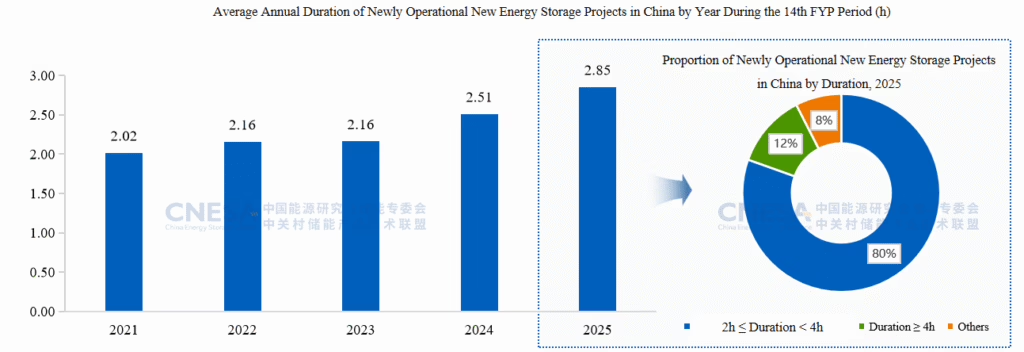
The added power and energy scales increased 52% and 73% year on year, respectively, which CNESA linked to a continued shift toward longer-duration configurations, it reported the average duration rising to 2.58 hours in 2025 (from 2.11 hours in 2021).
CNESA said the leading application scenario has shifted toward standalone energy storage, which accounted for 58%, while user-side storage fell to 8% and thermal-plus-storage frequency regulation to 1.4%; “renewables-paired storage” was described as stable.
Geographically, CNESA reported that the top 10 provinces each exceeded 5 GWh of newly commissioned capacity and together represented about 90% of additions. Inner Mongolia ranked first by both power and energy capacity, and Yunnan entered the top 10 for the first time.
Lithium iron phosphate (LFP) batteries continued to dominate, with CNESA reporting over 98% of new-type installed capacity. CNESA also noted emerging deployments of sodium-ion, vanadium flow, compressed air, gravity storage, and hybrid systems, separately citing a 40 MW/40 MWh grid-forming sodium-ion project in Wenshan, Yunnan as an example.
On procurement, CNESA reported 690 energy storage system tenders (excluding centralized/framework procurement), down 10.4%, while EPC tenders rose to 1,536, up 4.5%. Winning bid volumes (excluding centralized/framework procurement) reached 121.5 GWh for systems and 206.3 GWh for EPC.
CNESA’s tender-price analysis for LFP systems (excluding user-side applications) reported a 2025 winning bid price range of CNY 391.14/kWh ($55/kWh) to CNY 913.00/kWh ($128/kWh). For EPC (excluding user-side), CNESA reported average winning bid prices of CNY 1,043.82/kWh ($146/kWh) for 2-hour projects and CNY 935.40/kWh ($131/kWh) for 4-hour projects.
CNESA also launched a policy “map” for standalone storage market mechanisms covering 21 provinces.
A report from LevelTen Energy finds solar PPA prices in North America rose 3.2% in Q4 2025, marking a nearly 9% year-over-year increase as developers and buyers navigate a complex “post-OBBBA” regulatory environment.
Renewable energy power purchase agreement (PPA) prices continued their upward trajectory in the final quarter of 2025, driven by persistent policy headwinds and a shifting tax credit landscape.
According to the Q4 2025 PPA Price Index from marketplace operator LevelTen Energy, solar P25 prices rose by 3.2% following a 4% increase in the third quarter.
While solar costs climbed, wind PPA prices saw a slight dip, declining 1%. However, on an annual basis, both technologies have seen prices surge by nearly 9% compared to the same period last year.
Post-OBBBA
The market is currently adjusting to the “One Big Beautiful Bill Act” (OBBBA), which introduced tax credit cuts. LevelTen noted the second half of 2025 was defined by “ruthless” prioritization as firms scrambled to safe-harbor projects.
Despite these challenges, a November survey of developers representing over 230 GW of capacity found that more than 75% of projects slated to go online before 2029 expect to successfully retain access to tax credits.
This clarity has allowed some developers to dial in pricing by removing risk premiums that had previously accounted for OBBBA-related uncertainties, said the report.
Regional pricing
The report highlights significant price disparity across North American ISOs. For solar, P25 prices reached as high as $115 per MWh in ISO-NE and $81.03/MWh in PJM, while ERCOT remained the most competitive at $49 per MWh.
ISO Market
Solar P25 Price ($/MWh)
ISO-NE
$115.00
PJM
$81.03
MISO
$64.95
CAISO
$62.00
ERCOT
$49.00
In the wind sector, ERCOT has seen a massive 19% year-over-year price hike, fueled by an ongoing boom in data center development and a premium on available capacity.
Buyer headwinds
LevelTen pointed to several factors that could continue to apply upward pressure on prices:
Tariff uncertainties: Ongoing Section 232 investigation tariffs are adding direct development costs.
Permitting hurdles: “Harsh” new federal permitting procedures have stalled substantial amounts of development nationwide.
FEOC: The industry is still awaiting guidance on Foreign Entity of Concern (FEOC) rules, which are expected to add compliance costs and further complicate tax credit qualification.
Corporate strategy
Many corporate buyers are now pausing or adjusting their procurement strategies due to proposed updates to the Greenhouse Gas Protocol (GHGP) Scope 2 standards, said the report. The updates, expected to be finalized in 2027, may introduce more stringent accounting for hourly matching and physical deliverability.
“The current uncertainty has caused some buyers… to adjust or even delay their procurement strategies,” the report said.
LevelTen encourages industry players to weigh in on the proposal, as 97% of companies tracking emissions currently utilize the GHGP.
As buyers and sellers work to establish a “pricing equilibrium,” the report said in markets where contract values are challenging, sellers may need to find more transactable pricing levels to get deals done.
Voltalia has been awarded a 132 MW solar project in the Gabès region of south-east Tunisia by the Tunisian government. Construction of the Wadi solar project is scheduled to begin in 2027, with commissioning planned [...]
Nexus Renewables Inc., a full-service renewable energy developer and independent power producer operating as part of the Apricus Generation platform, has announced the appointment of Faizan Farooqi, the Company’s Vice […]
The Finnish start-up says its sand battery technology is scalable from 20 to 500 MWh with charging power from 1 to 20 MW, depending on industrial needs.
Finnish cleantech startup TheStorage says that its thermal storage technology could reduce industrial energy costs by up to 70% and cut carbon emissions by as much as 90%. The system converts renewable electricity into heat, stores it in sand, and delivers it on-demand for industrial heating.
The concept emerged in Finland in 2023, with engineering work beginning in 2024. In January 2026, TheStorage installed its first industrial-scale pilot at a brewery, putting the technology to the test in a real-world setting. There, it produces fossil-free steam for the brewery’s production lines.
“Producing steam without fossil fuels is a major step toward carbon-neutral production,” says Vesa Peltola, Production Director of the brewery.
TheStorage’s technology captures electricity when it is abundant and inexpensive, converts it into high-temperature heat, and stores it in sand. This stored heat can later be used in industrial processes independently of real-time electricity availability.
To continue reading, please visit our ESS News website.
Scientists have grown organic romaine lettuce under 13 different types of PV modules, in an unusual hot Canadian summer. Their analysis showed lettuce yields increased by over 400% compared to unshaded control plants.
A research group from Canada’s Western University has investigated the performance of organic romaine lettuce, a heat-sensitive crop, under a broad range of agrivoltaic conditions. The test was conducted in London, Ontario, in the summer of 2025, during which 18 days had temperatures over 30 C.
“Our study explores how agrivoltaic systems can be tailored to optimize crop growth, especially under extreme heat conditions, while contributing to sustainable energy generation,” corresponding researcher Uzair Jamil told pv magazine.
“This becomes especially relevant in the context of climate change, where we are experiencing temperature extremes across the world,” Jamil added. “We examined the performance of organic romaine lettuce under thirteen different agrivoltaic configurations – ranging from crystalline silicon PV to thin-film-colored modules (red, blue, green) – in outdoor, high-temperature stress conditions.”
More specifically, the experiment included c-Si modules with 8%, 44% and 69% transparency rate; blue c-Si modules with transparency of 60%, 70%, and 80%; green c-Si modules with transparency of 60%, 70%, and 80%; and red c-Si modules with transparency of of 40%, 50%, 70%, and 80%.
All agrivoltaics installations had a leading-edge height of 2.0 m and a trailing-edge height of 2.8 m, and the modules were oriented southwards at 34◦. Pots with organic romaine lettuce were placed under all configurations, along with three pots fully exposed to ambient sunlight without shading, used as controls.
In addition to measurements against the control, the scientific group has compared the results to the national average per-pot yield for 2022, which included less high-temperature days and was therefore considered typical. Those data points were taken from agricultural census data, which later enabled the researcher also to create nationwide projections of their results.
“Lettuce yields increased by over 400% compared to unshaded control plants, and 200% relative to national average yields,” Jamil said about the results. “60% transparent blue Cd-Te and 44% transparent crystalline silicon PV modules delivered the highest productivity gains, demonstrating the importance of both shading intensity and spectral quality in boosting plant growth.”
Jamil further added that if agrivoltaic were to scale up to protect Canada’s entire lettuce crop, they could add 392,000 tonnes of lettuce.
“That translates into CAD $62.9 billion (USD $46.6 billion) in revenue over 25 years,” he said. “If scaled across Canada, agrivoltaics could also reduce 6.4 million tonnes of CO2 emissions over 25 years, making it a key player in reducing the agricultural sector’s environmental footprint.”
Cubenergy has launched FlexCombo 2.0, a scalable battery energy storage system for utility, commercial, and industrial applications, offering up to 16 MWh capacity with LFP batteries. Its modular design, advanced BMS, and cloud-based operations enable easy installation, seamless expansion, and efficient grid integration, according to the manufacturer.
Cubenergy, a Chinese manufacturer of battery energy storage systems (BESS), has introduced a new energy block designed for utility, commercial, and industrial (C&I) applications.
The product, named FlexCombo 2.0, uses the company’s 835 kWh FlexCombo D2 batteries. It is available in three configurations: 10, 12, or 12 batteries, providing a total capacity of 8 MWh, 10 MWh, or 16 MWh, respectively.
“With the FlexCombo D2 modular design and parallel architecture, FlexCombo’s core advantage lies in its long-term scalability,” the company said in a statement. “It enables seamless capacity growth and effortless integration with power generation systems (PGS), simplifying deployment and accelerating delivery for ultimate flexibility.”
The FlexCombo D2 batteries feature lithium iron phosphate (LFP) chemistry, offering a lifespan of 8,000 cycles at 70% capacity retention, according to the manufacturer.
Each battery measures 2 m x 1.68 m x 2.55 m and has a weight of up to eight tons. They carry an IP55 protection rating. Each block also comes with a power conversion system (PCS) rated at 430 kW AC with an IP66 protection grade. Optional medium-voltage (MV) transformers are available, with AC power ratings of either 8,800 kVA or 5,250 kVA.
“The FlexCombo 2.0 is designed primarily for utility and C&I applications, including renewable energy arbitrage, stand-alone grid stabilization, factories, and commercial buildings,” the company stated. “This integrated, easy-to-install BESS can be quickly connected and aligned with project requirements, while the advanced Active Balancing battery management system (BMS) and cloud-based operations provide a superior user experience.”
This week Women in Solar+ Europe gives voice to Alba Sande, lawyer at Spanish law firm ASande Legal. She states that, despite progress, women remain underrepresented in the renewable energy industry. "As a woman and a mother, I have often encountered the unspoken assumption that professional ambition must take a backseat to family life, a bias rarely applied to men," she says.
The solar, energy storage, EV charging, and grid infrastructure sectors sit at the heart of the energy transition. What makes these industries particularly suited to, and in need of, gender diversity and inclusion is the nature of the challenge itself. The energy transition demands innovative thinking, long-term vision, and the ability to manage complexity across technical, legal, regulatory, and social dimensions. Gender diversity brings varied perspectives, leadership styles, and problem-solving approaches. Inclusion ensures those voices are heard and valued.
These industries work best when they reflect the diversity of the communities they serve. Decision-making becomes stronger when collaboration replaces uniformity. Diverse teams are not only fairer; they are more effective, more resilient, and better prepared to build a sustainable future.
From my experience, diversity, equity, and inclusion are directly linked to the resilience and success of the renewable energy sector. DEI broadens the range of inputs organizations rely on to navigate complexity. Inclusive workplaces foster trust and psychological safety, encouraging open dialogue and the kind of bold ideas that innovation requires. This is essential in a fast-evolving sector like renewable energy, where adaptation is constant. When professionals feel empowered to contribute, retention improves, decision-making becomes more robust, and strategies are better aligned with societal needs. DEI is not separate from business success, it is integral to long-term impact.
Looking back at my own career, I encountered systemic barriers that many women in male-dominated industries will recognise. Implicit biases about how leadership should look and sound, often shaped by traditional models, were persistent. The absence of visible female role models and the lack of structural support, particularly for those balancing care responsibilities, created additional friction. Overcoming these challenges required building strong support networks, staying grounded in purpose, and allowing results to speak clearly. It also meant resisting pressure to “fit the mould” and instead demonstrating that strategic thinking, empathy, and consistency are powerful leadership traits.
Over time, I have observed important shifts in how the industry approaches gender inclusion in leadership. There is greater recognition that diverse leadership is not simply desirable; it is necessary. We are seeing more women in strategic roles and greater openness to flexible career paths. That said, inclusion at senior levels still requires deliberate effort. True progress happens when organisations understand that leadership potential is not tied to a single profile or personal circumstance. Valuing varied life experiences, including those shaped by caregiving, strengthens leadership culture and builds resilience.
Navigating bias and scepticism has been a defining part of my professional journey. As a woman and a mother, I have often encountered the unspoken assumption that professional ambition must take a backseat to family life, a bias rarely applied to men. Yet this is not about choosing one over the other; it is about integration. Early on, I realised that women with young children are frequently expected to prove they are prioritising work in order to be taken seriously. My response was consistency, results, and a clear message: commitment is not gendered.
Even today, driving DEI initiatives at an executive level remains challenging. Despite progress, women remain underrepresented in decision-making spaces. In my experience, around 80% of strategic meetings still involve only men, particularly when critical decisions are being made. One of the greatest challenges is feeling like an equal, owning expertise, and expressing it with confidence in environments where women are often required to repeatedly prove their competence, while male colleagues are assumed to be capable by default. This imbalance makes DEI both essential and deeply personal to lead.
There are still specific gender dynamics within the energy sector that influence career progression. Women, especially mothers, are more frequently questioned about long-term commitment or availability. There remains an unequal expectation to prove expertise. While these dynamics are evolving, progress is slow. Acknowledging them and addressing them without penalising different life experiences is essential for building an inclusive, high-performing industry.
To young women entering the solar and renewable energy sector today, my advice is simple: believe in your voice and your contribution from day one. This industry needs critical thinkers, communicators, and leaders who reflect the diversity of society. Do not allow outdated assumptions to shape your path. Seek mentors who support your growth and organisations that recognise potential beyond traditional models. Being a woman is not a limitation, even when you are the only one in the room. Trust your expertise, ask questions boldly, and bring your full self to the table. The sector will be stronger for it.
Alba Sande is an administrative and regulatory lawyer specialised in energy, environment, and infrastructure. After several years advising major national and international clients at Clifford Chance Madrid, she founded Asandelegal, a boutique legal practice focused on strategic regulatory support for the energy transition. Her experience includes advising banks, funds, and energy companies on permitting, litigation, and regulatory matters in large-scale renewable energy projects—especially wind, solar PV, and storage. Alba holds a double degree in Law and Economics (ICADE) and a Master’s in Energy from the Spanish Energy Club. She is a regular contributor to industry publications and a speaker at sectoral forums. As a woman and mother working in a traditionally male-dominated industry, she is an advocate for inclusive leadership and visibility of diverse talent in energy law and infrastructure. She believes that legal certainty, diversity, and sustainability must go hand in hand to meet the challenges of the green transition.
Interested in joining Alba Sandeand other women industry leaders and experts at Women in Solar+ Europe? Find out more: www.wiseu.network
In a new weekly update for pv magazine, Solcast, a DNV company, reports that in January most of East Asia experienced normal to above-average solar irradiance, with southeastern China seeing surges due to reduced clouds and low aerosol levels under lingering La Niña effects. In contrast, the Philippines faced below-average irradiance from early Tropical Storm Nokaen, while other regional cities like Seoul, Tokyo, and Taipei recorded modest gains.
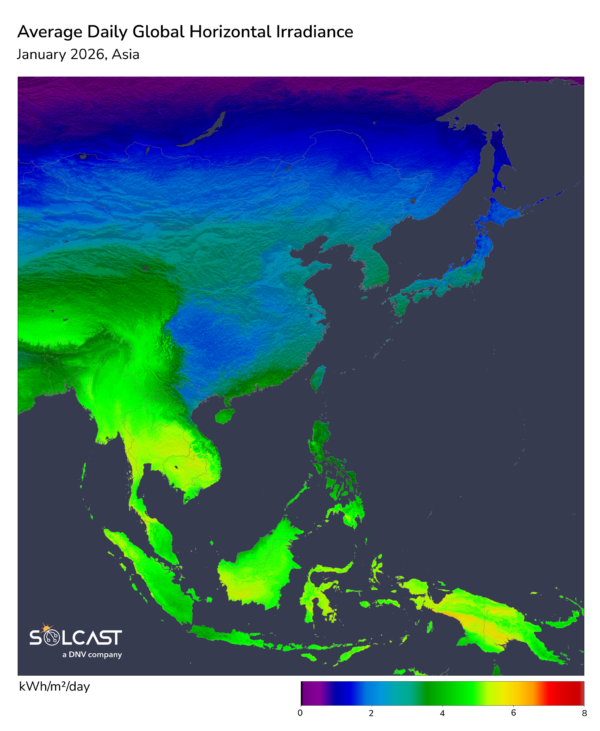
Most of East Asia recorded normal to above‑normal solar irradiance in January, as weak La Niña conditions continued to influence regional weather patterns. The largest gains were observed across southeastern China, where suppressed cloud formation and reduced aerosol-effects delivered a strong start to the year for solar operators, while unusual early tropical storm activity brought significant rainfall and irradiance losses to parts of the Philippines. With two days left in January at time of publishing, this data uses live data from 1-29 January, and forecasts for 30-31 Jan from the Solcast API.
Irradiance in southeastern China surged well above historical averages in January, with Hong Kong exceeding 25% above average. A dominant Siberian high pressure system, with temperatures in parts of Siberia more than 10 C below normal, extended into western China. The resulting northerly flow delivered drier air into southeastern China, reducing both precipitation and cloud formation. This irradiance pattern aligns with typical La Niña effects, even though the La Niña signal was weak and fading toward neutral by late January. Additionally, lower than normal aerosol levels contributed to above average irradiance in coastal parts of China.
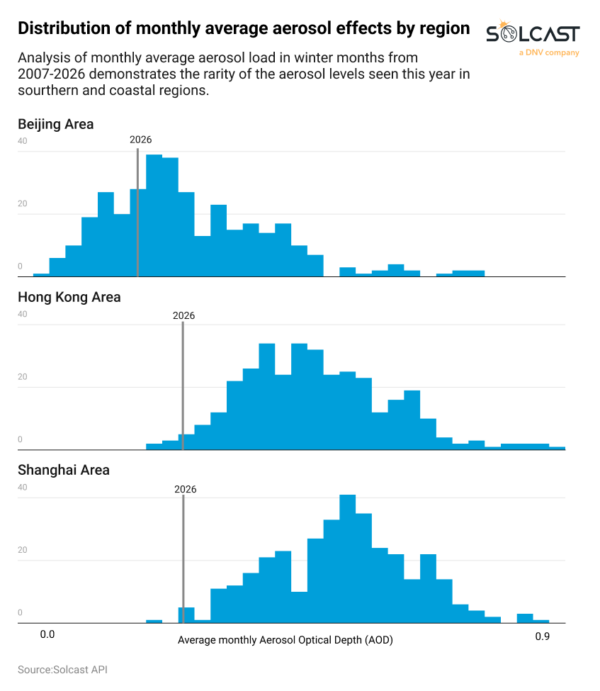
In a continuation of the irradiance and aerosol pattern seen in 2025, many parts of China, in particular low-lying industrial areas saw significant drops in aerosol load and a corresponding increase in available irradiance. Both Hong Kong and Shanghai regions saw significantly lower winter average aerosol loads, than the historical average for winter months from 2007-2026. Whilst this supported the exceptionally high irradiance in Hong Kong through January, Shanghai recorded slightly above-average irradiance, despite experiencing a rare snowfall late in the month. By contrast, Beijing has historically lower aerosol loads, however still saw slightly below-average irradiance due to prevailing cloud levels.
Elsewhere in East Asia, irradiance levels were generally normal to above normal for this month. Seoul and Tokyo recorded irradiance 5–10% above January averages and Taipei saw gains exceeding 10%. Across the maritime continent, irradiance and precipitation anomalies were near normal.
The most significant negative irradiance anomaly in the region was associated with Tropical Storm Nokaen (Ada), which marked an unusually early start to the 2026 Pacific typhoon season. Making landfall in January—the first such occurrence since 2019— Nokaen delivered intense rainfall and heavy cloud cover to the central and northern Philippines. Daily rainfall totals reached up to 200 mm, triggering mudslides and widespread disruption. Irradiance across the northern Philippines dropped by as much as 10% below average, while the southern parts of the archipelago, spared from the worst of the storm, saw irradiance climb to 10% above average.
Solcast produces these figures by tracking clouds and aerosols at 1-2km resolution globally, using satellite data and proprietary AI/ML algorithms. This data is used to drive irradiance models, enabling Solcast to calculate irradiance at high resolution, with typical bias of less than 2%, and also cloud-tracking forecasts. This data is used by more than 350 companies managing over 300 GW of solar assets globally.
Sungrow is introducing its large-scale energy storage system, PowerTitan 3.0, to Europe, featuring grid-forming capability, next-generation battery cells, DC coupling for co-located solar projects, and streamlined commissioning to accelerate deployment.
Sungrow is introducing its large-scale energy storage system, PowerTitan 3.0, to the European market. With the option to connect the battery to a central inverter on the DC side, the company is responding to strong demand for co-located solar-storage projects. The system was first presented at SNEC in Shanghai in June 2025 and has now been showcased to European developers at an event in Madrid.
The storage system is available in standard 10- and 20-foot container formats. The 20-foot version integrates a 1.78 MW power conversion system (PCS) with a 7.14 MWh battery, providing four hours of storage in a single container. A 30-foot version with roughly 12 MWh, also displayed in China, will not be offered in Europe due to logistics and transport costs, which could reduce project profitability. Larger systems in Europe can be achieved by connecting four units to form an AC block with approximately 7.2 MW of power and 28.5 MWh of capacity.
The higher energy density is enabled by new 648 Ah battery cells, with a volumetric energy density exceeding 440 Wh/L. A full liquid-cooling system and updated software maintain all cells within their optimal temperature range, reducing the system’s own energy consumption by around 10%, according to Sungrow. The company guarantees 10,000 cycles at 60% remaining capacity. State of charge is monitored at the rack level and synchronized across the system.
“We are seeing growing demand for stand-alone projects and a significant increase in co-location projects across Europe,” said Moritz Rolf, VP DACH at Sungrow. The DC coupling option is key to meeting this demand.
Paired with a PV system and Sungrow’s “1+X” central inverter, no separate PCS or medium-voltage switchgear is needed. The company estimates hardware and cabling savings for a 150 MWh project at around €1 million.
When connected on the AC side, the system includes an integrated PCS using silicon carbide MOSFETs. Maximum PCS efficiency is 99.5%, with a round-trip efficiency of 92%.
Fast commissioning
The PowerTitan 3.0 is delivered fully assembled and pre-configured. Commissioning is largely autonomous, taking about one hour per unit. A project can be connected to the grid in approximately 12 days, with no on-site parameterization required.
The system can also serve as an AC power source for plant certification tests. If a grid connection is not yet available, the battery can energize medium-voltage switchgear, inverters, and other equipment, simplifying logistics for commissioning and testing.
“Having completed the first stage of the energy transition—the expansion of renewables and their market integration—we are now entering the next phase: electrification, flexibility, and supply security,” said James Li, VP Europe of Sungrow, during a panel discussion.
Grid-forming capabilities were a central theme of the presentation. The system can provide short-circuit current with a ratio of 1.2, deliver instantaneous reserve power within five milliseconds, and contribute to harmonic attenuation, supporting grid strength and stability.
Antonio Arruebo, battery storage analyst at SolarPower Europe, highlighted the growing importance of these functions. Beyond frequency services, markets for instantaneous reserve, short-circuit current, and black-start capability are emerging across Europe. He stressed the need for early development of corresponding markets at EU and national levels, faster approval and certification processes for storage systems, and reduction of duplicate grid fees.
Key challenges
Discussions with event participants highlighted that, while the European battery storage market is developing positively overall, project financing remains a critical bottleneck. Highly leveraged projects are subject to intensive risk assessments by lenders, particularly regarding the valuation of future revenues from arbitrage and frequency markets. The long-term development of these markets is difficult to predict, directly affecting risk premiums and financing terms. Multi-bank financing structures appear to be becoming increasingly common.
From an investor perspective, the stability of revenue streams and technological risks are central. “The crucial factors are the resilience of the revenues and the likelihood of market mechanisms changing over time,” said Paula Renedo, Principal Engineer Director at Nuveen Infrastructure, during a panel discussion.
For battery storage, the balance between exposure to the stock market and contractually secured revenues is evolving. Creditworthiness of customers and technological reliability are gaining greater importance. “We look closely at proven technologies with robust operational experience, particularly regarding availability and degradation over the system’s lifespan,” Renedo added. Nuveen adopts conservative assumptions and engages external technical consultants to assess and mitigate these risks.
On pricing trends in the battery segment, and the Chinese government’s announcement requiring battery cell manufacturers to adopt “sustainable pricing,” Moritz Rolf noted that comparisons with recent photovoltaic module price trends are limited. PV modules have reached a high degree of commodification, whereas integrated large-scale storage systems involve numerous complex integration steps. As a result, prices equivalent to fractions of a cent per kilowatt, as seen in the module market, are not expected. After-sales service and local support remain critical for developers and operators. Sungrow currently employs around 800 people in Europe.
The South Korean giant said its new EHS All-in-One provides air heating and cooling, floor heating, and hot water from a single outdoor unit. It can supply hot water up to 65 C in below-zero weather.
South Korean tech giant Samsung has launched a new all-in-one heat pump for residential and commercial use.
Dubbed EHS All-in-One, the system provides air heating and cooling, floor heating, and hot water from a single outdoor unit. It is initially released for the European market, with a Korean rollout expected within a year.
“It delivers stable performance across diverse weather conditions. It can supply hot water up to 65 C even in below-zero weather and is designed to operate heating even in severe cold down to -25 C,” the company said in a statement. “The system also uses the R32 refrigerant, which has a substantially lower impact on global warming compared with the older R410A refrigerant.”
The product is an upgrade to the EHS Mono R290 monobloc heat pump that the company released in 2023. The company has enlarged the propeller fan and used a high-capacity motor in the novel model, reducing the number of fans from two to one. That results in a design with a height of about 850 mm, approximately 40% lower than before.
“The system also introduces a new Heat Recovery feature, which does not release waste heat from the cooling process to the outside but recycles it. Using this feature can boost the energy efficiency of water heating by more than twice under certain conditions,” Samsung added. “It also includes an ‘AI Saving Mode’ that can reduce energy consumption by up to 17%.”
The Dutch start-up, founded by former Tesla leaders, is taking a novel approach to sodium-ion battery technology, optimizing it for integration with solar power plants. Its technology is set to be deployed for the first time in a Dutch solar-plus-storage project later this year.
Amsterdam-based Moonwatt has developed a new type of battery storage system based on sodium-ion NFPP chemistry, purpose-built for seamless solar hybridization. The system integrates battery enclosures with hybrid string inverters, enabling efficient DC-coupled solar-plus-storage integration.
The company gained attention in March 2025 when it raised $8.3 million in seed funding to accelerate growth. Moonwatt operates as an energy storage system integrator, designing, developing, and supplying string battery enclosures, hybrid string inverters, and battery management and site control systems, while sourcing sodium-ion cells globally.
“Initially, we’re sourcing them from Asia, but we aim to add American and European cell sourcing options as soon as they become available and create value for our customers,” Valentin Rota, co-founder and CCO of Moonwatt, said in an earlier interview with ESS News.
To continue reading, please visit our ESS News website.
EDP Renewables North America LLC has commenced commercial operations at the Riverstart Solar IV project in Indiana. Located in Randolph county, the project has an installed capacity of 150 MW. It is expected to generate [...]
The Australian Energy Market Operator (AEMO) has announced that renewable energy sources supplied more than half of the quarterly energy demand in the National Electricity Market (NEM) for the first time.
Spain’s grid operator, Red Eléctrica, proudly declared that electricity demand across the country’s peninsular system was met entirely by renewable energy sources for the first time on a weekday, on 16 April 2025.
Just 12 days later, at 12:33 p.m. on Monday, 28 April, Spain and Portugal’s grids collapsed completely, plunging some 55 million people into one of the largest blackouts the region has ever seen. Entire cities lost electricity in the middle of the day. In the bustling airports of Madrid, Barcelona, and other key hubs, departure boards went blank. No power. No Internet. Even mobile phone service—something most people take for granted—was severely compromised. It was just disconnection and disruption. On the roads, traffic lights stopped functioning, snarling traffic and leaving people wondering when the power would return.
The size and scale of the impact were unsettling, but the scariest part was the speed at which it happened. Within minutes, the whole of the Iberian Peninsula’s energy generation dropped from roughly 25 GW to less than 1.2 GW.
While this may sound like a freak accident, incidents like this will continue to happen, especially given the rapid changes to the electrical grid over the past few decades. Worldwide, power systems are evolving from large centralized generation to a multitude of diverse, distributed generation sources, representing a major paradigm shift. This is not merely a “power” problem but also a “systems” problem. It involves how all the parts of the power grid interact to maintain stability, and it requires a holistic solution.
Power grids are undergoing a massive transformation—from coal- and gas-fired plants to millions of solar panels and wind turbines scattered across vast distances. It’s not just a technology swap. It’s a complete reimagining of how electricity is generated, transmitted, and used. And if we get it wrong, we’re setting ourselves up for more catastrophic blackouts like the one that hit all of Spain and Portugal. The good news is that a solution developed by our group at Illinois Institute of Technology over the past two decades and commercialized by our company, Syndem, has achieved global standardization and is moving into large-scale deployment. It’s called Virtual Synchronous Machines, and it might be the key to keeping the lights on as we transition to a renewable future.
Rapid Deployment of Renewable Energy
TheInternational Energy Agency (IEA) created a Net Zero by 2050 roadmap that calls for nearly 90 percent of global electricity generation to come from renewable, distributed sources, with solar photovoltaic (PV) and wind accounting for almost 70 percent. We are witnessing firsthand a paradigm shift in power systems, moving from centralized to distributed generation.
The IEA projects that renewable power installations will more than double between 2025 and 2030, underscoring the urgent need to integrate renewables smoothly into existing power grids. A key technical nuance is that many distributed energy resources (DERs) produce direct current (DC) electricity, while the grid operates on alternating current (AC). To connect these resources to the grid, inverters convert DC into AC. To understand this further, we need to discuss inverter technologies.
Professor Beibei Ren’s team at Texas Tech University built modules for a SYNDEM test bed with 12 modules and a substation module, consisting of 108 converters. Beibei Ren/Texas Tech University
Most of the inverters currently deployed in the field directly control the current (power) injected to the grid while constantly following the grid voltage, often referred to as grid-following inverters. Therefore, this type of inverter is a current source, meaning that its current is controlled, but its terminal voltage is determined by what it connects to. Grid-following inverters rely on a stable grid to inject power from renewable sources and operate properly. This is not a problem when the grid is stable, but it becomes one when the grid is less stable. For instance, when the grid goes down or experiences severe disturbances, grid-following inverters typically trip off, meaning they don’t provide support when the grid needs them most.
In recent years, attempts to address grid instability have led to the rise of grid-forming inverters. As the name suggests, these inverters could help form the grid. These usually refer to an inverter that controls its terminal voltage, including both the amplitude and frequency, which indirectly controls the current injected into the grid. This inverter behaves as a voltage source, meaning that its terminal voltage is regulated, but its current is determined by what it is connected to. Unlike grid-following inverters, grid-forming inverters can operate independently from the grid. This makes them useful in situations where the grid goes down or isn’t available, such as during blackouts. They can also help balance supply and demand, support voltage, and even restart parts of the grid if it shuts down.
One issue is that the term “grid-forming” means different things to different people. Some of them lack clear physical meaning or robust performance under complex grid conditions. Many grid-forming controls are model-based and may not scale properly in large systems. As a result, the design and control of these inverters can vary significantly. Grid-forming inverters made by different companies may not be interoperable, especially in large or complex power systems, which can include grid-scale battery systems, high-voltage DC (HVDC) links, solar PV panels, and wind turbines. The ambiguity of the term is increasingly becoming a barrier for grid-forming inverters, and no standards have been published yet.
Systemic Challenges When Modernizing the Grid
Let’s zoom out for a moment to examine the broader landscape of structural challenges we need to address when transitioning today’s grid into its future state. This transition is often called the democratization of power systems. Just as in politics, where democracy means everyone has a say, this transition in power systems means that every grid player can play a role. The primary difference between a political democracy and a power system is that the power system needs to maintain the stability of its frequency and voltage. If we apply a purely democratic approach to manage the power grid, it will sow the seeds for potential systemic failure.
The second systemic challenge is compatibility. The current power grid was designed long ago for a few big power plants—not for millions of small, intermittent energy sources like solar panels or wind turbines. Ideally, we’d build a whole new grid to fit today’s needs, but that would bring too much disruption, cost too much, and take too long. The only feasible option is to somehow make various grid players compatible with the grid. To better conceptualize this, think about the invention of the modem, which solved the compatibility issues between computers and telephone systems, or the widespread adoption of USB ports. These inventions made many devices, such as cameras, printers, and phones, compatible with computers.
The third systemic challenge is scalability. It’s one thing to hook up a few solar panels to the grid. It’s entirely different to connect millions of them and still keep everything running safely and reliably. It’s like walking one large dog versus walking hundreds of chihuahuas at once. It is crucial for future power systems to adopt an architecture that can operate at different scales, allowing a power grid to break into smaller grids when needed or reconnect to operate as one grid, all autonomously. This is crucial to ensure resilience during extreme weather events, natural disasters, and/or grid faults.
To address these systemic challenges, the technologies need to undergo a seismic transformation. Today’s power grids are electric-machine-based, with electricity generated by large synchronous machines in centralized facilities, often with slow dynamics. Tomorrow’s grid will run on power electronic converters—small, distributed, and with fast dynamics. It’s a significant change, and one we need to plan for carefully.
The Key Is Synchronization
Traditional fossil fuel power plants use synchronous machines to generate electricity, as they can inherently synchronize with each other or the grid when connected. In other words, they autonomously regulate their speeds and the grid frequency around a preset value, meeting a top requirement of power systems. This synchronization mechanism has underpinned the stable operation and organic expansion of power grids for over a century. So, preserving the synchronization mechanism in today’s grids is crucial for addressing the systemic challenges as we transition from today’s grid into the future.
Unlike traditional power plants, inverters are not inherently synchronous, but they need to be. The key enabling technology is called virtual synchronous machines (VSMs). These are not actual machines, but instead are power electronic converters controlled through special software codes to behave like physical turbines. You can think of them as having the body of power converters with the brain of the older spinning synchronous machines. With VSMs, distributed energy resources can synchronize and support the grid, especially when something unexpected happens.
Syndem’s all-in-one reconfigurable and reprogrammable power electronic converter educational kit.SYNDEM
This naturally addresses the systemic challenges of compatibility and scalability. Like conventional synchronous machines, distributed energy resources are now compatible with the grid and can be integrated at any scale. But it gets better. First, inverters can be added to existing power systems without major hardware changes. Second, VSMs support the creation of small, local energy networks—known as microgrids—that can operate independently and reconnect to the main grid when needed. This flexibility is particularly useful during emergencies or power outages. Lastly, VSMs provide an elegant solution for the common concern about inertia, traditionally provided by large spinning machines that help cushion the grid against sudden changes. By design, VSMs can offer similar or even better characteristics of inertia.
Until now, much of the expert discourse has focused primarily on energy generation. But that’s only half of the equation—the other half is demand: how different loads consume the electricity. Their behavior also plays a crucial role in maintaining grid stability, in particular when generation is powered by intermittent renewable energy sources.
There are many different loads, including motors, internet devices, and lighting, among others. They are physically different but technically have one thing in common: They will all have a rectifier at the front end because motor applications are more efficient with a motor drive, which consists of a rectifier; and internet devices and LED lights consume DC electricity, which needs rectifiers at the front end as well. Like inverters, these rectifiers can also be controlled as VSMs, with the only difference being the direction of the power flow. Rectifiers consume electricity, while inverters supply electricity.
As a result, most generation and consumption facilities in a future grid can be equipped and unified with the same synchronization mechanism to maintain grid stability in a synchronized-and-democratized (SYNDEM) manner. Yes, you read that correctly. Even devices that use electricity—like motors, computers, and LED lights—can play a similar active role in regulating the grid by autonomously adjusting their power demand according to instantaneous grid conditions. A less critical load can adapt its power demand by a larger percentage as needed, even up to 100 percent. In comparison, a more critical load can adjust its power demand at a smaller percentage or maintain its power demand. As a result, the power balance in a SYNDEM grid no longer depends predominantly on adjusting the supply but on dynamically adjusting both the supply and the demand, making it easier to maintain grid stability with intermittent renewable energy sources.
For many loads, it is often not a problem to adjust their demand by 5-10 percent for a short period. Cumulatively, this offers significant support for the grid. Due to the rapid response of VSM, the support provided by such loads is equivalent to inertia and/or spinning reserve—extra power from synchronized generators not at full load. This can reduce the need for large spinning reserves that are currently necessary in power systems and reduce the effort to coordinate generation facilities. It also mitigates the impact of dwindling inertia caused by the retirement of conventional large generating facilities.
In a SYNDEM grid, all active grid players, regardless of size, whether conventional or renewable, supplying or consuming, would follow the same SYNDEM rule of law and play the same equal role in maintaining grid stability, democratizing power systems, and paving the way for autonomous operation. It is worth highlighting that the autonomous operation can be achieved without relying on communication networks or human intervention, lowering costs and improving security.
The SYNDEM architecture takes VSMs to new heights, addressing all three systemic challenges mentioned above: democratization, compatibility, and scalability. With this architecture, you can stack grids at different scales, much like building blocks. Each home grid can be operated on its own, multiple home grids can be connected to form a neighborhood grid, and multiple neighborhood grids can be connected to create a community grid, and so on. Moreover, such a grid can be decomposed into smaller grids when needed and can reconnect to form a single grid, all autonomously, without changing codes or issuing commands.
The holistic theory is established, the enabling technologies are in place, and the governing standard is approved. However, the full realization of VSMs within the SYNDEM architecture depends on joint ventures and global deployment. This isn’t a task for any one group alone. We must act together. Whether you’re a policymaker, innovator, investor, or simply someone who cares about keeping the lights on, you can play a role. Join us to make power systems worldwide stable, reliable, sustainable, and, eventually, fully autonomous.
RWE can look back on a successful 2024 fiscal year. Group earnings exceeded expectations, with adjusted EBITDA of €5.7 billion and adjusted net income of €2.3 billion. The company continued to expand its portfolio, investing a total of €10 billion net in offshore and onshore wind farms, solar farms, battery storage systems and electrolysers. New plants with a … Continue reading RWE achieves strong earnings in 2024 and invests heavily in expanding its renewables portfolio→

 Login
Login



 Professor Beibei Ren’s team at Texas Tech University built modules for a SYNDEM test bed with 12 modules and a substation module, consisting of 108 converters. Beibei Ren/Texas Tech University
 Syndem’s all-in-one reconfigurable and reprogrammable power electronic converter educational kit.SYNDEM