Financing grid-scale BESS in Europe: successes and challenges in focus as segment becomes industry driver


This week Women in Solar+ Europe gives voice to Alba Sande, lawyer at Spanish law firm ASande Legal. She states that, despite progress, women remain underrepresented in the renewable energy industry. "As a woman and a mother, I have often encountered the unspoken assumption that professional ambition must take a backseat to family life, a bias rarely applied to men," she says.
The solar, energy storage, EV charging, and grid infrastructure sectors sit at the heart of the energy transition. What makes these industries particularly suited to, and in need of, gender diversity and inclusion is the nature of the challenge itself. The energy transition demands innovative thinking, long-term vision, and the ability to manage complexity across technical, legal, regulatory, and social dimensions. Gender diversity brings varied perspectives, leadership styles, and problem-solving approaches. Inclusion ensures those voices are heard and valued.
These industries work best when they reflect the diversity of the communities they serve. Decision-making becomes stronger when collaboration replaces uniformity. Diverse teams are not only fairer; they are more effective, more resilient, and better prepared to build a sustainable future.
From my experience, diversity, equity, and inclusion are directly linked to the resilience and success of the renewable energy sector. DEI broadens the range of inputs organizations rely on to navigate complexity. Inclusive workplaces foster trust and psychological safety, encouraging open dialogue and the kind of bold ideas that innovation requires. This is essential in a fast-evolving sector like renewable energy, where adaptation is constant. When professionals feel empowered to contribute, retention improves, decision-making becomes more robust, and strategies are better aligned with societal needs. DEI is not separate from business success, it is integral to long-term impact.
Looking back at my own career, I encountered systemic barriers that many women in male-dominated industries will recognise. Implicit biases about how leadership should look and sound, often shaped by traditional models, were persistent. The absence of visible female role models and the lack of structural support, particularly for those balancing care responsibilities, created additional friction. Overcoming these challenges required building strong support networks, staying grounded in purpose, and allowing results to speak clearly. It also meant resisting pressure to “fit the mould” and instead demonstrating that strategic thinking, empathy, and consistency are powerful leadership traits.
Over time, I have observed important shifts in how the industry approaches gender inclusion in leadership. There is greater recognition that diverse leadership is not simply desirable; it is necessary. We are seeing more women in strategic roles and greater openness to flexible career paths. That said, inclusion at senior levels still requires deliberate effort. True progress happens when organisations understand that leadership potential is not tied to a single profile or personal circumstance. Valuing varied life experiences, including those shaped by caregiving, strengthens leadership culture and builds resilience.
Navigating bias and scepticism has been a defining part of my professional journey. As a woman and a mother, I have often encountered the unspoken assumption that professional ambition must take a backseat to family life, a bias rarely applied to men. Yet this is not about choosing one over the other; it is about integration. Early on, I realised that women with young children are frequently expected to prove they are prioritising work in order to be taken seriously. My response was consistency, results, and a clear message: commitment is not gendered.
Even today, driving DEI initiatives at an executive level remains challenging. Despite progress, women remain underrepresented in decision-making spaces. In my experience, around 80% of strategic meetings still involve only men, particularly when critical decisions are being made. One of the greatest challenges is feeling like an equal, owning expertise, and expressing it with confidence in environments where women are often required to repeatedly prove their competence, while male colleagues are assumed to be capable by default. This imbalance makes DEI both essential and deeply personal to lead.
There are still specific gender dynamics within the energy sector that influence career progression. Women, especially mothers, are more frequently questioned about long-term commitment or availability. There remains an unequal expectation to prove expertise. While these dynamics are evolving, progress is slow. Acknowledging them and addressing them without penalising different life experiences is essential for building an inclusive, high-performing industry.
To young women entering the solar and renewable energy sector today, my advice is simple: believe in your voice and your contribution from day one. This industry needs critical thinkers, communicators, and leaders who reflect the diversity of society. Do not allow outdated assumptions to shape your path. Seek mentors who support your growth and organisations that recognise potential beyond traditional models. Being a woman is not a limitation, even when you are the only one in the room. Trust your expertise, ask questions boldly, and bring your full self to the table. The sector will be stronger for it.
Alba Sande is an administrative and regulatory lawyer specialised in energy, environment, and infrastructure. After several years advising major national and international clients at Clifford Chance Madrid, she founded Asandelegal, a boutique legal practice focused on strategic regulatory support for the energy transition. Her experience includes advising banks, funds, and energy companies on permitting, litigation, and regulatory matters in large-scale renewable energy projects—especially wind, solar PV, and storage. Alba holds a double degree in Law and Economics (ICADE) and a Master’s in Energy from the Spanish Energy Club. She is a regular contributor to industry publications and a speaker at sectoral forums. As a woman and mother working in a traditionally male-dominated industry, she is an advocate for inclusive leadership and visibility of diverse talent in energy law and infrastructure. She believes that legal certainty, diversity, and sustainability must go hand in hand to meet the challenges of the green transition.
Interested in joining Alba Sande and other women industry leaders and experts at Women in Solar+ Europe? Find out more: www.wiseu.network
In a new weekly update for pv magazine, Solcast, a DNV company, reports that in January most of East Asia experienced normal to above-average solar irradiance, with southeastern China seeing surges due to reduced clouds and low aerosol levels under lingering La Niña effects. In contrast, the Philippines faced below-average irradiance from early Tropical Storm Nokaen, while other regional cities like Seoul, Tokyo, and Taipei recorded modest gains.
Most of East Asia recorded normal to above‑normal solar irradiance in January, as weak La Niña conditions continued to influence regional weather patterns. The largest gains were observed across southeastern China, where suppressed cloud formation and reduced aerosol-effects delivered a strong start to the year for solar operators, while unusual early tropical storm activity brought significant rainfall and irradiance losses to parts of the Philippines. With two days left in January at time of publishing, this data uses live data from 1-29 January, and forecasts for 30-31 Jan from the Solcast API.
![]()
Irradiance in southeastern China surged well above historical averages in January, with Hong Kong exceeding 25% above average. A dominant Siberian high pressure system, with temperatures in parts of Siberia more than 10 C below normal, extended into western China. The resulting northerly flow delivered drier air into southeastern China, reducing both precipitation and cloud formation. This irradiance pattern aligns with typical La Niña effects, even though the La Niña signal was weak and fading toward neutral by late January. Additionally, lower than normal aerosol levels contributed to above average irradiance in coastal parts of China.
In a continuation of the irradiance and aerosol pattern seen in 2025, many parts of China, in particular low-lying industrial areas saw significant drops in aerosol load and a corresponding increase in available irradiance. Both Hong Kong and Shanghai regions saw significantly lower winter average aerosol loads, than the historical average for winter months from 2007-2026. Whilst this supported the exceptionally high irradiance in Hong Kong through January, Shanghai recorded slightly above-average irradiance, despite experiencing a rare snowfall late in the month. By contrast, Beijing has historically lower aerosol loads, however still saw slightly below-average irradiance due to prevailing cloud levels.
![]()
Elsewhere in East Asia, irradiance levels were generally normal to above normal for this month. Seoul and Tokyo recorded irradiance 5–10% above January averages and Taipei saw gains exceeding 10%. Across the maritime continent, irradiance and precipitation anomalies were near normal.
![]()
The most significant negative irradiance anomaly in the region was associated with Tropical Storm Nokaen (Ada), which marked an unusually early start to the 2026 Pacific typhoon season. Making landfall in January—the first such occurrence since 2019— Nokaen delivered intense rainfall and heavy cloud cover to the central and northern Philippines. Daily rainfall totals reached up to 200 mm, triggering mudslides and widespread disruption. Irradiance across the northern Philippines dropped by as much as 10% below average, while the southern parts of the archipelago, spared from the worst of the storm, saw irradiance climb to 10% above average.
Solcast produces these figures by tracking clouds and aerosols at 1-2km resolution globally, using satellite data and proprietary AI/ML algorithms. This data is used to drive irradiance models, enabling Solcast to calculate irradiance at high resolution, with typical bias of less than 2%, and also cloud-tracking forecasts. This data is used by more than 350 companies managing over 300 GW of solar assets globally.
In a new weekly update for pv magazine, OPIS, a Dow Jones company, provides a quick look at the main price trends in the global PV industry.
China’s TOPCon cell prices rose for a fourth consecutive week, led by higher production costs from surging silver prices and ongoing discussions around the removal of export tax rebates. In contrast, PERC cell prices declined amid weakening demand, due to the industry’s continued technological shift towards TOPCon cells, according to trade sources.
According to the OPIS Global Solar Markets Report released on January 20, Chinese TOPCon M10 cell prices were assessed 2.24% higher on the week at $0.0547/W Free-On-Board (FOB) China. Meanwhile, FOB China Mono PERC M10 cells fell 2.53% to $0.0463/W over the same period.
Join us on Jan. 28 for pv magazine Webinar+ | The Solar Module Market Playbook: Managing pricing, risks, and other procurement challenges. We analyzed real-time market data and offered insights to help EPCs, developers, investors, and distributors secure high-quality PV modules at competitive prices, thereby safeguarding project bankability. Silver prices have surged to record highs, gaining more than 40% year-to-date, driven by rising industrial demand and increased investment flows. Chinese policy developments have also further tightened the market, with authorities introducing export restrictions on silver through 2027. Under the new framework, only 44 approved companies are permitted to export silver under a quota-based licensing system, requiring exporters to secure approval for overseas shipments. Market sources said silver prices have become a key variable for cell pricing, as silver now represents one of the largest cost components in TOPCon cell manufacturing. Several sources noted that even if upstream prices soften from Q2 2026, cell and module prices are unlikely to retreat to 2025 price levels should silver prices remain elevated. Since the start of this year, downstream OPIS TOPCon cell prices have surged 46%, while TOPCon module prices climbed nearly 35%. Upstream cost increases have been more modest, with OPIS China Mono Premium—OPIS' assessment for mono-grade polysilicon used in N-type ingot production—up 0.15% and N-type wafer prices up around 13% over the same period. This week, upstream polysilicon and wafers segments showed early signs of weakness, with OPIS China Mono Premium and N-type M10 wafers down 2.34% and 2.20%, respectively. In contrast, FOB China TOPCon modules continued to edge higher by 3.48% over the same period. According to the China Nonferrous Metals Industry Association (CNMIA), sentiment in the wafer segment remained cautious this week, with upstream and downstream players locked in a stalemate. Despite continued price gains in cells and modules, driven by export tax rebate policy changes and rising silver prices, price increases have yet to effectively transmit upstream. CNMIA noted that domestic end demand remains sluggish, and under cost pressure, cell manufacturers have become increasingly reluctant to accept high-priced wafers, resulting in few wafer procurement orders. With downstream demand unlikely to recover meaningfully before the Lunar New Year, and polysilicon prices showing signs of softening, the wafer market is expected to stay weak in the near term, the association added. Downstream sources added that higher production costs, combined with weak end-user module demand, could limit cell output levels in the longer term. Market analysts have previously projected China’s installation demand to fall by over 20% in 2026, following the transition from feed-in-tariffs to a market-based electricity pricing mechanism. Furthermore, the planned removal of export tax rebates may weigh on overseas demand, reinforcing a bearish demand outlook for cells later this year, sources said. OPIS, a Dow Jones company, provides energy prices, news, data, and analysis on gasoline, diesel, jet fuel, LPG/NGL, coal, metals, and chemicals, as well as renewable fuels and environmental commodities. It acquired pricing data assets from Singapore Solar Exchange in 2022 and now publishes the OPIS APAC Solar Weekly Report.
Makers of humanoid robots are targeting logistics, specifically the warehouse, as they continue a steady march to integrate their human-looking machines into today’s increasingly automated workplaces. That’s because research shows that the labor-intensive warehouse is a promising market for the still-nascent technology, which mimics the human body and can perform a range of material handling and order fulfillment tasks.
U.K.-based research firm IDTechEx projects logistics and warehousing will be the second-largest adopter of humanoid robots over the next 10 years, following just behind the automotive industry (see Exhibit 1). Key benefits in the warehouse include bringing precision and consistency to repetitive tasks and improving speed while minimizing human error, the company said in an October market outlook report.
“Facing acute labor shortages and rising operational complexity, warehouses are turning to humanoids as a promising solution,” according to the report. “The benefits are multifaceted: Humanoid robots help lower labor costs, reduce operational disruptions, and offer unmatched flexibility, capable of adapting to varying tasks throughout the day.”
But the research also tells a deeper story: As of last year, humanoid robot deployment in warehouses remained below 5%, due to both technological and commercial roadblocks. Short operating time and long recharge cycles can create substantial downtime, for instance, while limited field testing and safety concerns have left many end-users cautious. A separate industry study, by U.K. researcher Interact Analysis, predicts humanoid robot growth will be relatively slow in the short term, reaching about 40,000 shipments globally by 2032.
“The humanoid robot market is currently experiencing substantial hype, fueled by a large addressable market and significant investment activity,” Rueben Scriven, research manager at Interact Analysis, wrote in the 2025 report. “However, despite the potential, our outlook remains cautious due to several key barriers that hinder widespread adoption, including high prices and the gap in the dexterity needed to match human productivity levels, both of which are likely to persist into the next decade. However, we maintain that there’s a significant potential in the mid- to long term.”
Challenges aside, the work to develop and deploy humanoids continues, with many companies hitting major milestones in 2025 and early 2026. Here’s a look at some of the most recent accomplishments.
Humanoid robots resemble the human body—in general, they have a torso, head, and two arms and legs, but they can also replicate just portions of the body. Robotic arms can be considered humanoid, as can bots that feature an upper body on a wheeled base. The bipedal variety—those that can walk on two legs—are gaining momentum.
Agility Robotics announced late last year that its bipedal humanoid robot, called Digit, had moved more than 100,000 totes in a commercial environment—at a GXO Logistics facility in Flowery Branch, Georgia. Just a few weeks later, the company said it would deploy Digit robots in San Antonio, Texas, to handle fulfillment operations for e-commerce fulfillment platform Mercado Libre. The companies said they plan to explore additional uses for Digit across Mercado Libre’s warehouses in Latin America. They did not give a timeframe for the rollout.
Agility’s humanoid robots are also in use at facilities run by Amazon and German motion technology company Schaeffler.
Agility is a business unit of Humanoid Global Holdings, which includes robotic companies Cartwheel Robotics, RideScan Ltd., and Formic Technologies Inc. in its portfolio of businesses.
U.K.-based robotics and AI (artificial intelligence) developer Humanoid launched its first bipedal robot this past December, introducing HMND 01 Alpha Bipedal. The robot went from design to working prototype in just five months and was up and walking just 48 hours after final assembly—a feat that typically takes weeks or even months, according to the bot’s developers.
Alpha Bipedal stands five feet, 10 inches tall and can carry loads of 33 pounds in its arms. Still in testing, the bot is designed to tackle industrial, household, and service tasks.
“HMND 01 is designed to address real-world challenges across industrial and home environments,” Artem Sokolov, founder and CEO of Humanoid, said in a December statement announcing the launch. “With manufacturing sectors facing labor shortages of up to 27%, leaving significant gaps in production, and millions of people performing physically demanding or repetitive tasks, robots can provide meaningful support. In domestic environments, they have the potential to assist elderly people or those with physical limitations, helping with object handling, coordination, and daily activities. Every day, over 16 billion hours are spent on unpaid domestic and care work worldwide—work that, if valued economically, would exceed 40% of GDP in some countries. By taking on these responsibilities, humanoid robots can free humans to focus on higher-value and safer work, improving their productivity and quality of life.”
HMND 01 Alpha Bipedal follows the September launch of Humanoid’s wheeled Alpha platform, which has been tested commercially and helped extend the company’s reach from industrial and logistics tasks—including warehouse automation, picking, and palletizing—to domestic support applications.
Robotic automation company Agile Robots launched its first humanoid robot, called Agile One, in November. The robot is designed to work in industrial settings, where company leaders say it can operate safely and efficiently alongside humans and other robotic solutions. The bot’s key tasks include material gathering and transport, pick-and-place operations, machine tending, tool use, and fine manipulation.
Agile One will be manufactured at the company’s facilities in Germany.
“At Agile Robots, we believe the next industrial revolution is Physical AI: intelligent, autonomous, and flexible robots that can perceive, understand, and act in the physical world,” Agile Robots’ CEO and founder, Dr. Zhaopeng Chen, said in a statement announcing the launch. “Agile One embodies this revolution.”
The new humanoid is part of the company’s wider portfolio of AI-driven robotic systems, which includes robotic hands and arms as well as autonomous mobile robots (AMRs) and automated guided vehicles (AGVs). All are driven by the company’s AI software platform, AgileCore, and are designed to work together.
“The real value for our industrial customers isn’t just a stand-alone intelligent humanoid, but an entire intelligent production system,” Chen said in the statement. “We see [Agile One] working seamlessly alongside our other robotic solutions, each part of the system, connected and learning from each other. This approach of applying Physical AI to whole production systems can give our customers a new level of holistic efficiency and quality.”
Full production of Agile One begins this year.
As two-legged and four-legged robots begin to find applications in supply chain operations, the sector is refining its safety standards to ensure that humanoid and collaborative robots can be deployed at scale, according to a December report from Interact Analysis.
The work is necessary because the unique mechanics associated with legged robotics introduce new challenges around stability, fall dynamics, and unpredictable motion, according to report author Clara Sipes, a market analyst at Interact Analysis. To be precise, unlike statically stable machines, dynamically stable machines such as humanoids collapse when power is cut, creating residual risk in the event of a fall.
In response, new standards such as the International Organization for Standardization’s ISO 26058-1 and ISO 25785-1 have been developed to address both statically and dynamically stable mobile robotics. In addition, ISO TR (Technical Report) R15.108 examines the challenges associated with bipedal, quadrupedal, and wheeled balancing mobile robots.
According to the Interact Analysis report, one of the most notable shifts is the removal of references to “collaborative modes.” In the most recent revisions, collaborative robots must be evaluated based on the application, not the robot alone, since each application carries its own risks, and the standard now encourages assessing the entire environment within which the robot operates.
Additional changes cover requirements for improved cyber resilience, the report said. European regulatory changes, particularly the Cyber Resilience Act (CRA), AI Act, and Machinery Regulation, are establishing a unified framework for safety, cybersecurity, and risk management. That will shape the future of industrial automation by addressing new vulnerabilities within products that are increasingly connected to a network.
In its report, Interact Analysis advised manufacturers and integrators in the robotic sector to prepare early for the upcoming standards revisions. With multiple regulations taking effect over the next few years, organizations that begin aligning now will avoid costly redesigns and rushed compliance efforts later, the report noted.
—Ben Ames, Senior News Editor
![]()
In a video call from the US, SolarPACES caught up with Ranga Pitchumani, Editor-in-Chief of Solar Energy, a leading journal in the field.
Dr. Pitchumani was the Chief Scientist at the U.S. Department of Energy (DOE), SunShot Initiative, Founding Director of its Concentrating Solar Power (CSP) program, and Director of the Initiative’s Systems (Grid) Integration program. A former Ex-Co member of the IEA SolarPACES, he has also served as an advisor to several solar energy programs in different countries including the Australian Solar Thermal Research Initiative of ARENA. In his academic role, he is the George R. Goodson Endowed Chair Professor of Mechanical Engineering at Virginia Tech where he directs the Advanced Materials and Technologies Laboratory and has authored numerous scientific papers in the field of solar energy.
SK: How has CSP changed since you led the DOE SunShot program for the Obama administration?
RP: The pursuit of making CSP cost-competitive with grid parity, that began with the SunShot Initiative, has advanced quite well. There has been a systematic exploration of the various options or pathways for Generation 3 CSP namely the liquid pathway (using molten salt as the heat transfer fluid and storage medium), the gas pathway (directly capturing concentrated solar energy using supercritical CO2), and the solid pathway (using particles for direct capture, transport and storage of concentrated solar energy). Of these, the particle pathway has emerged as a viable approach to realizing high-temperature next-generation CSP. Sandia is leading the development of the next-generation particle receiver and CSP system. There’s tremendous momentum in particle-based CSP now.
Apart from the engineering marvel and challenges in this technology, there’s a lot of interesting fundamental physics that we need to understand and incorporate into our traditional analysis. Particles are a new domain for CSP and likewise high-temperature Gen3 CSP brings unique challenges to particle flow, heat transfer, and interactions with confinement surfaces. So, it is an important learning and discovery exercise as we develop the technology driven by the science.
And we are just starting to “scratch the surface” of the problem.
SK: Literally, in some of your work..
RP: I have always argued that CSP is an amalgam of multiple disciplines, including physics, optics, chemistry, chemical engineering, mechanical engineering, materials science – and with particles also high temperature tribology. Now, more than ever, is a fertile opportunity for the broader community to engage in advancing this fantastic technology.
SK: Yes, it really is astonishing to me how many other disciplines are involved in particle CSP. How best to hoist sand up to the top of a tower is not what somebody imagines they’ll figure out when they get into concentrated solar research, right?
RP: Absolutely, absolutely. And to me, that makes it interesting and fun, because it keeps me young, because I am always needing to learn new things.
SK: Do your Virginia Tech students come from many kinds of engineering backgrounds?
RP: In my lab we have quite a mix. I have physicists, chemical engineers, mechanical engineers, electrical engineers, and materials scientists. It’s just getting the brightest minds to work on problems. It’s wonderful. My research group is passionate, whether I’m there or not. I mean, they’re not doing it because their supervisor gave them this problem. They’re doing it because they love it. And so they go above and beyond. And most of the time I’m learning from them.
It’s really a fantastic way to do work, because you excite them, you give them the broad picture, and say, here’s a big problem to solve. And they’re off. They’re not asking me what to do next. They are in the driver’s seat, and my role is to fuel their curiosity by asking the critical questions. It’s an extremely fun exchange. Quite unlike a classroom setting where the professor knows the answer to the problem and is testing to see if the student can arrive at the answer. Research is more of a two-way exchange. Very often, I am the student learning from them and discovering with them. These are the thought leaders, entrepreneurs and change makers of the future. I simply have the privilege of having them in my group now.
SK: That is great. It sounds really gratifying. So last time I covered your work, it was on coatings, if I recall. Has your focus always been on these physical surfaces?
RP: The nexus of materials and energy systems has certainly been one of the focus areas of the research in my lab. In our last conversation, we spoke about our work on surface innovations to tame corrosion attack of substrate alloys by molten chloride and carbonate salts at the Gen3 CSP relevant high temperatures. Following up on that, we showed through a rigorous technoeconomic analysis the impressive levelized cost reductions of over 60% compared to Haynes 230, enabled by the corrosion mitigation coatings on low-cost ferrous materials such as stainless steel, while offering corrosion protection on par with or better than the expensive Haynes alloy. So, with these coatings we developed, we can now use common materials like stainless steel, and they can withstand the worst of corrosive elements, such as molten chloride salts, at Gen3 CSP conditions.
We also spoke about our innovation on high temperature solar absorber coatings that feature very high solar absorptance with a low emittance that reduces re-radiation losses from the receiver, overall resulting in an exceptional efficiency for Gen3 systems. We have since subjected the coatings to several rounds of independent testing on sun at Sandia National Laboratories and the National Laboratory of the Rockies (previously, NREL). The coatings continue to amaze us by retaining their excellent optical properties with flying colors—or in spectral parlance, “flying wavelengths”—under on-sun conditions.
Aside from the surface sciences and engineering, the research projects in my laboratory include grid integration of solar energy, solar forecasting under uncertainty, and thermal and thermochemical energy storage.
SK: I’ll add the links to these when I post this. And your papers (below) advance particle-based heat exchangers for CSP. What are the unique challenges in designing heat exchangers for a falling particle system?
RP: One of the things that’s unique about particles, as opposed to the other fluids, is that when they interact with the surfaces on which they move, they introduce a different type of degradation than, say, molten salts and others. And this is really pertaining to the wear on the materials as particles interact with the surfaces. There are two ways that particles interact with a surface. One is when particles impinge on the surface and cause what’s called erosion, or erosive wear. The other is when a bed of particles slide on the surface, and they create what’s called abrasive wear. At high temperatures there’s also oxidation happening on the surfaces at the same time, that gets vigorous as temperature increases. All of these mechanisms occurring simultaneously need to be understood to predict how materials that interact with the particles may degrade or lose mass over time.
SK: Can you adapt abrasion lessons from other industries or are they too different to CSP?
RP: There’s a whole field – tribology – focused on wear mechanisms, but they were focused on particles interactions at low temperatures, room temperature or slightly higher, not at the temperatures that we see and expect to see in next generation CSP. So, there are unique challenges to abrasion in high temperature CSP, and there was a science gap that existed when we started looking at this problem. The question is how the interactions of particles, maybe carbo beads or silica sand, with the various components of the falling particle, CSP system influence material degradation at high temperatures.
A lot of work has been done on the solar receiver component. But there is a whole slew of other components. How the particles interact with the transfer chutes, with the valves and storage bins, and with the surfaces in the heat exchanger? So that’s kind of how we got interested in this problem; finding the wear mechanisms and the wear behavior of the surfaces, as particles are interacting with the various sub-components of the CSP system.
SK: How do you simultaneously maximize heat transfer and minimize abrasion?
RP: We studied the particle s-CO2 shell and tube heat exchanger configuration, and quantified both the heat transfer performance and the surface wear simultaneously. This is the first study of its kind looking at the two aspects together. The study brings forth the tradeoffs: designs and conditions that provide for good heat transfer are not necessarily the ones that are benign to erosion or abrasion wear. For example, you may want close packing of the heat transfer surfaces between which particles flow, as that would be good for heat transfer, but that’s also terrible for abrasion, because the particles are trying to squeeze in through the narrow gaps between surfaces, and rub against the surface and abrade more. The question then is, how do we develop designs that trade off between these physical mechanisms through fundamentally understanding the mechanisms.
To answer the question, we studied the heat transfer and abrasion characteristics quite comprehensively and developed trade-off maps so that designers can select tube layouts that achieve the desired heat transfer while keeping abrasion within whatever their desired limit is. What makes this a first is the coupled thermal and abrasion study for heat exchangers. Heat exchanger analysis is well established and can be found in textbooks, but they are based on fluids, liquids and gases flowing through the passages of the heat exchanger. Abrasion and erosion are at the heart of the field of tribology, but its confluence with fundamental heat transfer analysis, heat exchanger analysis, and in the context of a particle medium, is where the gaps, challenges and opportunities are. Our studies are filling this gap for the engineering community.
SK: So as Gen-3 CSP develops you want to clear any issues in advance?
RP: Right. We are trying to engineer this system without a full understanding of the science behind it. That’s really where our work comes in. We want to put out the science so that anybody can use it, and we make it in a way so that it’s not solving just one problem, but we give a design map that anybody can use for their material, for their system, and so forth.
SK: Which metal is it?
RP: We are studying different alloys, stainless steel, Inconel alloys, Haynes, and ceramics such as silicon carbide, to name a few. And usually the wear rate is a function of material properties such as hardness. So, we try to present results in a general form so that the results can be translated across materials.
SK: Could you make a harder metal?
RP: Yes that’s a whole field in metallurgy, how do you harden surfaces and materials? The other way to harden materials, and make them immune to abrasive or erosive wear, is with coatings. With a carbide coating, for example, you can bump up the surface hardness by a factor of five, ten, or more. Correspondingly, the wear rate can be diminished by about that factor. But then the question is, what is the cost trade-off? Is the cost of coatings worth the reduction they provide, or can we alter the heat exchanger design or its configuration, so that we may not need this coating, but can still reduce the wear? Another factor that comes into play are the oxides that grow on the surface at high temperatures, which may be beneficial in reducing wear, depending on the competing rates of oxidation and abrasion or erosion. Understanding all of these considerations is the crux of cost-effective and viable engineering for particle-based Gen3 CSP.
SK: Might this happy medium negate the potential advantage of using high temperature particles and s-CO2 cycle?
RP: The idea is not to degrade performance. Heat transfer is often the most important part of the thermal system. But within a desired heat transfer range, what is the abrasion or erosion wear for those designs? Then if I tweak the heat exchanger performance a little bit, am I saving a lot on material wear? So you can do the tradeoffs of heat exchanger efficiency – giving up a little bit on the efficiency – if that amounts to considerable increase in component life. Or you may say, material wear is paramount. If you want the material wear to be less than say 10 microns a year, you can determine the upper bound on the heat exchanger performance for this constraint. Either way it’s information for the designer to say, which way should I go? Our experiments and modeling are aimed toward developing happens when the particles interact with the surfaces at high temperatures in a heat exchanger and in other components.
SK: Right. Gen-3 particle CSP has such high temperatures, even up to 1500°C.
RP: As I mentioned before, one of the consequences of the high temperatures is oxidation. The surface grows an oxide layer, and so the particles are now interacting not with the nascent surface, but with the oxide layer on top. Now, there are many fundamental questions. What does the oxide layer do? Does it help to kind of shield the underlying surface from the particles? Does it make it worse? Does it crack and go away, all kinds of things can happen. So we are deliberately uncovering the physics of what happens at high temperatures to the layers. And it is fun part to be working on the problem, both from an experimental side and the computational modeling side. We have very detailed experimental data and very insightful simulations of the oxide layer growth with simultaneous abrasion that explain the data, which we’ll publish soon.
It’s a really fantastic domain of problems. We’re marching along trying to understand as we go and at the end we’ll have really nice portfolio of science that we have discovered, but also solutions enabled by the science. The more we approach the problem with a systematic focus, rather than a hurried “let’s put it together and see” approach, the more we can make advances towards the final goal of achieving cost competitive CSP. CSP is an awesome technology, perhaps less appreciated, whether it generates firm power or heat. And heat – generated cleanly – is very, very important for many applications.
SK: So if you were to predict the future, would you say that particle CSP with the s-CO2 Brayton loop is the future? That tiny little turbine is really a big, major change. I remember seeing the turbine at Crescent Dunes, it was like a 747. How could you make cheap power with something that gigantic?
RP: The large power block that you saw is similar to that in fossil powered plants that use steam for power generation. Steam cycles are at their limit of efficiency and pushing the efficiency higher quickly becomes cost prohibitive. s-CO2 based Brayton cycle offers the efficiencies needed for cost-competitive CSP. The genesis of a concerted development of s-CO2 cycle components, the tiny turbines, the compressors, and other subsystems dates back to SunShot. Since then a lot of progress has been made in addressing challenges in terms of materials, being able to handle the high pressures and so forth, and we are advancing closer to viable commercial system. And since a power block is something that is shared with conventional power generation, it really benefits multiple technologies: fossil and nuclear in addition to solar thermal. In reality, the first adopters could be fossil because there’s so many of them.
SK: But why should the fossil industry get to benefit from all the work done by concentrated solar researchers?
RP: That’s one way to see it. I actually see it a different way. If you can reduce the cost of the power block through the larger deployment opportunities in fossil or nuclear, that ultimately benefits CSP. So the more the deployment opportunities in other thermal plants, the more CSP benefits from that lower price. What SunShot brought was a sense of purpose, direction and urgency, in terms of what we need to reach the efficiency target for CSP, and what does the s-CO2 cycle have to look like? Without a purpose, if you just say, oh, this cycle looks like a good idea, let’s just explore, and see what we can develop – then you don’t know where you’re going, or how far you need to go. And all that changed with the DOE Gen-3 solar program that pushed for the s-CO2 Brayton cycle with particles for heat transfer.
Papers:
Analysis and design of a particle heat exchanger for falling particle concentrating solar power
Analysis and mitigation of erosion wear of transfer ducts in a falling particle CSP system
Analysis of erosion of surfaces in falling particle concentrating solar power
The post Ranga Pitchumani – we’ve just started scratching the surface of Gen3 CSP appeared first on SolarPACES.

A new paper from researchers at PROMES-CNRS in France presents a control strategy to reliably deliver a precise thermal power from concentrated solar to meet industrial heat requirements.
The objective was to design a proof-of-concept algorithm for operating a concentrated solar plant, but one intended primarily to deliver heat, and deliver it from thermal energy storage tanks rather than from each moment’s sunlight, as in a typical CSP power plant.
“There are lots of studies on the control of solar plants, but most of them are on CSP plants, with only power production objectives. So you can find lots of references trying to, for example, use an optimization algorithm to maximize the profit you can make with such a plant. But this is not our objective. Our objective was to satisfy a heat demand from industry.” said lead author Eliott Girard in a call from France.
To do this, the algorithm would control the flow rate of the hot storage liquid to deliver a required thermal power throughout the day.
“We are focusing on operational constraints, such as what happens when you have a larger DNI drop, on a smaller time scale, to determine the best mass flow rate in the plant over a short time horizon,” Girard explained. “This is what’s new about our study.”
The setup would comprise a solar field of parabolic trough collectors, delivering oil heated by focused sunlight to a single thermocline thermal energy storage tank, so that heat would primarily be drawn from the storage tank.
In thermocline storage, both the heated and cooled heat-transfer fluid is stored in a single tank. This creates a region of a mixed temperature (a ‘thermocline’) in the middle.
When this thermocline region can be minimized, it reduces costs to store both temperatures in a single tank. The solar-heated oil enters at the top, and once the heat is extracted by a heat exchanger in the middle, the now-cooler liquid sinks to the bottom. This cooler liquid is then routed back to the parabolic trough collector field for reheating by focused sunlight.
The study assumed that the liquid would be the thermal oil, the standard in commercial trough-type CSP plants. Small pebble-like particles inside a basket in the oil would store additional heat.
“We created this algorithm on the assumption that we would have particles in the oil,” Girard explained.
“The advantage of this is that the solid particles increase their storage capacity. And also, solid particles enhance stratification at the thermocline. So you can have a clear thermocline zone, a clear separation between hot and cold. That’s also why this tank has that high capacity, because there are lots of particles which also store some energy.”
The plant would use the control system to ensure the correct amount of heat is delivered by adjusting the flow rate of the heat-transfer fluid through the system. It is possible to increase or slow the flow rate by adjusting the pumps.
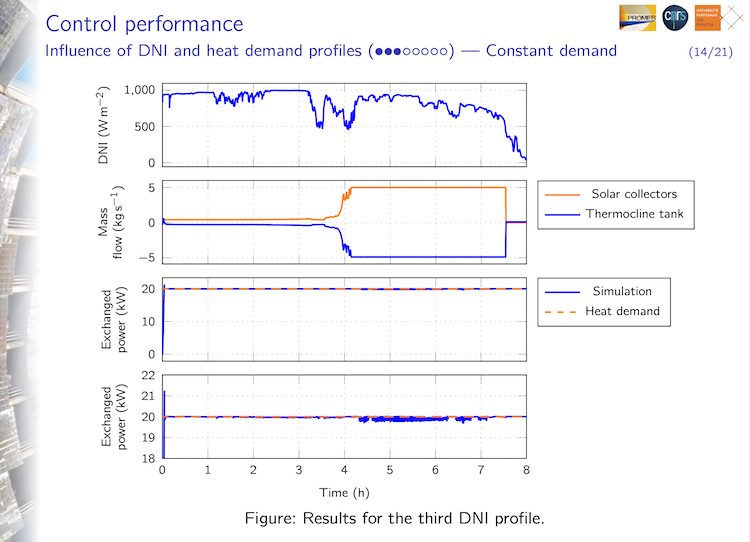
The team tested the setup under three scenarios: steady heat needs, on-and-off heat needs, and slowly changing heat needs (similar to what’s needed in paper processing, for example).
The effectiveness of the control algorithm was judged based on two factors:
How much the delivered heat deviated from the target and how much the system overshoots the target when responding to changes.
The team tested three heat-demand scenarios, all simulated under clear-sky, overcast and mixed conditions.
Constant demand: Steady 30 kW thermal power throughout.
Batch demand: Alternates between one hour at 60 kW and one hour with no heat required.
Realistic demand: Gradual changes typical of a paper treatment process during the day.
In all cases, the control system did a good job keeping to the target, with only minor differences from what was required and not much “overshoot” (where the system briefly gives too much heat). The system handled both slow and rapid changes in heat demand and incident solar energy reliably, suggesting it would perform well in other real-world situations.
When concentrated solar power is used primarily to supply a storage system, it should have relatively more storage capacity than the solar field, but determining how much is a work in progress.
Because it would primarily draw on stored solar thermal energy rather than on the sunlight incident on the solar collectors themselves, the prototype plant simulated in the study would have a higher solar ratio than conventional CSP plants. A small 150 kW solar field of parabolic trough collectors would be paired with 1,100 kW of thermal storage, a much higher ratio than in a CSP plant generating power.
“But this might be too extreme a ratio,” Girard considered. “I think the storage tank is actually too oversized in relation to the collectors.”
Next, Girard will be revisiting the effect of the storage tank size relative to the solar field.
The case study is based on a real plant at the PROMES laboratory.
But he emphasized that what is really needed at this point is physical validation:
“There are very few studies concerning the control of CST plants that are based on a physical plant; it’s mostly simulation. Physical validation of the control strategies is lacking. They almost always remain as only validated by simulations, but they need to really implement control strategies,” he said.
Read the Paper; Control of a concentrated solar plant for heat production under various thermal demand and the SolarPACES 2025 Conference Presentation: Model-Based Predictive Control of a Concentrated Solar Plant for Heat Production
The post Stored solar heat gets an algorithm to ensure a steady supply appeared first on SolarPACES.
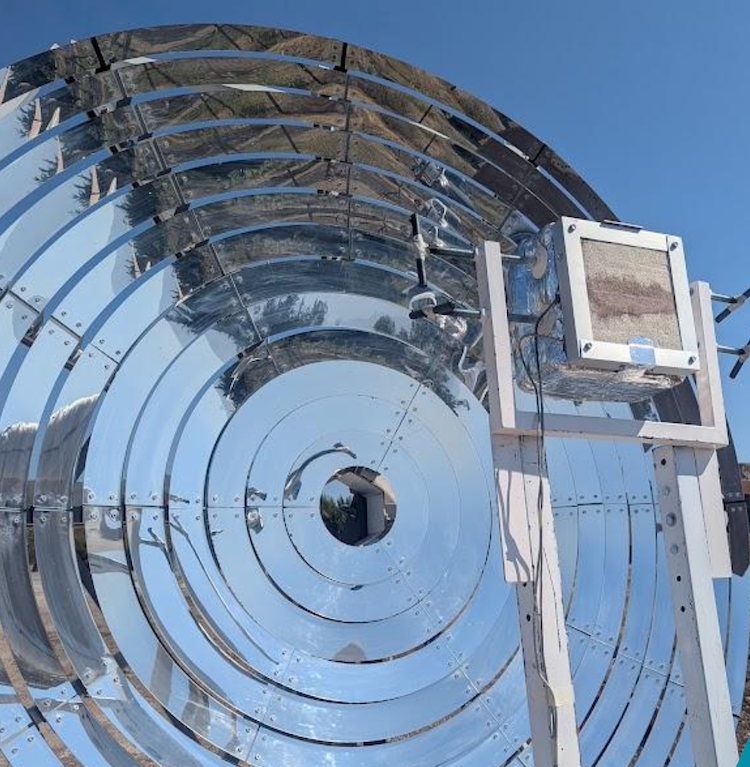
Solar researchers at Fraunhofer Chile have designed, built, and tested a complete solar collector and crucible system for melting and recycling aluminum, heated by Annular Fresnel solar collectors. In Annular Fresnel, each mirror is flat, like a Fresnel mirror, but arranged in a circle, enabling the very high concentration possible with Dish solar concentrators.
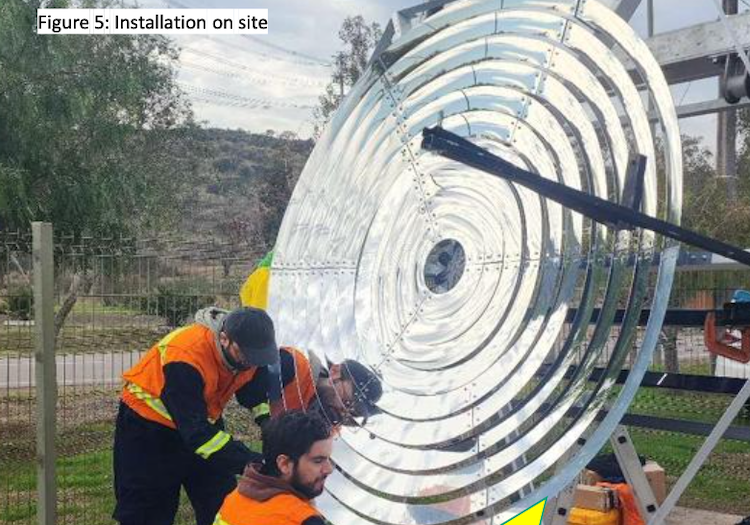
The Annular Fresnel concentrators they had manufactured locally are sliced from silver-coated acrylic sheets. The team built a full system, including a complete crucible furnace and a handling system, which has been operated through multiple aluminum melt/pour cycles under real DNI conditions in Chile for this application‑specific innovation and engineering demonstrator.
They showed that their setup, designed explicitly for aluminum recycling, will operate at the required high temperature at low cost and on a practical scale. As they revealed in a well-received presentation, Fresnel Solar Furnace for Aluminum Melting, and paper at the 2025 SolarPACES Conference in Spain, the team has successfully cast branded ingots during tests.
“We bypassed the standard laboratory phase and moved directly to testing in a relevant environment,” said lead author Pablo Castillo, in a call from Chile.
“It involved significant trial and error—specifically, determining exactly when the aluminum was molten by relying solely on the furnace’s temperature sensors, without visual confirmation.”
Annular Fresnel concentrators are a cross between linear Fresnel reflectors – long lines of flat mirrors – and the highly concentrating solar Dish, in which each little mirror is curved. Annular Fresnel concentrators have the high-concentration advantage of Dish collectors but are simpler to manufacture because they consist of flat mirrors arranged in concentric reflecting rings. In this case, the mirror surface was achieved with silver-plated acrylic plastic.
“Our challenge was achieving this level of concentration using Chile’s local manufacturing capabilities,” Castillo explained.
“We hit a wall realizing we couldn’t manufacture a three-meter parabolic dish locally. Instead, we adopted a simpler design based on the linear Fresnel concept: 13 concentric rings on a single plane with varying slopes. We were pleasantly surprised to find that, even with local limitations, we could successfully achieve these complex geometries.”
Because Fresnel systems are typically linear, they need only single-axis tracking. However, by combining the low-cost Fresnel flat mirrors into a circular Dish-like configuration, the tracking system requirement also changes. The team innovated a slewing drive system for dual-axis tracking for their concentrator to accommodate the change.
With its world-leading DNI, Chile has vast regions where this simple solar technology for aluminum melting can recycle aluminum and other metals with similar melting points. And increasingly, Chilean policy requires metal recycling.
Currently, aluminum is exported to Brazil for recycling. The Fraunhofer team believes that, by building a deployable system for large cities in Northern Chile, where there is abundant solar resource, they can recycle aluminum using solar energy domestically and then sell it to companies looking for aluminum with a zero-carbon footprint.
“We have seen significant interest from major multinationals in the food and beverage sector who are pursuing circular economy goals for their packaging,” said Castillo.
“Our industrial partner, who currently exports scrap aluminum, noted a shifting international demand toward ‘green aluminum’ produced with near-zero carbon emissions. We are working together to develop this technology for coastal cities with major ports, as well as more populated areas in the Central Valley of Chile.”
The team proved that this simple-to-manufacture annular mirror geometry, combined with their practical, field‑tested aluminum recycling furnace and control system, is a feasible, low-cost route to industrial aluminum recycling.
Designed to maintain the crucible strictly within the optimal processing range of 520–640°C for repeated aluminum pours, their system utilizes a unique ring‑mirror field on a compact slewing drive. With full two‑axis tracking and custom controls, the setup successfully managed the melt-pour cycles using relatively modest, locally manufactured equipment compared to the giant solar furnaces typically used for research, such as those at Odeillo.
In 21 outdoor trials conducted between November 2024 and May 2025, the team established a reliable industrial workflow. On a representative high-performance day (April 8, 2025), the system achieved a maximum daily melt of 1.71 kg under a median DNI of 902 W/m², successfully executing multiple pour-and-recharge cycles. The results have been validated via a six-node thermodynamic model, confirming the system’s potential for scaling.
The system integrates custom electronics, software, and a sun-tracking mechanism for azimuth and elevation, installed at Parque Caren in Santiago, Chile (33.4351°S, 70.8457°W). Iterative prototyping optimized optical and thermodynamic performance, with the furnace heating a crucible to melt aluminum and pour it into ingot molds.
To initially test the concept, it was most straightforward to position the furnace at a focal point above the dish. But in production, for practical reasons, the melting pour would need to be on the ground.
“Manipulating a furnace at 800°C and pouring molten liquid three meters above the ground poses significant safety risks,” he said.
To avoid this high-temperature operation at the natural sky-high focal point, they would add a secondary beam-down reflector, so that the furnace and the molten pour can be stable at ground level.
“While a beam-down reflector might incur slight optical energy loss, we gain stability and reduce exposure to wind and dust. So we believe we can achieve a higher output,” Castillo pointed out.
“We have already developed a ‘2.0’ design where the furnace remains stationary at ground level. Having proven the technology is feasible, our next steps are to refine the design, lower costs, and increase output.”
“Solar energy that can be poured in the fuel tank”: the Aldo Steinfeld Weltwoche interview
Solar furnace to melt steel at 2000°C for Swiss recycler Panatère
Startup concentrates solar to melt NASA’s lunar landing pads
Why Lunar Engineering is an Exciting R&D Field for the “Hot Solar”
The post Aluminum melted with Annular Fresnel solar at over 700°C appeared first on SolarPACES.
Modern power systems are undergoing a profound transformation. The rise of harmonic distortion is becoming a huge problem. The traditional grid once dominated by large synchronous generators and linear loads—has evolved into a complex, inverter-rich network driven by renewable generation,... Read more
The post The Rise of Harmonic Distortion in Modern Power Systems appeared first on EEP - Electrical Engineering Portal.
This week Women in Solar+ Europe gives voice to Melodie de l'Epine, Senior Project Manager/ Head of Research & Innovation at France's Becquerel Institute. She says that ncouraging men to shift from strict hierarchy to informal exchanges fosters more equitable rapport. Women can benefit from noticing how men address each other and consciously joining in, since subtle forms of address strongly shape power perceptions.
Our industries operate in a context of constant fluctuation. Policy frameworks change, market conditions evolve rapidly, and uncertainty is part of our daily reality. This means that, as an industry, we must be creative, adaptable, and resilient. From my perspective, the more diverse our teams are, the wider and more varied their experiences become. This increases the likelihood that we will find the viewpoint, the idea, or the understanding that allows us to adapt with resilience to changing environments. This richness of thought and experience is something our industry greatly benefits from, not only because we need it, but also because we tend to have a higher participation rate of women than many other energy sectors.
Looking back at my own career, the barriers I encountered were often systemic rather than explicit. In France, at least, I have found that respectfully encouraging men to move away from a strictly hierarchical viewpoint and into more informal exchanges has been incredibly useful in creating more equitable rapport. I would encourage women to be attentive to how men address each other and to consciously include themselves in this form of address. It is subtle, but forms of address underpin human perceptions in powerful ways.
At the same time, my knowledge and understanding have often been underestimated. In those situations, a willingness to raise my hand and demonstrate what I know has been fundamental in my roles. It is not easy to be visible, particularly when you feel you need to prove your competence, but learning to have confidence in myself was an important lesson in my professional development.
In terms of gender inclusion in leadership, I have observed meaningful shifts over time. Working in fields and jobs that have meaning and contribute to the greater good has often been a preferred pathway for women, and renewable energy clearly aligns with this motivation. However, reaching leadership roles has historically been hindered by several factors: the lower share of women in management positions, unconscious bias, and the commitment many women continue to have to home responsibilities. A generation of more accessible parental leave for fathers, alongside legislation mandating greater representation of women, is beginning to change this dynamic. I am thankful that in France, some major companies have clearly demonstrated their trust in women in leadership positions, ENGIE being one example.
I have also seen very tangible impacts from having diverse leadership teams. In my experience, diverse leadership has demonstrated that caring for the holistic wellbeing of employees and team members is both acceptable and beneficial. Women, at least in my experience, tend to be able to express this care more easily than men. I have seen women leaders identify and propose accommodations for employees experiencing stressful or difficult conditions at home much more regularly, often drawing on personal experience. The outcomes have been very positive, particularly in terms of anticipating work deadlines and making room for quality deliverables despite complicated availability.
An inclusive environment has also played an important role in my own career progression. I have teenagers, and when they were born and throughout their younger childhood, I was able to adapt my working hours and durations to be compatible with my care plans. That flexibility meant that I could concentrate fully on work when I was at work, without guilt, because I was also able to give my children the time I wanted to give them. French legislation has, of course, enabled this across the board. However, what truly made a difference was the attitude of my employer. This flexibility was welcomed as an opportunity to experiment with new people and new roles, rather than being seen as a constraint, and that made a significant difference to my experience.
For young women entering the solar and renewable energy industry today, my advice is grounded in experience. I believe we can change people’s perceptions by expecting the best of them. Expect men to treat you as their equal, and demonstrate this expectation through the way you work with them. Grow your own confidence—others cannot do it for you—and be conscious of your achievements. Know that you are valuable, that you can and will learn, and that a task is only undoable until you learn how to do it. Finally, do not hesitate to ask for advice and support from other women. We have been there too.
Mélodie de l’Épine is Head of Research & Innovation at the Becquerel Institute France, where she leads strategic analysis, market research and innovation programmes in photovoltaic energy. Recognised as a leading expert in the French PV sector with over 25 years of experience, she has previously coordinated the photovoltaic unit at HESPUL and contributed to national and institutional working groups on grid connection, support mechanisms and energy policy. Today, Mélodie works on European innovation projects spanning new PV technologies, manufacturing and operations, while also engaging in international collaborations, where she is co-manager of Task 1 for the International Energy Agency’s PVPS Programme. She regularly publishes market analyses and contributes to national and international reports on PV power applications, helping shape strategic insight into market trends and policy developments.
Interested in joining Mélodie de l’Épine and other women industry leaders and experts at Women in Solar+ Europe? Find out more: www.wiseu.network
In a new weekly update for pv magazine, Solcast, a DNV company, reveales that last year extreme Canadian wildfires drove aerosol levels around 30% above normal, sharply reducing solar irradiance across Canada and even impacting Europe, while the Congo Basin also saw worsening aerosol conditions. In contrast, China and South America experienced unusually low aerosol levels, supporting stronger solar irradiance due to cleaner air, reduced fires, and favorable climate and policy conditions.
Aerosol anomalies in 2025 reveal the outsized impact of Canadian wildfires on solar conditions, with smoke and particulates from one of the worst fire seasons in the country’s history driving major reductions in solar irradiance across Canada and beyond. While Canada saw a marked increase in aerosol loading, China and South America experienced anomalously low levels, supporting stronger irradiance conditions. Meanwhile, the Congo Basin registered worsening aerosol conditions, highlighting growing concerns for central Africa's solar outlook, according to analysis using the Solcast API. Aerosols impact solar irradiance by scattering and absorbing solar radiation as it passes through the atmosphere, when calculated this effect is called ‘aerosol extinction’.
Across Canada, 2025 aerosol extinction values were around 30% above climatological norms, indicating significantly higher levels of sunlight absorption and scattering by particulate matter. This spike is directly linked to the extreme wildfire season, with the total burned area in 2025 reaching twice the 10-year average. The timing of the peak fire activity, which aligned with the high-irradiance months of May and June, compounded the impact on solar conditions.
![]()
Smoke plumes from Canada were transported across the Atlantic by prevailing westerly winds, impacting solar production as far as Western Europe, where they overlapped with Spain's worst wildfire season in over a decade, further amplifying the regional aerosol burden.
![]()
![]()
Despite having a higher aerosol load than other solar generation regions, China experienced one of its cleanest atmospheric years in recent history. Aerosol extinction anomalies were approximately 20% below the recent climatology, driven by a combination of favourable meteorological patterns and continued reductions in industrial emissions. These conditions supported a strong irradiance performance throughout the past year when irradiance was already tracking 30% above average.
![]()
![]()
South America also recorded a notable improvement in aerosol conditions following a turbulent 2024. Anomalies in 2025 were generally 20% to 30% below average, allowing for clearer skies across the region. Solar production in Brazil, benefited from reduced smoke associated with a 45% reduction in burned areas within the Amazon Basin, as detected by the DETER satellite system. This significant decrease is part of a broader post-Bolsonaro shift in environmental management, further supported by La Niña-associated wetter conditions that helped suppress fire activity.
![]()
![]()
Meanwhile, the Congo Basin experienced worsening aerosol conditions, with extinction anomalies 20% to 30% above climatology. Unlike the declining trends in Saharan dust seen across northern Africa, this spike in aerosols is attributed to increasing fire activity within wet forest regions. The number of active fires in these forests has doubled over the past two decades, largely due to a combination of hotter, drier weather and anthropogenic factors such as conflict or agricultural-driven deforestation
Solcast produces these figures by tracking clouds and aerosols at 1-2km resolution globally, using satellite data and proprietary AI/ML algorithms. This data is used to drive irradiance models, enabling Solcast to calculate irradiance at high resolution, with typical bias of less than 2%, and also cloud-tracking forecasts. This data is used by more than 350 companies managing over 300 GW of solar assets globally.
In all ages, humankind decided to spend considerable amounts of the available productivity on special monumental projects. Managing climate change and rebalancing within the planetary boundaries is such an activity. The enormous energetic productivity of solar PV may evolve as the central pillar to create a sustainable civilization.
Since civilizations have existed, monumental projects have been undertaken, such as the Pyramids of Giza, the Great Wall of China, the Gothic cathedrals, or the Apollo programme. Substantial labour and resources were invested in such projects, ranging from 0.5% up to 10% of the available productivity in the respective society, and lasting between a few years and more than a century. Such monumental projects can be grouped into five categories: culture, infrastructure, technology, war and conflict, and disaster response. A recent study from Forschungszentrum Jülich, Helmholtz Institute Erlangen Nürnberg for Renewable Energies and LUT University entitled Marshalling our productivity to create a sustainable global civilization investigated monumental projects and their link to excess productivity.
Since the industrial revolution, unprecedented wealth around the world, along with an enormous increase in life expectancy, reduction of infant mortality, reduction of starvation, freeing people from poverty, and creating unparalleled standards of living for many. These benefits were made possible by an ever-increasing use of fuel. At the same time, excessive fossil fuel consumption has led to various repercussions, in particular environmental destruction and climate change.
Reaching a global net-zero emission energy system can be considered a monumental project. Depending on different sources, such as McKinsey, BNEF, the International Energy Agency, or the United Nations, the required annual expenditures to achieve this goal may lie between 0.7 and 1.3% of the global gross domestic product (GDP) to be allocated for a few decades. Such expenditures are in the range of accepted societal choices in the past, for instance the military spending during the Cold War (3% of GDP of the United States for decades, for example) or the Belt and Road Initiative (an estimated 0.75% of GDP of China).
Solar PV gaining ground in the energy system driven by sustainability
The ongoing global energy transition has various facets, with solar PV at its core reaching over 70% of all newly installed power capacity in the world in the recent past as the fastest ramping energy source since the industrial revolution, and positioning solar PV as a prime energy supply solution around the world. Plummeting costs of solar PV and additional renewable energy technologies, complemented by growing battery storage, form the basis of a comprehensive electrification. Since the mid-1990s, global energy transition studies regularly find the contribution of solar PV to the global energy supply by mid-century to be in the order of about 70%.
The energetic sustainability of solar PV has been improved since the invention of the silicon solar cell. The rate at which solar panels have improved over time has been consistent and high for decades. For example, the energy required to make a solar panel has been reduced by 14% every time installations doubled between the 1970s and the 2010s. This learning has been enabled by continuously rising efficiencies, an increase in technology lifetimes, and a reduction in the use of materials per rated power output, as summarized in a recent publication by international PV experts. The energy payback time for PV systems ranges globally between 0.44 – 1.42 years and in Europe between 0.89 – 1.24 years depending on location. The low payback time also results in a large value for the energy returned on investment – a PV system that is operated for 30 years generates between twenty and seventy times the energy that was needed for its production. The lifetime of PV systems may be further increased up to 50 years in the longer term. System-level studies have shown that the energetic sustainability of solar PV remains robust even when accounting for additional energy investments required for batteries, complementary renewable energy technologies, and curtailment, both at global and regional scales.
Rebalancing withing safe and just planetary boundaries enabled by solar PV
Solar PV may emerge as the key driver for a sustainable civilization. This would mean supplying all humans with all needed energy for the highest standards of living, which is estimated to require 150-200 TWp of solar PV installations by the end of this century. A comprehensive Solar-to-X Economy across energy sectors will become a major characteristic in many regions around the world. The upper limit of the range of solar PV installations would even include the energy demand for massive carbon dioxide removal activities to rebalance civilization within safe und just planetary boundaries, which equals to about 10 – 12% of global primary energy supply and may cost about 0.4 – 0.7% of the global GDP to return to 1.0℃ with about 350 ppm of atmospheric CO2 concentration. In this way, PV installations could help in powering carbon dioxide removal to avoid global GDP loss of about 8% if the unintended consequences of our productivity are not addressed. Reaching permanent climate safety and its respective investments can be regarded as a highly profitable venture of civilization in the row of monumental projects in history. The high energetic productivity of solar PV is a major driver to reach a sustainable civilization.
Authors: Christian Breyer, Ian Marius Peters, and Dominik Keiner
This article is part of a monthly column by LUT University.
Research at LUT University encompasses various analyses related to power, heat, transport, desalination, industry, and negative CO2 emission options. Power-to-X research is a core topic at the university, integrated into the focus areas of Planetary Resources, Business and Society, Digital Revolution, and Energy Transition. Solar energy plays a key role in all research aspects.
Energy storage for homes — anchored by hybrid inverter systems — will lead the next phase of solar growth in India. Not as an upgrade, but as a necessity for a nation building toward energy independence by 2047.
From pv magazine India
Every major shift in India’s energy story has started quietly — inside homes.
Before policy frameworks, before megawatt targets, before national missions, it is the household that first feels the strain: flickering lights during voltage dips, appliances restarting after outages, work disrupted by power interruptions, and the growing discomfort of energy uncertainty in an otherwise digital, always-on life.
Rooftop solar promised freedom from this uncertainty. And to a large extent, it delivered. But as solar adoption has scaled, a deeper truth has emerged: energy generation without energy control is only half the solution. The next phase of India’s solar growth will not be led by panels alone—it will be led by storage, intelligence, and integration.
This is where hybrid inverter systems step in.
India’s power grid today faces a different kind of pressure than it did a decade ago. Solar generation peaks during the day, often when household demand is low. This creates reverse power flows, voltage fluctuations, and localised grid stress — especially in high rooftop penetration zones.
The result is paradoxical: more solar on rooftops, yet less predictability inside homes.
Traditional on-grid systems shut down during outages. Diesel generators still require manual or delayed switchover—often 30 seconds to several minutes, which is enough to disrupt production, damage sensitive equipment, or break workflow continuity. In an economy where households and small institutions are deeply integrated into productivity, this gap is no longer tolerable.
India doesn’t just need more solar. It requires solar that behaves intelligently.
Policy shift
The direction is becoming clearer. Initiatives like the PM Surya Ghar Yojana are not just about expanding rooftop capacity; they signal a move toward distributed, household-level energy resilience. Storage is no longer an afterthought — it is the stabilising layer that allows solar to scale without destabilising the grid.
This matters because India’s economic structure is fundamentally household-driven. Nearly 60% of GDP comes from households, whether through consumption, home-based work, small enterprises, or services. If households are unstable from an energy perspective, the economy absorbs that instability.
As India moves toward its ambition of becoming a developed nation by 2047, energy independence will not be achieved only through large power plants or grid-scale storage. It will be built home by home.
Hybrid inverter systems are often misunderstood as just “inverters with batteries.” In reality, they are something far more consequential.
They act as the operating system of the home energy ecosystem — orchestrating solar generation, battery storage, and grid interaction in real time. Instead of passively responding to power availability, hybrid systems actively decide how energy should flow, where it should be stored, and when it should be used.
In doing so, they transform solar from a generation asset into a living, adaptive energy system.
By 2026, hybrid inverters have emerged as the intelligent core of home energy—moving solar adoption beyond installation toward optimisation, resilience, and long-term value.
Hybrid systems
Energy Independence That Actually Works – Hybrid systems ensure seamless continuity during grid outages by switching instantly to stored energy. There is no downtime, no manual intervention, and no reliance on fossil-based backup. For households, this changes the meaning of reliability.
Self-Consumption Becomes the Priority – Instead of exporting excess solar at low compensation and buying power back at higher tariffs later, homes can store energy and use it when it matters most. This shift — from grid dependency to self-optimisation — is central to the next solar phase.
Economic Resilience in a Changing Tariff Landscape – As electricity tariffs rise and demand-based pricing becomes more common, hybrid systems could protect households by using stored solar during peak periods. Energy becomes predictable — even when prices are not.
Built for the Future, Not Just Today – Hybrid architectures are modular by design. Homes can start small and scale—adding batteries, EV charging, or higher solar capacity over time. This adaptability is critical in an era where energy needs are evolving rapidly.
What makes this moment different is maturity.
Modern hybrid systems are powered by advanced software and AI-driven energy management, capable of learning usage patterns, forecasting weather, and optimising storage behaviour. High conversion efficiencies minimise losses, while grid-support features such as voltage and frequency stabilisation allow homes to act as micro-balancing units for the grid.
In effect, households move from being passive endpoints to active contributors in energy stability.
India’s 2047 Vision
India’s long-term energy ambitions are bold: massive renewable capacity, reduced fossil dependence, and eventual net-zero alignment. But these goals cannot be met through generation alone.
Storage — especially decentralised storage — will define success.
Hybrid inverter systems enable exactly what India needs at scale:
They support a future where millions of homes are not just consuming power, but managing it responsibly and intelligently.
Beyond the policy frameworks and technical advantages lies a simpler truth.
Hybrid systems mark the transition from “having solar” to living with energy confidence.
They offer that assurance — not through excess capacity, but through intelligence and balance.
And that is why energy storage for homes — anchored by hybrid inverter systems — will lead the next phase of solar growth in India. Not as an upgrade, but as a necessity for a nation building toward energy independence by 2047.
In a new weekly update for pv magazine, OPIS, a Dow Jones company, provides a quick look at the main price trends in the global PV industry.
China’s TOPCon module prices rose for a third consecutive week, as market participants continued to digest the impacts of export rebates removal and higher cell prices. Beyond spot prices, prices along the forward curve have also edged higher, reflecting expectations that recent policy shifts could feed through to forward pricing.
According to the OPIS Global Solar Markets Report released on January 20, the Chinese Module Marker (CMM), the OPIS benchmark assessment for TOPCon modules from China, rose 12.75% on the week to $0.115/W Free-On-Board (FOB) China.
OPIS FOB China TOPCon module forward curve indications for Q2 2026 loading cargoes were assessed at $0.120/W, up 14.29% on the week. Forward prices for Q3 2026 loading cargoes moved higher to $0.121/W, rising 15.24% on the week.
Q4 2026 loading cargoes rose 10.42% week-on-week to $0.106/W while Q1 2027 loading cargoes saw the steepest increase of 13.5% to $0.109/W.
Join us on Jan. 28 for pv magazine Webinar+ | The Solar Module Market Playbook: Managing pricing, risks, and other procurement challenges. We combine real-time market data, case studies, and an interactive Q&A to help EPCs, developers, investors, and distributors secure high-quality PV modules at competitive prices, thereby safeguarding project bankability. According to one tier-1 producer, silver prices will remain a key variable. Even if upstream polysilicon prices were to soften from April onward, module prices would struggle to fall back to end-2024 levels of around CNY0.70 ($0.10)/W as long as silver prices stay at current levels. The producer added that buyers have largely accepted the higher price levels and expect the uptrend to persist. However, some trade sources pointed to a lingering “wait and see” sentiment in the market, largely driven by uncertainty around upcoming policies, particularly China’s anti-monopoly measures, which may be limiting the full transmission of recent price increases. While these measures are primarily focused on the polysilicon segment and the proposed consolidation platform, downstream market participants told OPIS they could also have implications for cell and module markets, where major producers have been operating under strict production and sales coordination arrangements for over a year. Several producer sources said this could unintentionally intensify production and price competition in an industry already grappling with significant overcapacity. However, they noted that clearer regulatory guidance would still be needed before manufacturers adjust their production and sales strategies.
In early January, the Beijing Municipal Administration for Market Regulation initiated a meeting with major polysilicon producers and the China Photovoltaic Industry Association to address monopoly risks and outline rectification requirements related to anti-monopoly compliance. The rectification measures are due to be submitted to the State Administration for Market Regulations (SAMR) by Jan. 20. Under the proposed framework, companies are prohibited from reaching agreements on production capacity, utilization rates, sales volumes and pricing. Capital contribution ratios should not determine market allocation, output or profit distribution, and any form of coordination or communication on prices, costs, production and sale volumes is not allowed. Meanwhile, high inventory levels and downstream oversupply remain a headwind, making it difficult to justify current price levels, sources said. One tier-1 producer noted that the cell and module segments are likely to remain challenging in 2026, noting that it is difficult to pinpoint a clear price ceiling amid ongoing policy uncertainty, while further price increases could also weigh on power plant investment decisions.
A developer source said uncertainty remains elevated, with any further price gains dependent on the market acceptance of current module prices. The source added that while suppliers continue to push for increases, it may be difficult for module prices to keep rising given current electricity tariffs, as most new PV projects are priced through market-based mechanisms rather than guaranteed feed-in tariffs (FiTs). Major Chinese PV manufacturers are expected to release their financial results for 2025 in the coming weeks, with several already signalling another difficult year in 2025 amid oversupply across the value chain and persistently weak prices. Depressed module selling prices and tighter trade conditions have continued to squeeze margins, with some companies reporting wider losses in Q4 2025 versus Q3. OPIS, a Dow Jones company, provides energy prices, news, data, and analysis on gasoline, diesel, jet fuel, LPG/NGL, coal, metals, and chemicals, as well as renewable fuels and environmental commodities. It acquired pricing data assets from Singapore Solar Exchange in 2022 and now publishes the OPIS APAC Solar Weekly Report.
A report from McKinsey and Company says the relative ease of building out solar projects means the U.S and Europe are likely to meet their end-of-decade deployment targets, despite current pipeline gaps of around 205 GW and 181 GW.
The US and Europe are likely to meet their 2030 solar targets despite current project pipelines being smaller than their end-of-decade targets, according to a report from global management consulting firm McKinsey and Company.
McKinsey’s “Tracking the energy transition: where are we now?” report analyzes the pathway of solar, wind and battery energy storage system (BESS) technologies towards the 2030 deployment targets set by China, the United States and the EU-27, Norway, Switzerland and the UK in Europe.
It says the US is currently around 254 GW away from its 2030 target while Europe is around 275 GW away. In contrast, China has already more than doubled its 2030 target.
Despite the US and Europe currently lacking enough announced capacity to meet their 2030s targets, by around 205 GW and 181 GW respectively, McKinsey's analysis says they are still likely to find this additional capacity and reach their end-of-decade thresholds thanks to the ease of building out solar.
“While it is easier to track project build-out for other clean energy technologies, data visibility for solar is more limited due to individual household use and ease of build-out,” McKinsey’s report explains. “For example, a consumer can install household solar in two months. This means that the announced capacity may be underestimated in this analysis.”
Diego Hernandez Diaz, a partner at McKinsey, told pv magazine that while core markets will continue their build out, further demand growth will also occur in less saturated core markets such as Poland. “The advantage of some of these elements is that the more nascent markets can have a better economic trade off and can be built in an economically pragmatic way,” he explained.
The report does acknowledge that this growth trajectory is not guaranteed, citing supply chain risks, tariffs, shifting policy focus and growing political uncertainty as factors that can slow down progress. Hernandez Diaz added there will likely be an effect from shifting regulation across the board.
“Perhaps more importantly, however, is that beyond any regulation, what we continue to see is that if the underlying economics work, then deployment accelerates,” he stated. “All major geographies covered in the report have the underlying fundamentals to support accretive deployment of further renewable energy sources.”
The report also notes that the battery energy storage system (BESS) pipeline is growing rapidly across China, the US and Europe, but remains behind what is needed to meet 2030 targets. McKinsey estimates around an additional 123 GW is required in China, 154 GW in the US and 221 GW in Europe.
![]()
The analysts says BESS remains the dominant question mark but can be sited, permitted, constructed, and interconnected far faster than technologies such as nuclear or gas with carbon, capture, utilization and storage (CCUS) contributing to its rapid growth in recent years.
The report attributes the rapid acceleration of BESS installation to a positive business case for both large-scale operators and households when paired with solar. “Load balancing is also becoming a popular source of revenue for battery operators,” the report adds. “Planning and integrating BESS with renewable rollout is critical if 2030 net-zero targets are to be met.”